Should You Order CT with IV Contrast for Suspected Complicated Diverticulitis?
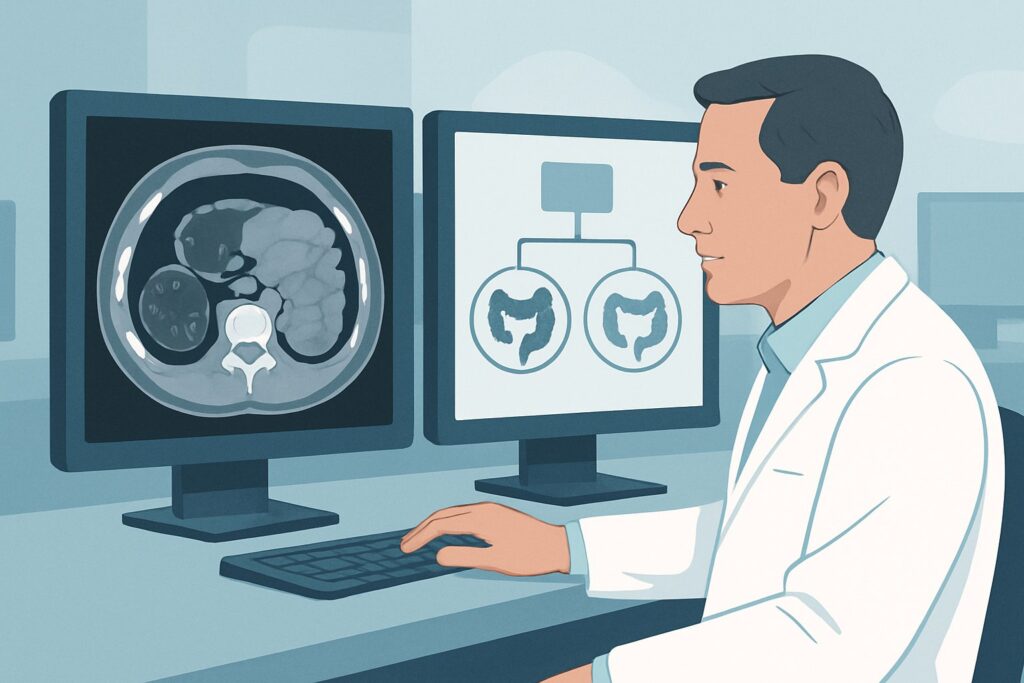
It’s 10 PM in the emergency department, and you’re evaluating a 68-year-old male with a known history of diverticulosis. He presented two days ago with left lower quadrant pain and was started on oral antibiotics for presumed uncomplicated diverticulitis. Tonight, he’s back with worsening pain, a fever of 102.1°F, and focal peritoneal signs on exam. You suspect a complication—an abscess, or perhaps even a perforation. The next step is imaging, but the choice of study is critical for guiding management, which may now involve interventional radiology or surgery. This article provides a focused workflow for this exact scenario: initial imaging for suspected complications of diverticulitis. According to the American College of Radiology (ACR) Appropriateness Criteria, CT abdomen and pelvis with IV contrast is rated Usually appropriate for this indication.
Who Fits This Clinical Scenario?
This guidance is specifically for patients with a high pre-test probability of complicated diverticulitis. The key distinction is the suspicion of a complication beyond simple, localized inflammation. This workflow applies to patients who present with:
- Worsening clinical symptoms (increasing pain, fever, or leukocytosis) despite 48-72 hours of appropriate medical therapy for uncomplicated diverticulitis.
- Signs of sepsis or systemic inflammatory response syndrome (SIRS).
- Physical exam findings suggestive of a complication, such as a palpable abdominal mass (suggesting a large phlegmon or abscess) or peritonitis (suggesting perforation).
- Immunocompromised status, as these patients may have a more fulminant course and are at higher risk for complications.
This article does not apply to patients with a first-time presentation of mild left lower quadrant pain where uncomplicated diverticulitis is suspected but not confirmed. That presentation falls under a different ACR variant, “Left lower quadrant pain. Suspected diverticulitis. Initial imaging.” It also does not apply to the undifferentiated patient with left lower quadrant pain where the differential is still broad. The current scenario assumes diverticulitis is the leading diagnosis and the primary question is whether a complication has occurred.
What Diagnoses Are You Working Up in This Scenario?
When ordering imaging for suspected complicated diverticulitis, you are no longer just confirming inflammation. You are actively searching for specific, actionable findings that will change management from medical to procedural or surgical. The differential for complications is focused.
Abscess Formation: This is the most common complication. An inflamed diverticulum can perforate, leading to a contained collection of pus. These can be small and pericolic (adjacent to the colon) or large and extend into the pelvis, retroperitoneum, or abdominal wall. Identifying the size and location of an abscess is critical for determining if percutaneous drainage by interventional radiology is feasible.
Bowel Perforation: A diverticulum can rupture, leading to either a contained microperforation or free perforation with pneumoperitoneum. Free perforation is a surgical emergency. The imaging study must be sensitive enough to detect even small locules of extraluminal gas or fluid that indicate a breach in the bowel wall.
Fistula Formation: Chronic inflammation can cause the colon to adhere to and erode into adjacent organs, creating an abnormal connection. The most common is a colovesical fistula (to the bladder), presenting with pneumaturia or fecaluria. Colovaginal, coloenteric, and colocutaneous fistulas are also possible. Imaging aims to identify the fistulous tract and associated inflammation.
Bowel Obstruction: Severe pericolic inflammation or chronic, fibrotic scarring from recurrent episodes can lead to a colonic stricture and subsequent large bowel obstruction. CT can demonstrate the transition point and the severity of the upstream colonic dilation.
Pylephlebitis: A rare but life-threatening complication, this refers to septic thrombophlebitis of the portal venous system. It arises from the spread of infection through the mesenteric veins. This diagnosis requires a high index of suspicion and is best visualized on a contrast-enhanced study.
Why Is CT Abdomen and Pelvis with IV Contrast the Recommended Study?
The ACR rates CT of the abdomen and pelvis with intravenous (IV) contrast as Usually appropriate because it provides a comprehensive and rapid evaluation for the entire spectrum of potential complications. Its high spatial resolution and the use of contrast media make it exceptionally sensitive and specific for the key diagnostic questions in this scenario.
The IV contrast is not optional; it is essential. It enhances the visibility of abscess walls, which typically appear as rim-enhancing fluid collections, differentiating them from simple, uninfected fluid or phlegmon (a mass of inflamed tissue without a drainable liquid center). Contrast also opacifies blood vessels, allowing for the detection of vascular complications like pylephlebitis, and improves the characterization of bowel wall inflammation and perfusion. Furthermore, it helps delineate the relationship of inflammatory masses to adjacent organs, which is crucial for identifying fistulas.
Other modalities are rated lower for specific reasons in this context:
- CT abdomen and pelvis without IV contrast is rated May be appropriate. While it can identify free air from a perforation, large fluid collections, and bowel obstruction, it is significantly less sensitive for detecting abscesses (which may be indistinguishable from phlegmon), fistulas, and vascular complications. It is a suboptimal study when a complication is the primary concern.
- Ultrasound (US) abdomen transabdominal is rated Usually not appropriate. While it avoids radiation, its utility is severely limited by overlying bowel gas and patient body habitus, both of which are common in this patient population. It is operator-dependent and cannot reliably visualize the deep pelvis or retroperitoneum to exclude a distant abscess or free air.
The radiation dose for this CT scan is moderate (ACR RRL ☢☢☢, 1-10 mSv), but the diagnostic benefit in a patient with a potentially life-threatening complication far outweighs the risk. The urgency of the clinical question justifies the use of ionizing radiation to obtain a definitive and actionable diagnosis. Once you’ve decided on CT with IV contrast, our protocol guide covers the technique, contrast, and reading principles: CT Chest/Abdomen/Pelvis with IV Contrast.
What’s Next After CT Abdomen and Pelvis with IV Contrast? Downstream Workflow
The results of the CT scan will directly guide your next steps. The workflow branches based on the key findings:
- If the study is positive for a drainable abscess: A small (<3-4 cm) pericolic abscess may be managed with continued IV antibiotics. For larger or more complex abscesses, an immediate consultation with Interventional Radiology (IR) for percutaneous catheter drainage is the standard of care. This can often serve as a bridge to elective surgery, avoiding an emergent operation.
- If the study is positive for free perforation (pneumoperitoneum): This is a surgical emergency. An immediate general surgery consultation is required for exploratory laparotomy, washout, and typically a Hartmann’s procedure or primary resection with anastomosis.
- If the study is positive for a fistula (e.g., colovesical): Management is typically non-emergent. The patient is treated for the acute inflammation, and a surgical consultation is placed for elective repair of the fistula once the acute episode has resolved. Additional imaging, such as a CT cystography, may be requested by the surgical or urology team for preoperative planning.
- If the study is negative for complications (shows only uncomplicated diverticulitis or phlegmon): The patient can typically continue with medical management (IV antibiotics, bowel rest). If they fail to improve, a repeat CT in 48-72 hours may be considered to assess for a developing abscess.
- If the study is negative and an alternative diagnosis is found: The workflow shifts to address the new diagnosis (e.g., epiploic appendagitis, ovarian pathology, or malignancy).
Pitfalls to Avoid (and When to Get Help)
In this high-stakes clinical scenario, several common pitfalls can delay diagnosis or lead to suboptimal outcomes. Be mindful of the following:
- Ordering without IV contrast: This is the most common error. In a patient with suspected complications, a non-contrast CT provides an incomplete and potentially misleading picture. Unless there is a severe, absolute contraindication, IV contrast should be used.
- Misinterpreting phlegmon as abscess: A phlegmon is a solid mass of inflamed tissue and is not drainable. An abscess is a liquid collection that is. Mistaking one for the other can lead to an unnecessary IR consult or a delay in recognizing that medical management is the right course.
- Delaying the scan: In a patient with peritonitis or sepsis, time is critical. Imaging should be obtained emergently to guide definitive source control.
- Anchoring on diverticulitis: If the CT is negative for complicated diverticulitis, reconsider the differential. Left-sided colon cancer can perforate and mimic diverticulitis, and other etiologies like gynecologic or urologic issues must be considered.
If the CT findings are complex, such as a large inflammatory mass with unclear drainability or suspicion of a fistula, escalate immediately by discussing the case directly with the radiologist and the relevant consulting service (General Surgery or Interventional Radiology).
Related ACR Topics and Tools
Navigating imaging decisions requires access to reliable, evidence-based resources. For a comprehensive overview of all clinical variants related to left-sided abdominal pain, see our parent guide. For tools to help with ordering, protocoling, and discussing radiation dose, see the resources below.
- For breadth across all scenarios in Left Lower Quadrant Pain, see our parent guide: Left Lower Quadrant Pain: ACR Appropriateness Decoded.
- To explore other clinical scenarios, use the ACR Appropriateness Criteria Lookup.
- To review standard techniques for various studies, consult the Imaging Protocol Library.
- To help frame conversations about medical radiation with patients, use the Radiation Dose Calculator.
Frequently Asked Questions
Why is intravenous (IV) contrast so critical for suspected complicated diverticulitis?
IV contrast is essential because it highlights differences in tissue blood flow. This allows radiologists to distinguish a phlegmon (a solid mass of inflammation) from an abscess (a fluid-filled cavity with an enhancing wall), which is a critical distinction for management. It also helps identify fistulous tracts to other organs and is necessary to diagnose rare but serious vascular complications like pylephlebitis (septic portal vein thrombosis).
What if my patient has renal insufficiency? Can I still order a CT with IV contrast?
This is a risk-benefit decision. For patients with stable chronic kidney disease and an estimated GFR > 30 mL/min/1.73m², the risk of contrast-induced nephropathy from a single dose of modern iodinated contrast is very low. In a patient with suspected sepsis from a perforated viscus or a large abscess, the benefit of obtaining a definitive diagnosis to guide life-saving intervention almost always outweighs the risk to the kidneys. Pre-hydration may be considered. For patients with severe renal dysfunction or on dialysis, the decision should be discussed with the radiology team; MRI may be considered as an alternative in select stable cases.
Is MRI a good alternative to CT to avoid radiation in this scenario?
MRI of the abdomen and pelvis without and with IV contrast is rated ‘May be appropriate’ by the ACR. It is an excellent problem-solving tool with high soft-tissue contrast and avoids ionizing radiation. However, it is generally not the first-line study in the acute setting because it takes longer to perform, is less readily available, is more susceptible to motion artifact from a sick patient, and is less sensitive for detecting small amounts of free air. It is typically reserved for indeterminate cases, pregnant patients, or for detailed fistula evaluation in a non-emergent setting.
Does the patient need oral contrast in addition to IV contrast?
The use of oral contrast for suspected diverticulitis complications is debated and varies by institution. While it can help opacify the bowel lumen and identify fistulas, it can also delay the scan by 60-90 minutes and may be poorly tolerated by a nauseated patient. Most modern CT protocols rely on IV contrast alone, as it provides the most critical information for identifying abscesses, perforation, and inflammation. The ACR guidelines do not specify a requirement for oral contrast in this scenario.
The CT shows a 3.5 cm pericolic abscess. What is the management threshold for drainage?
There is no absolute size cutoff, but generally, abscesses smaller than 3-4 cm that are confined to the pericolic fat can often be successfully treated with IV antibiotics alone. Abscesses larger than 4 cm, or smaller abscesses that are not responding to antibiotics or are in a location that is difficult for antibiotics to penetrate (e.g., deep in the pelvis), are typically candidates for percutaneous drainage by interventional radiology. The decision is always multifactorial, depending on the patient’s clinical status, the abscess location, and the feasibility of a safe drainage route.
Reviewed by Pouyan Golshani, MD, Interventional Radiologist — May 29, 2026