Should You Order MRI or CT for Staging Renal Cell Carcinoma Without Contrast Contraindications?
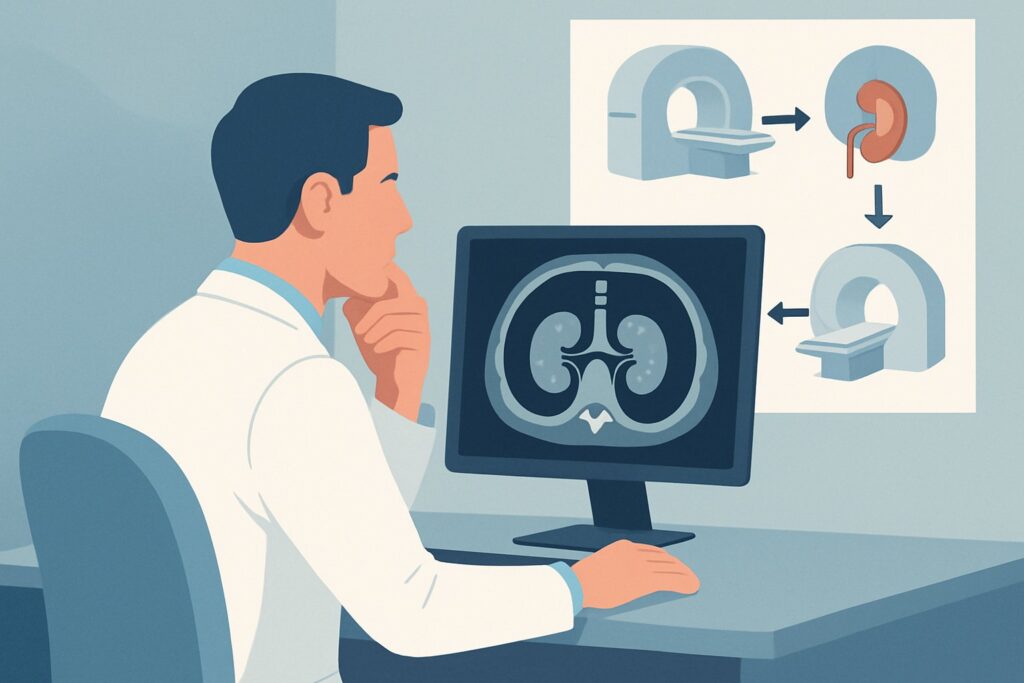
A 62-year-old patient is in your urology clinic for consultation. An incidental solid, enhancing 5 cm mass was found in the right kidney on a CT performed for an unrelated reason. The imaging characteristics are highly suspicious for renal cell carcinoma (RCC). The patient has a normal estimated Glomerular Filtration Rate (eGFR) and no history of allergy to either iodinated or gadolinium-based contrast agents. You now face the critical decision of which imaging study to order for definitive local and regional staging to guide surgical planning. This article details the clinical workflow for this specific scenario, explaining why certain studies are chosen over others. According to the American College of Radiology (ACR) Appropriateness Criteria, `MRI abdomen and pelvis without and with IV contrast` is rated Usually appropriate for this presentation.
Who Fits This Clinical Scenario?
This guidance applies to patients with a newly diagnosed, highly suspicious, or biopsy-proven renal cell carcinoma who require comprehensive staging. The central inclusion criterion is that the patient has no contraindication to either iodinated CT contrast or gadolinium-based MR intravenous contrast. This typically means the patient has adequate renal function (as defined by institutional guidelines for contrast administration) and no history of severe allergic-like or anaphylactic reactions to either class of contrast media. Furthermore, the patient must be able to undergo MRI, with no absolute contraindications such as incompatible implanted electronic devices (e.g., certain pacemakers, cochlear implants) or metallic foreign bodies in critical locations.
This workflow is distinct from other common clinical situations. It does not apply if:
- The patient has a contraindication to iodinated CT contrast only (e.g., severe prior reaction). In this case, the choice is simplified, and MRI becomes the primary modality.
- The patient has a contraindication to both CT and MR contrast agents. This challenging scenario requires a different imaging strategy, often relying on non-contrast techniques or alternative modalities.
- The goal is initial characterization of an indeterminate renal mass. While the studies are similar, the protocol and clinical question are different from formal staging of a known cancer.
What Diagnoses Are You Working Up in This Scenario?
For a known renal cell carcinoma, staging imaging is not meant to establish the primary diagnosis but to define the anatomic extent of the disease. This is essential for determining prognosis and selecting the appropriate therapy, whether it be partial nephrectomy, radical nephrectomy, or systemic treatment. The key questions you are working up relate directly to the TNM (Tumor, Nodes, Metastasis) staging system.
Local Tumor Extent (T-stage): The primary goal is to assess the tumor’s relationship to surrounding structures. Has it breached the renal capsule to invade the perinephric fat? Does it extend into the renal sinus? Has it directly invaded adjacent organs like the adrenal gland, liver, or bowel? Precise T-staging is critical for surgical planning, particularly in deciding between a partial and a radical nephrectomy.
Venous Invasion: A crucial and specific staging question for RCC is the presence and extent of tumor thrombus within the renal vein and potentially extending into the inferior vena cava (IVC). The level of the thrombus (e.g., below or above the diaphragm) dramatically alters surgical complexity, often requiring a multidisciplinary surgical team including cardiothoracic surgeons.
Regional Nodal Involvement (N-stage): The imaging study must carefully evaluate the retroperitoneal lymph nodes. The presence of enlarged or suspiciously enhancing nodes indicates potential regional metastatic disease, which impacts prognosis and may influence decisions regarding adjuvant therapy.
Distant Metastases (M-stage): While abdominal imaging is the focus, it also serves to screen for common sites of distant metastasis, including the liver, adrenal glands, and non-regional lymph nodes. Staging is often incomplete without dedicated chest imaging to evaluate for pulmonary metastases, a common site of spread for RCC.
Why Is MRI of the Abdomen and Pelvis With Contrast a Recommended Study?
In a patient without contraindications to either contrast agent, both multiphase CT and MRI are highly effective for staging RCC. The ACR rates both `MRI abdomen and pelvis without and with IV contrast` and `CT abdomen and pelvis with IV contrast` as Usually appropriate. However, MRI is often favored for its superior soft-tissue contrast resolution, which provides distinct advantages for answering specific staging questions.
The key strength of MRI is its ability to delineate the primary tumor’s extension into the perinephric fat, renal sinus, and adjacent organs (T-stage). Most importantly, MRI is considered the gold standard for evaluating the renal vein and IVC for tumor thrombus. Contrast-enhanced MRI can reliably distinguish bland (non-cancerous) thrombus from tumor thrombus, a distinction that is more challenging with CT. This information is paramount for surgical planning.
Another significant advantage of MRI is the lack of ionizing radiation (`adult_rrl=O 0 mSv`). While a single staging CT is not a prohibitive dose, avoiding radiation is always preferable, especially in younger patients or those who may require serial imaging.
How do alternative studies compare?
- CT Abdomen and Pelvis with IV Contrast: This is also rated Usually appropriate (`adult_rrl=☢☢☢ 1-10 mSv`). CT is faster, more widely available, and less susceptible to motion artifacts than MRI. It is excellent for detecting nodal and distant metastatic disease, particularly in the lungs (when chest CT is included). The choice between CT and MRI may ultimately depend on institutional expertise, scanner availability, and the specific clinical questions of greatest concern.
- US Abdomen: Ultrasound is rated Usually not appropriate for staging. While it may have been used to initially detect the mass, it is limited by operator dependence and its inability to reliably assess the entire retroperitoneum for lymph nodes or evaluate for venous extension and distant metastases.
- MRI Abdomen and Pelvis without IV Contrast: This study is also Usually not appropriate. Without gadolinium, the enhancement characteristics of the tumor, nodes, and potential venous thrombus cannot be assessed, rendering the examination inadequate for comprehensive staging.
When ordering, it is crucial to specify a “multiphase renal mass protocol” to ensure the radiologist acquires the necessary pre-contrast, corticomedullary, nephrographic, and excretory phase images for complete characterization and staging.
What’s Next After MRI of the Abdomen and Pelvis? Downstream Workflow
The results of the staging MRI will directly guide the subsequent clinical and surgical workflow. The radiologist’s report, detailing the TNM stage, is the primary input for the multidisciplinary tumor board discussion and treatment planning.
If the study shows localized disease (e.g., T1 or T2, N0, M0): The patient is typically a candidate for surgical resection. Based on the tumor’s size, location, and relationship to the renal hilum, the urologic surgeon will proceed with either a partial or radical nephrectomy, often using a minimally invasive robotic or laparoscopic approach.
If the study reveals locally advanced disease (e.g., T3 with venous thrombus): The surgical plan becomes significantly more complex. The presence of an IVC thrombus requires careful planning, potentially involving vascular or cardiothoracic surgeons. In some cases of borderline resectable or locally advanced disease, neoadjuvant systemic therapy may be considered to downstage the tumor before surgery.
If the study is positive for metastatic disease (M1): The treatment paradigm shifts from curative-intent surgery to systemic therapy. While surgery on the primary tumor (cytoreductive nephrectomy) may still be considered in select patients, the mainstay of treatment becomes immunotherapy-based combinations or targeted therapy managed by a medical oncologist.
If the study is indeterminate for a specific finding: An equivocal finding, such as a small, non-specific adrenal nodule or a borderline lymph node, may require further workup. This could involve a dedicated adrenal protocol CT or MRI, a PET/CT scan, or short-term follow-up imaging to assess for stability or growth.
Pitfalls to Avoid (and When to Get Help)
Navigating the staging of renal cell carcinoma requires attention to detail to avoid common errors that can impact patient management.
- Incomplete Thoracic Staging: Abdominal imaging alone is insufficient. RCC frequently metastasizes to the lungs. A dedicated `CT chest with IV contrast` is also rated Usually appropriate and is considered a standard part of the initial staging workup for all but the smallest, lowest-risk tumors.
- Ordering a Non-Protocol Study: Requesting a generic “MRI Abdomen with contrast” may not provide the specific multiphasic imaging sequences needed to fully stage RCC. Always specify a dedicated renal mass protocol.
- Misinterpreting Venous Thrombus: The distinction between bland and tumor thrombus is critical. If the report is equivocal on this point, a direct discussion with the reporting radiologist is warranted, as it has major implications for surgery.
- Overlooking Small Metastases: Small metastatic lesions in the liver, adrenal glands, or pancreas can be subtle. A careful review of the entire imaging volume is essential.
If staging is complex, findings are equivocal, or the case involves advanced disease, presentation at a multidisciplinary genitourinary tumor board is the standard of care to ensure consensus on the optimal treatment path.
Related ACR Topics and Tools
For a comprehensive overview of all clinical scenarios related to staging renal cell carcinoma, including those with contrast contraindications, please refer to our parent topic guide. The following GigHz tools can also assist in your clinical workflow, from exploring adjacent scenarios to discussing radiation dose with your patients.
- For breadth across all scenarios in Staging of Renal Cell Carcinoma, see our parent guide: Staging of Renal Cell Carcinoma: ACR Appropriateness Decoded.
- Imaging Appropriateness Selector — for adjacent scenarios
- Imaging Protocol Library — for technique on the recommended study
- Radiation Dose Calculator — for cumulative dose conversations
Frequently Asked Questions
Why would I choose MRI over CT if the ACR rates both as ‘Usually Appropriate’ for this scenario?
While both are excellent, MRI is often preferred for its superior soft-tissue contrast, which provides a more detailed assessment of local tumor invasion (T-stage) and is considered the best modality for evaluating and characterizing tumor thrombus in the renal vein and IVC. MRI also avoids the use of ionizing radiation. CT may be chosen if MRI is unavailable, the patient has an MRI contraindication, or if speed is a critical factor.
Is an MRI of the abdomen and pelvis sufficient for full staging, or do I need a chest CT?
An abdominal/pelvic study alone is not sufficient for complete staging. The lungs are a very common site for renal cell carcinoma metastases. The ACR rates ‘CT chest with IV contrast’ as ‘Usually appropriate’ and it should be considered a standard part of the initial staging workup for most patients with RCC to rule out metastatic disease.
What if my patient has a contraindication to gadolinium but not iodinated CT contrast?
That represents a different clinical scenario. In that case, ‘CT abdomen and pelvis with IV contrast’ would become the primary recommended study, as it is also rated ‘Usually appropriate’ and the patient has no contraindication to it. The workflow would then be centered around a multiphase CT protocol.
Is a multiphase acquisition protocol really necessary for staging RCC?
Yes, it is critical. Different phases of contrast enhancement highlight different features. The non-contrast phase helps identify calcifications and fat. The corticomedullary phase is best for evaluating vascular anatomy. The nephrographic phase provides the best view of parenchymal enhancement and tumor conspicuity. The excretory (delayed) phase is essential for evaluating the collecting system. A single-phase study is inadequate for complete staging.
What is the role of PET/CT in the initial staging of renal cell carcinoma?
According to the ACR, ‘FDG-PET/CT skull base to mid-thigh’ is rated ‘Usually not appropriate’ for the initial staging of RCC. Most common RCC subtypes (especially clear cell) are not reliably FDG-avid. PET/CT may have a role in specific situations, such as evaluating a patient with suspected metastatic disease when conventional imaging (CT/MRI) is negative or equivocal, or for some less common, more FDG-avid histologies.
Reviewed by Pouyan Golshani, MD, Interventional Radiologist — May 26, 2026