What Imaging Best Assesses Nodal and Distant Metastasis in High-Grade Endometrial Cancer?
A 68-year-old woman presents with postmenopausal bleeding. An endometrial biopsy confirms a high-grade (FIGO grade 3) endometrioid adenocarcinoma. As the treating gynecologic oncologist, your next step is accurate pretreatment staging to guide the surgical approach and determine the need for adjuvant therapy. You need to assess not only the local extent of the tumor—specifically, the depth of myometrial invasion and potential cervical stromal involvement—but also the presence of pelvic lymph node and distant metastasis. This clinical crossroads requires a robust imaging strategy that can answer these critical questions before the patient enters the operating room. For this specific scenario, the American College of Radiology (ACR) rates MRI pelvis without and with IV contrast as Usually appropriate.
Who Fits This Clinical Scenario?
This guidance is for clinicians evaluating a patient with newly diagnosed, biopsy-proven high-grade endometrial cancer who has not yet undergone treatment. This includes patients with Type I, grade 3 endometrioid adenocarcinoma as well as all Type II histologies, such as serous carcinoma, clear cell carcinoma, and carcinosarcoma. The primary goal of imaging in this context is comprehensive staging, focusing on the assessment of lymph node involvement and the search for distant metastatic disease, which are more common in these aggressive tumor types.
This workflow is distinct from other related clinical situations. It does not apply to:
- Patients with low-grade tumors (Type I, grade 1 or 2): These patients have a lower pretest probability of extrauterine disease, and the imaging strategy may differ. This is covered in a separate ACR variant for low-grade tumor assessment.
- Evaluation limited to local tumor extension: If the clinical question is solely about myometrial invasion without a primary concern for distant disease, the choice and scope of imaging might be more focused on the pelvis.
- Post-treatment surveillance or suspected recurrence: Imaging for asymptomatic surveillance or for a patient with new symptoms concerning for recurrence follows entirely different protocols and appropriateness criteria.
Applying this guidance is appropriate only when the initial diagnosis is a high-risk endometrial cancer and the clinical need is for comprehensive pretreatment staging.
What Diagnoses Are You Working Up in This Scenario?
In this scenario, the primary diagnosis of high-grade endometrial cancer is already established by biopsy. The “differential” for imaging is therefore not about identifying the primary tumor, but about determining its stage by assessing the extent of disease. The key questions imaging must answer directly influence surgical planning and prognosis.
Deep Myometrial Invasion (≥50%): This is one of the most important local prognostic factors. Invasion into the outer half of the myometrium significantly increases the risk of lymph node metastasis and is a primary indication for performing a lymphadenectomy. Imaging aims to precisely measure the depth of tumor invasion relative to the total myometrial thickness.
Cervical Stromal Invasion: Extension of the tumor into the connective tissue of the cervix upstages the disease from Stage I to Stage II. This finding can alter the surgical approach, potentially requiring a radical hysterectomy instead of a simple hysterectomy to achieve negative margins.
Pelvic and Para-aortic Lymph Node Metastasis: The presence of nodal disease is a critical factor for staging (Stage IIIC) and a strong indication for adjuvant chemotherapy and/or radiation. Imaging seeks to identify enlarged or morphologically suspicious lymph nodes in the pelvic (obturator, iliac) and para-aortic chains.
Distant Metastasis: While less common at initial presentation, high-grade tumors have a greater propensity for distant spread. Imaging is used to screen for metastases to common sites like the peritoneum, omentum, liver, and lungs. Discovering distant disease (Stage IV) fundamentally changes the treatment goal from curative surgery to systemic therapy.
Why Is MRI of the Pelvis Without and With IV Contrast the Recommended Study?
For the initial staging of high-grade endometrial cancer, the ACR designates MRI pelvis without and with IV contrast as a Usually appropriate examination. Its strength lies in superior soft-tissue contrast, which provides a detailed assessment of the local-regional tumor extent that is critical for surgical planning.
Multiplanar T2-weighted sequences are highly effective at delineating the tumor against the normal zonal anatomy of the uterus, allowing for accurate measurement of myometrial invasion. Furthermore, dynamic contrast-enhanced (DCE) imaging, which assesses the timing and pattern of gadolinium enhancement, helps differentiate viable tumor from the surrounding myometrium and can improve the detection of cervical stromal invasion. The addition of diffusion-weighted imaging (DWI) increases the conspicuity of the primary tumor and can improve the detection of metastatic lymph nodes and peritoneal deposits.
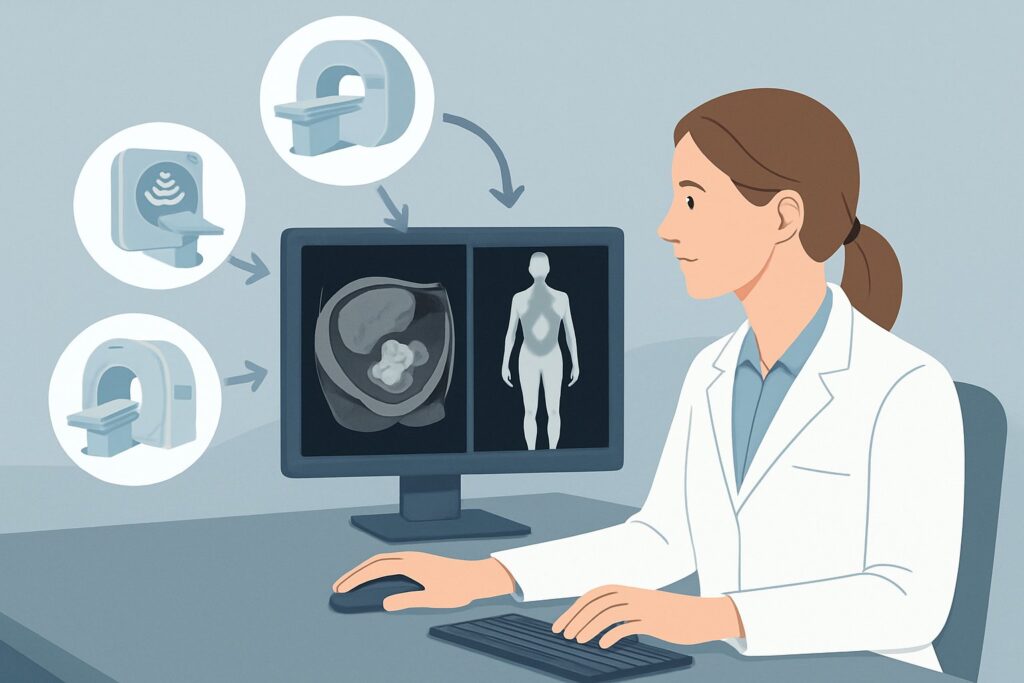
While pelvic MRI is the cornerstone for local staging, other modalities are also rated Usually appropriate and serve complementary roles, particularly for assessing distant disease:
- CT chest abdomen pelvis with IV contrast: This study is excellent for a rapid, comprehensive evaluation of the chest, abdomen, and pelvis to detect distant metastases, particularly in the lungs, liver, and distant lymph node basins. However, its soft-tissue resolution within the pelvis is inferior to MRI, making it less accurate for determining the precise depth of myometrial invasion or subtle cervical extension. It is often ordered in conjunction with or as an alternative to pelvic MRI when the primary concern is widespread metastatic disease.
- FDG-PET/CT skull base to mid-thigh: This functional imaging modality excels at identifying metabolically active sites of disease, making it highly sensitive for detecting nodal and distant metastases that may be missed by anatomic imaging alone. Its main limitation is lower spatial resolution, which, like CT, makes it less reliable for detailed T-staging within the uterus. It is often reserved for cases with very high-risk features or when conventional imaging is equivocal.
A key advantage of MRI is the absence of ionizing radiation (adult RRL=O 0 mSv), which is a significant consideration compared to the high radiation dose of both CT and PET/CT (adult RRL=☢☢☢☢ 10-30 mSv). For a comprehensive local and regional assessment, MRI provides the most detailed anatomic information without radiation exposure.
What’s Next After MRI of the Pelvis? Downstream Workflow
The results of the staging MRI directly inform the subsequent steps in patient management, creating a clear decision tree for the gynecologic oncology team.
If the MRI shows disease confined to the uterus with <50% myometrial invasion and no suspicious nodes: The patient is confirmed to have a lower-risk profile despite the high-grade histology. She would typically proceed to minimally invasive total hysterectomy, bilateral salpingo-oophorectomy (BSO), and sentinel lymph node mapping. The absence of high-risk features on imaging supports a less extensive surgical approach.
If the MRI demonstrates deep (≥50%) myometrial invasion or cervical stromal invasion: These findings confirm high-risk disease. The surgical plan will include a total hysterectomy, BSO, and a full pelvic and para-aortic lymphadenectomy, as the risk of nodal metastasis is high. The MRI results provide the justification for this more extensive staging surgery.
If the MRI identifies bulky pelvic/para-aortic lymphadenopathy or peritoneal disease: This suggests advanced-stage disease (Stage IIIC or IV). This finding may prompt a CT of the chest or a PET/CT to fully characterize the extent of disease. Depending on the findings, the management plan may shift from primary surgery to neoadjuvant chemotherapy to shrink the tumor burden before a potential surgical debulking, or to primary systemic therapy if the disease is widely metastatic.
If the MRI is indeterminate: In cases where findings are equivocal (e.g., a borderline-sized lymph node or subtle enhancement concerning for invasion), a PET/CT may be considered to provide functional information. Alternatively, the surgeon may proceed with surgical staging with the understanding that intraoperative findings will ultimately guide the extent of the procedure.
Pitfalls to Avoid (and When to Get Help)
Navigating the imaging workup for high-grade endometrial cancer requires careful consideration to avoid common errors that can impact staging and treatment.
- Misinterpreting post-biopsy inflammation: An endometrial biopsy or D&C performed shortly before the MRI can cause uterine inflammation and hemorrhage, which may mimic or obscure the extent of deep myometrial invasion. Whenever possible, schedule the MRI before an extensive biopsy procedure or allow several weeks for inflammation to subside.
- Relying solely on lymph node size: While nodes larger than 1 cm are suspicious, metastatic disease can be present in normal-sized nodes (micrometastases). Conversely, enlarged nodes can be benign and reactive. Pay attention to morphologic features on MRI, such as a rounded shape, irregular borders, and loss of the fatty hilum, which are more specific for malignancy.
- Ignoring imaging contraindications: Before ordering an MRI with contrast, confirm the patient has no non-MRI-compatible implants and has adequate renal function (eGFR) to safely receive gadolinium-based contrast. If contraindications exist, CT or PET/CT become the primary staging modalities.
If the initial pelvic MRI suggests disease extending beyond the pelvis or if there is a high clinical suspicion for widespread metastases not explained by the MRI, escalate the workup promptly with a CT of the chest, abdomen, and pelvis or an FDG-PET/CT.
Related ACR Topics and Tools
This article covers one specific scenario in depth. For a comprehensive overview of imaging recommendations across all clinical presentations of this condition, please consult the parent topic guide. Additionally, several tools are available to assist with evidence-based imaging decisions and patient communication.
- For breadth across all scenarios in Pretreatment Evaluation and Follow-Up of Endometrial Cancer, see our parent guide: Pretreatment Evaluation and Follow-Up of Endometrial Cancer: ACR Appropriateness Decoded.
- To explore other clinical situations, use the ACR Appropriateness Criteria Lookup.
- For detailed technical parameters of the recommended study, visit the Imaging Protocol Library.
- To discuss radiation exposure with patients, reference the Radiation Dose Calculator.
Frequently Asked Questions
Why not order a PET/CT for every patient with high-grade endometrial cancer?
While FDG-PET/CT is also rated ‘Usually appropriate’ and is excellent for detecting distant metastases, it has lower spatial resolution than MRI for evaluating local tumor extent. MRI is superior for assessing the depth of myometrial invasion and cervical stromal involvement, which are critical factors for surgical planning. PET/CT is often reserved for very high-risk cases or when conventional imaging results are equivocal.
Is an MRI of the pelvis without IV contrast sufficient for this scenario?
An MRI without contrast is rated as ‘May be appropriate’ but is suboptimal. The dynamic contrast-enhanced (DCE) portion of the exam significantly improves the differentiation between tumor and normal myometrium, increasing the accuracy for assessing the depth of invasion. Without contrast, this critical staging information is less reliable.
What is the best imaging alternative if my patient cannot receive gadolinium contrast due to an allergy or severe renal impairment?
If gadolinium is contraindicated, the best alternatives are other ‘Usually appropriate’ modalities that do not rely on it. A non-contrast pelvic MRI can still provide useful T2-weighted anatomical information. However, a ‘CT chest abdomen pelvis with IV contrast’ (assuming no contraindication to iodinated contrast) or an ‘FDG-PET/CT’ would be excellent choices to complete the staging, as they are highly effective for detecting nodal and distant disease.
How does the imaging recommendation change for low-grade (Grade 1-2) endometrial cancer?
For low-grade endometrial cancer, the pre-test probability of extrauterine disease is much lower. Therefore, comprehensive staging with advanced imaging is not always necessary. The ACR addresses this in a separate clinical variant, where the focus is often on assessing for deep myometrial invasion in select cases, rather than a routine search for distant metastasis.
Can an MRI be performed if the patient has an intrauterine device (IUD)?
Yes. Most modern IUDs, including copper (e.g., ParaGard) and hormonal (e.g., Mirena, Kyleena) types, are considered safe for MRI at 1.5T and 3T. The device may create a small local artifact, but it typically does not interfere with the diagnostic assessment of the myometrium and surrounding structures for cancer staging.
Reviewed by Pouyan Golshani, MD, Interventional Radiologist — May 29, 2026