When to Order Imaging for Pretreatment Evaluation and Follow-Up of Endometrial Cancer: ACR Appropriateness Decoded

A patient presents with a new diagnosis of endometrial cancer confirmed by biopsy. As the treating physician, your next step is accurate staging to guide therapy, which can range from surgery to radiation and chemotherapy. Deciding on the optimal initial imaging study—and how to conduct surveillance later—can be complex. Do you start with a pelvic MRI to assess local invasion, or a CT of the chest, abdomen, and pelvis to look for distant disease? What about PET/CT? For post-treatment follow-up in an asymptomatic patient, is routine imaging indicated at all? The American College of Radiology (ACR) provides evidence-based guidelines to navigate these decisions, ensuring the right test is ordered for the right clinical scenario, balancing diagnostic yield with radiation exposure.
What Does ACR Pretreatment Evaluation and Follow-Up of Endometrial Cancer Cover?
This ACR Appropriateness Criteria topic addresses the use of diagnostic imaging for patients with a histologically confirmed diagnosis of endometrial cancer. The guidelines are structured around specific clinical variants that cover the entire disease course, from initial staging to post-treatment surveillance and evaluation of suspected recurrence. Specifically, these recommendations apply to assessing the local extent of the primary tumor, evaluating for lymph node involvement and distant metastases before treatment, and monitoring patients after therapy is complete. The criteria differentiate between low-grade and high-grade tumors, as well as low-risk versus high-risk disease, as these factors significantly influence the probability of metastatic spread and the corresponding imaging strategy. These guidelines do not cover the initial workup of abnormal uterine bleeding or the screening of asymptomatic individuals without a cancer diagnosis.
What Imaging Should I Order for Pretreatment Evaluation and Follow-Up of Endometrial Cancer? Recommendations by Clinical Scenario
The optimal imaging strategy for endometrial cancer depends entirely on the clinical question, tumor grade, and treatment status. The ACR guidelines provide clear, scenario-based recommendations.
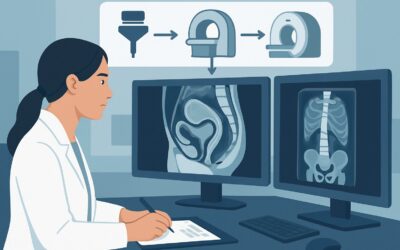
For the initial staging of pretreatment endometrial cancer and assessment of local tumor extension for all tumor grades, the ACR rates MRI of the pelvis without and with IV contrast as Usually appropriate. MRI provides excellent soft-tissue contrast, making it the premier modality for evaluating the depth of myometrial invasion, cervical stroma involvement, and extension to adjacent pelvic structures, all of which are critical for surgical planning. Transvaginal ultrasound and non-contrast pelvic MRI May be appropriate alternatives in certain situations.
When assessing for lymph node and distant metastasis in low-grade tumors (Type I, grade 1 or 2), the approach is more conservative. No single imaging study is rated as usually appropriate. Instead, several modalities, including CT of the chest, abdomen, and pelvis with IV contrast and FDG-PET/CT, are considered May be appropriate. This reflects the lower pretest probability of metastatic disease in this patient population, where extensive imaging may not always be necessary.
In contrast, for the initial staging of high-grade tumors (Type I, grade 3 and Type II), the risk of extrauterine disease is substantially higher. Consequently, the ACR rates three studies as Usually appropriate for assessing nodal and distant metastasis: MRI of the pelvis without and with IV contrast, CT of the chest, abdomen, and pelvis with IV contrast, and FDG-PET/CT from skull base to mid-thigh. These comprehensive studies are justified by the need to identify metastatic disease that would alter the treatment plan.
For post-treatment surveillance, the recommendations diverge based on risk. For surveillance of asymptomatic patients with treated low- or intermediate-risk endometrial cancer, all imaging modalities are rated as Usually not appropriate. Routine imaging has not been shown to improve outcomes in this group, and follow-up should be primarily clinical. However, for asymptomatic patients with treated high-risk disease, chest radiography and CT of the chest, abdomen, and pelvis with IV contrast May be appropriate, reflecting a higher baseline risk of recurrence that may warrant imaging surveillance.
Finally, if there is a clinical suspicion of recurrence after therapy, a comprehensive imaging workup is warranted. In this scenario, MRI of the abdomen and pelvis without and with IV contrast, CT of the chest, abdomen, and pelvis with IV contrast, and FDG-PET/CT are all considered Usually appropriate to identify the location and extent of recurrent disease.
ACR Imaging Recommendations Table
| Clinical Scenario | Top Procedure | ACR Rating | Adult RRL | Pediatric RRL |
|---|---|---|---|---|
| Initial staging of pretreatment endometrial cancer; assessment of local tumor extension for all tumor grades. | MRI pelvis without and with IV contrast | Usually appropriate | O 0 mSv | O 0 mSv [ped] |
| Pretreatment evaluation of endometrial cancer; assessment of lymph node and distant metastasis for low-grade tumor (Type I, grade 1, 2). | CT chest abdomen pelvis with IV contrast | May be appropriate | ☢ ☢ ☢ ☢ 10-30 mSv | ☢ ☢ ☢ ☢ 3-10 mSv [ped] |
| Initial staging of pretreatment endometrial cancer; assessment of lymph node and distant metastasis for high-grade tumor (Type I, grade 3 and Type II). | MRI pelvis without and with IV contrast | Usually appropriate | O 0 mSv | O 0 mSv [ped] |
| Surveillance of asymptomatic patients with treated low- or intermediate-risk endometrial cancer. | US abdomen | Usually not appropriate | O 0 mSv | O 0 mSv [ped] |
| Surveillance of asymptomatic patients with treated high-risk endometrial cancer. | CT chest abdomen pelvis with IV contrast | May be appropriate | ☢ ☢ ☢ ☢ 10-30 mSv | ☢ ☢ ☢ ☢ 3-10 mSv [ped] |
| Posttherapy evaluation of clinically suspected recurrence of known endometrial cancer. | MRI pelvis without and with IV contrast | Usually appropriate | O 0 mSv | O 0 mSv [ped] |
Adult vs. Pediatric Pretreatment Evaluation and Follow-Up of Endometrial Cancer Imaging: Radiation Dose Tradeoffs
While endometrial cancer is exceedingly rare in the pediatric population, the principles of radiation safety are paramount when imaging is required in younger patients. The ACR guidelines provide distinct pediatric relative radiation level (RRL) estimates, which are often lower than their adult counterparts for the same CT-based examination. This reflects dose-reduction techniques and size-specific protocols used in pediatric imaging. The fundamental principle of ALARA (As Low As Reasonably Achievable) governs these recommendations. For any given clinical scenario, if a non-ionizing modality like MRI or ultrasound can provide the necessary diagnostic information, it is strongly preferred over a CT scan to avoid radiation exposure. This is especially critical in children and adolescents, who have a longer lifetime to manifest potential risks from cumulative radiation dose. When CT is unavoidable, protocols must be optimized to use the lowest possible dose that still achieves diagnostic image quality.
Imaging Protocol Details for Pretreatment Evaluation and Follow-Up of Endometrial Cancer
Once you’ve decided on the right study based on the clinical scenario, ensuring it is performed correctly is the next critical step. The specific imaging protocol—including contrast timing, slice thickness, and acquisition planes—directly impacts diagnostic accuracy. Our protocol guides cover technique, contrast considerations, and key interpretation principles for the studies recommended in these guidelines.
Tools to Help You Order the Right Study
Navigating imaging guidelines can be challenging, especially when dealing with complex clinical presentations. GigHz offers several resources designed to support evidence-based decision-making at the point of care.
The Imaging Appropriateness Selector tool provides a searchable interface for the full library of ACR guidelines, extending far beyond endometrial cancer to cover thousands of clinical scenarios across all specialties.
For detailed procedural information on the studies discussed here, the Imaging Protocol Library offers standardized, scannable guides on how to perform and interpret a wide range of common imaging examinations.
To help manage and communicate radiation exposure with patients, the Radiation Dose Calculator allows you to estimate effective dose for various studies and track cumulative exposure over time, facilitating informed conversations about the risks and benefits of imaging.
What is the best imaging test for initial local staging of endometrial cancer?
For assessing the local extent of the tumor, including the depth of myometrial invasion and cervical involvement, MRI of the pelvis with and without IV contrast is rated “Usually appropriate” by the ACR and is considered the gold standard. It offers superior soft-tissue resolution compared to CT and ultrasound.
Is routine imaging recommended for follow-up after treatment for endometrial cancer?
For asymptomatic patients with treated low- or intermediate-risk endometrial cancer, routine surveillance imaging is “Usually not appropriate.” Follow-up is typically clinical. For high-risk patients, imaging with CT or chest X-ray “May be appropriate,” but is not universally recommended and should be considered on a case-by-case basis.
When should a PET/CT scan be ordered for endometrial cancer?
A FDG-PET/CT scan is rated “Usually appropriate” for the initial staging of high-grade tumors to assess for nodal and distant metastases. It is also “Usually appropriate” for evaluating a clinically suspected recurrence. For staging low-grade tumors, it “May be appropriate” but is not a first-line recommendation due to the lower likelihood of metastatic disease.
Why is CT without IV contrast “Usually not appropriate” for initial local staging?
CT without IV contrast provides poor soft-tissue differentiation within the uterus and pelvis. It cannot reliably assess the depth of myometrial invasion or distinguish tumor from normal uterine tissue, which are critical factors for staging and treatment planning. Contrast-enhanced MRI is far superior for this purpose.
Do I need to order a chest CT for every new diagnosis of endometrial cancer?
Not necessarily. For low-grade tumors, a comprehensive CT of the chest, abdomen, and pelvis “May be appropriate” but is not mandatory, as the risk of distant metastasis is low. For high-grade tumors, however, a CT of the chest, abdomen, and pelvis with IV contrast is “Usually appropriate” to screen for metastatic disease, which is more common in this group.
Frequently Asked Questions
What is the best imaging test for initial local staging of endometrial cancer?
For assessing the local extent of the tumor, including the depth of myometrial invasion and cervical involvement, MRI of the pelvis with and without IV contrast is rated “Usually appropriate” by the ACR and is considered the gold standard. It offers superior soft-tissue resolution compared to CT and ultrasound.
Is routine imaging recommended for follow-up after treatment for endometrial cancer?
For asymptomatic patients with treated low- or intermediate-risk endometrial cancer, routine surveillance imaging is “Usually not appropriate.” Follow-up is typically clinical. For high-risk patients, imaging with CT or chest X-ray “May be appropriate,” but is not universally recommended and should be considered on a case-by-case basis.
When should a PET/CT scan be ordered for endometrial cancer?
A FDG-PET/CT scan is rated “Usually appropriate” for the initial staging of high-grade tumors to assess for nodal and distant metastases. It is also “Usually appropriate” for evaluating a clinically suspected recurrence. For staging low-grade tumors, it “May be appropriate” but is not a first-line recommendation due to the lower likelihood of metastatic disease.
Why is CT without IV contrast “Usually not appropriate” for initial local staging?
CT without IV contrast provides poor soft-tissue differentiation within the uterus and pelvis. It cannot reliably assess the depth of myometrial invasion or distinguish tumor from normal uterine tissue, which are critical factors for staging and treatment planning. Contrast-enhanced MRI is far superior for this purpose.
Do I need to order a chest CT for every new diagnosis of endometrial cancer?
Not necessarily. For low-grade tumors, a comprehensive CT of the chest, abdomen, and pelvis “May be appropriate” but is not mandatory, as the risk of distant metastasis is low. For high-grade tumors, however, a CT of the chest, abdomen, and pelvis with IV contrast is “Usually appropriate” to screen for metastatic disease, which is more common in this group.
Reviewed by Pouyan Golshani, MD, Interventional Radiologist — May 26, 2026