What Imaging Is Best Before Cardioversion for Atrial Fibrillation? An ACR-Guided Workflow
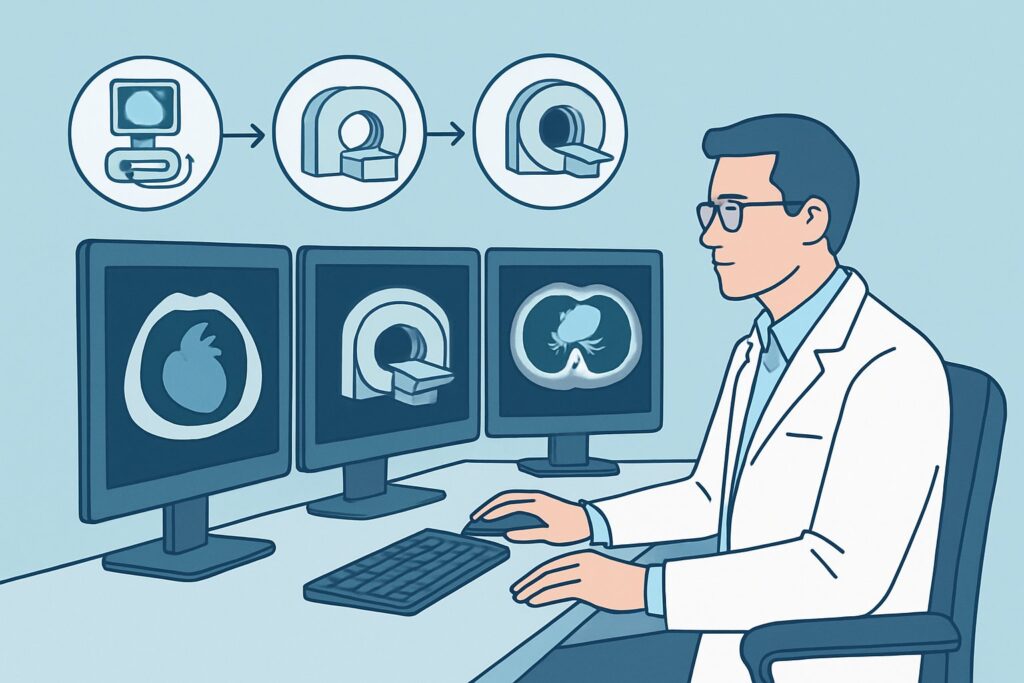
A 72-year-old man with a history of hypertension presents with palpitations and new-onset dyspnea. An ECG confirms atrial fibrillation with a rapid ventricular response. The duration of his symptoms is unclear, but he believes it has been “at least a few days.” You and the cardiology team are planning for electrical cardioversion to restore sinus rhythm, but a critical question arises: what is his risk of a thromboembolic event? The central imaging decision is how to definitively rule out a left atrial appendage thrombus before proceeding. For this specific scenario, the American College of Radiology (ACR) Appropriateness Criteria rate US echocardiography transesophageal as Usually appropriate.
Who Fits This Clinical Scenario for Pre-Cardioversion Imaging?
This guidance applies to patients diagnosed with atrial fibrillation (AF) who are candidates for electrical or pharmacologic cardioversion, particularly when the risk of intracardiac thrombus is a concern. The primary indication for pre-procedural imaging is AF that is either of unknown duration or has persisted for more than 48 hours. It also applies to patients who have been on anticoagulation, but whose adherence or therapeutic levels (e.g., INR for warfarin) have been inconsistent or subtherapeutic.
This workflow is distinct from other preprocedural planning scenarios in atrial fibrillation. It is crucial to distinguish this patient from:
- Patients undergoing catheter ablation for AF: This procedure requires detailed anatomical mapping of the left atrium and pulmonary veins to guide the ablation strategy. That workup falls under a different clinical scenario (Atrial fibrillation, atrial tachycardia, or atypical atrial flutter. Preprocedural planning prior to left atrial ablation) where cardiac CT or MRI is often preferred for anatomical detail.
- Patients being evaluated for left atrial appendage (LAA) occlusion devices: This requires precise measurements of the LAA ostium and landing zone to ensure proper device sizing and deployment. While TEE is used, the procedural goals and imaging requirements are highly specific to that device and represent a separate ACR variant.
This article focuses exclusively on the imaging needed to clear a patient for cardioversion by ruling out a pre-existing thrombus.
What Is the Primary Goal of Imaging Before Cardioversion?
The imaging workup before cardioversion is not a broad search for pathology but a highly focused mission to answer one critical question: Is there a thrombus in the left atrium or, more specifically, the left atrial appendage? The restoration of coordinated atrial contraction during cardioversion can dislodge a pre-existing clot, leading to a potentially devastating stroke.
Left Atrial Appendage (LAA) Thrombus: This is the primary target. The LAA is a small, finger-like pouch in the left atrium where, in the setting of AF, blood flow becomes stagnant. This stasis is the principal driver of thrombus formation, with over 90% of atrial thrombi in non-valvular AF originating in the LAA. Identifying a thrombus is an absolute contraindication to immediate cardioversion.
Spontaneous Echo Contrast (SEC): Often described as “smoke-like” echoes on ultrasound, SEC represents aggregated red blood cells due to profound blood stasis. While not a thrombus itself, the presence of dense SEC is a significant risk factor for thrombus formation and future thromboembolic events. Its detection may lead to a more aggressive anticoagulation strategy, even if a discrete thrombus is not seen.
Complex Aortic Plaque: While evaluating the left atrium, imaging can also visualize the thoracic aorta. The identification of large, mobile, or ulcerated aortic plaques represents an independent source of emboli and can influence long-term stroke prevention strategies, although it does not typically alter the immediate decision regarding cardioversion.
Underlying Structural Heart Disease: The chosen imaging modality can also provide valuable information about left atrial size, mitral valve function (e.g., stenosis or regurgitation), and left ventricular function, all of which inform the long-term management of the patient’s atrial fibrillation and overall cardiovascular health.
Why Is Transesophageal Echocardiography (TEE) the Recommended Study for Pre-Cardioversion Planning?
The ACR rates US echocardiography transesophageal (TEE) as Usually appropriate for this scenario because it offers the highest diagnostic accuracy for the primary clinical question. The rationale is based on its superior visualization of the key structures at risk.
The transesophageal probe is positioned in the esophagus, directly behind the left atrium. This proximity provides high-frequency, high-resolution images of the left atrial appendage, free from the interference of the lungs and chest wall that limits other approaches. This makes TEE exceptionally sensitive and specific for detecting LAA thrombus and spontaneous echo contrast.
In contrast, several alternatives are rated lower for this specific task:
- US echocardiography transthoracic resting (TTE) is rated Usually not appropriate. The LAA is a posterior structure that is rarely, if ever, adequately visualized on a standard TTE. Relying on a TTE to clear a patient for cardioversion provides a false sense of security and is considered below the standard of care.
- CT heart function and morphology with IV contrast is rated Usually appropriate but is often considered a second-line option to TEE. Cardiac CT can provide excellent anatomical detail and has high negative predictive value for LAA thrombus. However, it requires ionizing radiation (☢☢☢☢ 10-30 mSv) and iodinated contrast, and its sensitivity can be reduced for small, non-occlusive, or flat thrombi. The accuracy is highly dependent on precise contrast timing.
The primary advantage of TEE is its combination of excellent spatial resolution for the LAA, real-time functional assessment, and the complete absence of ionizing radiation (0 mSv). While it is a semi-invasive procedure requiring patient sedation, its diagnostic yield for this critical question is unparalleled.
What Are the Next Steps After a Pre-Cardioversion TEE?
The results of the transesophageal echocardiogram create a clear, actionable decision tree for patient management.
If the TEE is positive for LAA thrombus: Cardioversion is immediately contraindicated and deferred. The patient should be started on or continued with therapeutic anticoagulation for a minimum of 3 to 4 weeks. Following this period of intensive anticoagulation, a repeat TEE is performed. If the thrombus has resolved, the patient may then proceed to cardioversion. If the thrombus persists, long-term anticoagulation and a rate-control strategy are typically pursued.
If the TEE is negative for LAA thrombus: The patient is considered cleared for cardioversion from a thromboembolic risk standpoint. To minimize the interval risk of new thrombus formation, cardioversion is often performed on the same day, immediately following the TEE procedure while the patient is still sedated. The patient will still require long-term anticoagulation based on their underlying stroke risk profile (e.g., CHA₂DS₂-VASc score).
If the TEE shows dense spontaneous echo contrast (SEC) but no discrete thrombus: This finding indicates significant blood stasis and a heightened risk of thromboembolism. While not an absolute contraindication, it prompts a careful risk-benefit discussion. Many clinicians will proceed with cardioversion but will be particularly stringent about ensuring uninterrupted therapeutic anticoagulation both before and long-term after the procedure.
Pitfalls to Avoid (and When to Get Help)
Several common pitfalls can compromise patient safety in this workflow. First, never rely on a transthoracic echocardiogram (TTE) to rule out LAA thrombus; its sensitivity is inadequate for this purpose. Second, ensure the patient has been appropriately NPO (nothing by mouth) before the TEE to minimize aspiration risk during sedation. Third, for patients who undergo a cardiac CT instead of a TEE, confirm that the protocol used was specifically timed to assess the LAA, as a standard CTA of the chest may not provide adequate opacification. If the TEE or CT results are equivocal or the images are of poor quality, it is essential to escalate. A discussion with the interpreting cardiologist or radiologist is critical, and a repeat study or switch to the alternative modality (e.g., CT if TEE was non-diagnostic) may be necessary before proceeding with cardioversion.
Related ACR Topics and Tools
This article covers a single, focused clinical scenario. For a comprehensive overview of imaging across all related presentations, or for tools to help with study selection and patient communication, the following resources are valuable:
- For breadth across all scenarios in Preprocedural Planning for Left Atrial Procedures in Atrial Fibrillation, see our parent guide: Preprocedural Planning for Left Atrial Procedures in Atrial Fibrillation: ACR Appropriateness Decoded.
- To explore ACR ratings for thousands of other clinical scenarios, use the ACR Appropriateness Criteria Lookup.
- For detailed procedural techniques on recommended studies, consult the Imaging Protocol Library.
- To discuss radiation exposure with patients, the Radiation Dose Calculator can help contextualize the dose from CT scans.
Frequently Asked Questions
Is a TEE always necessary before cardioversion for atrial fibrillation?
No. If the atrial fibrillation is known to be of less than 48 hours duration in a hemodynamically stable patient, guidelines often permit proceeding with cardioversion without prior imaging, provided anticoagulation is initiated. The TEE-guided strategy is primarily for AF of unknown duration or duration greater than 48 hours.
Can a cardiac CT or MRI replace a TEE for pre-cardioversion clearance?
Cardiac CT Angiography (CTA) is rated ‘Usually appropriate’ by the ACR and is a valid alternative to TEE, especially if TEE is contraindicated or unavailable. It has a high negative predictive value for LAA thrombus. Cardiac MRI is rated ‘May be appropriate’ but is used less commonly for this specific indication due to longer scan times and higher cost. Both involve IV contrast, and CT involves radiation.
What if a patient has a contraindication to TEE, such as esophageal strictures?
In cases of esophageal pathology, severe swallowing disorders, or recent esophageal surgery, TEE is contraindicated. In this situation, a cardiac CT with a dedicated LAA thrombus protocol is the best alternative imaging modality to assess for thrombus before cardioversion.
If the TEE is negative, how soon should cardioversion be performed?
Ideally, cardioversion should be performed as soon as possible after a negative TEE, often within the same day. The goal is to minimize the time window during which a new thrombus could form. Performing the cardioversion while the patient is still recovering from TEE sedation is a common and efficient practice.
Does a negative TEE mean the patient can stop anticoagulation after cardioversion?
No. The decision to continue long-term anticoagulation is based on the patient’s underlying stroke risk, calculated using scores like the CHA₂DS₂-VASc score, not on the presence or absence of sinus rhythm. Most patients with atrial fibrillation will require lifelong anticoagulation regardless of a successful cardioversion.
Reviewed by Pouyan Golshani, MD, Interventional Radiologist — May 30, 2026