What Imaging Is Best for Increased Nuchal Translucency in Monochorionic Twins?
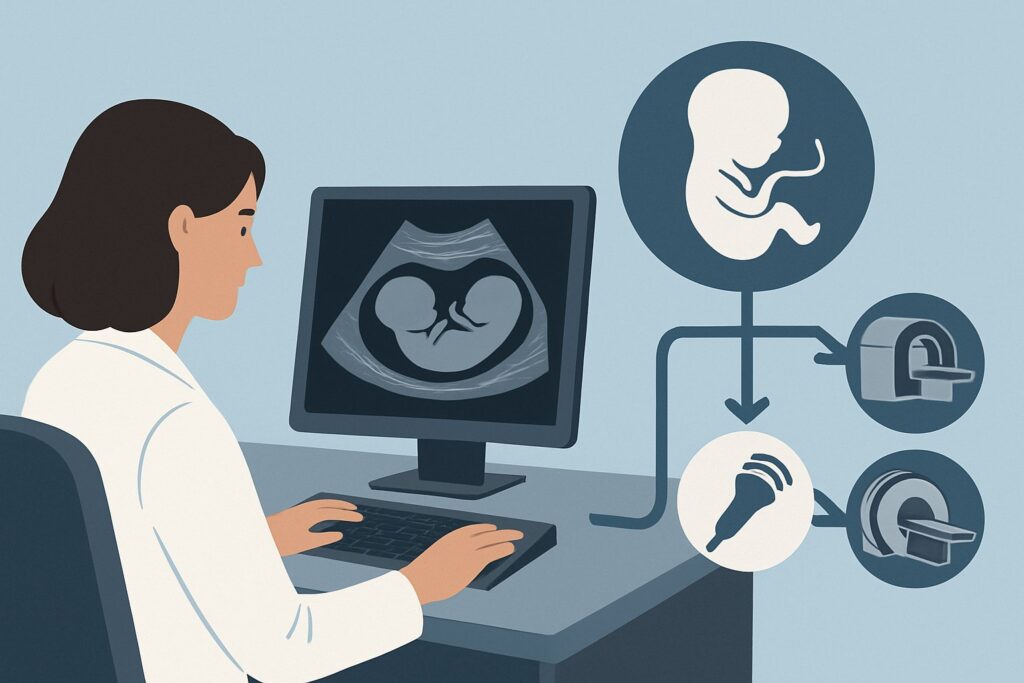
A 34-year-old patient presents for her first-trimester screening ultrasound at 12 weeks and 4 days of gestation. The scan confirms a monochorionic-diamniotic twin pregnancy, but also reveals a nuchal translucency (NT) measurement of 3.8 mm in one fetus and 3.5 mm in the co-twin, both above the 95th percentile for gestational age. As the ordering clinician, you must now determine the most appropriate next step in the imaging workup to assess the significant risks associated with this finding in the context of a shared placenta. This article details the clinical workflow for this specific scenario, explaining why the American College of Radiology (ACR) Appropriateness Criteria rate a dedicated `US echocardiography fetal` as a Usually Appropriate next step.
Who Fits This Clinical Scenario for Increased Nuchal Translucency?
This guidance applies to a specific and high-risk patient population. The inclusion criteria are precise: a confirmed monochorionic twin pregnancy between 11 weeks 0 days and 13 weeks 6 days of gestation, with an increased nuchal translucency measurement in one or both fetuses. An “increased” NT is typically defined as a measurement at or above the 95th percentile for the given crown-rump length (CRL), or often simplified to ≥3.0 mm or ≥3.5 mm depending on institutional standards.
It is critical to distinguish this scenario from similar but distinct clinical presentations that follow different management pathways:
- Increased NT in a Singleton Pregnancy: While the differential includes aneuploidy and cardiac defects, the unique risks of shared placental circulation are absent. The management and counseling differ significantly.
- Increased NT in Dichorionic Twins: In pregnancies with two separate placentas, the fetuses are typically not genetically identical and do not share vascular connections. The finding of an increased NT is managed on a per-fetus basis, similar to a singleton, without the immediate concern for complications like Twin-to-Twin Transfusion Syndrome (TTTS).
- Routine First-Trimester Screening: This workflow does not apply to monochorionic twin pregnancies where the NT measurements for both fetuses are within the normal range. Those pregnancies are still high-risk but do not require this specific urgent workup.
What Diagnoses Are You Working Up with Increased Nuchal Translucency in Monochorionic Twins?
An increased NT in a monochorionic twin pregnancy is a powerful marker for several serious conditions, many of which are linked to the shared circulation. The imaging workup is designed to differentiate among these possibilities and guide further management.
Congenital Heart Disease (CHD): This is a primary concern. Increased NT is one of the strongest early markers for major structural cardiac defects. In monochorionic twins, a severe cardiac anomaly in one fetus can have profound hemodynamic consequences for the chromosomally normal co-twin due to the placental vascular anastomoses, potentially leading to cardiac failure or demise in both.
Aneuploidy: Conditions like Trisomy 21 (Down syndrome), Trisomy 18, and Trisomy 13 are strongly associated with increased NT. Because monochorionic twins are genetically identical, if one fetus is affected by aneuploidy, the co-twin is as well. This differs from dichorionic twins, where aneuploidy can be discordant.
Twin-to-Twin Transfusion Syndrome (TTTS): Increased NT can be one of the earliest signs of the profound hemodynamic imbalance that defines TTTS. The fluid accumulation in the nuchal space may reflect early cardiac strain or venous congestion in the recipient twin long before the classic ultrasound findings of polyhydramnios and oligohydramnios become apparent.
Selective Fetal Growth Restriction (sFGR): Caused by unequal sharing of the placenta, sFGR can lead to hemodynamic stress and cardiac dysfunction in the smaller twin, which may manifest as an increased NT. This condition also carries significant risks for both fetuses.
Why Is Fetal Echocardiography the Recommended Study for This Presentation?
The ACR designates `US echocardiography fetal` as Usually Appropriate because it directly targets the most significant and actionable diagnoses in this high-risk scenario. While a detailed anatomic survey is also essential, the fetal echocardiogram provides a focused, high-resolution evaluation of cardiac structure and function that is critical for prognosis and management.
The rationale for prioritizing a fetal echocardiogram includes:
- High Diagnostic Yield for CHD: Fetal echocardiography is the gold standard for detecting structural heart defects. Early identification allows for comprehensive counseling with maternal-fetal medicine (MFM) and pediatric cardiology specialists, and informs decisions about further diagnostic testing and delivery planning.
- Assessment of Cardiac Function: Beyond anatomy, the study evaluates cardiac function, which can provide early clues to hemodynamic compromise from evolving TTTS or sFGR, even before other biometric or fluid changes are evident.
- Informing Genetic Testing Decisions: The presence or absence of a major cardiac defect significantly alters the risk profile and can influence a patient’s decision to pursue invasive diagnostic testing like chorionic villus sampling (CVS) or amniocentesis to obtain a definitive karyotype.
Other imaging studies have a role but are not considered the primary problem-solving tool for this specific question. A standard `US pregnant uterus transabdominal`, while also rated Usually Appropriate, serves as a broader anatomic survey and is often performed first or concurrently. However, it lacks the specialized detail of a dedicated cardiac exam. `US duplex Doppler pregnant uterus` is rated May be appropriate as an adjunctive tool to assess blood flow in key vessels like the ductus venosus and umbilical artery, which can add information about fetal well-being and risk for TTTS, but it does not replace the structural evaluation of the heart. All of these ultrasound-based modalities are safe in pregnancy, with a radiation level of 0 mSv.
When ordering, it is crucial to specify “detailed fetal echocardiogram” and include the clinical indication of monochorionic twins with increased NT to ensure the appropriate level of scrutiny is applied.
What’s Next After Fetal Echocardiography? Downstream Workflow
The results of the fetal echocardiogram are a critical branch point in the management of the pregnancy. Regardless of the findings, these patients should be managed in close consultation with an MFM specialist.
- If the study is positive for a major cardiac defect: The immediate next step is a consultation with both MFM and pediatric cardiology. This allows for a detailed discussion of the specific anomaly, prognosis, options for in-utero management (if any), and planning for delivery at a tertiary care center with neonatal cardiac services. Counseling about invasive genetic testing is also paramount.
- If the study is negative (structurally normal hearts): This is reassuring but does not render the pregnancy low-risk. The risk of aneuploidy remains elevated, and counseling for invasive diagnostic testing should proceed. Furthermore, the pregnancy must undergo frequent ultrasound surveillance (typically every one to two weeks) to monitor for the development of TTTS, TAPS (Twin Anemia Polycythemia Sequence), or sFGR, as the increased NT may have been a harbinger of these placental complications.
- If the study is indeterminate or shows subtle findings: A follow-up fetal echocardiogram is typically scheduled for the mid-second trimester (18-22 weeks), when the fetal heart is larger and anatomical details are more clearly visualized. Close surveillance for monochorionic complications should continue in the interim.
Common Pitfalls to Avoid in Monochorionic Twin Pregnancies
Navigating this scenario requires avoiding several common pitfalls that can delay diagnosis or lead to suboptimal management.
- Dismissing the Finding: Do not underestimate the significance of an increased NT in a monochorionic pregnancy, even if it is only borderline elevated or present in just one twin. It is a sign of underlying pathology until proven otherwise.
- Focusing Only on Aneuploidy: While aneuploidy is a key concern, the immediate risks of structural heart disease and evolving TTTS are equally critical and require prompt evaluation with targeted imaging.
- Not Referring to MFM Promptly: These pregnancies are inherently high-risk and complex. They require the expertise of a maternal-fetal medicine specialist for surveillance, counseling, and co-management from the moment the increased NT is identified.
If any signs of discordance develop—such as differing amniotic fluid volumes, discordant bladder sizes, or significant size discrepancy between the twins—escalate immediately to an MFM specialist for a formal TTTS evaluation, as this may represent a true obstetric emergency.
Related ACR Topics and Tools
For a comprehensive overview of all clinical variants related to first-trimester nuchal translucency evaluation, please consult the parent topic article. Additional GigHz tools can help you navigate adjacent scenarios and understand the technical aspects of the recommended imaging.
- For breadth across all scenarios in Nuchal Translucency Evaluation at 11 to 14 Weeks Gestational Age, see our parent guide: Nuchal Translucency Evaluation at 11 to 14 Weeks Gestational Age: ACR Appropriateness Decoded.
- To explore other clinical presentations, use the ACR Appropriateness Criteria Lookup.
- For technical details on performing the recommended studies, see the Imaging Protocol Library.
- To discuss cumulative radiation exposure with patients for other imaging, consult the Radiation Dose Calculator.
Frequently Asked Questions
Why is the workup for increased NT in monochorionic twins different from that in dichorionic twins?
The key difference is the shared placenta and vascular connections (anastomoses) in monochorionic twins. This shared circulation means that a problem in one twin, like a cardiac defect, can directly impact the other. It also creates the risk for unique conditions like Twin-to-Twin Transfusion Syndrome (TTTS), which are not a concern in dichorionic pregnancies.
If the fetal echocardiogram is normal, can the pregnancy be considered lower risk?
No. While a normal fetal echocardiogram is very reassuring regarding cardiac structure, the pregnancy remains high-risk. The increased NT is still a marker for potential aneuploidy and the ongoing risk of developing placental complications like TTTS, TAPS, or selective FGR. These pregnancies require continued close surveillance by a maternal-fetal medicine specialist.
Should both twins have a fetal echocardiogram if the NT is only increased in one?
Yes, absolutely. Because monochorionic twins are genetically identical, they share the same baseline risk for congenital anomalies. Furthermore, the shared circulation means that hemodynamic stress from one twin can affect the cardiac function of the other. A comprehensive evaluation requires a detailed fetal echocardiogram on both fetuses.
What is the role of cell-free DNA (cfDNA) screening in this scenario?
Cell-free DNA screening can be offered to assess the risk for common aneuploidies like Trisomy 21, 18, and 13. However, its performance is less robust in twin pregnancies compared to singletons, and it is a screening test, not a diagnostic one. It does not replace the need for a detailed anatomic evaluation with ultrasound and fetal echocardiography, nor does it replace the option of definitive diagnostic testing with CVS or amniocentesis.
Does a normal NT in one twin and an increased NT in the other suggest a specific diagnosis?
This finding, known as discordant NT, is particularly concerning for an underlying hemodynamic imbalance. It can be an early indicator of developing TTTS or selective fetal growth restriction due to unequal placental sharing. It strongly warrants a prompt referral to an MFM specialist for a comprehensive evaluation and initiation of close surveillance.
Reviewed by Pouyan Golshani, MD, Interventional Radiologist — May 29, 2026