What Imaging Is Best for Left Atrial Appendage Occlusion Planning in Atrial Fibrillation?

A 78-year-old man with non-valvular atrial fibrillation and a recent gastrointestinal bleed on apixaban is referred by his cardiologist. His CHA₂DS₂-VASc score is high, but long-term anticoagulation is no longer a safe option. The heart team has recommended a percutaneous left atrial appendage (LAA) endovascular occlusion device to reduce his stroke risk. As the referring physician, you are tasked with ordering the initial preprocedural imaging. The core questions are clear: Is there a pre-existing thrombus that would prohibit the procedure, and is the patient’s LAA anatomy suitable for a device? This article provides a clinical workflow for this specific scenario, grounded in the American College of Radiology (ACR) Appropriateness Criteria, which rate US echocardiography transesophageal as Usually Appropriate.
Who Fits This Clinical Scenario?
This guidance applies specifically to patients with atrial fibrillation (AF) being evaluated for percutaneous, endovascular occlusion of the left atrial appendage. The primary indication is stroke prevention in patients, typically with non-valvular AF, who have a high stroke risk (e.g., elevated CHA₂DS₂-VASc score) and a concurrent contraindication to long-term oral anticoagulation, such as a high bleeding risk, history of major bleeding, or intolerance.
It is critical to distinguish this scenario from similar, but distinct, clinical presentations that require different imaging workups:
- Preprocedural Planning for AF Ablation: If the patient is being planned for pulmonary vein isolation or another left atrial ablation procedure, the imaging focus shifts to defining pulmonary venous anatomy and left atrial size and geometry. While there is overlap, the primary questions are different.
- Preprocedural Planning for Cardioversion: For patients undergoing electrical or pharmacologic cardioversion, the imaging goal is narrowly focused on ruling out a left atrial or LAA thrombus immediately prior to the procedure to prevent embolic stroke. Comprehensive anatomical assessment for a device is not the primary goal.
- Patients with Valvular AF: Patients with moderate-to-severe mitral stenosis or a mechanical heart valve are generally not candidates for currently available LAA occlusion devices, and this imaging workflow does not apply.
What Key Questions Must Preprocedural Imaging Answer?
Unlike a typical diagnostic workup for symptoms, preprocedural imaging for LAA occlusion is designed to answer a specific set of anatomical and safety questions. The success of the procedure hinges on these findings.
First and foremost is the presence of LAA thrombus. This is an absolute contraindication to device placement. Attempting to manipulate catheters and deploy a device in an appendage containing a thrombus carries a very high risk of systemic embolization and stroke. This is the single most important question to answer before proceeding.
Second, the imaging must comprehensively define the LAA anatomy and morphology. The LAA is a highly variable structure, and its dimensions dictate device selection. Key measurements include the ostial diameter (in multiple planes), landing zone area, and overall depth. The morphology, often categorized into types like “chicken wing,” “windsock,” “cactus,” or “cauliflower,” influences the complexity of the procedure and the suitability of different devices.
Third, the study must assess the interatrial septum, the site of the transseptal puncture required to access the left atrium. The presence of a patent foramen ovale (PFO), atrial septal defect (ASD), septal aneurysm, or a very thick or fibrotic septum can complicate or preclude a standard transseptal approach.
Finally, the imaging serves as a screen for other significant cardiac pathology. The discovery of previously unknown severe valvular disease, a large pericardial effusion, or intracardiac masses could fundamentally alter the patient’s management plan and the appropriateness of the LAA occlusion procedure itself.
Why Is US Echocardiography Transesophageal the Recommended Study for This Presentation?
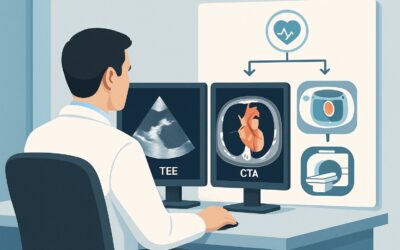
The ACR rates US echocardiography transesophageal (TEE) as Usually Appropriate for preprocedural planning prior to LAA endovascular occlusion. Its unique capabilities directly address the critical questions outlined above, making it the cornerstone of this workup.
TEE provides superb spatial and temporal resolution of posterior cardiac structures, including the left atrium and, most importantly, the LAA. It is considered the gold standard for detecting LAA thrombus, with excellent sensitivity and specificity. The real-time, dynamic nature of ultrasound allows for the confident differentiation of organized thrombus from slow-flowing blood, known as spontaneous echo contrast (SEC). The use of 3D TEE further enhances the comprehensive morphological assessment of the LAA, allowing for precise measurements of the ostium and depth from multiple angles to guide device sizing.
How do alternative studies compare for this specific scenario?
- CT Heart Function and Morphology with IV Contrast and CTA Chest with IV Contrast are also rated Usually Appropriate. Cardiac CT provides excellent, high-resolution, static 3D anatomical data. It is less operator-dependent than TEE and can be superior for visualizing complex LAA morphologies and their relationship to surrounding structures like the pulmonary artery and left upper pulmonary vein. Many centers use CT for initial anatomical planning and device sizing. However, it involves significant ionizing radiation (☢☢☢☢ 10-30 mSv for a cardiac CT) and iodinated contrast. Crucially, its sensitivity for detecting small, non-obstructive thrombi is generally considered lower than that of TEE. For this reason, even if a planning CT is performed, a TEE is almost always performed immediately before or during the procedure to definitively rule out thrombus.
- US Echocardiography Transthoracic Resting (TTE) is rated Usually Not Appropriate. The LAA is a posterior structure located in the far field of the transthoracic window. It is rarely, if ever, adequately visualized by TTE, making this modality unsuitable for ruling out thrombus or performing the detailed anatomical measurements required for device sizing.
The choice between TEE and CT as the primary planning tool often depends on institutional preference and expertise. However, TEE’s superior ability to rule out thrombus and its lack of ionizing radiation (0 mSv) solidify its role as an essential component of the workflow.
What’s Next After US Echocardiography Transesophageal? Downstream Workflow
The results of the preprocedural TEE create clear and distinct pathways for patient management. The goal is to ensure patient safety and procedural success.
- Result: No Thrombus, Suitable Anatomy: If the TEE confirms the absence of LAA thrombus and reveals an appendage morphology and size compatible with an available device, the patient can be scheduled for the LAA occlusion procedure. An intraprocedural TEE will still be used to guide the transseptal puncture, device deployment, and final assessment of device stability and peri-device leak.
- Result: Thrombus Identified: If a thrombus is found in the LAA, the procedure is immediately cancelled. This finding is an absolute contraindication. The patient must undergo a course of therapeutic anticoagulation for a minimum of several weeks. A follow-up TEE is then performed to reassess for thrombus resolution. Only if the thrombus has completely resolved can the LAA occlusion procedure be reconsidered.
- Result: Indeterminate Finding or Unsuitable Anatomy: If the TEE is equivocal for thrombus (e.g., differentiating dense SEC from a mural thrombus) or if the LAA anatomy is highly complex and difficult to fully characterize, a complementary imaging study is warranted. In this case, a CT heart function and morphology with IV contrast or MRI heart function and morphology without and with IV contrast (May be appropriate) can provide additional anatomical detail and tissue characterization to clarify the findings and guide decision-making. If the anatomy is definitively unsuitable for any available device (e.g., ostium too large, appendage too shallow), alternative stroke prevention strategies must be explored.
Pitfalls to Avoid (and When to Get Help)
Navigating the preprocedural workup requires attention to detail to avoid common errors that can impact patient safety and procedural outcomes.
- Underestimating LAA Complexity: Relying on a single 2D plane to measure the LAA ostium can lead to significant sizing errors. The ostium is often elliptical, not circular. Multiplanar and 3D imaging are essential for accurate assessment.
- Misinterpreting Spontaneous Echo Contrast (SEC): Differentiating very dense, swirling SEC (“sludge”) from a true thrombus can be challenging. A thrombus is typically a discrete mass, may be mobile or attached to the wall, and has a different echotexture than the surrounding blood.
- Ignoring Patient Factors: For patients with esophageal pathology, dysphagia, or a history of esophageal surgery, TEE may be high-risk or impossible. In these cases, cardiac CT becomes the primary imaging modality for both planning and thrombus exclusion.
If there is a discrepancy between imaging findings (e.g., CT suggests thrombus but TEE does not) or if the anatomy is exceptionally challenging, the case should be escalated for review by a multidisciplinary structural heart team.
Related ACR Topics and Tools
This article focuses on a single clinical scenario. For a broader view of imaging in other related situations, or to explore the tools used in this workflow, the following resources are available.
- For breadth across all scenarios in Preprocedural Planning for Left Atrial Procedures in Atrial Fibrillation, see our parent guide: Preprocedural Planning for Left Atrial Procedures in Atrial Fibrillation: ACR Appropriateness Decoded.
- ACR Appropriateness Criteria Lookup — for adjacent scenarios
- Imaging Protocol Library — for technique on the recommended study
- Radiation Dose Calculator — for cumulative dose conversations
Frequently Asked Questions
Is a transthoracic echocardiogram (TTE) ever sufficient for LAA occlusion planning?
No. According to the ACR Appropriateness Criteria, a TTE is ‘Usually Not Appropriate’ for this purpose. The left atrial appendage is a posterior structure that is poorly visualized from the standard transthoracic window, making it impossible to reliably rule out thrombus or obtain the precise anatomical measurements needed for device sizing.
My institution uses cardiac CT for all LAA occlusion planning. Is that also correct?
Yes, cardiac CT is also rated as ‘Usually Appropriate’ by the ACR. It provides excellent, high-resolution 3D anatomical data for planning and device sizing. However, it involves radiation and contrast, and it is less sensitive than TEE for small thrombi. For this reason, most centers will still perform a TEE on the day of the procedure to give a final confirmation that no thrombus is present before device deployment.
What if the patient cannot tolerate a TEE due to esophageal issues?
In cases where a TEE is contraindicated or cannot be performed (e.g., esophageal stricture, recent surgery), cardiac CT becomes the primary imaging modality for both anatomical planning and thrombus exclusion. The proceduralist must be aware that CT has a slightly lower sensitivity for detecting small, non-occlusive thrombi compared to TEE.
How soon before the LAA occlusion procedure should the TEE be performed?
The TEE to rule out thrombus should be performed as close to the procedure time as possible. The ideal workflow is to perform it on the same day, often in the procedural suite immediately before starting the intervention. This minimizes the risk of a new thrombus forming in the interval between the imaging and the procedure.
Does the specific type of LAA occlusion device change the imaging requirements?
The fundamental imaging requirements remain the same regardless of the device brand (e.g., Watchman, Amulet). All procedures require ruling out thrombus and obtaining key anatomical measurements like ostial diameter and appendage depth. However, the specific ‘landing zone’ criteria and measurement techniques may differ slightly between devices, so the imager should be in communication with the proceduralist about which device is being considered.
Reviewed by Pouyan Golshani, MD, Interventional Radiologist — May 30, 2026