What Imaging Is Best for Routine Surveillance After Stage I-III NSCLC Treatment?
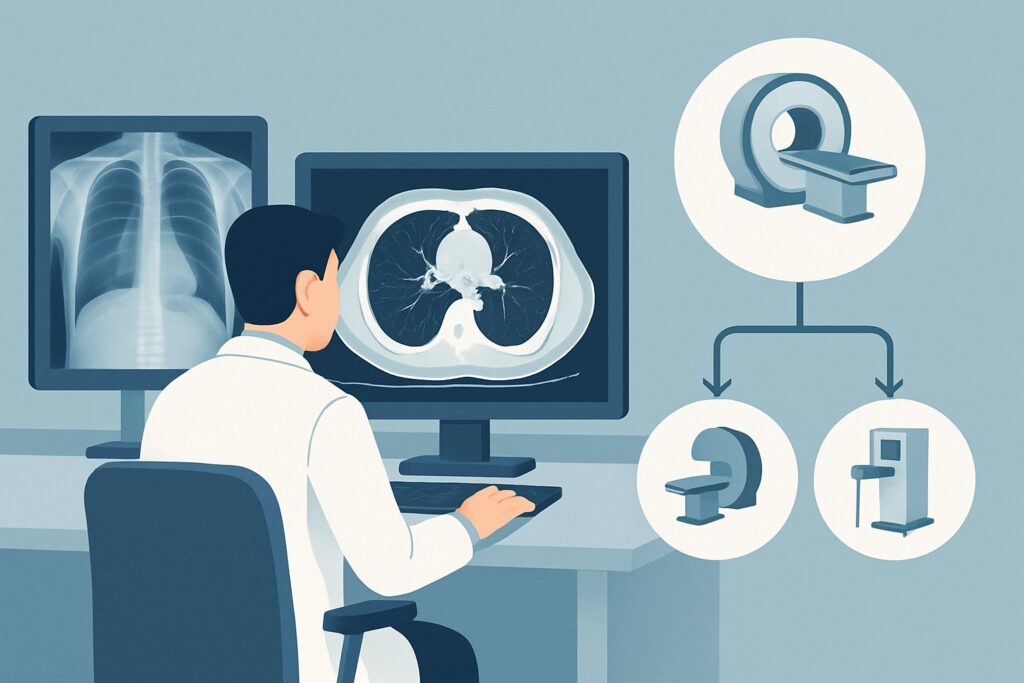
A 68-year-old man, a former smoker, is in your oncology clinic for a routine follow-up. Two years ago, he completed definitive chemoradiation for stage IIB non–small-cell lung cancer (NSCLC) and has been clinically well since, with no new cough, dyspnea, or weight loss. It is time for his scheduled surveillance imaging, and you must decide which study offers the best balance of detection and risk. This is a common and critical decision point in long-term cancer survivorship, aiming to detect recurrence early while it may still be treatable.
This article provides a detailed clinical workflow for this specific scenario: routine, noninvasive imaging surveillance in an asymptomatic adult following curative-intent treatment for stage I-III NSCLC. For this presentation, the American College of Radiology (ACR) Appropriateness Criteria rate CT chest with IV contrast as Usually Appropriate.
Who Fits This Clinical Scenario?
This guidance applies to a well-defined patient population: asymptomatic adults in the routine surveillance phase after receiving treatment with curative intent for pathologically confirmed stage I, II, or III non–small-cell lung cancer. The key elements are that the patient has completed their primary therapy (such as surgery, radiation, chemotherapy, or a combination) and has no new or worsening symptoms suggestive of cancer recurrence. The imaging is being performed as part of a scheduled, routine follow-up plan.
It is crucial to distinguish this scenario from similar but distinct clinical situations that require a different imaging approach:
- Symptomatic Patients: If the patient presents with new symptoms like persistent cough, hemoptysis, chest pain, or unexplained weight loss, the workup shifts from routine surveillance to an evaluation for suspected recurrence or progression. This is a separate ACR variant with different imaging recommendations, often involving FDG-PET/CT earlier in the workflow.
- Small-Cell Lung Cancer (SCLC): This guidance is specific to NSCLC. SCLC has a different biological behavior, pattern of spread, and surveillance strategy.
- Stage IV (Metastatic) NSCLC: Patients initially diagnosed with or who have progressed to stage IV disease are not undergoing surveillance after curative-intent therapy. Their imaging is for monitoring treatment response or progression in a palliative setting, which follows different protocols.
Applying this workflow to the correct patient—asymptomatic, post-curative treatment for localized NSCLC—is the first step toward appropriate imaging.
What Diagnoses Are You Working Up in This Scenario?
Routine surveillance imaging in this context is designed to detect potentially curable disease recurrence or new disease before it becomes clinically apparent. The differential diagnosis for a new finding on a surveillance scan includes several key possibilities.
The most common and critical concern is locoregional recurrence. This can manifest as a new or enlarging solid nodule within the lung parenchyma (local recurrence), particularly near a surgical resection margin or within a prior radiation field. It can also present as new or enlarging hilar or mediastinal lymph nodes (regional recurrence), indicating the cancer has returned in the lymphatic drainage basin of the original tumor.
Another significant consideration is a metachronous primary lung cancer. Survivors of lung cancer have a substantially elevated risk of developing a second, entirely new lung primary. Surveillance CT is highly effective at detecting these new cancers at an early stage, when they are often treatable with curative intent.
While routine surveillance focuses on the chest, it can also detect intrathoracic distant metastases. These include new pleural or pericardial nodules or effusions, which would signify metastatic progression and dramatically alter the patient’s prognosis and management plan.
Finally, a major diagnostic challenge is distinguishing true recurrence from benign post-treatment changes. Radiation pneumonitis, radiation-induced fibrosis, and post-surgical scarring can all mimic or obscure recurrent disease. Differentiating these benign etiologies from malignancy is a primary task of the interpreting radiologist and a key reason for high-quality, consistent imaging.
Why Is CT Chest with IV Contrast the Recommended Study for This Presentation?
The ACR panel designates CT chest with IV contrast as Usually Appropriate for routine NSCLC surveillance because it provides the necessary anatomical detail to address the primary clinical questions in this scenario. Its high spatial resolution is superior for detecting small pulmonary nodules, evaluating the surgical bed, and assessing lymph node size and morphology.
The administration of intravenous contrast is key to this recommendation. Contrast enhances vascular structures, allowing for clear differentiation of blood vessels from adjacent lymph nodes in the hilum and mediastinum. This is critical for accurately identifying and measuring potentially pathologic nodes, a common site of recurrence. Contrast also helps characterize any new mass, delineating its relationship to adjacent vessels or the chest wall.
In contrast, other modalities are rated lower for this specific purpose:
- CT chest without IV contrast is rated May be appropriate (Disagreement). While a non-contrast study is excellent for detecting parenchymal lung nodules, its ability to evaluate the mediastinum and hilum is limited. The “Disagreement” among panelists highlights that some may consider it sufficient, but the consensus favors the additional information provided by IV contrast for a comprehensive surveillance exam.
- Radiography chest is rated Usually not appropriate. A standard chest X-ray lacks the sensitivity to detect the small, early-stage recurrences or new primaries that surveillance CT is designed to find. Many recurrences would be occult on radiography until they are much larger and potentially less treatable.
- FDG-PET/CT is also rated Usually not appropriate for routine surveillance. While invaluable for staging and for evaluating a suspected recurrence found on CT, its use as a primary screening tool in asymptomatic patients is not recommended. This is due to higher radiation dose (☢☢☢☢ 10-30 mSv vs. ☢☢☢ 1-10 mSv for CT), higher cost, and a greater potential for false-positive findings from post-treatment inflammation, which could lead to unnecessary anxiety and invasive procedures.
The recommended study, CT chest with IV contrast, represents the optimal balance of diagnostic yield and practicality for routine surveillance in this population. Once you’ve decided on this study, our protocol guide, which covers the principles of contrast-enhanced chest CT, can help ensure optimal technique: CT Chest/Abdomen/Pelvis with IV Contrast.
What’s Next After CT Chest with IV Contrast? Downstream Workflow
The results of the surveillance CT will dictate the subsequent clinical pathway. A clear and structured approach to the findings is essential.
- If the study is negative or shows stable post-treatment changes: This is the ideal outcome. The patient can continue with their scheduled surveillance plan as recommended by national guidelines (e.g., NCCN, ASCO), which typically involves annual low-dose CT scans for a defined period. Reassurance and continued clinical follow-up are key.
- If the study is positive for a new or growing finding suspicious for recurrence: The next step is typically further characterization. This almost always involves obtaining an FDG-PET/CT to assess the metabolic activity of the suspicious finding and to screen for other sites of disease. If the PET/CT is also positive, a tissue diagnosis via biopsy (e.g., CT-guided needle biopsy, endobronchial ultrasound (EBUS)-guided biopsy, or surgical biopsy) is required to confirm malignancy before initiating further treatment. This workflow effectively transitions the patient from the “routine surveillance” scenario to the “suspected recurrence” scenario.
- If the study is indeterminate: This is a common challenge. A finding might be a small, new, sub-solid nodule or a subtle change in a post-radiation scar. Management depends on the level of suspicion. Options include a short-interval follow-up CT in 3 to 6 months to assess for stability or growth. For new nodules, principles from lung cancer screening guidelines (such as Lung-RADS) can be applied to risk-stratify the finding and guide the follow-up interval.
Pitfalls to Avoid (and When to Get Help)
Several common pitfalls can complicate routine NSCLC surveillance. Awareness of these issues can help ensure accurate interpretation and appropriate patient management.
- Misinterpreting post-treatment scarring: Radiation fibrosis and surgical changes can evolve for up to two years post-treatment. Attributing a growing opacity to “scar” without careful comparison to multiple prior scans is a frequent error. Any growth should be considered suspicious.
- Failing to use IV contrast: Opting for a non-contrast CT to save time or avoid contrast exposure may compromise the evaluation of the mediastinum, a critical area for detecting regional recurrence.
- Overlooking the upper abdomen: Standard chest CT protocols include the adrenal glands and the superior aspect of the liver. These are common sites of NSCLC metastasis and must be carefully scrutinized on every surveillance scan.
- Inconsistent imaging technique: Variations in scanner protocol, slice thickness, or contrast timing between studies can make it difficult to accurately assess for subtle changes. Performing surveillance imaging at the same center with a consistent protocol is highly recommended.
If a finding is equivocal or if there is a discrepancy between imaging findings and the clinical picture, escalation to a multidisciplinary tumor board is the most appropriate next step.
Related ACR Topics and Tools
For a comprehensive overview of imaging across all post-treatment lung cancer scenarios, refer to the parent topic article. For specific tools to aid in your clinical practice, see the resources below.
- For breadth across all scenarios in Lung Cancer: Surveillance After Therapy, see our parent guide: Lung Cancer: Surveillance After Therapy: ACR Appropriateness Decoded.
- ACR Appropriateness Criteria Lookup — for adjacent scenarios
- Imaging Protocol Library — for technique on the recommended study
- Radiation Dose Calculator — for cumulative dose conversations
Frequently Asked Questions
Why is CT with contrast preferred over non-contrast CT for routine NSCLC surveillance?
CT with IV contrast is rated ‘Usually Appropriate’ because it provides superior evaluation of the mediastinum and hilum, which are common sites of nodal recurrence. Contrast helps distinguish lymph nodes from blood vessels, allowing for more accurate detection and measurement. While non-contrast CT is good for lung nodules, it is less reliable for assessing regional recurrence, leading to its lower rating of ‘May be appropriate (Disagreement)’.
Should I order a PET/CT for every routine surveillance scan after NSCLC treatment?
No. For routine surveillance in an asymptomatic patient, FDG-PET/CT is rated ‘Usually not appropriate’ by the ACR. While it is a critical tool for initial staging and for working up a suspected recurrence found on CT, its routine use for surveillance is discouraged due to higher radiation dose, cost, and a higher rate of false-positive results from post-treatment inflammation.
How often should surveillance CT scans be performed after treatment for stage I-III NSCLC?
The frequency of surveillance imaging is guided by organizations like the NCCN and ASCO. A common recommendation is annual low-dose chest CT for a number of years post-treatment. However, the exact interval and duration can depend on the initial stage, treatment modality, and individual patient risk factors. This article focuses on *which* study to order, while the timing should be determined by established oncologic guidelines.
What if my patient has a contraindication to IV contrast, like severe renal impairment or a true allergy?
In cases with a strong contraindication to iodinated IV contrast, a non-contrast chest CT is the logical alternative. It is still a powerful tool for detecting new or growing lung nodules, which represent local recurrence or a new primary. The limitations in evaluating the mediastinum must be acknowledged, and a lower threshold for further investigation (like PET/CT) may be warranted if any suspicious, non-contrast findings arise.
Does this surveillance guidance apply to patients treated with immunotherapy or targeted therapy?
Yes, this guidance for routine surveillance in the post-curative setting generally applies regardless of the specific systemic therapy used (chemotherapy, immunotherapy, or targeted therapy). However, it’s important to be aware of treatment-specific imaging findings, such as immunotherapy-related pneumonitis, which can sometimes mimic infection or cancer progression and pose a diagnostic challenge.
Reviewed by Pouyan Golshani, MD, Interventional Radiologist — May 30, 2026