What Imaging Is Best for TB Screening Before Group Home Placement?
A primary care physician is finalizing the admission paperwork for an 82-year-old man moving into a skilled nursing facility. The facility requires tuberculosis screening for all new residents to prevent outbreaks. The patient is completely asymptomatic, with no cough, fever, or weight loss. However, due to logistical constraints and a history of an unreliable reading in the past, a Purified Protein Derivative (PPD) skin test is not available. The physician needs to decide on the most appropriate and efficient imaging study to fulfill this screening requirement. This article details the American College of Radiology (ACR) Appropriateness Criteria workflow for this specific scenario, where a chest radiograph is rated Usually Appropriate.
Who Fits This Clinical Scenario for TB Screening?
This guidance applies to a specific subset of patients: asymptomatic individuals who require screening for tuberculosis prior to placement in a congregate living situation. This includes settings like skilled nursing facilities, group homes, long-term care facilities, shelters, or correctional institutions. The key defining element of this scenario is the unavailability or impracticality of first-line immunologic tests like the PPD skin test or an Interferon-Gamma Release Assay (IGRA). The patient must have no clinical signs or symptoms of active TB, such as a persistent cough, hemoptysis, fever, night sweats, or unexplained weight loss.
It is critical to distinguish this situation from closely related clinical presentations that follow different diagnostic pathways:
- Patients with symptoms of active TB: If a patient presents with a cough, fever, or other constitutional symptoms, they no longer fit this screening scenario. They should be evaluated under the “Suspect active tuberculosis” variant, which may involve different imaging and immediate infection control protocols.
- Patients with a known positive PPD or IGRA: An individual with a newly positive test, or a previously known positive test, requires a chest radiograph to rule out active disease. This falls under a separate ACR variant and represents a different pre-test probability.
This article is exclusively for the asymptomatic screening patient where immunologic testing is not an option.
What Diagnoses Are You Working Up in This Scenario?
In this asymptomatic screening context, the primary goal is to identify individuals who could pose an infection risk within a vulnerable, congregated population. The imaging study is therefore looking for evidence of either past or present tuberculous disease.
The most critical finding to rule out is unsuspected active pulmonary tuberculosis. While the patient is asymptomatic, subclinical or early-stage active disease can sometimes be detected radiographically. Identifying such a case is paramount for public health, allowing for immediate treatment and preventing transmission within the facility.
More commonly, the imaging may reveal findings consistent with latent tuberculosis infection (LTBI). A chest radiograph cannot diagnose LTBI—which is a clinical diagnosis based on immunologic testing—but it can show the sequelae of a prior, contained infection. Classic signs include apical scarring, fibronodular changes, or a calcified Ghon complex (a calcified parenchymal nodule and a calcified hilar lymph node). Identifying these individuals is important for risk stratification, as they may be candidates for LTBI treatment to prevent future reactivation, especially if they are or become immunocompromised.
Of course, the most frequent result is a normal chest radiograph, which effectively fulfills the screening requirement and provides a valuable baseline for future comparisons. Additionally, particularly in the elderly population entering skilled nursing facilities, the radiograph may uncover important incidental findings, such as evidence of congestive heart failure, chronic obstructive pulmonary disease, or an unsuspected lung nodule requiring further evaluation.
Why Is a Chest Radiograph the Recommended Study for This Presentation?
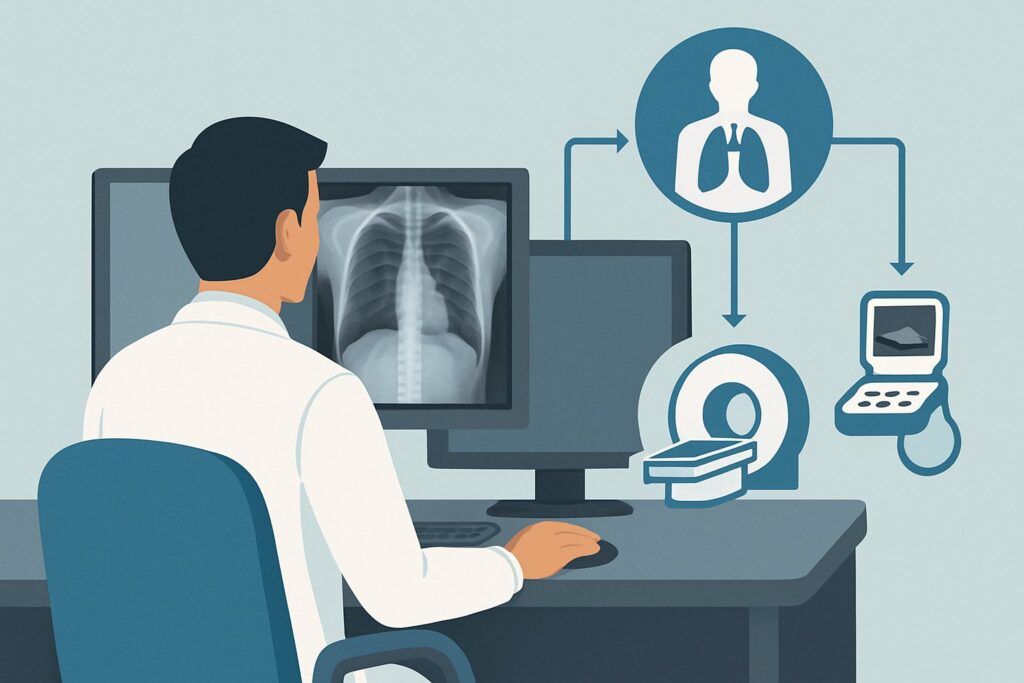
The ACR designates a standard chest radiograph as Usually Appropriate for this screening scenario because it provides the ideal balance of diagnostic utility, safety, cost-effectiveness, and accessibility. It is highly effective at identifying the radiographic signs of both active and old, healed tuberculosis, which are the primary targets of the workup.
A two-view (posteroanterior and lateral) chest radiograph is sensitive for detecting parenchymal infiltrates, cavitation, pleural effusions, and hilar adenopathy that may suggest active disease. It is also the standard for identifying the calcified granulomas and apical fibrotic changes characteristic of prior infection. For a screening test in an asymptomatic person, its performance is excellent. Furthermore, it involves a very low radiation dose, with a relative radiation level (RRL) of ☢ (<0.1 mSv), which is a fraction of the average annual background radiation exposure in the United States.
Alternative, higher-technology imaging studies are considered Usually Not Appropriate for this initial screening purpose:
- Computed Tomography (CT) of the chest (without or with contrast): While CT is more sensitive than radiography for subtle nodules and early disease, its use as a first-line screening tool is not justified. The radiation dose is substantially higher (RRL ☢☢☢ 1-10 mSv), and its increased sensitivity often leads to the detection of clinically insignificant incidental findings, triggering further unnecessary workups and patient anxiety. CT is reserved for problem-solving when the chest radiograph is abnormal or equivocal.
- Magnetic Resonance Imaging (MRI) of the chest: MRI is also rated Usually Not Appropriate. It has no ionizing radiation (RRL O 0 mSv), but it is poorly suited for evaluating the lung parenchyma for the typical findings of TB. It has inferior spatial resolution for small nodules, calcifications, and fine interstitial patterns compared to both radiography and CT. Its primary role in thoracic imaging is for evaluating soft tissue masses, the heart, and major vessels, not for TB screening.
Given these considerations, the simple, low-dose chest radiograph remains the clear and appropriate first choice for fulfilling pre-placement TB screening requirements when immunologic tests are unavailable.
What’s Next After Radiography chest? Downstream Workflow
The results of the screening chest radiograph dictate the subsequent clinical pathway. The decision tree is generally straightforward and aimed at ensuring patient and community safety.
If the chest radiograph is negative (normal): The screening is complete. The report provides the necessary documentation to clear the patient for placement in the group home or skilled nursing facility. No further TB-specific workup is indicated unless the patient develops symptoms in the future.
If the radiograph shows findings suggestive of old, healed (inactive) TB: This may include findings like a solitary calcified granuloma, apical pleural thickening, or minor fibrotic scarring. In an asymptomatic patient, this is typically interpreted as evidence of LTBI. The patient does not have active, contagious disease and can usually be cleared for placement. However, this finding should prompt a clinical discussion about the risks and benefits of treatment for LTBI to prevent future reactivation, based on the patient’s age, comorbidities, and overall health status.
If the radiograph is suspicious for active TB: Findings such as a focal infiltrate (especially in the upper lobes), cavitation, pleural effusion, or adenopathy are red flags. This result requires immediate action. The patient should be placed in respiratory isolation, and sputum samples should be collected for acid-fast bacilli (AFB) smear and culture. A referral to an infectious disease specialist or the local public health department is mandatory. Further imaging, often with a chest CT, may be warranted to better characterize the extent of the disease. The patient cannot be cleared for placement until active TB is definitively ruled out.
Pitfalls to Avoid (and When to Get Help)
When ordering and interpreting screening chest radiographs for TB, several common pitfalls can compromise patient care and public health efforts.
- Misinterpreting old scarring as active disease: Over-reading stable, calcified, or fibrotic changes as active TB can lead to unnecessary isolation, anxiety, and costly workups. Comparing with any available prior imaging is the single most important step to establish stability.
- Dismissing subtle upper-lobe infiltrates: Early active TB can present with subtle findings. A low threshold for suspicion is necessary, especially for infiltrates or ill-defined nodules in the lung apices, which are classic locations for post-primary (reactivation) TB.
- Failing to act on suspicious findings: A radiograph suspicious for active TB is a critical result. Delaying isolation, sputum collection, and public health notification puts the community at risk.
- Ignoring the clinical context: Remember this is a screening test in an asymptomatic person. The interpretation and downstream actions must always be integrated with the patient’s lack of symptoms.
If the radiographic findings are equivocal or if there is any uncertainty about whether the findings represent active versus inactive disease, the appropriate next step is to escalate. This typically involves obtaining prior images for comparison and consulting with a radiologist or an infectious disease specialist.
Related ACR Topics and Tools
This article covers one specific clinical scenario in depth. For a comprehensive overview of all clinical variants related to tuberculosis imaging, including for symptomatic patients or those with positive PPD/IGRA tests, please consult the parent guide.
- For breadth across all scenarios in Imaging of Possible Tuberculosis, see our parent guide: Imaging of Possible Tuberculosis: ACR Appropriateness Decoded.
- To explore other clinical situations, use the Imaging Appropriateness Selector.
- For details on imaging techniques, see the Imaging Protocol Library.
- To discuss radiation exposure with patients, use the Radiation Dose Calculator.
Frequently Asked Questions
Why not just get a CT scan to be more thorough for TB screening?
A CT scan is rated ‘Usually Not Appropriate’ for initial screening in an asymptomatic person because its significantly higher radiation dose is not justified. While more sensitive, it can lead to over-investigation of benign incidental findings. A standard chest radiograph provides an excellent balance of diagnostic utility and low radiation risk for this specific screening purpose.
What if the patient had a PPD test years ago but doesn’t remember the result?
If prior PPD or IGRA status is unknown and a new test is not feasible, the patient fits this clinical scenario. The chest radiograph serves as the primary screening tool to rule out radiographically-evident disease before placement in a congregate setting.
If the chest X-ray shows old, healed TB, is the patient contagious?
No. Radiographic findings of old, healed tuberculosis, such as calcified granulomas or stable apical scarring, indicate a past infection that the body’s immune system has successfully contained. The patient is not contagious and does not pose a risk to others in the facility. However, they may be a candidate for latent TB treatment.
Does a normal chest X-ray completely rule out tuberculosis?
A normal chest X-ray effectively rules out active pulmonary tuberculosis in the vast majority of immunocompetent, asymptomatic individuals. It makes contagious disease extremely unlikely. It does not, however, rule out latent TB infection (LTBI), which is an immunological state without radiographic findings. The goal of this screening is to rule out active disease, which a normal X-ray accomplishes.
Is a single-view (AP) portable chest X-ray sufficient for this screening?
While a portable anteroposterior (AP) chest X-ray is better than no imaging, a standard two-view (posteroanterior and lateral) study performed in a radiology department is strongly preferred. The two-view study is technically superior, provides better visualization of the lungs (especially the bases and retrocardiac regions), and is more sensitive for detecting subtle abnormalities.
Reviewed by Pouyan Golshani, MD, Interventional Radiologist — May 26, 2026