What Is the Best Initial Imaging for Suspected Diaphragm Dysfunction Causing Chronic Dyspnea?

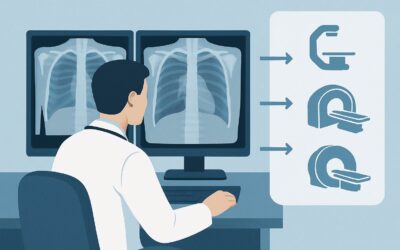
A 68-year-old patient with a history of cervical spine surgery presents with six months of progressive shortness of breath. The dyspnea is most pronounced when he lies flat and improves when he sits up. On physical examination, you note diminished breath sounds at the left base and observe paradoxical inward movement of his abdomen during inspiration. You suspect diaphragm dysfunction, possibly related to phrenic nerve injury. As you prepare to order initial imaging, you face a critical decision: which study will most effectively and safely evaluate the diaphragm without exposing the patient to unnecessary radiation or cost? This article provides a detailed clinical workflow for this specific scenario, grounded in the American College of Radiology (ACR) Appropriateness Criteria, which rate chest radiography as “Usually Appropriate” for the initial evaluation.
Who Fits This Clinical Scenario for Suspected Diaphragm Dysfunction?
This guidance applies specifically to adult patients presenting with chronic dyspnea (lasting weeks to months) where there is a clinical suspicion of diaphragm dysfunction. The clinical clues pointing toward this diagnosis are often key to inclusion. These may include unexplained orthopnea (shortness of breath when lying flat), a history of conditions known to affect the phrenic nerve (such as neck or thoracic surgery, trauma, or certain malignancies), or a known neuromuscular disorder like amyotrophic lateral sclerosis (ALS) or myasthenia gravis. Physical exam findings like paradoxical abdominal wall motion during breathing further strengthen the suspicion.
It is crucial to distinguish this focused scenario from similar presentations that require different imaging pathways. This workflow is not intended for:
- Patients with chronic dyspnea of unclear etiology: If there are no specific signs or symptoms pointing to the diaphragm, the initial workup is broader. This patient presentation is covered in a separate ACR variant.
- Patients with suspected Chronic Obstructive Pulmonary Disease (COPD) or small airways disease: If the history and exam strongly suggest bronchospasm, smoking-related lung disease, or asthma, the imaging rationale shifts toward evaluating for hyperinflation, bullous disease, or interstitial changes.
- Patients with acute dyspnea: Sudden onset of shortness of breath requires an urgent workup for life-threatening conditions like pulmonary embolism, pneumothorax, or acute heart failure, which follow different diagnostic algorithms.
What Diagnoses Are You Working Up in This Scenario?
When ordering initial imaging for suspected diaphragm dysfunction, you are primarily investigating conditions that impair the mechanical action of this principal muscle of respiration. The differential diagnosis guides the interpretation of the imaging findings.
Diaphragmatic Paralysis or Paresis
This is the most direct and common consideration. Weakness (paresis) or complete loss of function (paralysis) of one or both hemidiaphragms prevents proper lung inflation. This is often caused by injury to the phrenic nerve anywhere along its path from the cervical spine to the diaphragm. Causes can be idiopathic (phrenic neuritis), post-surgical (e.g., after cardiac or thoracic surgery), traumatic, or due to compression from a tumor.
Diaphragmatic Eventration
This is a less common condition, often congenital, where a portion of the diaphragm muscle is abnormally thin and weak. This weakened area balloons upward into the chest cavity during respiration, mimicking the appearance of paralysis and leading to similar symptoms of reduced lung volume and dyspnea.
Subpulmonic Pleural Effusion
Fluid can accumulate in the pleural space between the base of the lung and the superior surface of the diaphragm. A large subpulmonic effusion can create the illusion of an elevated hemidiaphragm on physical exam and imaging, making it a key mimic to rule out. The clinical context often helps differentiate this from true diaphragm pathology.
Basilar Atelectasis
Poor diaphragmatic excursion directly leads to inadequate ventilation of the lung bases, causing volume loss or collapse (atelectasis). While often a consequence of diaphragm dysfunction, significant atelectasis can also be a primary contributor to dyspnea and is an important finding to identify on initial imaging.
Why Is a Chest Radiograph the Recommended Initial Study for This Presentation?
The ACR designates Radiography chest as “Usually appropriate” for the initial imaging of an adult with chronic dyspnea and suspected diaphragm dysfunction. This recommendation is based on the test’s high diagnostic utility for this specific question, combined with its excellent safety profile and accessibility.
A standard posteroanterior (PA) and lateral chest radiograph provides a wealth of information. It is the ideal first step to assess the position, contour, and relative height of the two hemidiaphragms. An abnormally elevated hemidiaphragm is the classic sign of unilateral paralysis or eventration. The radiograph can also readily identify alternative or coexisting causes of the patient’s symptoms, such as a large subpulmonic effusion, significant basilar atelectasis, or other unexpected parenchymal lung disease. The extremely low radiation dose (ACR Relative Radiation Level ☢ <0.1 mSv) makes it a safe starting point for nearly all adult patients.
Alternative imaging modalities are rated lower for this initial evaluation for clear reasons:
- CT chest (without or with IV contrast) is rated “May be appropriate.” While CT provides exquisite anatomical detail, it is not the right tool for the initial diagnosis of diaphragm dysfunction. It involves a significantly higher radiation dose (☢☢☢ 1-10 mSv) and is better reserved as a second-line, problem-solving study. For instance, if a radiograph confirms an elevated hemidiaphragm, a CT might then be used to search for a mediastinal mass compressing the phrenic nerve.
- Fluoroscopy chest is rated “Usually not appropriate.” Although the “sniff test” under fluoroscopy was historically a common method to assess for paradoxical diaphragmatic motion, it has largely been supplanted by ultrasound due to its higher radiation dose (☢☢☢ 1-10 mSv) and less comprehensive anatomical assessment compared to other modalities.
- US chest is rated “Usually not appropriate” for the initial workup, though it plays a key downstream role. Ultrasound is excellent for confirming or quantifying diaphragmatic motion and thickness but is not a good screening tool for the entire thorax. It cannot adequately evaluate the lung parenchyma or mediastinum for alternative diagnoses, which is a primary goal of the first imaging test.
What’s Next After Radiography chest? Downstream Workflow
The results of the initial chest radiograph will dictate the subsequent diagnostic pathway. The goal is to move from identifying an abnormality to confirming its functional significance and, if possible, determining its cause.
If the radiograph is positive for an elevated hemidiaphragm:
The next step is to confirm functional impairment. This is most commonly done with a dedicated chest ultrasound. An experienced sonographer can directly visualize the diaphragm, measure its thickness, and assess its movement during quiet breathing, deep breathing, and voluntary sniffing. The absence of thickening or the presence of paradoxical (upward) motion during inspiration confirms paralysis. If ultrasound is unavailable or equivocal, a fluoroscopic sniff test may be considered. If paralysis is confirmed, a contrast-enhanced CT of the chest may be warranted to evaluate the entire course of the phrenic nerve for a compressive lesion.
If the radiograph is negative or shows non-specific findings:
A normal chest radiograph with symmetric, normally positioned hemidiaphragms makes significant diaphragm paralysis or eventration much less likely. If clinical suspicion remains high, consider referral for pulmonary function testing (PFTs), which can reveal a restrictive pattern and a significant drop in vital capacity when moving from an upright to a supine position—a classic indicator of bilateral diaphragm weakness. If the dyspnea remains unexplained, the workup may proceed down the pathway for “Chronic dyspnea. Unclear etiology.”
If the radiograph is indeterminate or suggests an alternative diagnosis:
Findings like a suspected subpulmonic effusion can be confirmed with a lateral decubitus radiograph or, more definitively, a chest ultrasound. If extensive atelectasis or an unexpected mass is seen, a CT chest (rated “May be appropriate”) becomes the logical next step to better characterize the abnormality.
Pitfalls to Avoid (and When to Get Help)
Navigating the workup for suspected diaphragm dysfunction requires careful interpretation and awareness of common pitfalls.
- Over-interpreting slight asymmetry: Minor differences in the height of the hemidiaphragms (with the right typically slightly higher than the left) are normal. Only marked elevation should raise suspicion.
- Forgetting the patient’s position: A radiograph taken with the patient in a semi-erect or supine position (common in portable exams) can alter the apparent diaphragm position and is less reliable for assessment. A fully erect, inspiratory film is standard.
- Stopping at the radiograph: An elevated hemidiaphragm is a finding, not a final diagnosis. The downstream workflow to confirm functional paralysis and investigate the cause is essential.
- Ignoring bilateral weakness: Bilateral diaphragm paralysis can be subtle on a chest radiograph, as both hemidiaphragms are elevated symmetrically, which may be mistaken for low lung volumes. If the clinical picture (especially severe orthopnea) is highly suggestive, proceed to PFTs and ultrasound even if the radiograph is not striking.
If the diagnosis remains elusive or the patient’s respiratory status is deteriorating, escalation to a pulmonologist or thoracic surgeon for further evaluation, including electromyography (EMG) of the phrenic nerve, is the appropriate next step.
Related ACR Topics and Tools
For a comprehensive overview of imaging for other related clinical presentations, as well as tools to help in your daily practice, please refer to the following resources. For breadth across all scenarios in Chronic Dyspnea-Noncardiovascular Origin, see our parent guide: Chronic Dyspnea-Noncardiovascular Origin: ACR Appropriateness Decoded.
- ACR Appropriateness Criteria Lookup — for adjacent scenarios
- Imaging Protocol Library — for technique on the recommended study
- Radiation Dose Calculator — for cumulative dose conversations
Frequently Asked Questions
Why isn’t a ‘sniff test’ under fluoroscopy the first choice anymore?
While the fluoroscopic ‘sniff test’ can demonstrate paradoxical diaphragm motion, it has been largely replaced by chest ultrasound as the preferred functional test. Ultrasound provides the same functional information with no ionizing radiation and can also assess diaphragm thickness, a marker of muscle atrophy. The initial chest radiograph is still the first step to assess overall anatomy before any functional test is performed.
Can a chest radiograph diagnose bilateral diaphragm paralysis?
Diagnosing bilateral diaphragm paralysis on a chest radiograph can be challenging. The key finding is elevation of both hemidiaphragms, resulting in low lung volumes. However, this can be a non-specific finding. If the clinical suspicion for bilateral paralysis is high (e.g., severe orthopnea in a patient with a neuromuscular disorder), the radiograph is still the right first step, but a normal-appearing result should not end the workup. Pulmonary function tests (PFTs) are often more sensitive in this specific situation.
When should I order a CT scan for suspected diaphragm dysfunction?
A CT scan is generally a second-line test in this scenario. According to the ACR, it ‘May be appropriate.’ You should consider ordering a CT chest after a chest radiograph has already confirmed an elevated hemidiaphragm. The primary purpose of the CT would be to search for a cause, such as a tumor in the neck, mediastinum, or lung apex that could be compressing the phrenic nerve.
What if my patient has a pacemaker? Does that change the imaging choice?
A pacemaker does not change the initial imaging recommendation. A chest radiograph is perfectly safe and remains the most appropriate first study. The presence of pacemaker or defibrillator leads is also a potential, albeit rare, cause of phrenic nerve irritation or injury, making the radiograph a useful tool to visualize the course of the leads in relation to the diaphragm.
Is there a role for MRI in evaluating the diaphragm?
For the initial evaluation of suspected diaphragm dysfunction causing chronic dyspnea, the ACR rates MRI as ‘Usually not appropriate.’ While advanced MRI techniques can assess diaphragm motion, they are complex, less available, and offer little advantage over the combination of chest radiography and ultrasound for this clinical question. MRI’s role is typically reserved for niche research applications or complex cases where other imaging is inconclusive.
Reviewed by Pouyan Golshani, MD, Interventional Radiologist — May 29, 2026