What Imaging Is Needed for Low-Grade Endometrial Cancer Staging?
A 62-year-old woman presents to your clinic with a new diagnosis of FIGO grade 1 endometrioid adenocarcinoma of the endometrium, confirmed on biopsy after she reported postmenopausal bleeding. Her physical exam is unremarkable. You are planning her surgical management and face a key decision: is preoperative imaging necessary to assess for lymph node involvement or distant metastases? For this specific scenario—assessing for extrauterine spread in a low-grade tumor—the American College of Radiology (ACR) rates several imaging modalities, including pelvic ultrasound, MRI, and CT, as ‘May be appropriate’, indicating that the decision requires careful clinical judgment based on individual patient risk factors.
Who Fits This Clinical Scenario?
This guidance applies specifically to the pretreatment evaluation of patients with a confirmed diagnosis of low-grade (Type I, FIGO grade 1 or 2) endometrial cancer. The central clinical question is whether to perform imaging to assess for pelvic or para-aortic lymph node involvement and distant metastases before primary surgical treatment. The goal is to identify the small subset of patients with low-grade tumors who may have occult advanced disease that would alter their management plan.
This workflow is not intended for:
- Patients with high-grade tumors: Those with FIGO grade 3 endometrioid adenocarcinoma, uterine serous carcinoma, clear cell carcinoma, or carcinosarcoma have a much higher risk of extrauterine spread, and the imaging recommendations are different. This is addressed in a separate ACR variant for high-grade tumors.
- Assessment of local tumor extension only: While related, the primary question of assessing myometrial invasion depth and cervical stromal involvement is covered under a distinct ACR scenario, for which MRI is the preferred modality.
- Post-treatment surveillance: This guidance does not apply to asymptomatic patients who have already completed primary treatment for endometrial cancer.
What Diagnoses Are You Working Up in This Scenario?
While the primary diagnosis of endometrial cancer is already established by biopsy, preoperative imaging aims to differentiate the extent of disease. The “differential” in this context is one of staging, which directly impacts surgical planning and potential adjuvant therapies.
Uterus-Confined Disease (Stage I): This is the most common and expected finding in patients with low-grade endometrial cancer. In this situation, the tumor has not spread beyond the uterus. Imaging may show deep myometrial invasion, which is a risk factor for nodal spread, but will not show evidence of metastatic disease.
Regional Lymph Node Metastases (Stage IIIC): A less common but critical finding to identify preoperatively. Spread to pelvic and/or para-aortic lymph nodes significantly changes the patient’s stage and prognosis, mandating a systematic lymphadenectomy during surgery rather than just a sentinel node biopsy. Identifying bulky nodal disease beforehand is a key goal of staging imaging.
Distant Metastases (Stage IV): This is rare at presentation for low-grade endometrial cancer but has profound implications. Imaging may be performed to rule out spread to distant sites like the lungs, liver, peritoneum, or bone. Discovering distant disease would fundamentally shift the treatment paradigm from curative-intent surgery to systemic therapy, potentially avoiding a morbid operation that would not be curative.
Synchronous Ovarian Primary: Endometrial and ovarian cancers can occur simultaneously. Imaging, particularly ultrasound or MRI, can help evaluate the adnexa for a concurrent mass that might represent a separate primary tumor, which would require a different surgical approach.
How to Choose Among ‘May Be Appropriate’ Imaging Options
For low-grade endometrial cancer, the pre-test probability of extrauterine disease is low. Consequently, the ACR Appropriateness Criteria do not designate a single study as “Usually Appropriate,” instead listing several as ‘May be appropriate’. The decision to order imaging—and which study to choose—depends on balancing the need to detect occult disease against the risks of cost, radiation, and potential false positives.
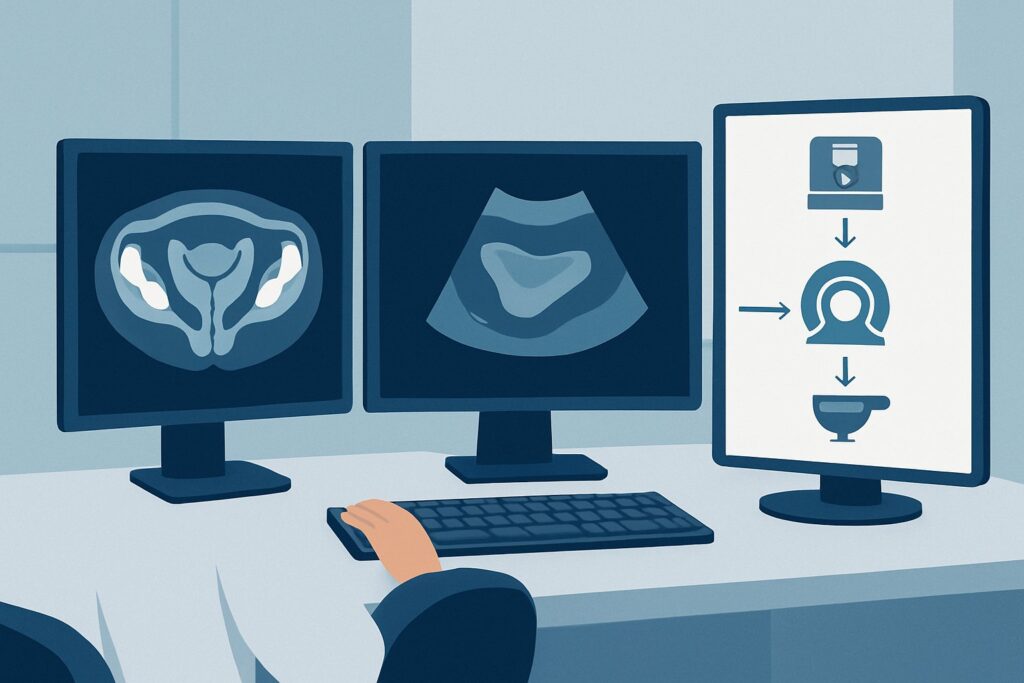
MRI of the Pelvis without and with IV contrast is often the most valuable single study in this context. While its primary strength is local staging—assessing the depth of myometrial invasion and cervical stromal involvement—these local findings are the strongest predictors of lymph node metastasis. If MRI shows no or minimal myometrial invasion, the risk of nodal disease is very low, and further systemic imaging is often unnecessary. It is rated ‘May be appropriate’ and involves no ionizing radiation (0 mSv).
CT of the Chest, Abdomen, and Pelvis with IV contrast is a better choice when the primary concern is distant metastatic disease. It provides a comprehensive, one-time assessment of the lungs, liver, peritoneum, and distant lymph nodes. This study is typically reserved for patients with higher-risk features even within the “low-grade” category, such as a very large tumor on physical exam or clinical suspicion of widespread disease. It is rated ‘May be appropriate’ but carries a significant radiation dose (☢☢☢☢ 10-30 mSv).
FDG-PET/CT from skull base to mid-thigh is another ‘May be appropriate’ option for whole-body staging. It can be highly sensitive for detecting nodal and distant metastases. However, its use is generally limited to cases where conventional imaging (CT or MRI) is equivocal or in patients with high-risk features where there is a strong suspicion of metastatic disease. Like CT, it involves a high radiation dose (☢☢☢☢ 10-30 mSv).
US of the Pelvis (Transabdominal and Transvaginal), while also rated ‘May be appropriate’, has a more limited role in staging for metastatic disease. It is excellent for initial evaluation of the uterus and adnexa but lacks the sensitivity and specificity of MRI for assessing myometrial invasion and cannot reliably evaluate retroperitoneal lymph nodes or distant organs. It is often performed as part of the initial diagnostic workup for abnormal bleeding but is not typically the primary modality for preoperative staging of nodes and distant mets.
An alternative rated ‘Usually not appropriate’ is CT of the chest, abdomen, and pelvis without IV contrast. Omitting intravenous contrast severely limits the evaluation of lymph nodes, peritoneal implants, and visceral organ parenchyma, making the study inadequate for cancer staging.
What’s Next After Imaging? Downstream Workflow
The results of preoperative staging imaging directly guide the next steps in management, primarily the surgical plan.
- If imaging is negative for metastatic disease: The patient proceeds with the standard surgical plan, which typically includes a total hysterectomy, bilateral salpingo-oophorectomy, and intraoperative lymphatic assessment (usually sentinel lymph node biopsy). The final decision on the extent of lymph node dissection is often guided by intraoperative findings and frozen section analysis of the primary tumor.
- If imaging is positive for suspicious pelvic or para-aortic lymph nodes: This finding alerts the gynecologic oncologist to perform a full systematic lymphadenectomy in the affected nodal basins. It also upstages the patient and confirms the need for adjuvant therapy (typically radiation and/or chemotherapy) after surgery.
- If imaging is positive for distant metastases (Stage IV): This is a game-changing finding. The patient’s case should be discussed in a multidisciplinary tumor board. Management will likely shift from primary surgery to systemic therapy (chemotherapy, hormonal therapy). Surgery may be reconsidered later for palliative purposes (e.g., to control bleeding) but is no longer the primary curative modality.
- If imaging is indeterminate: Equivocal findings, such as borderline-enlarged lymph nodes, often do not change the initial surgical plan. The surgeon will proceed with surgical staging, and the final pathologic analysis of the removed nodes will provide the definitive answer. In some complex cases, an indeterminate finding might prompt an additional study like an FDG-PET/CT.
Pitfalls to Avoid (and When to Get Help)
In this specific scenario, several common pitfalls can impact patient care. First, avoid the routine use of whole-body imaging like CT or PET/CT for every patient with low-grade endometrial cancer; the yield is very low and can lead to unnecessary costs, radiation exposure, and anxiety from incidental findings. Second, if ordering a CT for staging, do not forget to specify intravenous contrast, as a non-contrast study is inadequate. Third, remember that imaging is for risk stratification, not definitive diagnosis of nodal status; final staging relies on pathology. If imaging reveals unequivocal evidence of distant metastatic disease, it is crucial to escalate the case to a multidisciplinary tumor board including gynecologic oncology, medical oncology, and radiation oncology before proceeding with any treatment.
Related ACR Topics and Tools
For a comprehensive overview of imaging across all clinical variants related to this condition, please consult our parent topic hub article. For further exploration of adjacent scenarios or imaging techniques, the following GigHz resources are available.
- For breadth across all scenarios in Pretreatment Evaluation and Follow-Up of Endometrial Cancer, see our parent guide: Pretreatment Evaluation and Follow-Up of Endometrial Cancer: ACR Appropriateness Decoded.
- ACR Appropriateness Criteria Lookup — for adjacent scenarios
- Imaging Protocol Library — for technique on the recommended study
- Radiation Dose Calculator — for cumulative dose conversations
Frequently Asked Questions
Is preoperative imaging always required for low-grade endometrial cancer?
No. For many patients with low-grade (FIGO grade 1 or 2) endometrial cancer and no other high-risk features, the risk of extrauterine disease is so low that proceeding directly to surgery without preoperative staging imaging is a common and acceptable strategy. Imaging is typically reserved for patients with clinical or pathologic features that suggest a higher risk of spread, such as large tumor size or deep myometrial invasion suspected on initial ultrasound.
If I only want to assess myometrial invasion, which study is best?
For assessing the local extent of the tumor, specifically the depth of myometrial invasion and cervical stromal involvement, MRI of the pelvis with and without IV contrast is the most accurate non-invasive imaging modality. This falls under a different, though related, ACR clinical scenario focused on local tumor extension.
Why is CT without contrast considered ‘Usually Not Appropriate’?
Intravenous contrast is essential for cancer staging with CT. It enhances the visibility of organs like the liver and spleen, delineates blood vessels, and makes lymph nodes more conspicuous. Without contrast, it is very difficult to reliably detect small metastatic deposits in organs or to differentiate lymph nodes from surrounding structures, rendering the study inadequate for assessing metastatic disease.
What if my patient has a contraindication to MRI contrast (e.g., severe renal failure)?
If a patient has a contraindication to gadolinium-based contrast agents, a non-contrast MRI of the pelvis can still provide valuable information about myometrial invasion, though it may be slightly less accurate. The ACR rates ‘MRI pelvis without IV contrast’ as ‘May be appropriate’ for this scenario. If assessment for distant disease is the primary goal, a CT chest/abdomen/pelvis with IV contrast would be the logical alternative, assuming no contraindication to iodinated contrast.
How does lymphovascular space invasion (LVSI) on the biopsy affect the imaging decision?
The presence of lymphovascular space invasion on the initial endometrial biopsy is a significant risk factor for lymph node metastasis. If LVSI is reported, the clinical suspicion for extrauterine disease increases, which strengthens the argument for obtaining preoperative staging imaging, such as a pelvic MRI to assess for suspicious nodes or a CT of the abdomen and pelvis to evaluate the full extent of pelvic and para-aortic nodes.
Reviewed by Pouyan Golshani, MD, Interventional Radiologist — May 29, 2026