
What Imaging Should You Order for Acute Limb Ischemia After Lower Extremity Revascularization?
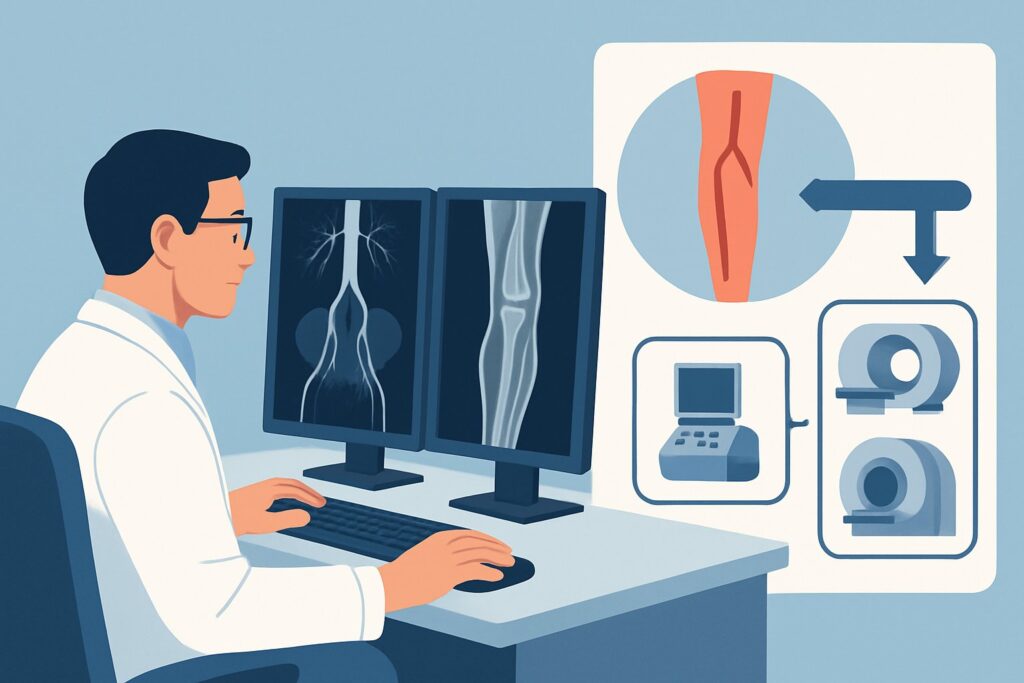
A 68-year-old man with a history of a left femoral-popliteal bypass graft presents to the emergency department with a 3-hour history of severe, unremitting pain in his left foot. On examination, the foot is cool to the touch, pale, and you cannot palpate a dorsalis pedis or posterior tibial pulse. You suspect acute limb ischemia from a failed bypass. The immediate question is which imaging study to order to confirm the diagnosis and guide urgent intervention. This clinical workflow article details the American College of Radiology (ACR) guidance for this specific, time-sensitive scenario. For this presentation, the ACR rates US duplex Doppler lower extremity as Usually Appropriate.
Who Fits This Clinical Scenario?
This guidance applies to a specific patient population: individuals with a known history of infrainguinal revascularization who now present with signs and symptoms of acute limb ischemia (ALI). This is a vascular emergency, often characterized by the “6 Ps”:
- Pain (severe, often out of proportion)
- Pallor (pale or mottled skin)
- Pulselessness (diminished or absent distal pulses)
- Poikilothermia (cold extremity)
- Paresthesia (numbness or tingling)
- Paralysis (weakness or inability to move the foot/toes)
The patient’s history must include a prior infrainguinal endovascular procedure (such as angioplasty or stenting) or a surgical bypass (e.g., femoral-popliteal, femoral-tibial). This workflow is for the initial imaging choice in this acute setting.
This article does not apply to patients with:
- Asymptomatic presentations: These patients fall under a surveillance imaging protocol, which has a different set of recommendations.
- Chronic symptoms: Patients with gradually worsening claudication or chronic limb-threatening ischemia (CLI) are evaluated under a separate ACR variant, as the urgency and diagnostic goals differ.
- No prior revascularization: A patient presenting with ALI without a history of a bypass or stent is evaluated under a different diagnostic algorithm for native vessel disease.
What Diagnoses Are You Working Up in This Scenario?
When a patient with a prior revascularization presents with acute limb ischemia, the differential diagnosis is focused and urgent. The imaging study must rapidly confirm or exclude these possibilities to facilitate limb-saving therapy.
Bypass Graft or Stent Thrombosis
This is the most common and feared cause in this scenario. The previously placed conduit—whether a synthetic graft, vein graft, or metallic stent—has acutely occluded with thrombus. This can result from underlying issues like progressive neointimal hyperplasia at an anastomosis, poor distal runoff, or a hypercoagulable state, leading to flow stagnation and thrombosis.
Embolism to the Graft or Distal Vasculature
Less common but critical to consider, an embolus from a proximal source (such as the heart in atrial fibrillation or an aortic aneurysm) can travel downstream and lodge within the bypass graft, stent, or the native vessels just beyond the revascularized segment, causing an abrupt cutoff of blood flow.
Critical Stenosis with Low-Flow State
A severe, flow-limiting stenosis may have been developing over time at an anastomosis or within the graft itself. A transient period of hypotension or dehydration can be the final insult that reduces flow below a critical threshold, leading to acute thrombosis and ischemic symptoms.
Graft or Vessel Dissection
While uncommon, iatrogenic or spontaneous dissection at an anastomotic site or within a stented segment can create a flap that obstructs flow. This is a crucial diagnosis to make as its management can differ from simple thrombosis.
Why Is US Duplex Doppler Lower Extremity the Recommended Study for This Presentation?
The ACR Appropriateness Criteria rate US duplex Doppler lower extremity as Usually Appropriate for the initial evaluation of acute limb ischemia in a patient with prior infrainguinal revascularization. This recommendation is based on a balance of diagnostic accuracy, safety, and logistical advantages in an emergency setting.
The primary strength of duplex ultrasound is its ability to provide both anatomic and physiologic information in real-time. It can directly visualize the bypass graft or stented segment, identify the presence and extent of thrombus, and assess blood flow characteristics. By measuring flow velocities, sonographers can pinpoint the exact location of an occlusion or identify a hemodynamically significant stenosis that precipitated the event. This information is often sufficient to confirm the diagnosis and allow for immediate consultation with vascular surgery or interventional radiology.
From a safety and practical standpoint, ultrasound is unparalleled in this scenario:
- Radiation Dose: It involves no ionizing radiation (0 mSv).
- Contrast Risk: It requires no intravenous contrast, avoiding the risk of contrast-induced nephropathy in potentially fragile patients.
- Accessibility: It is widely available and can be performed quickly at the patient’s bedside in the emergency department or intensive care unit, saving critical time.
While other powerful imaging modalities exist, they are often better suited as second-line or pre-procedural studies. Both CTA lower extremity with IV contrast and Arteriography lower extremity are also rated Usually Appropriate. However, CTA involves significant radiation (☢☢☢ 1-10 mSv) and iodinated contrast. Arteriography is an invasive procedure that is typically reserved for when a decision to intervene has already been made, as it serves as both a diagnostic and therapeutic tool. For the initial, rapid diagnostic question, duplex ultrasound is the most efficient and safest first step.
Once you’ve decided on US duplex Doppler, our protocol guide covers the technique and reading principles. For more details, see: US Lower Extremity Doppler (DVT).
What’s Next After US Duplex Doppler Lower Extremity? Downstream Workflow
The results of the duplex ultrasound will directly guide the subsequent, urgent management steps. The clinical workflow diverges based on the findings.
If the study is positive for graft/stent occlusion:
This is a surgical and interventional emergency. The immediate next step is an urgent consultation with vascular surgery or interventional radiology. The patient will likely be taken for catheter-based angiography with possible intervention (e.g., pharmacomechanical thrombectomy, thrombolysis) or open surgical revision (e.g., thrombectomy, graft revision/replacement). The duplex ultrasound provides the crucial localization of the problem, allowing the interventional team to plan their approach.
If the study is negative (graft/stent is patent):
A patent graft in the setting of clear signs of acute limb ischemia is a diagnostic challenge. The clinical team must reconsider the differential. Is there an occlusion in a small distal vessel beyond the resolution of ultrasound? Is this a case of “trash foot” from microemboli? Or could the cause be non-vascular, such as an acute compressive neuropathy or compartment syndrome? In this situation, proceeding to CTA or MRA may be necessary to evaluate the entire vascular tree with higher spatial resolution. This shifts the workup toward the sibling scenario of evaluating a patient with ongoing symptoms despite a seemingly patent revascularization.
If the study is indeterminate:
Occasionally, the duplex exam may be technically limited due to factors like severe edema, patient body habitus, or deep vessel location. If the study cannot confidently confirm or exclude an occlusion, the next step is typically to proceed to CTA lower extremity with IV contrast. As a Usually Appropriate study, CTA provides an excellent, non-invasive anatomic roadmap and will definitively answer the question of patency.
Pitfalls to Avoid (and When to Get Help)
In this high-stakes clinical scenario, several common pitfalls can compromise patient outcomes. Awareness is key to avoidance.
- Delaying the initial imaging study: Acute limb ischemia is a time-sensitive emergency. “Time is muscle” and, more importantly, “time is limb.” Delays in diagnosis can lead to irreversible nerve damage, muscle necrosis, and ultimately, amputation. The initial diagnostic study should be ordered and performed emergently.
- Ordering a venous-only study: Be specific in your order. Request a “lower extremity arterial duplex to evaluate bypass graft/stent patency.” A standard DVT study will not provide the necessary arterial flow information.
- Misinterpreting a patent graft with no distal flow: If the graft itself is patent but there is no flow in the tibial vessels, this implies a severe outflow obstruction. This is still a critical finding requiring urgent intervention.
- Ignoring clinical signs if imaging is “normal”: If a patient has unequivocal signs of ALI but the initial duplex is negative, do not stop the workup. Escalate to a more comprehensive study like CTA and obtain an urgent specialty consultation.
If the patient exhibits signs of advanced, irreversible ischemia (e.g., fixed skin mottling, muscle rigidity, profound sensory loss), escalate immediately to a vascular specialist, as imaging may delay limb-saving intervention.
Related ACR Topics and Tools
Navigating imaging decisions requires access to reliable, evidence-based resources. For broader context on this topic and tools to assist in ordering, consider the following:
- For breadth across all scenarios in Lower Extremity Arterial Revascularization-Post-Therapy Imaging, see our parent guide: Lower Extremity Arterial Revascularization-Post-Therapy Imaging: ACR Appropriateness Decoded.
- To explore other clinical scenarios, use the ACR Appropriateness Criteria Lookup.
- To review technical details for various studies, consult the Imaging Protocol Library.
- To discuss radiation exposure with patients, the Radiation Dose Calculator can help frame the conversation.
Frequently Asked Questions
Why not go straight to CTA for every patient with suspected acute limb ischemia after bypass?
While CTA is also rated ‘Usually Appropriate’ and provides excellent anatomical detail, US duplex Doppler is often preferred as the initial test because it is faster, can be done at the bedside, uses no radiation, and avoids IV contrast. In a time-sensitive emergency, these advantages make it the most efficient first step to confirm the diagnosis and mobilize the appropriate specialty team.
What if the patient’s renal function is poor? Does that change the recommendation?
Yes, poor renal function strongly favors US duplex Doppler as the initial study. It completely avoids the risk of contrast-induced nephropathy associated with CTA and catheter-based arteriography. If the duplex is non-diagnostic, a non-contrast MRA (‘May be appropriate’) could be considered, but CTA would be used with extreme caution and pre-procedural hydration.
How does the type of bypass graft (e.g., vein vs. synthetic) affect the imaging choice?
The initial imaging choice of US duplex Doppler remains the same regardless of graft type. However, the sonographer should be made aware of the graft material and location (e.g., ‘left femoral to above-knee popliteal PTFE graft’) as this information helps them tailor the exam and identify specific failure modes common to different conduits.
If the duplex shows an occlusion, is another imaging study needed before intervention?
Often, yes. While the duplex confirms the diagnosis of occlusion, the interventionalist (vascular surgeon or IR) will typically perform on-table catheter-based arteriography just before and during the intervention. This provides the most detailed, real-time roadmap of the vessel anatomy, inflow, and outflow needed to guide wires, catheters, and therapeutic devices accurately.
What is the role of Ankle-Brachial Index (ABI) in this acute scenario?
In the setting of acute limb ischemia, a formal ABI measurement can be deferred. The clinical signs of a cold, painful, pulseless extremity are sufficient to proceed directly to imaging. An ABI is more valuable for monitoring chronic conditions like claudication. In an acute occlusion, the distal ankle pressures may be absent or too low to measure, and attempting to obtain them would only delay definitive imaging.
Reviewed by Pouyan Golshani, MD, Interventional Radiologist — May 29, 2026