What Imaging Should You Order for Suspected Bone Tumors with Negative Radiographs?
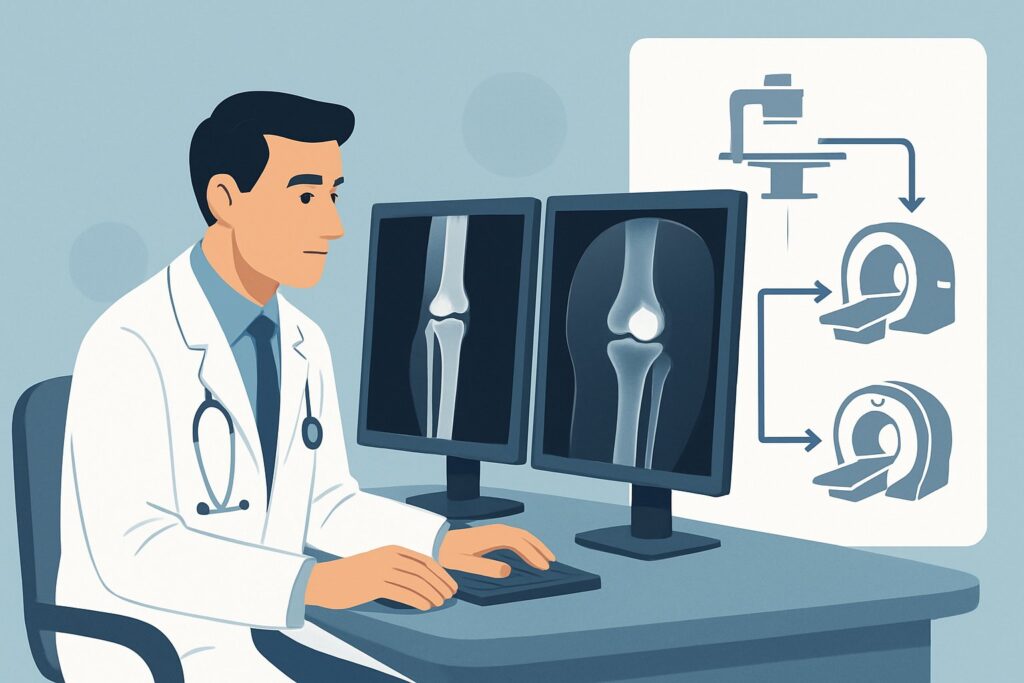
A 15-year-old presents with three months of worsening, localized pain in his distal femur, waking him from sleep. It’s not related to any specific injury. You obtain radiographs of the knee and femur, which are completely unremarkable—no fracture, no periosteal reaction, no lytic or blastic lesion. Despite the negative initial imaging, the clinical suspicion for a primary bone tumor, such as Ewing sarcoma or osteosarcoma, remains. The crucial next question is which advanced imaging study will provide a definitive answer without delaying a potential diagnosis. This article details the clinical workflow for this specific scenario, where the American College of Radiology (ACR) Appropriateness Criteria rate MRI of the area of interest without and with IV contrast as Usually Appropriate.
Who Fits This Clinical Scenario?
This guidance applies to both adult and pediatric patients who present with clinical signs concerning for a primary bone tumor but have normal initial radiographs. The key inclusion criteria are a combination of high-risk clinical features and unrevealing plain films.
Inclusion Criteria:
- Persistent, localized, and often progressive bone pain, especially pain at night.
- A palpable soft tissue or bony mass in the absence of trauma.
- Systemic symptoms like fever or weight loss accompanying focal bone pain.
- Initial radiographs of the symptomatic area are interpreted as negative or normal.
This workflow is specifically for when the first-line imaging test fails to identify a cause. It is crucial to distinguish this situation from related, but distinct, clinical presentations that follow different diagnostic pathways.
Exclusion Criteria (These patients follow different guidelines):
- Patients with a lesion on radiographs: If radiographs show a benign-appearing, indeterminate, or aggressive lesion, the workup follows a different branch of the ACR guidelines. This scenario is exclusively for radiographically occult lesions.
- Patients with a known primary malignancy elsewhere: If the patient has a history of breast, lung, prostate, kidney, or thyroid cancer, the primary concern is a metastatic lesion, not a primary bone tumor.
- Patients with a clear history of acute, high-impact trauma: In this case, the differential would favor an occult fracture, and the imaging choice might differ.
What Diagnoses Are You Working Up in This Scenario?
When radiographs are negative, the differential diagnosis shifts toward processes that primarily affect the bone marrow or have not yet caused significant cortical changes. Advanced imaging is required to detect these radiographically occult conditions.
Aggressive Marrow-Replacing Processes
The highest-concern diagnoses are primary malignant bone tumors that begin within the medullary cavity. In children and adolescents, this includes Ewing sarcoma and osteosarcoma. In adults, lymphoma and leukemia can present with focal bone pain and normal radiographs. These tumors replace normal hematopoietic marrow, and an MRI is exceptionally sensitive for detecting this marrow infiltration long before it erodes the cortex or creates a visible periosteal reaction.
Early Osteomyelitis
Bacterial infection of the bone can perfectly mimic a tumor, causing intense localized pain, swelling, and sometimes systemic symptoms. Radiographic changes of osteomyelitis, such as bone destruction and periostitis, typically lag behind clinical symptoms by 10 to 14 days. MRI can detect the early marrow edema and associated soft tissue inflammation characteristic of infection.
Stress Fracture or Reaction
In athletes or individuals with new, repetitive physical stressors, a stress fracture can cause severe pain with initially normal radiographs. MRI is the most sensitive imaging modality for detecting the early marrow edema of a stress reaction or a non-displaced fracture line that is invisible on an X-ray.
Benign Tumors or Tumor-like Conditions
Less commonly, benign lesions like an early aneurysmal bone cyst or fibrous dysplasia may be symptomatic before they are large enough to remodel or thin the cortex in a way that is visible on a radiograph. MRI can characterize these lesions and differentiate them from more aggressive processes.
Why Is MRI Without and With IV Contrast the Recommended Study?
The ACR designates MRI of the area of interest without and with IV contrast as Usually Appropriate because of its superior ability to visualize bone marrow and soft tissues, which is the key to diagnosis in this scenario. An MRI without contrast is also rated Usually Appropriate and may be sufficient in some cases, but the addition of contrast provides critical information for characterization and surgical planning.
Superior Diagnostic Sensitivity and Specificity
MRI’s primary advantage is its unparalleled contrast resolution for soft tissue and bone marrow. It can directly visualize tumor infiltration, marrow edema, soft tissue extension, and involvement of adjacent neurovascular structures. This allows for early detection when a process is confined to the medullary space. T1-weighted sequences are excellent for showing replacement of normal fatty marrow, while fluid-sensitive sequences (like T2-fat-suppressed or STIR) highlight edema associated with tumor, infection, or trauma.
The Role of Intravenous Contrast
Administering a gadolinium-based contrast agent helps delineate the viable, enhancing portions of a tumor from necrotic or cystic areas. This is not just an academic distinction; it is vital for guiding a biopsy to the most diagnostically fruitful area. Contrast also helps differentiate a phlegmon or abscess from a solid tumor and defines the extent of vascularity.
Comparison to Alternative Studies
- Bone Scan (Technetium-99m MDP): Rated May be appropriate, a whole-body bone scan is highly sensitive for detecting areas of increased bone turnover. However, it is not specific. A “hot spot” can be caused by a tumor, infection, fracture, or arthritis. Crucially, it provides poor anatomical detail, making it insufficient for local staging or surgical planning.
- Computed Tomography (CT): Rated May be appropriate, CT excels at evaluating cortical bone, subtle periosteal reactions, and matrix mineralization. However, it is relatively insensitive to early changes within the bone marrow. In this scenario, where the pathology is presumed to be intramedullary, CT is likely to be negative and would delay the definitive diagnosis provided by MRI.
Radiation and Safety Considerations
A significant advantage of MRI is the absence of ionizing radiation (Relative Radiation Level: O 0 mSv). This is particularly important in children and young adults, who are more susceptible to the long-term risks of radiation and are also the peak demographic for many primary bone tumors.
What’s Next After MRI? Downstream Workflow
The results of the contrast-enhanced MRI will guide the subsequent management steps, which typically involve a multidisciplinary team.
- If the MRI shows an aggressive lesion: A finding suspicious for a primary bone malignancy (e.g., a large, enhancing intramedullary mass with soft tissue extension) is a critical result. The patient requires immediate referral to a specialized orthopedic oncology service at a sarcoma center. Further workup will include staging studies (often chest CT and a whole-body bone scan or PET/CT) followed by a carefully planned biopsy.
- If the MRI is negative: A completely normal MRI provides strong evidence against a significant bone tumor or osteomyelitis and can be highly reassuring. If symptoms persist, the focus should shift to alternative diagnoses, such as referred pain from a joint, a neurological cause, or a rheumatologic condition. Clinical follow-up is warranted.
- If the MRI shows a benign-appearing lesion: Findings like a simple bone cyst or a non-ossifying fibroma may explain the patient’s symptoms. Depending on the specific lesion and its stability, the next step may be observation with follow-up imaging or, if it is causing significant pain or risk of fracture, orthopedic consultation for possible treatment.
- If the MRI is indeterminate or suggests infection: An indeterminate finding may require short-interval follow-up MRI to assess for change. If osteomyelitis is suspected, blood cultures and inflammatory markers (ESR, CRP) should be checked, and consultation with orthopedic surgery or infectious disease is appropriate for consideration of biopsy or aspiration.
Pitfalls to Avoid (and When to Get Help)
Navigating this clinical scenario requires avoiding several common diagnostic traps that can delay care.
- False Reassurance from Negative Radiographs: The most significant pitfall is dismissing persistent, localized bone pain—especially night pain—in the face of normal X-rays. This clinical presentation is a red flag that warrants advanced imaging.
- Choosing the Wrong Advanced Modality: Ordering a CT scan as the next step is a frequent error. While excellent for bone detail, it will likely miss the marrow-based pathology central to this scenario, leading to a false-negative result and a delayed diagnosis.
- Inadequate MRI Field of View: Ensure the MRI prescription covers the entire symptomatic bone to avoid missing “skip lesions,” which can occur with tumors like osteosarcoma and Ewing sarcoma.
- Not Using Contrast When Indicated: While a non-contrast MRI is often diagnostic, forgoing contrast can make it difficult to differentiate tumor from peritumoral edema and can compromise biopsy planning.
If the MRI reveals a lesion with aggressive features, the situation is urgent. Escalate care immediately by referring the patient to an orthopedic oncologist at a comprehensive cancer center.
Related ACR Topics and Tools
This article focuses on a single, specific clinical question. For a broader overview of imaging for all related presentations, or to explore the technical details of the recommended studies, the following resources are available.
- For breadth across all scenarios in Suspected Primary Bone Tumors, see our parent guide: Suspected Primary Bone Tumors: ACR Appropriateness Decoded.
- Imaging Appropriateness Selector: For direct access to the guidelines for this and thousands of other clinical scenarios.
- Imaging Protocol Library: To review detailed imaging techniques and protocols for musculoskeletal MRI.
- Radiation Dose Calculator: To help in discussions with patients about cumulative radiation exposure from various imaging studies.
Frequently Asked Questions
Why not just order a whole-body bone scan first if I’m worried about a tumor?
A bone scan is rated ‘May be appropriate’ but is not the preferred next step. While highly sensitive for bone turnover, it lacks specificity and anatomical detail. A positive finding could be from a tumor, infection, or trauma, and a negative finding doesn’t fully exclude certain tumors like multiple myeloma. MRI provides a direct, high-resolution view of the bone marrow and soft tissues, offering a much more definitive diagnosis in this specific scenario.
Is intravenous contrast always necessary for the MRI?
The ACR rates MRI without contrast as ‘Usually Appropriate,’ same as an MRI with contrast. A non-contrast study is often sufficient to detect a marrow abnormality. However, adding contrast is highly recommended because it helps delineate viable tumor from necrosis, defines the true extent of the lesion versus surrounding reactive edema, and is critical for planning a safe and effective biopsy. In most cases where a tumor is suspected, the benefits of contrast outweigh the risks.
What if my patient has a contraindication to MRI, like a pacemaker?
If MRI is contraindicated, the next best test depends on the specific clinical question. A whole-body bone scan with SPECT/CT of the area of interest is rated ‘May be appropriate’ and would be a reasonable alternative. The SPECT/CT component provides better anatomical localization than a planar bone scan alone. A CT scan of the area of interest might also be considered, but with the understanding that it is less sensitive for early marrow disease.
Does this guidance apply if the patient has a known history of cancer elsewhere?
No. This workflow is specifically for the workup of a suspected primary bone tumor. If a patient has a known primary cancer (e.g., breast, lung, prostate), any new, painful bone lesion is considered a metastasis until proven otherwise. The imaging workup for suspected metastases follows a different ACR guideline, often involving a bone scan or PET/CT to assess the entire skeleton.
How urgently should this MRI be performed?
The urgency depends on the severity of symptoms and degree of clinical suspicion. For a patient with severe, progressive pain, night pain, and/or a palpable mass, the MRI should be performed expeditiously, typically within a few days to a week. Delays in diagnosing aggressive primary bone tumors like Ewing sarcoma or osteosarcoma can negatively impact outcomes.
Reviewed by Pouyan Golshani, MD, Interventional Radiologist — May 26, 2026