What Imaging Should You Order for Suspected Chest Wall Infection After a Normal X-Ray?

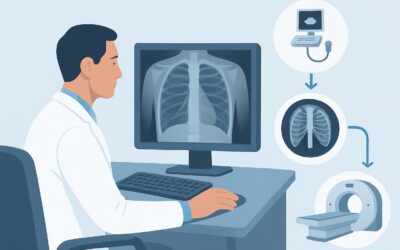
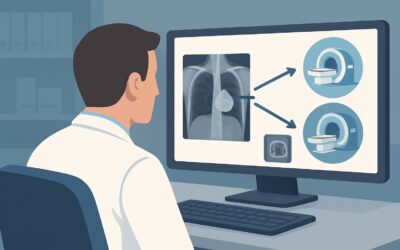
A 48-year-old man with a history of intravenous drug use presents to the emergency department with three days of worsening, focal, and exquisitely tender pain over his left sternoclavicular joint. He has a low-grade fever and his C-reactive protein is significantly elevated. A portable chest radiograph is performed and read as normal, showing no acute cardiopulmonary process, bony destruction, or soft tissue gas. You suspect a localized infectious or inflammatory process like septic arthritis or a chest wall abscess. The next step is to choose the right advanced imaging study to confirm the diagnosis and guide management. This article details the American College of Radiology (ACR) workflow for this specific scenario, where CT chest with IV contrast is rated Usually Appropriate.
Who Fits This Clinical Scenario?
This guidance applies to a specific patient population: those presenting with nontraumatic chest wall pain where there is a strong clinical suspicion for an underlying infectious or inflammatory cause. Key inclusion criteria include:
- Focal or localized chest wall pain without a history of recent trauma.
- Clinical or laboratory signs of infection or inflammation (e.g., fever, erythema, swelling, warmth, elevated ESR or CRP).
- A recent chest radiograph that is normal or non-diagnostic for the cause of the pain.
It is critical to distinguish this presentation from similar, but distinct, clinical scenarios that follow different diagnostic pathways. This workflow is not intended for:
- Patients with a known or suspected malignancy: In this case, the primary concern shifts to metastatic disease or primary chest wall tumors, which may require different imaging protocols or modalities like PET/CT.
- Patients with a history of prior chest intervention: Post-surgical or post-procedural pain involves a different differential, including hematoma, seroma, or surgical site infection, which can alter imaging interpretation.
- Patients with generalized, non-focal chest wall pain and no signs of inflammation: This presentation is more likely musculoskeletal and is covered in the initial imaging variant of the ACR Nontraumatic Chest Wall Pain guidelines.
What Diagnoses Are You Working Up in This Scenario?
After a normal chest radiograph has excluded obvious causes like pneumonia, large effusions, or overt bony lesions, advanced imaging is used to investigate pathology within the chest wall itself. The differential diagnosis in this context is focused and consequential.
Chest Wall Abscess or Cellulitis: This is a primary concern. A localized collection of pus (abscess) or diffuse inflammation of the soft tissues (cellulitis/phlegmon) can cause severe, focal pain. An abscess requires drainage for source control, a decision that hinges entirely on imaging findings. IV contrast is essential to identify the characteristic rim-enhancing fluid collection of an abscess.
Osteomyelitis of the Ribs, Sternum, or Clavicle: Infection of the bone is a serious diagnosis requiring long-term antibiotic therapy and sometimes surgical debridement. Early osteomyelitis may show only subtle cortical erosion or periosteal reaction, which is well-visualized on CT. Plain radiographs are notoriously insensitive in the first one to two weeks of infection.
Septic Arthritis: The sternoclavicular and sternocostal joints are common sites for septic arthritis, particularly in patients with risk factors like IV drug use, diabetes, or immunosuppression. Imaging must clearly delineate the joint space, surrounding soft tissues, and adjacent bone to confirm joint involvement.
Tietze Syndrome: This is an inflammatory, non-suppurative condition causing painful swelling of the costal cartilages, typically at the second or third costochondral junction. While it is a diagnosis of exclusion, imaging can help rule out more serious infectious mimics and may show cartilage enlargement and enhancement.
Why Is CT Chest with IV Contrast the Recommended Study for This Presentation?
The ACR designates CT chest with IV contrast as Usually Appropriate because it provides a comprehensive and rapid evaluation of the bones, soft tissues, and joints of the chest wall, directly addressing the key differential diagnoses.
The primary strength of CT is its superior spatial resolution and ability to characterize tissues. It excels at detecting subtle cortical bone erosion or periosteal reaction indicative of early osteomyelitis, findings that are invisible on a plain radiograph. For soft tissue pathology, the administration of intravenous contrast is critical. It allows for the clear differentiation between a phlegmon (diffuse inflammation) and a well-defined, rim-enhancing fluid collection that defines a drainable abscess. This distinction is fundamental to patient management, separating cases that may be managed with antibiotics alone from those requiring procedural intervention.
While CT chest without IV contrast is also rated Usually Appropriate, it is less effective at characterizing soft tissue collections and cannot reliably distinguish an abscess from phlegmon. Therefore, in most cases where infection is suspected, contrast is strongly preferred.
How do alternative studies compare?
- MRI chest without and with IV contrast is rated May be appropriate. MRI offers superior soft tissue contrast and is highly sensitive for detecting marrow edema in early osteomyelitis. However, it is generally more time-consuming, less widely available, and more susceptible to motion artifact. It is often reserved for complex cases, indeterminate CT findings, or when there is a strong contraindication to iodinated contrast.
- Ultrasound (US) chest is also rated May be appropriate. Ultrasound is excellent for evaluating superficial, palpable abnormalities. It can readily identify a fluid collection and guide needle aspiration. However, its utility is limited for deep structures, the sternum, and the osseous ribs. It is also highly operator-dependent and can be limited by patient body habitus.
The radiation dose for a CT chest (adult RRL ☢☢☢ 1-10 mSv) is a relevant consideration, but the diagnostic yield in clarifying a potentially serious infection generally outweighs the risk. Once you’ve decided on this study, our protocol guide covers the technique, contrast, and reading principles: CT Chest/Abdomen/Pelvis with IV Contrast.
What’s Next After CT Chest with IV Contrast? Downstream Workflow
The results of the CT scan will directly guide your next clinical steps. The workflow typically branches based on whether the findings are positive, negative, or indeterminate.
If the CT is positive for a drainable abscess: This is an actionable finding that requires prompt intervention. The next step is typically a consultation with Interventional Radiology for percutaneous drain placement or with Thoracic or General Surgery for surgical incision and drainage. Concurrently, antibiotic therapy should be tailored based on culture results from the drained fluid.
If the CT is positive for osteomyelitis or septic arthritis: This finding confirms a serious infection requiring long-term (typically 4-6 weeks) intravenous antibiotic therapy. Consultation with Infectious Disease is recommended to guide the antibiotic regimen. A CT-guided or open bone biopsy may be necessary to obtain tissue for culture if blood cultures are negative.
If the CT is negative: A negative high-quality CT scan makes a significant chest wall infection or abscess highly unlikely. The focus should shift back to other causes of chest wall pain, such as musculoskeletal strain, costochondritis (without the swelling of Tietze syndrome), or neuropathic pain. Management would become conservative with analgesics and follow-up. If clinical suspicion remains exceptionally high despite the negative CT, an MRI could be considered to look for subtle marrow edema or soft tissue inflammation not resolved by CT.
If the CT is indeterminate: Findings such as a phlegmon without a drainable fluid collection or subtle periosteal reaction may be indeterminate. In these cases, management often involves initiating empiric antibiotic therapy and considering a short-interval follow-up scan (CT or US) to assess for progression or organization into a drainable abscess.
Pitfalls to Avoid (and When to Get Help)
Navigating this clinical scenario requires careful attention to a few common pitfalls. First, ordering a CT without IV contrast can severely limit the study’s utility; if you suspect an abscess, contrast is almost always necessary unless a strong contraindication exists. Second, be sure to provide a specific clinical history on the imaging requisition—phrases like “chest wall pain, rule out infection” are far more helpful to the radiologist than just “chest pain.” Third, do not overlook the sternoclavicular joints, as they are a frequent but sometimes forgotten site of septic arthritis. Finally, remember that imaging should not delay treatment in a clinically unstable patient. If the patient shows signs of sepsis, initiate fluid resuscitation and broad-spectrum antibiotics immediately, even before the patient goes to the CT scanner.
Related ACR Topics and Tools
This article focuses on one specific variant within the broader topic of Nontraumatic Chest Wall Pain. For a comprehensive overview of all clinical scenarios and their corresponding imaging recommendations, please consult our parent guide. Additional GigHz tools can help you apply these guidelines in your daily practice.
- For breadth across all scenarios in Nontraumatic Chest Wall Pain, see our parent guide: Nontraumatic Chest Wall Pain: ACR Appropriateness Decoded.
- ACR Appropriateness Criteria Lookup — for adjacent scenarios
- Imaging Protocol Library — for technique on the recommended study
- Radiation Dose Calculator — for cumulative dose conversations
Frequently Asked Questions
Why not just order an MRI first if it’s better for soft tissue and bone marrow?
While MRI has excellent sensitivity, CT with contrast is rated ‘Usually Appropriate’ because it is faster, more widely available, and provides sufficient diagnostic information to guide management in the majority of cases. It excels at showing bony destruction and defining abscesses for drainage. MRI is a valuable problem-solving tool, often used when CT findings are indeterminate or if there’s a strong contraindication to CT.
Is a CT without contrast ever sufficient for suspected chest wall infection?
A non-contrast CT is also rated ‘Usually Appropriate’ and is excellent for evaluating bony pathology like osteomyelitis or fractures. However, it cannot reliably distinguish a drainable abscess from a phlegmon (diffuse inflammation). If your primary clinical question is ‘Is there a collection that needs drainage?’, then IV contrast is essential. If the patient has a severe contrast allergy or prohibitive renal dysfunction, a non-contrast CT may be the best first step, followed by MRI or ultrasound if needed.
My patient’s chest X-ray was normal. Why is more imaging necessary?
A chest radiograph is a 2D image that is primarily designed to evaluate the lungs, heart, and major bony structures. It is very insensitive for early bone infections (osteomyelitis) and cannot visualize soft tissue pathology like abscesses or cellulitis. A normal X-ray successfully rules out many common causes of chest pain but does not exclude a serious infection localized to the chest wall itself, which is why cross-sectional imaging like CT is required when clinical suspicion is high.
How does the workup change if the patient is immunocompromised?
In an immunocompromised patient, the clinical threshold to proceed to advanced imaging should be lower. These patients may not mount a robust inflammatory response, leading to subtler clinical signs (e.g., less fever or a lower white blood cell count) despite having a significant infection. The choice of imaging remains the same—CT with IV contrast is still the recommended next step—but the urgency is greater, and the differential should be broader to include opportunistic or atypical infections.
What if the pain is located directly over the sternum?
Sternal osteomyelitis is a primary concern for midline chest wall pain, especially in post-cardiac surgery patients (though this scenario is nontraumatic) or those with risk factors like IV drug use. CT with IV contrast is the ideal study to evaluate the sternum for cortical erosion, intramedullary changes, and any associated pre-sternal or retrosternal abscesses or mediastinitis.
Reviewed by Pouyan Golshani, MD, Interventional Radiologist — May 29, 2026