What Is the Best Initial Imaging for a Suspected Pathologic Rib Fracture?
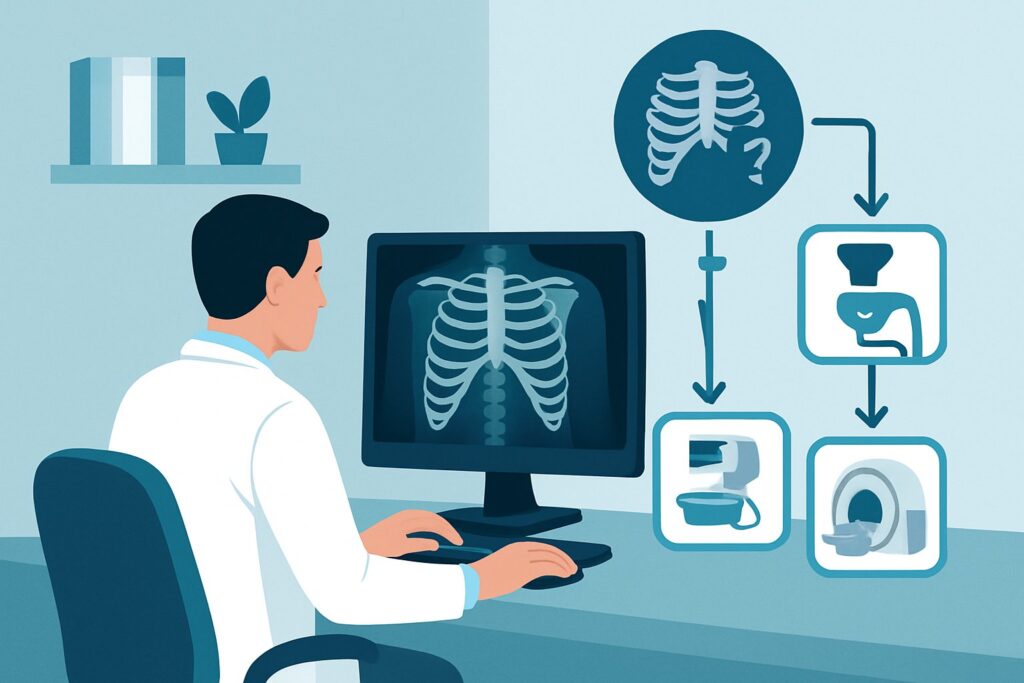
A 72-year-old man with a history of prostate cancer presents to your clinic with three weeks of worsening, localized left-sided chest wall pain. He denies any recent falls or significant trauma but notes the pain is sharpest when he coughs or takes a deep breath. On exam, he has exquisite point tenderness over the eighth lateral rib. You are concerned about a pathologic fracture, but what is the most appropriate first step to confirm your suspicion and guide management? This scenario requires a deliberate imaging choice to balance diagnostic yield with radiation exposure. According to the American College of Radiology (ACR) Appropriateness Criteria, a standard chest radiograph is Usually Appropriate as the initial imaging study.
## Who Fits the ‘Suspected Pathologic Rib Fracture’ Scenario?
This clinical workflow is designed for patients where the suspicion for a rib fracture is high, but the underlying cause is thought to be a pathologic process rather than simple trauma. The key is a mismatch between the clinical presentation and the reported mechanism of injury.
Inclusion criteria for this scenario include:
- Focal rib pain with minimal or no history of trauma (e.g., pain after coughing, sneezing, or turning over in bed).
- Pain that is disproportionately severe for a minor reported injury.
- Known history of malignancy, particularly those with a propensity for bone metastases (e.g., breast, lung, prostate, renal, thyroid cancer).
- Clinical suspicion for multiple myeloma (e.g., associated anemia, renal insufficiency, or hypercalcemia).
- Presence of constitutional symptoms like unexplained weight loss, night sweats, or fevers alongside focal bone pain.
- Known metabolic bone disease, such as severe osteoporosis or Paget’s disease, where an insufficiency fracture is suspected.
This guidance does not apply to patients who:
- Have sustained significant, direct blunt trauma to the chest (e.g., from a motor vehicle collision or a fall from height). This presentation is covered in the ACR variant for suspected rib fractures from minor blunt trauma.
- Developed chest pain immediately following cardiopulmonary resuscitation (CPR). This is a distinct clinical context with its own ACR recommendations.
- Present with diffuse, non-focal chest pain without a specific point of tenderness, which would broaden the differential beyond a focal rib lesion.
## What Diagnoses Are You Working Up with a Suspected Pathologic Fracture?
The initial imaging choice is driven by a specific differential diagnosis focused on underlying bone pathology. The goal is not just to identify a fracture but to uncover its cause.
Metastatic Disease
This is the most common and critical diagnosis to consider in adults with a suspected pathologic fracture. Primary malignancies from the breast, lung, prostate, kidney, and thyroid frequently metastasize to bone. These lesions can be lytic (bone-destroying), blastic (bone-forming), or mixed. The ribs are a common site for osseous metastases, and a pathologic fracture may be the first sign of disseminated disease.
Multiple Myeloma
This hematologic malignancy is a primary cancer of plasma cells that characteristically affects the bone marrow. It classically produces well-defined, “punched-out” lytic lesions that weaken the bone structure, making ribs highly susceptible to fracture with minimal stress. In an older adult with bone pain and associated lab abnormalities, myeloma should be high on the differential.
Primary Bone Tumor
While less common than metastases, a primary bone tumor can arise in a rib. This category includes malignant tumors like chondrosarcoma or Ewing sarcoma (more common in younger patients) and benign but locally destructive lesions like fibrous dysplasia. These often present as an expansile mass or a focal area of bone destruction.
Severe Osteoporosis or Metabolic Bone Disease
In patients with profoundly low bone mineral density, an insufficiency fracture can occur. This is a type of stress fracture resulting from normal physiologic stress on weakened bone. While not a malignancy, it falls under the “pathologic” umbrella because the bone itself is abnormal. It’s a crucial consideration, especially in elderly patients or those on long-term steroid therapy.
## Why Is a Chest Radiograph the Recommended Initial Study?
For a suspected pathologic rib fracture, the ACR panel designates a standard Radiography chest as Usually Appropriate. This recommendation is based on an optimal balance of diagnostic utility, accessibility, and safety for an initial evaluation.
The primary strength of a chest radiograph is its role as a high-value screening tool. It is widely available, rapidly performed, and inexpensive. It can often directly visualize a displaced fracture, a large lytic or blastic lesion, or a significant associated soft tissue mass. Furthermore, a chest radiograph provides crucial context by imaging the entire thorax. This allows for the simultaneous evaluation of the lungs for a primary mass, the pleura for an effusion, and the mediastinum for adenopathy, any of which could be related to the underlying pathology.
While its sensitivity for subtle, non-displaced fractures or very small lytic lesions is lower than cross-sectional imaging, its specificity for a destructive bone process, when visible, is high and sufficient to guide the next steps in the workup.
Comparing Alternatives for Initial Imaging:
- Radiography rib views are rated as May be appropriate. While these focused views can sometimes better delineate a fracture line, they deliver a substantially higher radiation dose (adult RRL ☢☢☢ 1-10 mSv) compared to a standard chest radiograph (adult RRL ☢ <0.1 mSv). For the initial question of a pathologic process, the broad overview of the chest radiograph is generally more valuable than the focal detail of rib views, making the extra radiation difficult to justify upfront.
- CT chest without IV contrast is also rated Usually Appropriate, but it is not typically the first-line study. It is far more sensitive for detecting subtle fractures and characterizing bone lesions. However, it involves a significantly higher radiation dose and cost. It is best reserved as a problem-solving tool if the initial radiograph is negative or equivocal in a patient with high clinical suspicion.
- CT chest with IV contrast is rated Usually not appropriate for the initial evaluation of a suspected bone lesion. Intravenous contrast does not improve the visualization of the bone itself and adds unnecessary risks (e.g., contrast reaction, nephrotoxicity) and cost.
The logical first step is to start with the low-dose, high-utility chest radiograph. It can often provide the diagnosis or, if negative, confirm the need for more advanced, higher-dose imaging.
## What’s Next After Radiography chest? Downstream Workflow
The results of the initial chest radiograph will dictate the subsequent clinical and imaging pathway.
If the radiograph is positive for a fracture with a clear underlying lesion:
The next step is to characterize the lesion and stage the disease. This almost always involves further imaging. A CT chest without IV contrast is excellent for defining the extent of bone destruction. Depending on the suspected primary malignancy, a whole-body Bone scan or an FDG-PET/CT may be ordered for staging to identify other sites of osseous or systemic disease. An orthopedic or oncology consultation is warranted for biopsy and treatment planning.
If the radiograph is negative or equivocal, but clinical suspicion remains high:
A negative radiograph does not rule out a pathologic fracture. The next step is typically more sensitive imaging. A CT chest without IV contrast is an excellent choice to look for occult fractures or subtle lytic lesions missed on the plain film. Alternatively, a whole-body bone scan is highly sensitive for detecting areas of abnormal bone turnover, which can highlight metastases or fractures before they are visible on a radiograph. The choice between these depends on the specific clinical question and suspected diagnosis.
If the radiograph shows a fracture but no clear underlying lesion:
This finding can be ambiguous. It could represent an insufficiency fracture from severe osteoporosis or a subtle lytic lesion that is not well-visualized. In this case, further investigation is needed. A CT scan can help characterize the fracture edges and surrounding bone for subtle signs of pathology. If multiple myeloma is a concern, serum protein electrophoresis and urine studies should be ordered. For suspected osteoporosis, a bone density scan (DXA) would be the appropriate next step.
## Pitfalls to Avoid (and When to Get Help)
- Stopping the workup after a negative radiograph: In a patient with high-risk features (e.g., known cancer, constitutional symptoms) and persistent, focal pain, a negative chest X-ray is not sufficient to rule out a pathologic process.
- Ordering dedicated rib views initially: This adds significant radiation dose for minimal diagnostic benefit over a standard chest radiograph in the context of a suspected pathologic, rather than traumatic, fracture.
- Attributing the fracture to trauma without considering the context: In an elderly patient or one with a cancer history, even a minor fall can cause a pathologic fracture. Do not dismiss the possibility of underlying disease just because a minor traumatic event is reported.
- Forgetting systemic workup: The rib lesion is often a sign of a systemic disease. Once a pathologic fracture is confirmed, the workup must include identifying the primary source or staging the known disease.
If a destructive bone lesion is identified or highly suspected, immediate escalation to an oncology or orthopedic specialist is crucial for biopsy, diagnosis, and management to prevent further skeletal-related events.
## Related ACR Topics and Tools
This article covers one specific scenario within the broader topic of rib fractures. For a comprehensive overview of all related presentations, from minor trauma to post-CPR imaging, please consult our parent guide. The tools below can assist in navigating adjacent scenarios and discussing imaging decisions with patients.
- For breadth across all scenarios in Rib Fractures, see our parent guide: Rib Fractures: ACR Appropriateness Decoded.
- To explore other clinical scenarios, use the Imaging Appropriateness Selector.
- For details on imaging techniques, see the Imaging Protocol Library.
- To help with patient conversations about radiation, use the Radiation Dose Calculator.
Frequently Asked Questions
Why is a chest radiograph preferred over a more sensitive CT scan as the very first step?
A chest radiograph is the recommended initial step due to its excellent balance of being a low-radiation, low-cost, and widely available screening tool. It can often confirm the diagnosis or identify related thoracic pathology (like a lung mass). A CT scan, while more sensitive, involves a significantly higher radiation dose and is best used as a second-line, problem-solving study if the radiograph is negative or inconclusive in a high-risk patient.
If the chest radiograph is negative, what is the best next imaging study?
If clinical suspicion for a pathologic fracture remains high despite a negative radiograph, the next step is a more sensitive test. Both a CT chest without IV contrast and a whole-body bone scan are rated as ‘Usually Appropriate’. A CT is superior for anatomic detail of the bone, while a bone scan is highly sensitive for metabolic activity and provides a full skeletal survey. The choice often depends on the suspected underlying cause (e.g., CT for myeloma, bone scan for suspected prostate cancer metastases).
Is there any role for ultrasound in this scenario?
No. According to the ACR, ultrasound of the chest is ‘Usually not appropriate’ for evaluating a suspected pathologic rib fracture. While ultrasound can sometimes identify rib fractures, it cannot assess the underlying bone quality or visualize lytic/blastic lesions, which is the primary clinical question in this scenario. It also cannot evaluate the lung parenchyma for a primary tumor.
What if the patient has a history of breast cancer and new focal rib pain?
This patient perfectly fits the ‘suspected pathologic rib fracture’ scenario. A standard two-view chest radiograph is the correct initial imaging test. Given the high pre-test probability of a metastatic lesion, you should have a low threshold to proceed to CT or a bone scan if the radiograph is negative or equivocal.
Does this guidance apply to children?
While the ACR provides pediatric radiation dose estimates, a suspected pathologic rib fracture in a child is a very different clinical scenario than in an adult. The differential diagnosis shifts towards primary bone tumors (like Ewing sarcoma), infection, or non-accidental trauma. While a chest radiograph is still a reasonable first step, this presentation requires urgent pediatric specialist consultation, and the imaging workup should be guided by their recommendations.
Reviewed by Pouyan Golshani, MD, Interventional Radiologist — May 26, 2026