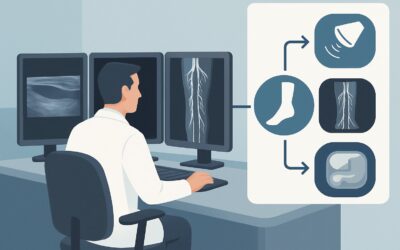
What Is the Best Initial Imaging for Lower Extremity Arterial Claudication Assessment?

A 68-year-old male with a history of smoking and type 2 diabetes presents to your vascular clinic. He reports progressive, cramping pain in his left calf that reliably begins after walking two blocks and is relieved within minutes of stopping. His physical exam is notable for non-palpable dorsalis pedis and posterior tibial pulses on the left, and his ankle-brachial index (ABI) is 0.7. You suspect peripheral arterial disease (PAD) and are considering revascularization options. What is the most appropriate initial imaging study to map his arterial anatomy and guide treatment?
This article provides a detailed workflow for this specific clinical scenario, based on the American College of Radiology (ACR) Appropriateness Criteria. For the initial imaging assessment of lower extremity arterial claudication in a patient being considered for revascularization, a US duplex Doppler lower extremity is rated Usually Appropriate.
Who Fits This Clinical Scenario?
This guidance applies to patients presenting with classic symptoms of intermittent claudication who are being evaluated for potential revascularization. The key inclusion criteria are:
- History of exertional limb pain (aching, cramping, tiredness) that is relieved by rest.
- Objective evidence of peripheral arterial disease, such as an abnormal ankle-brachial index (ABI) typically less than 0.9, or diminished or absent peripheral pulses.
- The patient’s symptoms are significant enough to warrant consideration for intervention (either endovascular or surgical) to improve blood flow.
- This is the initial imaging workup intended to define the location and severity of arterial stenosis or occlusion.
It is critical to distinguish this presentation from clinically similar but distinct scenarios that require a different diagnostic pathway. This workflow does not apply to:
- Acute Limb Ischemia: A patient presenting with the “6 Ps” (pain, pallor, pulselessness, poikilothermia, paresthesia, paralysis) has a vascular emergency. This requires immediate evaluation, often with emergent Computed Tomography Angiography (CTA) or catheter angiography, not a scheduled outpatient ultrasound.
- Neurogenic Claudication: If the patient’s pain is more positional (e.g., worse with standing, relieved by leaning forward or sitting), this suggests lumbar spinal stenosis. The appropriate workup would involve imaging of the lumbar spine, typically with MRI.
- Venous Claudication: This presents as a “bursting” or heavy sensation with associated limb swelling, often worsening throughout the day. This points toward significant venous obstruction, and the imaging workup would focus on the venous system.
What Diagnoses Are You Working Up in This Scenario?
When ordering initial imaging for arterial claudication, the primary goal is to identify and characterize the anatomic basis for the patient’s symptoms. The differential diagnosis includes several possibilities, though one is overwhelmingly common.
Atherosclerotic Peripheral Arterial Disease (PAD) is by far the most common cause. This systemic disease involves the buildup of atherosclerotic plaque within the arterial walls, leading to stenosis (narrowing) or complete occlusion. The imaging study aims to pinpoint the level of disease—be it in the aortoiliac, femoropopliteal, or infrapopliteal segments—and to measure the hemodynamic significance of each lesion.
Thromboangiitis Obliterans (Buerger’s Disease) is a less common but important consideration, particularly in younger patients (under 45) with a heavy smoking history. This is a non-atherosclerotic, inflammatory vasculopathy affecting small and medium-sized arteries and veins in the distal extremities. Imaging may show segmental occlusions with intervening normal vessels and characteristic “corkscrew” collaterals.
Popliteal Artery Entrapment Syndrome is a rare cause of claudication, typically seen in young, athletic individuals. An anomalous relationship between the popliteal artery and surrounding musculotendinous structures causes dynamic arterial compression during exercise. Imaging, particularly with provocative maneuvers (plantarflexion/dorsiflexion), is key to diagnosis.
External Iliac Artery Endofibrosis is another uncommon condition affecting high-performance athletes, especially cyclists. Repetitive hip flexion is thought to cause fibrosis and narrowing of the external iliac artery. The diagnosis can be challenging and often requires a high index of suspicion in the right clinical context.
Why Is US Duplex Doppler the Recommended Initial Study for This Presentation?
The ACR rates US duplex Doppler lower extremity as Usually Appropriate for the initial imaging of arterial claudication because it provides a superb balance of diagnostic accuracy, safety, and accessibility. It directly visualizes the arterial anatomy (B-mode imaging) while simultaneously providing detailed hemodynamic information (Doppler spectral analysis and color flow). This combination allows the sonographer and interpreting physician to identify stenoses, measure peak systolic velocities to grade their severity, and map the extent of disease from the common femoral artery down to the tibial vessels.
The primary advantages of ultrasound in this scenario are:
- No Ionizing Radiation: The procedure is entirely radiation-free (adult_rrl=O, 0 mSv), a significant benefit for all patients, especially those who may require serial imaging over time.
- No Nephrotoxic Contrast: Many patients with PAD have concurrent renal insufficiency or diabetes, making them high-risk for contrast-induced nephropathy. Ultrasound avoids this risk entirely.
- High Diagnostic Accuracy: In experienced hands, duplex ultrasound has high sensitivity and specificity for detecting hemodynamically significant stenoses (>50%) in the femoropopliteal segment, which is the most common location for symptomatic disease.
While other advanced imaging modalities are also rated Usually Appropriate, they are typically reserved for preoperative planning after an initial ultrasound or for cases where ultrasound is inconclusive. For example:
- CTA abdomen and pelvis with bilateral lower extremity runoff with IV contrast provides a comprehensive, high-resolution map of the entire arterial tree. However, it involves a significant radiation dose (adult_rrl=☢☢☢☢, 10-30 mSv) and requires iodinated contrast, making it less ideal as a first-line screening tool.
- MRA abdomen and pelvis with bilateral lower extremity runoff with IV contrast offers a similar global view without radiation (adult_rrl=O, 0 mSv). However, it is more expensive, less widely available, and requires gadolinium-based contrast, which carries a risk of nephrogenic systemic fibrosis in patients with severe renal dysfunction.
Therefore, duplex ultrasound serves as the ideal initial test to confirm the diagnosis, localize the disease, and determine if the patient is a candidate for intervention. If the results are clear and align with the clinical picture, they may be sufficient to proceed directly to treatment. Once you’ve decided on this study, our protocol guide covers the essential technical details. For technique, contrast considerations, and reading principles, see our detailed guide: US Lower Extremity Doppler (DVT).
What’s Next After US Duplex Doppler? Downstream Workflow
The results of the lower extremity arterial duplex ultrasound will guide the subsequent clinical management and potential need for further imaging. The workflow typically branches based on the findings.
If the study is positive and clearly defines the disease: If the ultrasound identifies a discrete, hemodynamically significant stenosis or short occlusion (e.g., in the superficial femoral artery) that correlates with the patient’s symptoms, this information may be sufficient for an interventionalist to plan a procedure. For straightforward endovascular interventions like angioplasty or stenting, many operators will proceed directly to the angiography suite based on high-quality ultrasound findings, using catheter-based arteriography for real-time guidance.
If the study is negative or does not explain the symptoms: A normal arterial duplex ultrasound in a patient with classic claudication symptoms is uncommon but prompts a re-evaluation of the diagnosis. The next step is to reconsider non-atherosclerotic causes, such as neurogenic claudication (prompting a workup of the lumbar spine) or popliteal entrapment (which may require specialized ultrasound with provocative maneuvers or CTA/MRA).
If the study is indeterminate or suggests complex disease: Ultrasound may be limited by factors like severe vessel calcification, obesity, or significant edema. If the study is technically limited or reveals extensive, multi-level disease that requires more detailed anatomic mapping for complex surgical or endovascular planning (e.g., a bypass graft), a second-line imaging study is warranted. In this case, either CTA or MRA of the abdomen, pelvis, and lower extremity runoff would be the next logical step to provide the detailed “road map” needed for procedural planning.
Pitfalls to Avoid (and When to Get Help)
Several common pitfalls can complicate the initial workup of arterial claudication. First, be wary of attributing all leg pain to PAD, even with a low ABI; always consider neurogenic and musculoskeletal causes. Second, remember that the ABI can be falsely normal or elevated in patients with heavily calcified, non-compressible arteries (often seen in diabetes or end-stage renal disease); in these cases, a toe-brachial index (TBI) is more reliable. Third, failing to specify the clinical question on the imaging requisition can lead to a generic study. Clearly state “rule out hemodynamically significant stenosis for claudication” to ensure the sonographer performs the correct protocol.
If a patient’s symptoms rapidly progress from claudication to rest pain or they develop signs of tissue loss (ulceration, gangrene), this represents a transition to chronic limb-threatening ischemia. This situation requires urgent escalation to a vascular specialist for expedited workup and intervention.
Related ACR Topics and Tools
For a comprehensive understanding of imaging for lower extremity arterial disease and related clinical scenarios, the following resources are valuable. They provide tools to explore adjacent criteria, understand imaging techniques, and discuss radiation safety with patients.
- For breadth across all scenarios in Lower Extremity Arterial Claudication-Imaging Assessment for Revascularization, see our parent guide: Lower Extremity Arterial Claudication-Imaging Assessment for Revascularization: ACR Appropriateness Decoded.
- Imaging Appropriateness Selector — for adjacent scenarios
- Imaging Protocol Library — for technique on the recommended study
- Radiation Dose Calculator — for cumulative dose conversations
Frequently Asked Questions
Why not order a CTA or MRA as the very first test for claudication?
While CTA and MRA provide excellent anatomic detail, US duplex Doppler is recommended as the initial test because it is non-invasive, uses no radiation, requires no potentially nephrotoxic contrast, and is highly accurate for localizing the most common sites of disease. It effectively triages patients, and CTA/MRA can be reserved for cases where ultrasound is inconclusive or when complex surgical planning is required.
What if the patient’s ankle-brachial index (ABI) is normal (>0.9) but they have classic exertional leg pain?
A normal resting ABI does not entirely exclude PAD. In such cases, an exercise ABI (measuring pressures before and after treadmill walking) can unmask disease by demonstrating a significant post-exercise pressure drop. If suspicion remains high, imaging may still be warranted, but the pre-test probability of finding a significant lesion is lower.
Does the US duplex Doppler exam cover the arteries in the abdomen and pelvis?
A standard lower extremity arterial duplex exam typically begins at the common femoral artery in the groin and extends down to the ankle. It does not routinely visualize the aortoiliac segment. If there is clinical suspicion for inflow disease (e.g., diminished femoral pulses, symptoms in the buttock or thigh), you should specifically request evaluation of the aortoiliac segment or consider proceeding to CTA or MRA, which cover this region comprehensively.
Can US duplex Doppler be used for follow-up after a revascularization procedure?
Yes, duplex ultrasound is the primary modality for surveillance after endovascular intervention (like stenting) or surgical bypass. It is used to monitor the patency of the stent or graft and to detect early signs of restenosis or other complications, allowing for timely re-intervention if needed.
Is there a role for non-contrast MRA in this scenario?
Non-contrast MRA is rated as ‘May be appropriate’ by the ACR. It can be a valuable option for patients with severe contrast allergies or advanced renal failure who cannot receive gadolinium. However, the image quality can be more variable than contrast-enhanced MRA, and it may be less reliable for visualizing smaller, distal vessels. It is generally considered a problem-solving tool rather than a first-line test.
Reviewed by Pouyan Golshani, MD, Interventional Radiologist — May 26, 2026