What Is the Best Initial Imaging for Massive, Life-Threatening Hemoptysis?
It’s 3 AM in the emergency department, and your patient is coughing up large volumes of bright red blood, struggling to maintain their airway. This is massive, life-threatening hemoptysis, a true medical emergency requiring rapid, coordinated action. As the team works to stabilize the patient, you must make a critical decision: what is the first imaging study to order? This article provides a focused, deep-dive workflow for this specific clinical scenario, guiding you through the American College of Radiology (ACR) Appropriateness Criteria for initial imaging in massive hemoptysis. For this presentation, the ACR rates a Radiography chest as Usually Appropriate.
Who Fits the Scenario of Massive, Life-Threatening Hemoptysis?
This guidance applies to patients presenting with hemoptysis of a volume or rate that poses an immediate threat to life, primarily through airway obstruction or hemodynamic collapse. While definitions vary, massive hemoptysis is often quantified as expectorated blood exceeding 100 mL per hour or 500 mL over a 24-hour period. However, the clinical definition is more practical: any amount of bleeding that causes hemodynamic instability, impairs gas exchange, or requires airway intervention qualifies as massive. The patient is acutely ill, and the primary goals are to secure the airway, stabilize circulation, and urgently identify the bleeding source for intervention.
This workflow is distinct from that for other, less acute presentations. It is crucial not to apply this guidance to:
- Nonmassive (non–life-threatening) hemoptysis: Patients with smaller volumes of bleeding who are hemodynamically stable and have no airway compromise. Their workup is less urgent and may follow a different diagnostic algorithm.
- Recurrent or chronic hemoptysis: Patients with repeated, small-volume bleeding episodes over weeks or months. Their evaluation is typically performed in an outpatient setting and focuses on identifying an underlying chronic condition.
The acuity and life-threatening nature of massive hemoptysis dictate a unique and accelerated diagnostic and therapeutic pathway.
What Diagnoses Are You Working Up with Massive Hemoptysis?
In the setting of massive hemoptysis, the imaging and subsequent interventions are aimed at identifying and controlling a source of bleeding from the pulmonary or bronchial circulation. The differential diagnosis is broad, but a few key etiologies account for the majority of cases.
One of the most common causes is bronchiectasis, particularly in patients with underlying conditions like cystic fibrosis or prior severe infections. Chronic inflammation leads to airway damage and the hypertrophy of bronchial arteries, which are systemic vessels under high pressure. These fragile, enlarged arteries are prone to rupture, causing brisk and significant bleeding.
Lung cancer, whether primary or metastatic, is another critical consideration. Tumors can directly invade and erode into pulmonary or bronchial vessels. An endobronchial lesion may be the culprit, or a large cavitating mass could be the source. The bleeding can be the initial presentation of a previously undiagnosed malignancy.
Infectious etiologies, especially tuberculosis (TB), remain a major cause worldwide. Bleeding can occur from active infection, a Rasmussen’s aneurysm (a pseudoaneurysm of a pulmonary artery branch adjacent to a tuberculous cavity), or a secondary fungal colonization of a cavity, such as an aspergilloma.
Less common but important causes include pulmonary arteriovenous malformations (AVMs), which are direct connections between arteries and veins that bypass the capillary bed. These can rupture and cause severe hemorrhage. Finally, diffuse alveolar hemorrhage (DAH), often resulting from systemic vasculitis or coagulopathy, can present as massive hemoptysis, typically with diffuse opacities on imaging rather than a focal source.
Why Is a Chest Radiograph the Initial Recommended Study for Massive Hemoptysis?
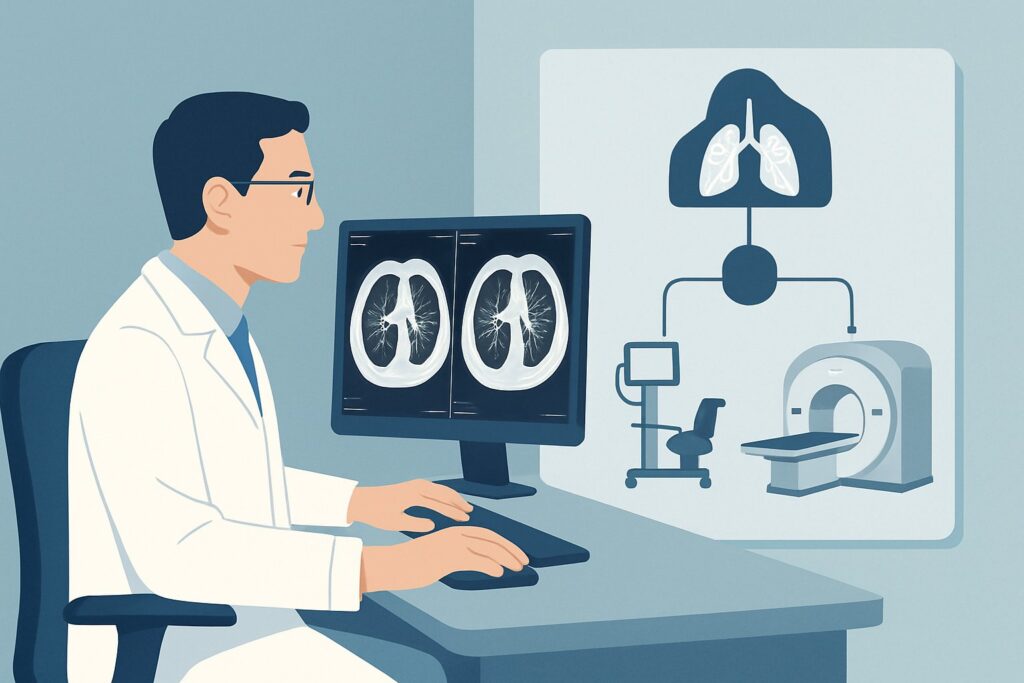
In a high-stakes scenario like massive hemoptysis, the initial imaging choice must balance diagnostic yield with speed, availability, and patient safety. The ACR designates a portable Radiography chest as Usually Appropriate because it excels as a rapid, first-line triage tool. Its primary role is not definitive diagnosis but localization. A chest radiograph can often identify the affected lung or even the specific lobe by showing a focal opacity, a mass, a cavity, or an area of atelectasis. This information is invaluable for guiding subsequent, more advanced interventions like bronchoscopy or angiography.
Performed at the bedside, a portable chest X-ray minimizes patient transport, a critical consideration for an unstable individual. It delivers a very low radiation dose (☢ <0.1 mSv) and provides immediate information to the entire clinical team. While its sensitivity is limited—a normal chest radiograph does not exclude a life-threatening bleed, especially in cases of bronchiectasis—its value lies in its ability to quickly narrow the search area. It's important to understand why other, more detailed studies are not the initial choice:
- CT chest without and with IV contrast: The ACR rates this biphasic study as Usually not appropriate. The initial non-contrast phase adds radiation and time without providing significant additional information relevant to the acute vascular emergency. A single, well-timed contrast-enhanced phase is sufficient.
- CT chest without IV contrast: This is rated May be appropriate but is a suboptimal choice. While it can reveal parenchymal abnormalities like cavities or masses, it completely fails to delineate the vascular anatomy—the hypertrophied bronchial arteries or other aberrant vessels—which is the primary target for interventional treatment.
While CTA chest with IV contrast and Arteriography bronchial with embolization are also rated Usually Appropriate, they represent the next steps in the workflow, not the first. The chest radiograph is the foundational test that informs these subsequent, more invasive procedures.
What’s the Downstream Workflow After the Initial Chest Radiograph?
The result of the initial chest radiograph dictates the immediate next steps in a rapidly evolving clinical pathway. The goal is to move swiftly from localization to definitive intervention.
- If the chest radiograph is positive and localizes the bleeding: When the X-ray clearly shows a unilateral process—such as a mass, cavity, or focal consolidation—the team can proceed with a focused plan. The next step is typically a CTA chest with IV contrast. This study provides a detailed vascular map, identifying the hypertrophied bronchial arteries and any non-bronchial systemic collateral vessels that may be contributing to the bleed. This map is the essential guide for the interventional radiologist, who will then perform bronchial artery embolization (BAE) to stop the hemorrhage. In some centers, flexible or rigid bronchoscopy may also be used for airway clearance and to confirm the bleeding site.
- If the chest radiograph is negative or non-localizing: A normal or nonspecific chest radiograph is a common finding, particularly in patients with bronchiectasis where the underlying architectural changes may be subtle. In this situation, a negative finding does not provide reassurance. The patient is still actively bleeding, and the next step remains CTA chest with IV contrast. The CTA becomes the primary localization tool, searching for signs of active extravasation or identifying the abnormal vessels responsible for the bleeding.
- If the radiograph shows diffuse bilateral opacities: This pattern suggests diffuse alveolar hemorrhage (DAH). The workflow shifts away from a focal intervention like BAE. The next crucial step is bronchoscopy with sequential bronchoalveolar lavage (BAL) to confirm the diagnosis. The clinical focus then turns to identifying and treating the underlying systemic cause, such as vasculitis, an autoimmune disorder, or a coagulopathy.
In all pathways, close collaboration with interventional radiology, pulmonology, and potentially thoracic surgery is paramount.
Common Pitfalls to Avoid in Massive Hemoptysis Imaging
In this high-pressure clinical scenario, several common errors can compromise patient outcomes. Awareness of these pitfalls is key to navigating the workup effectively.
- Delaying Imaging for Stabilization: While securing the airway is the absolute first priority (ABCs), imaging should not be significantly delayed. A portable chest radiograph can be performed concurrently with resuscitation efforts. Delaying localization of the bleed can postpone life-saving interventions like embolization.
- Over-reliance on a Negative Chest Radiograph: A normal chest X-ray does not rule out a life-threatening source of hemoptysis. The bleeding source, such as abnormal bronchial arteries in bronchiectasis, is often invisible on plain radiography. A negative result should immediately trigger the next step (CTA) in an unstable patient.
- Ordering a Non-Contrast CT: In the workup of massive hemoptysis, a CT scan without intravenous contrast provides very limited actionable information. It fails to visualize the vascular anatomy, which is the entire point of the study in this context. Always order a CTA or a CT with IV contrast.
- Forgetting the Airway: The most immediate threat is asphyxiation. Before, during, and after imaging, the patient’s airway and respiratory status must be continuously monitored and managed. If there is any doubt, intubation for airway protection should be performed early.
If the patient remains hemodynamically unstable despite resuscitation or if bleeding cannot be controlled via embolization, immediate escalation to thoracic surgery for potential emergent resection is required.
Related ACR Topics and Tools
For a comprehensive overview of imaging for all hemoptysis scenarios and for additional decision-support resources, the following GigHz tools are available.
- For breadth across all scenarios in Hemoptysis, see our parent guide: Hemoptysis: ACR Appropriateness Decoded.
- To explore adjacent clinical presentations, consult the ACR Appropriateness Criteria Lookup.
- For detailed procedural techniques, see the Imaging Protocol Library.
- To discuss cumulative radiation exposure with patients, use the Radiation Dose Calculator.
Frequently Asked Questions
Why not go straight to CTA for massive hemoptysis instead of starting with a chest X-ray?
While CTA is the definitive non-invasive imaging study, a portable chest X-ray is faster, can be done at the bedside without moving an unstable patient, and uses significantly less radiation. It serves as an immediate triage tool to localize the bleeding side, which can guide intubation (if single-lung ventilation is needed) and focus the subsequent CTA and interventional procedure. In a true emergency, this speed and logistical simplicity are critical.
What is the role of bronchoscopy in the initial management of massive hemoptysis?
Bronchoscopy plays a crucial, often parallel, role to imaging. Its primary functions are therapeutic (airway clearance, balloon tamponade of a bleeding segment) and diagnostic (visualizing an endobronchial lesion and confirming the bleeding site). The decision to perform bronchoscopy before or after CTA depends on institutional resources and the patient’s stability. Often, both are performed in rapid succession.
If the CTA identifies the bleeding vessel, is bronchial artery embolization (BAE) always successful?
Bronchial artery embolization has a high technical success rate, with immediate control of bleeding achieved in the vast majority of cases. However, re-bleeding can occur, often due to recanalization of embolized vessels or the development of new collateral supply from non-bronchial systemic arteries. For this reason, a thorough initial angiogram is essential to identify all contributing vessels.
Can a patient have massive hemoptysis with a completely normal chest X-ray and CTA?
This is rare but possible. In such cases, the bleeding may be from a small source that is below the resolution of CTA or the bleeding may have temporarily stopped at the time of the scan. Other possibilities include a source in the upper airways or nasopharynx (pseudohemoptysis) or a bleeding diathesis without a clear anatomical source. Further investigation with bronchoscopy is essential in this scenario.
What are non-bronchial systemic arteries, and why are they important in massive hemoptysis?
These are arteries other than the bronchial arteries that arise from the systemic circulation (e.g., from intercostal, internal mammary, or subclavian arteries) and develop as collateral supply to diseased lung tissue. They are a common cause of both initial massive hemoptysis and re-bleeding after BAE. A high-quality CTA and a thorough diagnostic arteriogram are crucial for identifying and treating these vessels.
Reviewed by Pouyan Golshani, MD, Interventional Radiologist — May 29, 2026