What Is the Best Initial Imaging for Suspected Appendicitis in a Pregnant Patient?
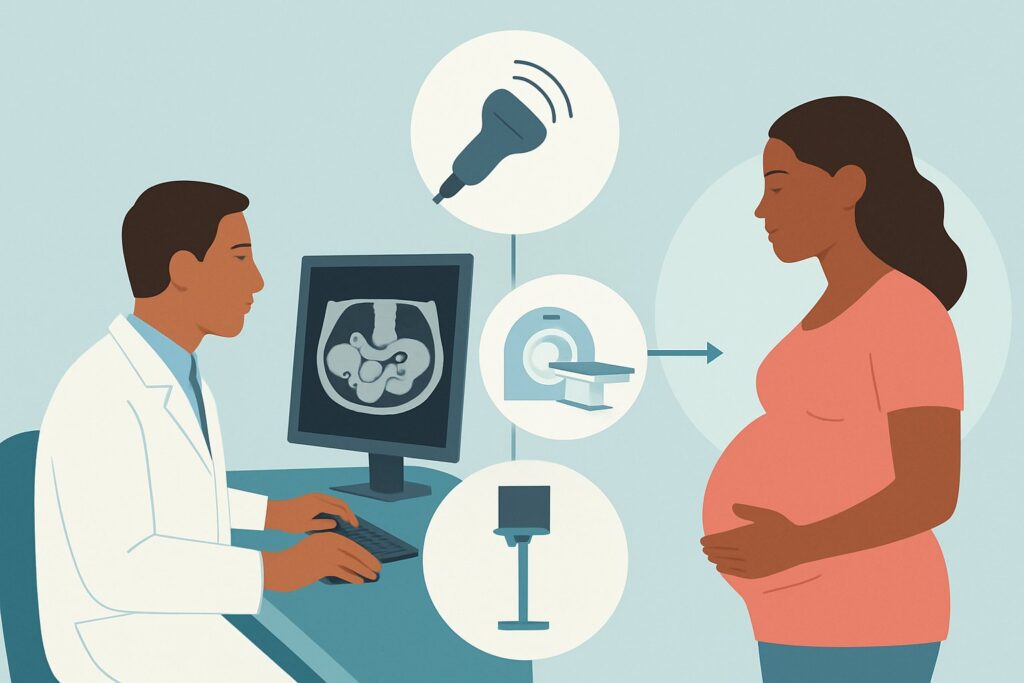
A 28-year-old woman, 22 weeks pregnant, presents to the emergency department at 2 a.m. with sharp, migrating right lower quadrant pain, a low-grade fever, and an elevated white blood cell count. The clinical picture strongly suggests acute appendicitis, a diagnosis that carries significant risk for both mother and fetus if delayed. The immediate question for the managing physician is which imaging study to order first—a decision that must balance diagnostic accuracy with the absolute priority of fetal safety. This article provides a detailed clinical workflow for this specific scenario, guided by the American College of Radiology (ACR) Appropriateness Criteria, which rate US abdomen as Usually appropriate for this initial workup.
Who Fits This Clinical Scenario?
This guidance is specifically for a pregnant patient presenting with a constellation of symptoms highly suspicious for acute appendicitis: right lower quadrant (RLQ) pain, fever, and leukocytosis. The key inclusion criteria are confirmed pregnancy and a clinical presentation that places appendicitis at or near the top of the differential diagnosis. The workflow detailed here is for the initial imaging study selection.
This article does not apply to several similar-appearing but distinct clinical situations:
- Non-pregnant patients: A non-pregnant adult with the same symptoms follows a different diagnostic algorithm, where CT imaging is more frequently the initial study of choice.
- Pregnant patients with RLQ pain but no systemic signs: A pregnant patient with isolated pain, without fever or leukocytosis, may have a broader differential where other causes (e.g., round ligament pain, Braxton-Hicks contractions) are more likely, potentially altering the urgency and choice of imaging.
- Known alternative diagnosis: If a patient has a known history of Crohn’s disease, ovarian cysts, or nephrolithiasis that could explain the symptoms, the imaging strategy may be tailored differently from the outset.
Correctly identifying the patient who fits this specific scenario is crucial for applying the appropriate, radiation-sparing diagnostic pathway.
What Diagnoses Are You Working Up in This Scenario?
While acute appendicitis is the primary concern, the gravid state introduces a unique and critical differential diagnosis. The goal of imaging is not only to confirm or exclude appendicitis but also to evaluate for other urgent maternal and fetal conditions.
Acute Appendicitis
This is the most common non-obstetric surgical emergency in pregnancy. The enlarging uterus can displace the appendix superiorly and laterally, causing pain to present in the right mid-abdomen or even the right upper quadrant, complicating the classic physical exam findings. Prompt diagnosis is critical, as perforation rates are higher in pregnancy and are associated with increased rates of fetal loss and preterm labor.
Ovarian Torsion
This gynecologic emergency is a key consideration. The risk is elevated in pregnancy, particularly in the first trimester. Torsion presents with acute, severe, colicky pain and can be associated with nausea and leukocytosis, closely mimicking appendicitis. Ultrasound is the primary modality for evaluating blood flow to the ovary.
Pyelonephritis or Nephrolithiasis
Right-sided hydronephrosis is physiologic in pregnancy, but an obstructing stone or superimposed infection (pyelonephritis) can cause flank or RLQ pain, fever, and leukocytosis. An ultrasound can readily identify hydronephrosis and, in some cases, the offending calculus.
Degenerating Uterine Fibroid
Fibroids are common and can outgrow their blood supply during pregnancy, leading to infarction (degeneration). This process can cause intense, focal pain, tenderness, and low-grade fever, creating a clinical picture that can be mistaken for appendicitis.
Why Is US abdomen the Recommended Initial Study for This Presentation?
The ACR designates US abdomen as Usually appropriate for this scenario because it provides a strong balance of diagnostic capability and safety. The primary driver for this recommendation is the complete absence of ionizing radiation (0 mSv), making it the safest initial option for the fetus.
The rationale for starting with ultrasound includes:
- Safety: As a non-radiation modality, ultrasound poses no known risk to the developing fetus. This is the paramount consideration in any imaging decision during pregnancy.
- Diagnostic Capability: A graded-compression ultrasound examination performed by an experienced sonographer can visualize an inflamed, non-compressible appendix with high specificity. It can also identify alternative causes of pain, such as ovarian torsion, hydronephrosis, or an abscess.
- Accessibility and Speed: Ultrasound is widely available, relatively inexpensive, and can be performed quickly at the bedside in the emergency department, facilitating rapid decision-making.
However, it’s important to understand why other modalities are rated differently and when they might be used.
MRI abdomen and pelvis without IV contrast is also rated Usually appropriate. It is an excellent problem-solving tool with high sensitivity and specificity for appendicitis, and it also uses no ionizing radiation. It is often the next step if the ultrasound is negative or equivocal. Ultrasound is typically performed first due to its wider availability, lower cost, and faster acquisition time compared to MRI.
CT abdomen and pelvis with IV contrast is rated May be appropriate. This rating reflects its use as a secondary option when ultrasound is inconclusive and MRI is unavailable or contraindicated. While CT is highly accurate for appendicitis, it involves ionizing radiation (ACR RRL: ☢☢☢ 1-10 mSv), which carries a small but non-zero risk to the fetus. Its use requires a careful discussion of risks and benefits with the patient and consulting teams, often employing a low-dose protocol to minimize fetal exposure.
Radiography abdomen is rated Usually not appropriate. A plain film has very low diagnostic yield for appendicitis and its complications while still exposing the fetus to radiation (ACR RRL: ☢☢ 0.1-1mSv). It is not a recommended study in this workup.
What’s Next After US abdomen? Downstream Workflow
The results of the initial ultrasound will guide the subsequent clinical pathway. The decision tree is critical for ensuring timely and appropriate care while minimizing unnecessary tests.
- If the US is positive for appendicitis: A clear diagnosis of an inflamed, non-compressible, and thickened appendix warrants an immediate surgical consultation for appendectomy. No further imaging is typically required.
- If the US is negative or equivocal: An inconclusive or non-visualized appendix on ultrasound is a common outcome, especially in the third trimester as the gravid uterus limits the acoustic window. If clinical suspicion for appendicitis remains high, do not stop the workup. The next step is to proceed to the other Usually appropriate study: MRI abdomen and pelvis without IV contrast. MRI excels at visualizing the appendix and identifying inflammation without radiation exposure.
- If the US identifies an alternative diagnosis: If the ultrasound reveals another cause for the patient’s symptoms, such as ovarian torsion, an obstructing kidney stone with hydronephrosis, or a degenerating fibroid, the clinical management shifts. This will involve consultation with the appropriate service (e.g., OB/GYN, Urology) to manage the identified condition.
In the rare circumstance where MRI is unavailable or contraindicated and the ultrasound is non-diagnostic, a low-dose CT scan (May be appropriate) may be considered after a multidisciplinary discussion involving the emergency physician, radiologist, surgeon, and obstetrician, along with informed consent from the patient.
Pitfalls to Avoid (and When to Get Help)
Navigating this clinical scenario requires vigilance to avoid common diagnostic traps that can lead to delayed care and adverse outcomes.
- Pitfall 1: Stopping the workup after an inconclusive US. A non-visualized appendix is not a negative study. If clinical suspicion is moderate to high, you must proceed to the next imaging step, typically an MRI.
- Pitfall 2: Atypical pain location. Do not dismiss the possibility of appendicitis if the pain is in the right mid-abdomen or flank. The appendix is displaced superiorly by the uterus as pregnancy advances.
- Pitfall 3: Attributing leukocytosis to pregnancy alone. While a mild physiologic leukocytosis occurs in pregnancy, a significant or left-shifted elevation in the setting of acute pain and fever should be considered a sign of infection until proven otherwise.
- Pitfall 4: Delaying surgical consultation. In a patient with a high pre-test probability of appendicitis, involve surgical and obstetric teams early in the evaluation, even before imaging is completed.
If the patient shows signs of sepsis, peritonitis, or hemodynamic instability, escalate care immediately. This constitutes a surgical and obstetric emergency requiring urgent intervention that may proceed in parallel with, or even supersede, the imaging workup.
Related ACR Topics and Tools
This article focuses on one specific variant within the broader topic of Right Lower Quadrant Pain. For a comprehensive overview of all clinical scenarios and imaging recommendations, or to explore the tools used to develop these guidelines, please refer to the following resources.
- For breadth across all scenarios in Right Lower Quadrant Pain, see our parent guide: Right Lower Quadrant Pain: ACR Appropriateness Decoded.
- Imaging Appropriateness Selector — for adjacent scenarios
- Imaging Protocol Library — for technique on the recommended study
- Radiation Dose Calculator — for cumulative dose conversations
Frequently Asked Questions
Why not go straight to MRI, since it is also rated ‘Usually Appropriate’?
While both ultrasound and non-contrast MRI are rated ‘Usually Appropriate,’ ultrasound is typically the first-line study due to its wider availability, lower cost, and faster acquisition time. It can often provide a definitive diagnosis or identify an alternative cause without the need for a more resource-intensive MRI. MRI is best reserved as the next step if the ultrasound is inconclusive and clinical suspicion remains high.
Is gadolinium-based contrast safe for an MRI in pregnancy?
The ACR guidelines for this scenario specify ‘MRI abdomen and pelvis WITHOUT IV contrast’ as ‘Usually Appropriate.’ The use of gadolinium-based contrast agents during pregnancy is generally avoided unless the potential benefit to the mother substantially outweighs the potential fetal risk. For appendicitis, a non-contrast MRI is highly effective and is the recommended protocol.
How does the stage of pregnancy affect the choice of imaging?
The diagnostic yield of ultrasound for appendicitis can decrease in the third trimester as the enlarged uterus displaces the appendix and other organs, making visualization more difficult. While ultrasound is still the recommended first step regardless of gestational age, clinicians should have a lower threshold to proceed to MRI if the ultrasound is non-diagnostic in a late-term pregnancy.
What is a ‘low-dose’ CT protocol for pregnancy?
A low-dose CT protocol involves modifying scanner settings (e.g., reducing tube current (mA) and sometimes tube voltage (kVp)) to minimize the radiation dose while maintaining sufficient image quality to make a diagnosis. The goal is to keep the estimated fetal dose as low as reasonably achievable, ideally below 50 mGy. This should always be done in consultation with a radiologist.
If the appendix is not visualized on ultrasound, is the study useless?
No. Even if the appendix itself is not seen, the ultrasound is still valuable. It can identify secondary signs of inflammation in the right lower quadrant, such as free fluid or inflamed fat. More importantly, it is an excellent tool for evaluating for other critical diagnoses on the differential, such as ovarian torsion, hydronephrosis, or tubo-ovarian abscess, which can guide management in a different direction.
Reviewed by Pouyan Golshani, MD, Interventional Radiologist — May 26, 2026