What Is the Best Initial Imaging for Suspected Cluster Headache and Other TACs?

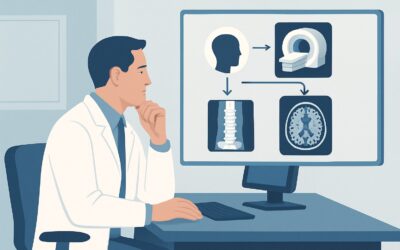
A 42-year-old male presents to your clinic with a three-week history of excruciating, unilateral headaches. He describes the pain as a searing, stabbing sensation behind his right eye, lasting about 45 minutes and occurring like clockwork every afternoon. During the attacks, his right eye becomes red and watery, and his right nostril feels congested. The attacks are so severe he paces the room, unable to sit still. You recognize the classic features of a cluster headache, a primary trigeminal autonomic cephalalgia (TAC). While the diagnosis seems clear clinically, this is his first presentation. You must decide on the appropriate initial imaging to exclude a secondary cause mimicking this distinct syndrome. This article details the American College of Radiology (ACR) recommended workflow for this specific scenario, explaining why one study is the clear first choice. For the initial imaging of primary trigeminal autonomic cephalalgias, the ACR designates MRI head without and with IV contrast as Usually appropriate.
Who Fits This Clinical Scenario?
This guidance applies to patients presenting with a new diagnosis of a primary trigeminal autonomic cephalalgia (TAC). The hallmark of this group of headache disorders is unilateral head pain occurring in association with ipsilateral cranial autonomic features. The most common and well-known TAC is the cluster headache, characterized by severe, short-lasting (15-180 minutes) attacks of periorbital, supraorbital, or temporal pain, often with a striking circadian and circannual rhythmicity.
Other TACs that fit this scenario include paroxysmal hemicrania, short-lasting unilateral neuralgiform headache attacks with conjunctival injection and tearing (SUNCT), and short-lasting unilateral neuralgiform headache attacks with cranial autonomic symptoms (SUNA). The key inclusion criteria are the characteristic clinical syndrome of a TAC and the need for initial, first-time diagnostic imaging.
This workflow is distinct from other headache presentations. It does not apply to patients with a sudden, explosive “thunderclap” headache, which requires an urgent workup for subarachnoid hemorrhage. It is also separate from the workup for a typical primary migraine or tension-type headache in a patient with a normal neurologic exam, where imaging is often not indicated. Finally, this guidance is not for patients with clear signs of intracranial hypertension (like papilledema) or hypotension (a postural headache), as those scenarios follow different diagnostic pathways.
What Diagnoses Are You Working Up in This Scenario?
While the vast majority of patients with a classic TAC presentation will have a primary headache disorder, the purpose of initial neuroimaging is to confidently exclude the minority of cases where these symptoms are mimicked by an underlying structural lesion. The differential diagnosis for a secondary, or symptomatic, TAC is focused on pathologies that can irritate the trigeminal-autonomic reflex pathway, particularly structures in and around the sella turcica, cavernous sinus, and posterior fossa.
Pituitary Macroadenoma or Apoplexy: A lesion in the pituitary gland, especially a large one or one that has undergone hemorrhage or infarction (apoplexy), can compress or inflame the adjacent cavernous sinus. This can irritate the trigeminal nerve and sympathetic fibers, producing a clinical picture indistinguishable from a primary cluster headache. This is one of the most critical “cannot miss” diagnoses in this workup.
Cavernous Sinus Pathology: Besides pituitary lesions, other pathologies within the cavernous sinus, such as meningioma, schwannoma, metastatic disease, or inflammatory conditions like Tolosa-Hunt syndrome, can cause symptomatic TACs. These processes directly involve the key neural and vascular structures responsible for the pain and autonomic features.
Vascular Lesions: Although less common, vascular abnormalities such as an internal carotid artery aneurysm, dissection, or an arteriovenous malformation can present with TAC-like symptoms. These lesions can cause pain through direct mass effect, local inflammation, or altered hemodynamics affecting perivascular nerves.
Other Structural Lesions: Rarely, other intracranial tumors or posterior fossa abnormalities can be the culprit. The goal of imaging is to provide a comprehensive survey of these anatomical regions to rule out a structural cause before committing a patient to a long-term diagnosis and treatment plan for a primary TAC.
Why Is MRI Head Without and With IV Contrast the Recommended Study?
The American College of Radiology (ACR) rates MRI head without and with IV contrast as Usually appropriate for the initial imaging of a suspected primary trigeminal autonomic cephalalgia. This recommendation is based on the modality’s superior ability to visualize the specific anatomical structures implicated in secondary TACs.
Magnetic Resonance Imaging (MRI) provides exquisite soft-tissue contrast, which is essential for evaluating the pituitary gland, the cavernous sinuses, the brainstem, and the cranial nerves. The non-contrast sequences can identify hemorrhage (as in pituitary apoplexy) and delineate basic anatomy. The addition of intravenous gadolinium-based contrast is crucial. It highlights areas of abnormal enhancement, which is key to identifying inflammatory processes (e.g., Tolosa-Hunt syndrome, hypophysitis) and neoplastic lesions like meningiomas or pituitary adenomas, which typically enhance avidly. This comprehensive evaluation directly addresses the most important differential diagnoses.
Alternative studies are rated lower for specific reasons in this clinical context:
- CT head without IV contrast is rated Usually not appropriate. While fast and excellent for detecting acute hemorrhage or large masses, its poor soft-tissue resolution makes it insensitive for small pituitary tumors, cavernous sinus inflammation, or subtle brainstem lesions. A negative non-contrast CT can provide false reassurance, missing the very pathology the workup is designed to find. It also involves ionizing radiation (ACR Relative Radiation Level ☢☢☢ 1-10 mSv), whereas MRI has none (RRL O 0 mSv).
- MRA head without IV contrast is also rated Usually not appropriate as the initial study. While it is excellent for visualizing major intracranial arteries to rule out an aneurysm, it does not provide the detailed parenchymal and structural information of a full MRI protocol. The primary concern in a TAC workup is a structural or inflammatory lesion, not purely a vascular one. A standard post-contrast MRI often provides sufficient vascular screening information, making a dedicated MRA unnecessary for the initial evaluation unless a specific vascular concern arises.
Therefore, a complete brain MRI, both without and with contrast, offers the highest diagnostic yield, directly interrogating the relevant anatomy with the greatest sensitivity and specificity for the differential, all without using ionizing radiation.
What’s Next After MRI Head Without and With IV Contrast? Downstream Workflow
The results of the MRI will guide the subsequent clinical pathway. The workflow branches based on whether the study is positive, negative, or indeterminate.
If the study is positive for a structural lesion: A finding such as a pituitary macroadenoma, meningioma, or evidence of cavernous sinus inflammation dictates the next steps. This patient no longer has a primary TAC but a symptomatic one. The workflow involves immediate referral to the appropriate specialist. A pituitary mass requires consultation with both neurosurgery and endocrinology for further management, which may include hormonal testing, visual field assessment, and planning for surgical resection or medical therapy. A suspected inflammatory or neoplastic process would prompt a neurology or neuro-oncology consultation.
If the study is negative (the most common outcome): A normal MRI effectively rules out a secondary cause. This result provides diagnostic confirmation of a primary trigeminal autonomic cephalalgia. The clinician can confidently proceed with initiating appropriate medical management. For cluster headache, this includes acute therapy (e.g., high-flow oxygen, sumatriptan injections) and preventive therapy (e.g., verapamil, galcanezumab). The negative scan is also a powerful tool for patient reassurance, validating that their severe symptoms are not caused by a life-threatening underlying condition.
If the study is indeterminate: Occasionally, the MRI may reveal incidental or non-specific findings, such as scattered white matter hyperintensities or a tiny pituitary microadenoma of unclear clinical significance. In these cases, the findings must be correlated with the clinical picture. If the patient’s symptoms are absolutely classic for a primary TAC, these findings are likely incidental. A neurology consultation can be valuable to help adjudicate whether the finding is causative or unrelated, and to decide if any follow-up imaging is warranted.
Pitfalls to Avoid (and When to Get Help)
In the workup of suspected TACs, several common pitfalls can delay diagnosis or lead to inappropriate management. First, avoid the temptation to dismiss a classic TAC presentation as a “severe migraine” and forgo imaging; the small but significant chance of a secondary cause makes imaging essential at initial diagnosis. Second, ordering a non-contrast CT of the head is a frequent error; it lacks the sensitivity for the key pathologies in the pituitary and cavernous sinus and can be falsely reassuring. Third, be specific when ordering the MRI; failing to request IV contrast administration will render the study incomplete and may miss the enhancing lesions you are looking for. Finally, be cautious not to over-attribute the patient’s symptoms to common incidental findings on a high-resolution MRI. If the MRI is abnormal but the findings do not convincingly explain the classic TAC syndrome, consultation with a neurologist or neuroradiologist is the best next step.
Related ACR Topics and Tools
The ACR Appropriateness Criteria are a comprehensive resource for evidence-based imaging decisions. This article covers one specific scenario, but many related clinical questions arise in practice. For a broader overview of all headache variants, from migraine to thunderclap headache, please see our parent guide. For other tools to refine your imaging orders, the resources below are available.
- For breadth across all scenarios in Headache, see our parent guide: Headache: ACR Appropriateness Decoded.
- To look up other clinical scenarios, visit the ACR Appropriateness Criteria Lookup tool.
- To review institutional standards or build a new sequence, see the Imaging Protocol Library.
- To discuss cumulative exposure with patients, use the Radiation Dose Calculator.
Frequently Asked Questions
Why is MRI so strongly preferred over CT for a first-time cluster headache workup?
MRI is strongly preferred because it provides far superior soft-tissue detail of the key anatomical areas where secondary causes of trigeminal autonomic cephalalgias (TACs) are found, namely the pituitary gland, cavernous sinus, and posterior fossa. A CT scan, especially without contrast, can easily miss small tumors or inflammatory changes in these regions. Since the primary goal of imaging is to rule out these specific structural mimics, MRI is the most sensitive and appropriate test.
Is imaging necessary for every single patient with classic cluster headache symptoms?
Yes, for an initial diagnosis. While the clinical diagnosis of cluster headache is often very clear, there is a small but significant percentage of patients whose symptoms are caused by an underlying structural lesion (a ‘symptomatic’ or ‘secondary’ TAC). The International Headache Society (IHS) diagnostic criteria and expert consensus recommend neuroimaging for all patients at their first presentation to confidently rule out these mimics before starting long-term treatment for a primary disorder.
What should be ordered if a patient has a contraindication to MRI, like a non-compatible pacemaker?
If a patient has an absolute contraindication to MRI, the next best test is a high-quality CT of the head with and without IV contrast, with thin slices through the sella and posterior fossa. While still less sensitive than MRI, a contrast-enhanced CT (CECT) is significantly better than a non-contrast study for detecting enhancing lesions like meningiomas or large pituitary adenomas. A CTA (CT Angiography) may also be considered if a vascular cause like an aneurysm is a specific concern. This is a situation where consulting with a radiologist to determine the optimal CT protocol is highly recommended.
Does a normal MRI definitively confirm the diagnosis of a primary TAC?
A normal MRI does not ‘confirm’ the diagnosis in a positive sense, but it provides strong evidence by exclusion. The diagnosis of a primary TAC, like cluster headache, remains a clinical one based on the patient’s history and examination. A normal MRI effectively rules out the major secondary causes, allowing the clinician to proceed with a high degree of confidence in the clinical diagnosis and initiate the correct medical management.
Why is intravenous contrast necessary for the MRI if we expect the study to be normal?
Intravenous contrast is essential because many of the key pathologies that can mimic a primary TAC are best visualized—or only visualized—after contrast administration. Lesions like pituitary adenomas, meningiomas, and inflammatory conditions (e.g., Tolosa-Hunt syndrome, sarcoidosis) show characteristic enhancement patterns. Without contrast, these lesions could be missed, defeating the primary purpose of the imaging study. The risk of a contrast reaction is very low and is outweighed by the diagnostic benefit in this specific clinical scenario.
Reviewed by Pouyan Golshani, MD, Interventional Radiologist — May 30, 2026