What Is the Best Initial Imaging for Suspected Nonischemic Dilated Cardiomyopathy?
A 45-year-old patient presents to your clinic with several weeks of progressive dyspnea on exertion and new bilateral lower extremity edema. An ECG shows nonspecific T-wave abnormalities but no acute ischemic changes. Based on a low pre-test probability and a recent negative stress test, you have effectively ruled out active coronary artery disease. Your leading suspicion is a new-onset heart failure secondary to a nonischemic dilated cardiomyopathy. The critical next step is to confirm the diagnosis, assess ventricular function, and guide further management. This article details the ACR-guided imaging workflow for this specific clinical scenario: the initial workup of suspected nonischemic dilated and unclassified cardiomyopathy. For this presentation, the ACR designates `US echocardiography transthoracic resting` as a Usually Appropriate initial imaging study.
Who Fits This Clinical Scenario?
This imaging workflow is designed for patients presenting with signs and symptoms suggestive of heart failure—such as exertional dyspnea, orthopnea, paroxysmal nocturnal dyspnea, or peripheral edema—where a nonischemic cardiomyopathy is suspected as the underlying cause. The key inclusion criterion is that significant ischemic heart disease has already been reasonably excluded. This exclusion could be based on a recent normal coronary angiogram, a negative coronary CT angiography (CTA), a negative functional stress test, or a very low clinical probability in a patient without traditional risk factors for coronary artery disease.
This guidance specifically applies to the initial diagnostic imaging for a suspected dilated or otherwise unclassified cardiomyopathy. It is crucial to distinguish this presentation from others that may appear similar but follow different diagnostic pathways:
- Suspected Hypertrophic Cardiomyopathy: If the patient has a family history of sudden cardiac death or the physical exam and ECG strongly suggest left ventricular hypertrophy disproportionate to any hypertension, the workup follows a different track.
- Suspected Restrictive or Infiltrative Cardiomyopathy: Patients with signs of right-sided heart failure, low-voltage ECG, and systemic symptoms suggestive of diseases like amyloidosis or sarcoidosis require a distinct imaging approach.
- Suspected Arrhythmogenic Cardiomyopathy: When the primary manifestation is ventricular arrhythmia, palpitations, or syncope, especially with ECG findings like epsilon waves or T-wave inversions in right precordial leads, the focus shifts.
This article focuses squarely on the patient in whom dilated left ventricular dysfunction is the primary suspicion after ischemia has been ruled out.
What Diagnoses Are You Working Up in This Scenario?
When ordering initial imaging for suspected nonischemic dilated cardiomyopathy (DCM), you are investigating a heterogeneous group of disorders characterized by left ventricular (or biventricular) dilation and impaired systolic function. The goal of imaging is to confirm this phenotype and search for clues to the underlying etiology.
Idiopathic Dilated Cardiomyopathy is the most common ultimate diagnosis, representing a diagnosis of exclusion after a thorough workup fails to identify a specific cause. Imaging will confirm the dilated, poorly contractile ventricle but may not reveal a specific etiology, prompting further clinical investigation.
Familial or Genetic Cardiomyopathy accounts for a substantial portion of DCM cases. While imaging features are often indistinguishable from idiopathic DCM, identifying the phenotype is the first step toward a potential genetic workup, which has significant implications for family screening and prognosis.
Myocarditis, often post-viral, can lead to myocardial inflammation and damage, resulting in a dilated and dysfunctional ventricle. While the acute inflammatory phase may have passed by the time of presentation, imaging can reveal the functional consequences. Cardiac MRI is particularly sensitive for detecting the myocardial edema and scar patterns characteristic of prior myocarditis.
Toxin-Induced Cardiomyopathy is another key consideration. A careful history is paramount, but imaging confirms the structural heart disease. Common culprits include chronic excessive alcohol consumption, certain chemotherapeutic agents (like anthracyclines), and illicit substances such as cocaine. Imaging establishes a baseline for monitoring potential recovery after the offending agent is removed.
A less common but critical consideration is Tachycardia-Induced Cardiomyopathy, a potentially reversible condition where chronic, uncontrolled tachyarrhythmias (like atrial fibrillation with a rapid ventricular response) lead to ventricular dysfunction. Imaging confirms the cardiomyopathy, and subsequent rhythm or rate control can lead to significant improvement or normalization of ventricular function.
Why Is US Echocardiography Transthoracic Resting the Recommended Initial Study?
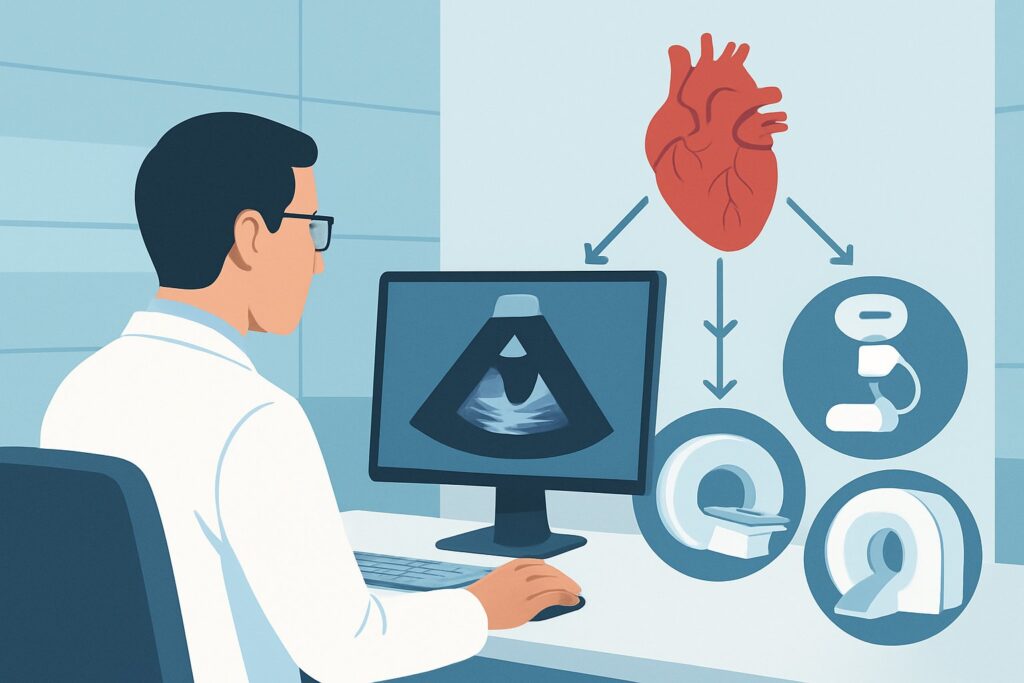
For the initial evaluation of suspected nonischemic dilated cardiomyopathy, `US echocardiography transthoracic resting` (TTE) is rated Usually Appropriate and serves as the cornerstone of diagnosis. Its recommendation is based on its wide availability, lack of ionizing radiation (0 mSv), cost-effectiveness, and ability to provide a comprehensive initial assessment of cardiac structure and function at the bedside or in the clinic.
A resting TTE directly visualizes and quantifies the key features of DCM: left ventricular size, wall thickness, and global and regional systolic function, most commonly summarized by the left ventricular ejection fraction (LVEF). It also provides crucial information on diastolic function, right ventricular size and function, valvular integrity (e.g., secondary mitral regurgitation due to annular dilation), and the presence of a pericardial effusion. This single, non-invasive test can confirm the suspected diagnosis, stratify risk, and guide the initiation of guideline-directed medical therapy.
While Cardiac MRI (CMR) is also rated Usually Appropriate (`MRI heart function and morphology without and with IV contrast`), TTE is typically the preferred first step. CMR is an outstanding problem-solving tool that offers superior tissue characterization through techniques like Late Gadolinium Enhancement (LGE), which can identify myocardial fibrosis or scar. This can help differentiate between etiologies (e.g., a mid-wall LGE pattern in genetic DCM vs. epicardial LGE in prior myocarditis). However, CMR is more expensive, less accessible, and has a longer acquisition time, making TTE the more practical and efficient initial examination.
Other imaging modalities are rated lower for this specific initial workup:
- Coronary Arteriography: This is rated Usually not appropriate because the scenario explicitly states that ischemic cardiomyopathy has already been excluded. Performing an invasive angiogram at this stage would be redundant and expose the patient to unnecessary risk and radiation (☢☢☢ 1-10 mSv).
- FDG-PET/CT Heart: Also rated Usually not appropriate for this initial, undifferentiated presentation. While invaluable for assessing active inflammation in conditions like cardiac sarcoidosis, it is a highly specialized test reserved for cases where there is a strong clinical suspicion for a specific inflammatory or infiltrative process, not for the general workup of DCM. It also involves significant radiation exposure (☢☢☢☢ 10-30 mSv).
What’s Next After US Echocardiography Transthoracic Resting? Downstream Workflow
The results of the initial transthoracic echocardiogram are a critical branch point in the patient’s diagnostic and therapeutic journey. The subsequent steps depend directly on the TTE findings.
If the TTE confirms dilated cardiomyopathy (e.g., LVEF <50% with LV dilation): The immediate priority is to initiate guideline-directed medical therapy (GDMT) for heart failure with reduced ejection fraction. The focus of the workup then shifts to determining the underlying etiology. This involves a comprehensive history (focusing on family history, alcohol/toxin exposure), laboratory testing (including BNP, troponin, thyroid function), and often, a referral to a heart failure specialist. A Cardiac MRI is frequently the next logical imaging step to search for specific diagnostic clues, such as patterns of late gadolinium enhancement that might suggest prior myocarditis, genetic causes, or infiltrative disease.
If the TTE is normal or does not show significant systolic dysfunction: This finding prompts a re-evaluation of the patient’s symptoms. The cause of their dyspnea may be non-cardiac (e.g., pulmonary, deconditioning) or related to a different cardiac pathology not fully captured by a standard TTE, such as heart failure with preserved ejection fraction (HFpEF) or constrictive pericarditis. Further evaluation might include pulmonary function testing, a cardiopulmonary exercise test, or advanced echocardiographic techniques to assess diastolic function.
If the TTE is indeterminate or reveals unexpected findings: Sometimes, the echo reveals features that point away from a simple dilated cardiomyopathy. For instance, if significant, asymmetric left ventricular hypertrophy is discovered, the workup should pivot to the pathway for suspected hypertrophic cardiomyopathy. If the myocardium appears thickened, bright, and “sparkling,” with restrictive filling patterns, the investigation should proceed down the path for suspected restrictive or infiltrative cardiomyopathy. In these cases, Cardiac MRI becomes an essential next step for definitive characterization.
Pitfalls to Avoid (and When to Get Help)
In the workup of suspected nonischemic DCM, several common pitfalls can delay diagnosis or lead to misinterpretation. First, ensure that ischemic heart disease has been truly and reasonably excluded based on the patient’s risk profile and prior testing; anchoring on a “nonischemic” diagnosis prematurely can be dangerous. Second, avoid focusing solely on the left ventricular ejection fraction. A comprehensive TTE report includes vital information on diastolic function, right ventricular function, and valvular disease that is critical for management. Third, do not forget to consider and rule out reversible causes, such as uncontrolled tachyarrhythmias or alcohol/toxin exposure, as addressing these can dramatically alter the patient’s prognosis. Finally, recognize the limits of echocardiography. If the TTE confirms DCM but the etiology remains obscure after initial clinical workup, this is a key moment to escalate. If the diagnosis remains uncertain or a more specific etiology like myocarditis or sarcoidosis is suspected, a timely referral to a cardiologist and consideration for Cardiac MRI are warranted.
Related ACR Topics and Tools
This article focuses on a single clinical scenario. For a comprehensive overview of imaging for all forms of nonischemic myocardial disease, or to explore adjacent clinical questions, the following resources are essential.
- For breadth across all scenarios in Nonischemic Myocardial Disease with Clinical Manifestations (Ischemic Cardiomyopathy Already Excluded), see our parent guide: Nonischemic Myocardial Disease with Clinical Manifestations (Ischemic Cardiomyopathy Already Excluded): ACR Appropriateness Decoded.
- To explore other clinical presentations and their recommended imaging studies, use the ACR Appropriateness Criteria Lookup.
- For detailed procedural techniques on recommended studies, consult the Imaging Protocol Library.
- To discuss cumulative radiation exposure with patients when considering different imaging pathways, the Radiation Dose Calculator can be a useful aid.
Frequently Asked Questions
Why is transthoracic echocardiography (TTE) preferred over Cardiac MRI (CMR) if both are rated ‘Usually Appropriate’?
While both are excellent, radiation-free modalities, TTE is typically the preferred *initial* test due to its lower cost, wider availability, and faster acquisition time. It provides a rapid, comprehensive assessment of cardiac structure and function sufficient to make the initial diagnosis and start therapy. CMR is often used as a second-line or problem-solving tool to provide more detailed tissue characterization when the diagnosis remains unclear after TTE.
What should I do if my patient has a poor acoustic window for the echocardiogram?
A suboptimal or non-diagnostic TTE due to poor acoustic windows (e.g., in patients with obesity or severe lung disease) is a primary indication to proceed directly to Cardiac MRI. CMR is not limited by body habitus and provides clear, high-resolution images of cardiac anatomy and function, making it the ideal alternative in this situation.
Is a stress echocardiogram useful in this specific scenario?
No, for this presentation, a stress echocardiogram is rated ‘Usually not appropriate’ by the ACR. The purpose of a stress test is to provoke and detect myocardial ischemia. Since this clinical scenario is predicated on ischemic cardiomyopathy already being excluded, a stress test would not provide relevant information for diagnosing a primary nonischemic cardiomyopathy.
When should I consider cardiac CT instead of echo or MRI?
Cardiac CT with IV contrast is rated ‘May be appropriate’ and is considered a secondary option. It might be useful if both echocardiography is non-diagnostic and MRI is contraindicated (e.g., due to an incompatible implanted device or severe claustrophobia). CT provides excellent anatomical detail but involves significant radiation exposure and iodinated contrast, making it less ideal for the initial workup compared to TTE or CMR.
Does ‘ischemic cardiomyopathy already excluded’ require a patient to have had a coronary angiogram?
Not necessarily. The exclusion of ischemic disease can be established in several ways depending on the clinical context. It could be based on a recent normal invasive coronary angiogram, a negative coronary CT angiogram, a negative high-quality functional stress test, or a very low pre-test probability of coronary artery disease in a young patient with no risk factors.
Reviewed by Pouyan Golshani, MD, Interventional Radiologist — May 29, 2026