

What Is the Best Initial Imaging for Suspected Parapneumonic Effusion or Empyema?
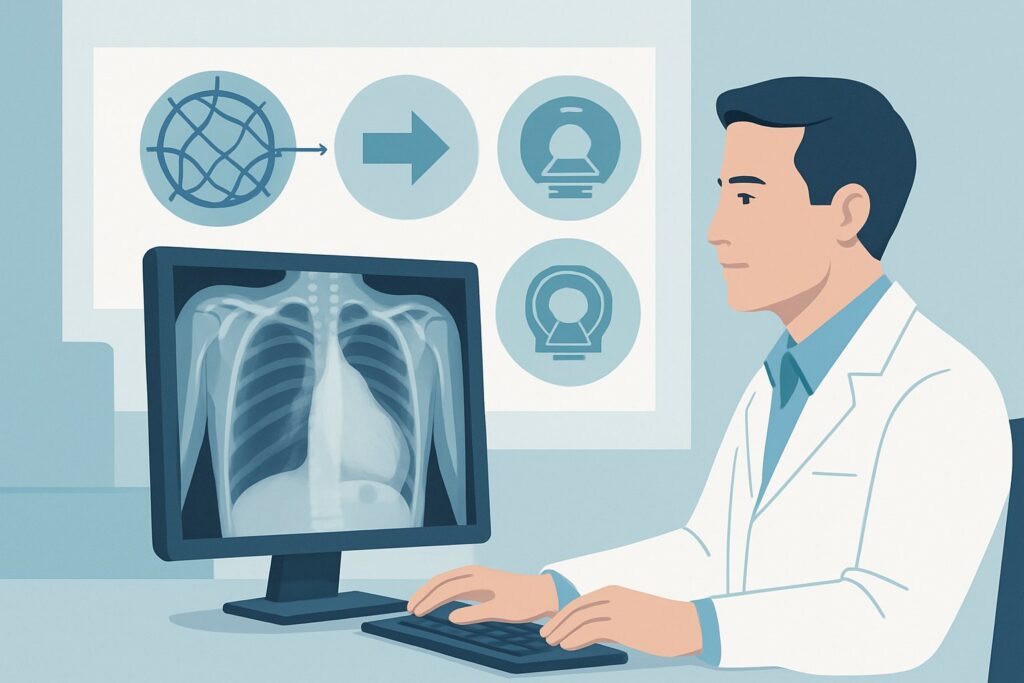
It’s late in your shift, and you’re re-evaluating a 68-year-old patient admitted two days ago for community-acquired pneumonia. Despite appropriate intravenous antibiotics, their fever persists at 38.8°C, and they now complain of new, sharp right-sided pleuritic chest pain. Their oxygen requirement has also increased slightly. You suspect the development of a parapneumonic effusion or, more concerningly, an empyema. The immediate clinical question is which imaging study to order first to confirm your suspicion and guide the next steps in management. For this specific scenario, the American College of Radiology (ACR) Appropriateness Criteria rate a Radiography chest as Usually appropriate, establishing it as the foundational first step in the diagnostic workflow.
Who Fits This Clinical Scenario for Suspected Parapneumonic Effusion?
This guidance is specifically for patients with a recent, clinically diagnosed pneumonia who are not responding to standard antibiotic therapy as expected. The key indicators that should prompt consideration of a parapneumonic effusion or empyema include persistent or recurrent fever, worsening dyspnea or hypoxemia, new or worsening pleuritic chest pain, or a persistently elevated white blood cell count despite treatment. This applies to community-acquired, hospital-acquired, or aspiration pneumonia.
This workflow is distinct from other clinical presentations that may also involve pleural fluid. It is crucial to differentiate this scenario from:
- Recent minor blunt trauma with suspected pleural effusion: In this case, the primary concern is hemothorax, and the imaging workup is tailored to assess for traumatic injury, not infection.
- Dyspnea, cough, or chest pain with suspected noninfectious pleural effusion: If the clinical context suggests an etiology like congestive heart failure, malignancy, or pulmonary embolism, the diagnostic priorities and imaging choices will differ significantly.
- Pleural effusion incidentally detected on another study: When an effusion is found unexpectedly (e.g., on an abdominal CT), the subsequent workup is aimed at characterizing a newly discovered finding, which follows a different diagnostic path than confirming a suspected complication of a known infection.
Applying this article’s workflow to those scenarios could lead to delayed or incorrect diagnoses.
What Diagnoses Are You Working Up in This Scenario?
When ordering initial imaging for a patient with pneumonia who is failing to improve, you are trying to differentiate between several possibilities along the spectrum of parapneumonic disease. The imaging findings will directly influence whether medical management is sufficient or if a procedural intervention is required.
The most common finding is an uncomplicated parapneumonic effusion. This is a sterile, free-flowing exudative fluid collection in the pleural space that typically resolves with antibiotic treatment of the underlying pneumonia. Imaging will show a simple, mobile fluid collection without evidence of loculation.
A more serious condition is a complicated parapneumonic effusion. This occurs when the effusion becomes infected with bacteria, leading to inflammation and fibrin deposition. These effusions are often loculated (trapped in pockets by fibrinous strands) and may have septations. They often require drainage in addition to antibiotics for resolution.
The most severe form is an empyema, which is defined by the presence of frank pus in the pleural space. On imaging, an empyema is typically loculated and may be associated with significant thickening and enhancement of the visceral and parietal pleura (the “split pleura” sign on contrast-enhanced CT). Empyemas almost always require drainage.
Less commonly, the imaging may reveal a lung abscess that is peripherally located and abuts the pleura. Differentiating a lung abscess from a loculated empyema is a critical diagnostic challenge, as their management can differ. An abscess is a collection of pus within the lung parenchyma itself, while an empyema is a collection within the pleural space.
Why Is a Chest Radiograph the Recommended First Study for This Presentation?
The ACR designates a chest radiograph as Usually appropriate for the initial evaluation of a suspected parapneumonic effusion because it effectively balances diagnostic utility with accessibility, cost, and radiation safety. An upright posteroanterior (PA) and lateral chest radiograph is a fast, widely available test that can reliably confirm the presence of a moderate-to-large effusion, evidenced by blunting of the costophrenic angle or a visible meniscus. It also provides crucial context by showing the location and extent of the underlying parenchymal consolidation from the pneumonia.
The radiation dose is minimal (adult RRL ☢ <0.1 mSv), making it a safe first-line choice. If the patient is too ill to stand, a supine or decubitus view can still be informative, though less sensitive for small effusions. The primary goal of this initial study is to answer the simple but critical question: "Is a significant effusion present?" While other modalities are more detailed, they are not the recommended first step.
- CT chest with IV contrast is also rated Usually appropriate, but it is best reserved as a second-line study if the chest radiograph is positive or equivocal, or if the patient remains critically ill. CT provides superior detail for characterizing the effusion (identifying loculations, septations, and pleural thickening) and is essential for differentiating an empyema from a lung abscess. However, its higher radiation dose (adult RRL ☢☢☢ 1-10 mSv) and need for intravenous contrast make it less ideal for initial screening when a simple radiograph often suffices.
- US chest is rated May be appropriate (Disagreement). Chest ultrasound is an excellent, radiation-free (RRL O 0 mSv) tool for confirming a suspected effusion, assessing its volume and character (simple anechoic fluid vs. complex septated fluid), and, most importantly, guiding thoracentesis safely at the bedside. The “Disagreement” in its rating reflects its variability as a primary diagnostic tool; it is highly operator-dependent and may not be the initial modality ordered by the primary team. It is more commonly used as a problem-solving tool or procedural guide after an effusion is identified on a radiograph.
What’s the Next Step After the Initial Chest Radiograph?
The results of the initial chest radiograph will guide your subsequent management and imaging decisions. The workflow typically branches based on the findings in the context of the patient’s clinical status.
If the radiograph is negative for effusion: If no pleural effusion is seen and the patient’s clinical picture is stable or improving, the focus remains on optimizing medical management for the pneumonia itself. If the patient continues to deteriorate despite a negative radiograph, consider a CT chest to look for a small, radiographically occult effusion or alternative diagnoses like a developing lung abscess or pulmonary embolism.
If the radiograph shows a small, free-flowing effusion: In a patient who is clinically improving, this finding often represents an uncomplicated parapneumonic effusion. The typical next step is to continue antibiotics and monitor for clinical resolution. No immediate drainage is usually necessary.
If the radiograph shows a moderate-to-large or loculated effusion: This finding, especially in a patient who is not improving or is septic, is highly suspicious for a complicated parapneumonic effusion or empyema. This is a critical branch point. The next step is often twofold:
1. Characterize the fluid: A CT chest with IV contrast is indicated to assess for loculations, septations, and pleural enhancement (“split pleura” sign), which helps confirm a complicated effusion or empyema.
2. Sample the fluid: A diagnostic thoracentesis, often guided by ultrasound, is necessary to analyze the pleural fluid (pH, glucose, LDH, cell count, Gram stain, and culture). The results will definitively classify the effusion and guide the need for chest tube drainage.
Pitfalls to Avoid (and When to Get Help)
Navigating the workup for parapneumonic effusions requires avoiding several common pitfalls to ensure timely and appropriate care.
- Pitfall 1: Relying solely on a supine radiograph. A supine anteroposterior (AP) chest X-ray is significantly less sensitive for detecting pleural effusions. Fluid layers posteriorly, causing a diffuse haziness over the hemithorax rather than a distinct meniscus. If possible, always obtain an upright or decubitus view.
- Pitfall 2: Delaying follow-up imaging. In a patient with pneumonia who is not responding to therapy, delaying imaging can lead to a missed empyema, which can result in significant morbidity from fibrothorax and trapped lung.
- Pitfall 3: Forgetting ultrasound for procedural guidance. Attempting a blind thoracentesis is associated with a higher risk of complications like pneumothorax or solid organ injury. Bedside ultrasound should be used to confirm the presence of fluid, identify an optimal and safe needle entry site, and assess for loculations.
If a large or complex, loculated effusion is identified on CT, this is the time to escalate. Early consultation with Thoracic Surgery or Interventional Pulmonology/Radiology is crucial to plan for definitive drainage, which may range from a simple chest tube to video-assisted thoracoscopic surgery (VATS).
Related ACR Topics and Tools
This article covers one specific scenario within the broader topic of pleural disease. For a comprehensive overview of all related clinical variants and their recommended imaging pathways, please refer to our parent guide.
- For breadth across all scenarios in Workup of Pleural Effusion or Pleural Disease, see our parent guide: Workup of Pleural Effusion or Pleural Disease: ACR Appropriateness Decoded.
For additional resources to help refine your imaging orders and discuss them with patients, explore these GigHz tools:
- ACR Appropriateness Criteria Lookup — for adjacent scenarios
- Imaging Protocol Library — for technique on the recommended study
- Radiation Dose Calculator — for cumulative dose conversations
Frequently Asked Questions
Why is a chest radiograph recommended over a CT scan as the very first step?
A chest radiograph is recommended as the initial step because it is a low-radiation, low-cost, and highly accessible test that can quickly answer the primary question: is a pleural effusion present? If the radiograph is negative or shows only a small effusion in a stable patient, the higher radiation and contrast burden of a CT scan can be avoided. CT is reserved for when the radiograph is positive and further characterization is needed, or if the clinical suspicion remains high despite a negative X-ray.
If my patient cannot stand for an upright chest X-ray, what is the best alternative?
If an upright view is not possible, a lateral decubitus radiograph (with the suspected effusion side down) is the next best option. This view uses gravity to layer out the fluid along the lateral chest wall, making even small effusions visible. A standard supine AP radiograph is the least sensitive option and should be interpreted with caution, as significant fluid can be missed.
When should I order a CT scan with intravenous contrast versus without?
For evaluating a suspected complicated parapneumonic effusion or empyema, intravenous contrast is essential. Contrast enhances the inflamed pleural membranes, producing the ‘split pleura’ sign that is characteristic of empyema. It also helps differentiate a fluid collection in the pleural space (empyema) from a collection within the lung parenchyma (abscess). A non-contrast CT is less useful in this specific infectious context.
What is the role of bedside ultrasound in this scenario?
Bedside ultrasound is extremely valuable as a complementary tool. After a chest radiograph suggests an effusion, ultrasound can be used at the bedside to confirm the presence of fluid, estimate its volume, assess its complexity (e.g., presence of septations), and, most critically, provide real-time guidance for a safe thoracentesis to obtain a fluid sample for analysis.
Does this guidance apply to children with pneumonia?
Yes, the general principles apply to the pediatric population, with an even stronger emphasis on minimizing radiation exposure. A chest radiograph (pediatric RRL ☢ <0.03 mSv) is the standard initial imaging modality. Ultrasound is often used more liberally in children to characterize effusions and guide drainage, given that it is radiation-free. CT scans are reserved for complex cases where ultrasound is inconclusive or surgical planning is required.
Reviewed by Pouyan Golshani, MD, Interventional Radiologist — May 30, 2026


