What Is the Next Step for an Indeterminate Mediastinal Mass on MRI?
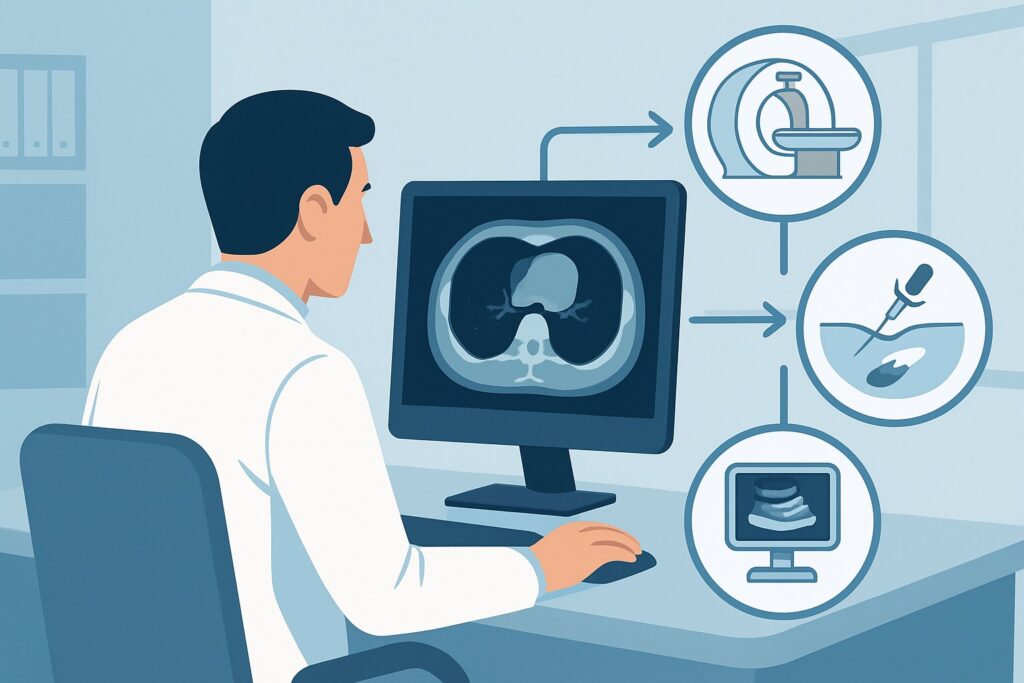
A 45-year-old patient’s chest Magnetic Resonance Imaging (MRI), ordered for atypical chest pain, reveals a 4 cm anterior mediastinal mass. The signal characteristics are complex—not a simple cyst, but without definitive features of a specific tumor like a thymoma or lymphoma. The radiology report concludes “indeterminate mediastinal mass.” You are now faced with a critical decision: pursue more imaging, proceed to tissue sampling, or opt for surveillance? This clinical crossroads is common, and navigating it requires a clear understanding of the diagnostic yield and risks of the next steps. This article provides a focused workflow for this exact scenario, guided by the American College of Radiology (ACR) Appropriateness Criteria, which rate an Image-guided transthoracic needle biopsy as Usually Appropriate to secure a definitive diagnosis.
Who Fits This Clinical Scenario?
This guidance applies specifically to adult or pediatric patients who have already undergone a chest MRI that identified a mediastinal mass, but the findings were inconclusive. The term “indeterminate” implies that while the mass is well-visualized, its characteristics on MRI (e.g., T1/T2 signal, enhancement pattern, diffusion restriction) do not allow for a confident diagnosis of a specific benign or malignant entity.
Inclusion criteria for this workflow:
- A mediastinal mass has been identified on a prior MRI.
- The MRI report explicitly states the mass is “indeterminate,” “equivocal,” or “nonspecific.”
- The patient is a candidate for further intervention, whether it be additional imaging or a biopsy.
This workflow is distinct from other common clinical situations. It does not apply to patients who are undergoing their initial workup for a clinically suspected mass (who have not yet had any imaging) or to those whose indeterminate finding was first seen on a different modality. For instance, a patient with an indeterminate mass found on a chest radiograph or CT would follow a different diagnostic algorithm, as the pre-test probabilities and the information needed from the next study are different.
What Diagnoses Are You Working Up in This Scenario?
When an MRI of a mediastinal mass is indeterminate, the differential diagnosis remains broad, spanning benign, inflammatory, and malignant conditions. The primary goal of the next step is to differentiate these possibilities to guide treatment.
A primary consideration in the anterior mediastinum is a thymoma or other thymic neoplasm. While MRI can often suggest a thymic origin, atypical features, cystic changes, or hemorrhage can render the appearance nonspecific, making it difficult to distinguish from other entities like lymphoma.
Lymphoma, particularly Hodgkin or non-Hodgkin lymphoma, is a key differential. Lymphomatous masses can have variable appearances on MRI. While they often show homogeneous enhancement and restricted diffusion, these features are not entirely specific and can overlap with other neoplasms, necessitating a tissue diagnosis for subtyping and treatment planning.
Germ cell tumors (teratomas, seminomas, etc.) are another possibility, especially in younger male patients. Mature cystic teratomas may be identifiable on CT if fat or calcification is present, but on MRI, their complex cystic and solid components can appear indeterminate without these classic signs.
Less common but important considerations include atypical benign lesions. A bronchogenic or pericardial cyst with proteinaceous or hemorrhagic content can lose its simple fluid signal on MRI and mimic a solid or complex cystic-solid mass. Similarly, neurogenic tumors in the posterior mediastinum can sometimes have an indeterminate appearance, although their location is often a strong clue.
Why Is Image-guided Transthoracic Needle Biopsy the Recommended Study?
After an MRI has provided high-resolution soft-tissue detail but failed to yield a specific diagnosis, the most direct path to an answer is often tissue sampling. The ACR rates Image-guided transthoracic needle biopsy as Usually Appropriate because it directly addresses the central clinical question: what is the histology of the mass? This information is essential for planning subsequent management, whether it be surgical resection, chemotherapy, radiation, or observation.
The rationale for prioritizing biopsy includes:
- Diagnostic Definitiveness: Biopsy provides a histologic diagnosis, which is the gold standard. This definitively separates malignant processes like lymphoma and thymic carcinoma from benign entities like an atypical cyst or a benign neurogenic tumor.
- Treatment Planning: The treatment for the primary differential diagnoses varies dramatically. Lymphoma requires chemotherapy, while a thymoma typically requires surgical resection. A biopsy provides the necessary information to direct the patient to the correct specialty and treatment pathway without delay.
Another Usually Appropriate option is a repeat MRI chest without and with IV contrast. This may be considered if the initial MRI was technically limited, performed without contrast when contrast was indicated, or if a short-term follow-up is thought to be sufficient to assess for change. However, if the initial study was of good quality, a repeat scan is unlikely to resolve the indeterminacy, making biopsy a more efficient next step.
Other imaging studies are rated lower for this specific scenario. An FDG-PET/CT is rated May be appropriate. While it can provide valuable metabolic information and is crucial for staging confirmed malignancies like lymphoma, its role in the initial diagnosis of an MRI-indeterminate mass is less clear. Both inflammatory conditions and various neoplasms can be FDG-avid, limiting its specificity. Furthermore, it involves significant radiation exposure (☢☢☢☢ 10-30 mSv). A CT chest with IV contrast is also rated May be appropriate but often provides less soft-tissue characterization than the MRI that has already been performed.
What’s Next After Image-guided Transthoracic Needle Biopsy? Downstream Workflow
The results of the biopsy will dictate the subsequent clinical pathway. The workflow branches significantly based on whether the pathology is malignant, benign, or non-diagnostic.
If the biopsy confirms malignancy:
The next step is staging and treatment planning. For a diagnosis of lymphoma, this typically involves a referral to hematology-oncology and staging with an FDG-PET/CT. For a thymoma or other solid malignancy, a referral to thoracic surgery and medical oncology is appropriate to discuss neoadjuvant therapy or primary surgical resection. The PET/CT may also be used for staging in these cases.
If the biopsy confirms a specific benign diagnosis:
If the tissue confirms a benign entity like a fibroma or a benign neurogenic tumor, management may shift to surveillance or, if the patient is symptomatic, surgical resection. A definitive benign diagnosis provides reassurance and a clear endpoint to the diagnostic workup.
If the biopsy is non-diagnostic or indeterminate:
A non-diagnostic sample is a common challenge, often due to sampling error or insufficient tissue. In this situation, the clinical team must decide between a repeat biopsy (potentially with a different approach, such as surgical excisional biopsy) or proceeding with another imaging modality. This is a point where an FDG-PET/CT (May be appropriate) could be reconsidered to assess the metabolic activity of the mass, which might raise or lower the suspicion of malignancy and guide the decision for a more invasive surgical biopsy.
Pitfalls to Avoid (and When to Get Help)
Navigating the workup of an indeterminate mediastinal mass requires careful coordination and awareness of potential missteps.
- Pitfall 1: Delaying Tissue Sampling. When an MRI is truly indeterminate, ordering more, often lower-yield, imaging studies can delay a definitive diagnosis. If malignancy is a real possibility, this delay can impact prognosis.
- Pitfall 2: Misinterpreting Biopsy Risks. While biopsy is invasive, the risks (e.g., pneumothorax, bleeding) must be weighed against the risk of not having a diagnosis. For masses abutting the pleura, the risk of pneumothorax is higher and should be discussed with the patient and the interventional radiologist.
- Pitfall 3: Inadequate Clinical History. Failing to provide the radiologist and pathologist with the full clinical context, including patient age, symptoms, and relevant history (e.g., myasthenia gravis for suspected thymoma), can hinder an accurate interpretation.
If the biopsy is non-diagnostic or the clinical picture remains confusing despite the results, escalation is warranted. This typically involves a multidisciplinary tumor board discussion with input from radiology, pathology, thoracic surgery, and oncology to form a consensus plan.
Related ACR Topics and Tools
For a comprehensive overview of all clinical scenarios related to mediastinal masses, further reading and specialized tools can provide additional context.
For breadth across all scenarios in Imaging of Mediastinal Masses, see our parent guide: Imaging of Mediastinal Masses: ACR Appropriateness Decoded.
Additional resources can help in applying these guidelines:
- ACR Appropriateness Criteria Lookup — for adjacent scenarios not covered here.
- Imaging Protocol Library — for technique on recommended studies.
- Radiation Dose Calculator — for cumulative dose conversations with patients.
Frequently Asked Questions
Why not just get an FDG-PET/CT instead of a biopsy for an MRI-indeterminate mass?
While an FDG-PET/CT is rated as ‘May be appropriate,’ it often lacks diagnostic specificity in this context. Many conditions, including benign inflammatory processes and various tumors, can be FDG-avid, leading to a high rate of false positives. A biopsy provides a definitive histologic diagnosis, which is required for planning specific treatments like chemotherapy for lymphoma versus surgery for thymoma. PET/CT is more valuable for staging once a malignancy is confirmed.
Is a repeat MRI with contrast ever the right next step?
Yes, a repeat MRI chest with and without contrast is also rated ‘Usually Appropriate.’ This option is most suitable if the initial MRI was technically suboptimal—for example, if it was performed without IV contrast and enhancement characteristics are needed to narrow the differential. However, if the initial MRI was of high quality and still indeterminate, a repeat scan is unlikely to be conclusive, making biopsy a more direct route to diagnosis.
What are the main risks of a transthoracic needle biopsy for a mediastinal mass?
The primary risks include pneumothorax (air leak around the lung), which is the most common complication, bleeding (hemoptysis or hemorrhage into the mass or chest), and, rarely, air embolism. The specific risk depends on the mass’s location, its proximity to major blood vessels and the lungs, and the patient’s underlying lung health. These risks are generally low when performed by an experienced interventional radiologist.
If the biopsy is non-diagnostic, what is the next step?
A non-diagnostic biopsy requires a multidisciplinary discussion. Options include repeating the percutaneous needle biopsy, potentially using a larger needle, or proceeding to a more invasive surgical biopsy (e.g., mediastinoscopy, video-assisted thoracoscopic surgery [VATS]). The decision depends on the level of clinical suspicion for malignancy, the perceived risk of a repeat procedure, and the potential information to be gained from another imaging study like an FDG-PET/CT.
Does this guidance change for pediatric patients?
The general principles are similar, but the differential diagnosis for a mediastinal mass in children is different, with neuroblastoma, lymphoma, and germ cell tumors being more common. The ACR notes that MRI is often preferred in children to avoid ionizing radiation. While biopsy is still the definitive step for an indeterminate mass, the decision-making process must heavily weigh the risks of anesthesia and invasive procedures in a pediatric patient, often involving a pediatric subspecialty team.
Reviewed by Pouyan Golshani, MD, Interventional Radiologist — May 29, 2026