What Is the Best Next Imaging Study for an Aggressive-Appearing Bone Lesion on Radiographs?
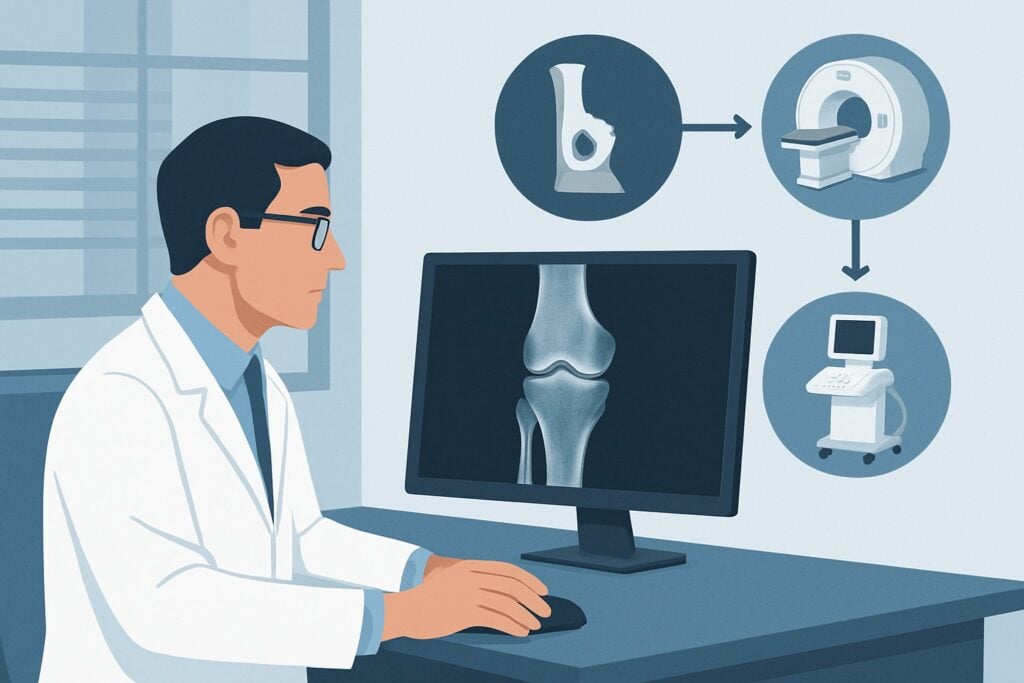
A 16-year-old presents to your clinic with several weeks of worsening right knee pain. A radiograph reveals a destructive, ill-defined lesion in the distal femoral metaphysis with cortical breakthrough and a sunburst periosteal reaction. The appearance is aggressive and highly concerning for a primary bone malignancy. You know the next step is advanced imaging to stage the lesion and guide the orthopedic oncologist, but which study provides the most critical information? What is the most appropriate next imaging study to characterize this lesion and plan for biopsy?
According to the American College of Radiology (ACR) Appropriateness Criteria, the definitive next step is clear. For a patient with an indeterminate or aggressive-appearing bone lesion on radiographs, the recommended study is MRI of the area of interest without and with IV contrast, which is rated as Usually Appropriate.
Who Fits This Clinical Scenario for a Suspected Bone Tumor?
This clinical workflow applies to a specific and urgent patient presentation: any adult or child who has already undergone radiography that demonstrates a primary bone lesion with indeterminate or aggressive features.
Inclusion criteria for this pathway:
- A bone lesion has been identified on initial radiographs.
- Radiographic features suggest potential malignancy. These include, but are not limited to:
- Ill-defined or permeative margins (“moth-eaten” appearance)
- Cortical destruction or breakthrough
- Aggressive periosteal reaction (e.g., sunburst, hair-on-end, or Codman triangle)
- A large, associated soft-tissue mass
This guidance does NOT apply if:
- No initial imaging has been performed. The first step in evaluating focal bone pain is almost always a radiograph. That workup is covered in the ACR variant for initial imaging.
- The radiograph shows a clearly benign lesion. A lesion with a narrow zone of transition, a sclerotic border, and no aggressive features (e.g., a classic non-ossifying fibroma or simple bone cyst) follows a different, less urgent pathway.
- The radiograph is normal. If a patient has persistent, focal bone pain concerning for a tumor but radiographs are negative, the next imaging choice is different, often involving MRI to detect marrow-based pathology not yet visible on X-ray.
- The patient has a known primary cancer elsewhere. In that case, the primary consideration is a metastatic lesion, which involves a related but distinct diagnostic algorithm.
What Diagnoses Are You Working Up with an Aggressive Bone Lesion?
When a radiograph shows an aggressive bone lesion, the differential diagnosis is centered on primary bone sarcomas but must also include key mimics. The goal of subsequent imaging is to characterize the lesion to narrow this differential and, most importantly, to accurately stage it for treatment planning.
Osteosarcoma
This is the most common primary malignant bone tumor in children and adolescents, typically occurring in the metaphysis of long bones like the distal femur or proximal tibia. It is characterized by the production of malignant osteoid, which can sometimes be seen as cloud-like mineralization on radiographs and CT. Its aggressive nature necessitates precise staging of local extent.
Ewing Sarcoma
The second most common malignant bone tumor in this age group, Ewing sarcoma is a small round blue cell tumor that often arises in the diaphysis of long bones or in flat bones like the pelvis. It classically presents with a permeative or “moth-eaten” pattern of bone destruction and an “onion-skin” periosteal reaction.
Chondrosarcoma
More common in adults over 40, chondrosarcoma is a malignant tumor of cartilage. It can arise de novo or from a pre-existing benign lesion like an enchondroma or osteochondroma. Imaging may show characteristic “rings and arcs” or “popcorn” calcification, representing chondroid matrix.
Tumor Mimics: Infection and Others
Aggressive osteomyelitis can be radiographically indistinguishable from a primary bone sarcoma, causing rapid bone destruction, periosteal reaction, and a soft tissue mass. It is a critical consideration in the differential. In adults, other malignancies like lymphoma, myeloma, or a solitary metastasis must also be considered, as they can present as a destructive bone lesion.
Why Is MRI Without and With IV Contrast the Recommended Next Study?
For a suspected primary bone sarcoma, defining the precise anatomical extent of the tumor is paramount for treatment planning, particularly for limb-salvage surgery. This is where Magnetic Resonance Imaging (MRI) excels, making it the cornerstone of local staging.
The ACR rates MRI of the area of interest without and with IV contrast as Usually Appropriate. Its superior soft-tissue contrast resolution provides critical information that no other modality can match:
- Intraosseous Extent: MRI accurately delineates the tumor’s spread within the bone marrow, identifying the proximal and distal margins. This is essential for determining the level of surgical resection. Fluid-sensitive sequences like STIR are particularly effective at highlighting marrow infiltration.
- Extraosseous Extent: It is the best modality for visualizing a soft-tissue mass extending from the bone. It can precisely show the tumor’s relationship to adjacent muscles, neurovascular bundles, and joints—all critical factors in determining resectability.
- Tumor Characterization: The administration of IV gadolinium contrast helps assess tumor vascularity and identify viable, solid tumor components versus areas of necrosis or cystic change. This is crucial for guiding a biopsy to the most diagnostically fruitful area, avoiding a non-diagnostic sample from a necrotic region.
Critically, MRI achieves this with no ionizing radiation (0 mSv), a significant advantage, especially for pediatric and young adult patients who may require multiple imaging studies over the course of their treatment.
Why are other studies rated lower for this specific step?
- **CT Scans (May be appropriate):** Computed Tomography is excellent for evaluating cortical bone integrity and characterizing tumor matrix (e.g., osteoid vs. chondroid). It is often a complementary study. However, its inferior soft-tissue contrast makes it a poor choice for the primary task of defining the tumor’s full extent and relationship to surrounding soft tissues.
- **Image-Guided Biopsy (Usually not appropriate):** This is a common and critical pitfall. Biopsy is absolutely necessary for a definitive histologic diagnosis, but it must be performed after comprehensive staging with MRI. Performing a biopsy prematurely can cause hemorrhage and edema, which can contaminate tissue planes and obscure the true tumor margins on subsequent MRI, potentially leading to an inaccurate assessment of tumor size and extent. The biopsy tract must be meticulously planned by the surgical oncologist based on the MRI findings to ensure it can be completely excised during the definitive surgery.
What’s Next After MRI? Downstream Workflow
The results of the contrast-enhanced MRI are a critical branch point in the patient’s management, directly informing the next steps in conjunction with a multidisciplinary tumor board.
- If MRI confirms a mass with aggressive features: The patient should be referred urgently to a specialized orthopedic oncology center. The next step is a carefully planned image-guided biopsy. The MRI results are used to select the safest and most representative location for the biopsy, avoiding major neurovascular structures and ensuring the biopsy tract can be resected with the tumor. Once a histologic diagnosis is confirmed, further systemic staging (often with chest CT and PET/CT) is performed, followed by neoadjuvant chemotherapy and/or surgical resection.
- If MRI suggests a benign or non-neoplastic process (e.g., osteomyelitis): The workflow shifts. For suspected infection, a biopsy or aspiration for culture and histology is still typically required to confirm the diagnosis and guide antibiotic therapy. For a lesion deemed benign with high confidence on MRI (e.g., an aneurysmal bone cyst), the plan may shift to observation or a less aggressive surgical procedure like curettage.
- If MRI findings are indeterminate: The case requires multidisciplinary discussion among radiologists, orthopedic oncologists, and pathologists. A biopsy is almost always necessary to obtain a tissue diagnosis and resolve the uncertainty. Other imaging modalities, such as CT to better assess matrix mineralization, may be considered to provide additional information before the biopsy.
Pitfalls to Avoid (and When to Get Help)
Navigating the workup of a suspected bone sarcoma is a high-stakes process where missteps can impact patient outcomes. Be aware of these common pitfalls:
- Pitfall 1: Premature Biopsy. Never biopsy a suspected primary bone sarcoma before obtaining a staging MRI. This is the most critical error to avoid, as it can compromise surgical planning and limb salvage.
- Pitfall 2: Ordering the Wrong MRI. An MRI of the entire bone (e.g., “MRI of the entire femur”) is required, not just the “area of interest.” This is to look for skip metastases—non-contiguous tumor deposits within the same bone—which occur in some sarcomas.
- Pitfall 3: Inadequate Clinical History. Failing to provide the radiologist with the patient’s age, lesion location, and a description of the radiographic findings can hinder interpretation. Age is one of the most important factors in the differential diagnosis of bone tumors.
If a radiograph shows a lesion with any features concerning for malignancy, the patient should be referred immediately to a center with expertise in musculoskeletal oncology. These are rare tumors that require specialized, multidisciplinary care from the outset.
Related ACR Topics and Tools
For a comprehensive overview of all clinical scenarios related to this topic, further reading and specialized tools can provide additional context and support for your clinical decisions.
- For breadth across all scenarios in Suspected Primary Bone Tumors, see our parent guide: Suspected Primary Bone Tumors: ACR Appropriateness Decoded.
- To explore adjacent clinical presentations, use the ACR Appropriateness Criteria Lookup.
- For details on imaging techniques, consult the Imaging Protocol Library.
- To discuss radiation exposure with patients, especially for follow-up studies, the Radiation Dose Calculator can be a useful aid.
Frequently Asked Questions
Why is MRI with and without contrast recommended over just a non-contrast MRI?
While a non-contrast MRI is also rated ‘Usually Appropriate’ and is excellent for showing tumor extent in bone and soft tissue, the addition of IV gadolinium contrast provides crucial information about tumor vascularity. It helps differentiate viable, solid tumor from necrotic or cystic areas, which is essential for accurately targeting a biopsy to the most aggressive part of the lesion and avoiding a non-diagnostic sample.
Is a PET/CT scan a substitute for an MRI in this scenario?
No. While FDG-PET/CT is rated ‘Usually Appropriate,’ it serves a different purpose. PET/CT is primarily used for systemic staging—detecting distant metastases in lymph nodes, lungs, or other bones. It is not the primary tool for local staging because its spatial resolution is much lower than MRI, making it inadequate for defining the tumor’s precise relationship to adjacent neurovascular structures and fascial planes, which is critical for surgical planning.
Does this guidance apply if I strongly suspect the lesion is osteomyelitis instead of a tumor?
Yes. The radiographic features of aggressive osteomyelitis and primary bone sarcoma can be identical. Because the initial management (staging MRI before biopsy) is the same for both until a tissue diagnosis is made, this pathway should be followed. The MRI can also provide clues favoring infection, such as a prominent abscess collection or sinus tract, but a biopsy for histology and culture is typically still required for confirmation.
For a pediatric patient, are there any changes to this recommendation?
The recommendation remains the same for both children and adults. The lack of ionizing radiation with MRI is a particularly significant advantage in pediatric patients, who are more sensitive to the long-term effects of radiation. The choice of MRI as the primary modality for local staging is strongly reinforced in this population.
What if the patient has a contraindication to MRI, like an incompatible pacemaker?
In cases where MRI is contraindicated, CT without and with IV contrast becomes the next best option and is rated ‘May be appropriate.’ While it has inferior soft-tissue resolution, it is the best alternative for assessing bone destruction and the general extent of the mass. The case should be discussed in detail with the radiologist and the orthopedic oncologist to formulate the best possible imaging plan under the circumstances.
Reviewed by Pouyan Golshani, MD, Interventional Radiologist — May 29, 2026