What Is the Next Imaging Study for a Benign-Appearing Bone Lesion on Radiographs?
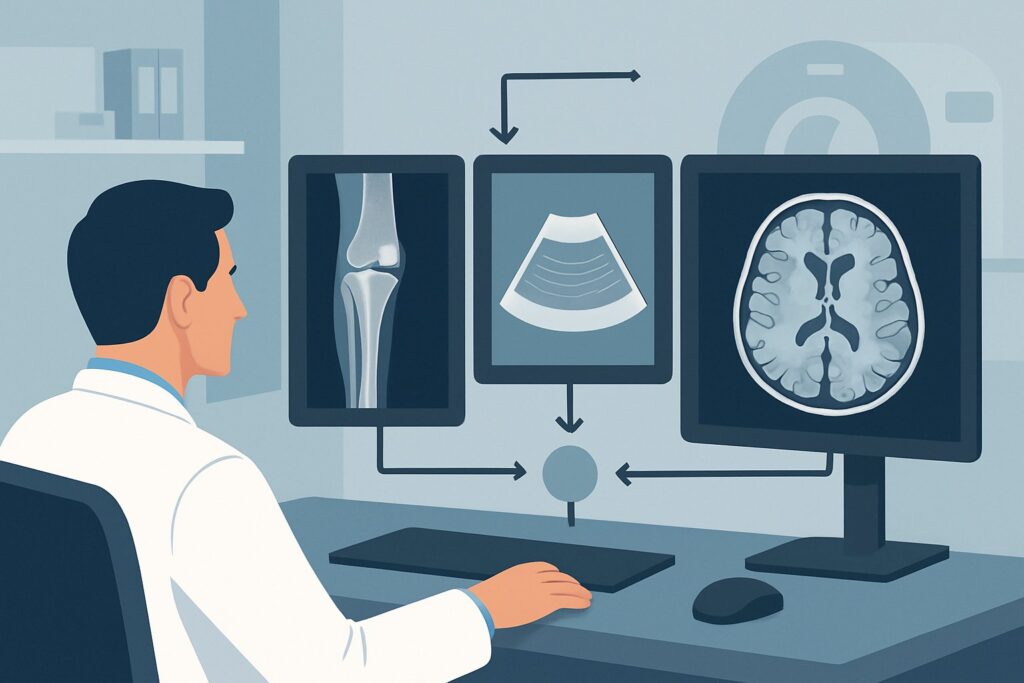
A 14-year-old boy presents to your clinic with several weeks of dull, aching pain in his right knee, worse at night. An initial radiograph reveals a well-circumscribed, geographic lesion in the metaphysis of his distal femur with a sclerotic border and no evidence of cortical destruction or aggressive periosteal reaction. The appearance is benign but not pathognomonic for a specific entity like an osteoid osteoma. You need to characterize this lesion further to guide management, but which advanced imaging study will provide the most diagnostic information without unnecessary radiation? According to the American College of Radiology (ACR) Appropriateness Criteria, for this specific scenario, an MRI of the area of interest without and with IV contrast is rated as May be appropriate, representing a primary pathway for further evaluation.
Who Fits This Clinical Scenario?
This clinical workflow is designed for a specific patient presentation: an adult or child who has already undergone initial radiography that identified a primary bone lesion with benign features. This guidance applies only when you have a definitive finding on an X-ray to evaluate further.
Inclusion Criteria for This Workflow:
- A bone lesion has been identified on a plain radiograph.
- The radiographic features are benign (e.g., well-defined “geographic” margins, a narrow zone of transition, sclerotic border, no cortical breakthrough, no aggressive periosteal reaction).
- The lesion is not characteristic of an osteoid osteoma, which has its own distinct imaging and management pathway.
Exclusion Criteria (These Scenarios Require a Different Approach):
- Initial Imaging: If the patient has symptoms concerning for a bone tumor but has not yet had any imaging, the first step is typically radiography. This article is for the workup after a lesion is found on that initial X-ray.
- Aggressive Appearance: If the radiograph shows features suggestive of malignancy (e.g., ill-defined margins, cortical destruction, sunburst or Codman’s triangle periosteal reaction), the workup is more urgent and follows a different ACR variant for aggressive-appearing lesions.
- Suspected Osteoid Osteoma: If the clinical picture (nocturnal pain relieved by NSAIDs) and radiographic findings (a small nidus with surrounding sclerosis) strongly suggest an osteoid osteoma, the imaging workup is tailored to confirming that specific diagnosis.
What Diagnoses Are You Working Up in This Scenario?
When a radiograph shows a benign-appearing bone lesion, the goal of further imaging is to confirm its benign nature, arrive at a specific diagnosis if possible, and rule out any features that might warrant biopsy or surgical intervention. The differential diagnosis is broad but typically centers on several common “leave-me-alone” lesions and other benign entities.
Non-ossifying Fibroma (NOF): One of the most common benign bone lesions in children and adolescents, NOFs are fibrous developmental defects, not true neoplasms. They have a classic eccentric, lobulated, and sclerotic-rimmed appearance on radiographs. MRI is used to confirm the solid, fibrous nature and lack of aggressive features if the radiographic appearance is slightly atypical.
Enchondroma: A common benign tumor of hyaline cartilage located in the medullary cavity of a bone. On radiographs, they often appear as lytic lesions with characteristic “rings and arcs” calcification (chondroid matrix). MRI is exceptionally useful for confirming the cartilaginous nature, showing lobules of high T2 signal, and assessing for any features concerning for malignant transformation into chondrosarcoma, such as endosteal scalloping or soft tissue extension.
Simple (Unicameral) Bone Cyst: A fluid-filled cavity most often seen in the proximal humerus or femur of children. While often classic on radiographs, MRI can definitively confirm the simple cystic (non-solid) nature of the lesion and identify a “fallen fragment” sign if a pathologic fracture has occurred, which is pathognomonic.
Aneurysmal Bone Cyst (ABC): An expansile, blood-filled benign tumor that can be locally destructive. While benign, they can grow rapidly and cause pain or fracture. MRI is the modality of choice for diagnosis, classically demonstrating the characteristic internal septations and fluid-fluid levels resulting from layering of blood products.
Fibrous Dysplasia: A developmental anomaly where normal bone is replaced with fibro-osseous tissue. Radiographs show a “ground-glass” matrix. MRI helps define the full extent of the lesion and can identify complications like fractures or, rarely, secondary ABC formation.
Why Is MRI the Recommended Next Step for a Benign-Appearing Lesion?
For a radiographically benign-appearing bone lesion, the primary goal is tissue characterization and detailed anatomical assessment. Magnetic Resonance Imaging (MRI) is uniquely suited for this task, which is why both MRI of the area of interest without and with IV contrast and MRI without IV contrast are rated as May be appropriate by the ACR.
MRI provides unparalleled contrast resolution of bone marrow and soft tissues. It can differentiate between cystic, fibrous, cartilaginous, and fatty tissue within a lesion, often leading to a specific diagnosis without the need for biopsy. Furthermore, it precisely delineates the lesion’s extent, its relationship to adjacent structures like growth plates (in children), neurovascular bundles, and joints. The administration of intravenous contrast can further characterize a lesion by assessing its vascularity, helping to distinguish between a simple cyst (non-enhancing) and a solid tumor or an aneurysmal bone cyst (which shows septal and peripheral enhancement).
A significant advantage, particularly in the pediatric population, is that MRI does not use ionizing radiation (adult and pediatric relative radiation level: O, 0 mSv).
Why are other imaging studies rated lower for this specific scenario?
- CT of the area of interest without IV contrast is also rated May be appropriate but is often considered secondary to MRI. CT excels at evaluating the bone matrix (e.g., subtle calcifications in an enchondroma) and cortical integrity. However, it offers far less information about the internal composition of the lesion and any potential soft tissue component.
- Bone Scan (whole body or with SPECT/CT) is rated Usually not appropriate. This modality measures metabolic activity, which is non-specific. Many benign lesions (like fibrous dysplasia or healing fractures through a cyst) can be “hot” on a bone scan, providing little diagnostic value and potentially causing unnecessary alarm. Its primary role is in staging known malignancies or detecting skeletal metastases, not characterizing a solitary benign-appearing lesion.
What’s Next After MRI? Downstream Workflow
The results of the MRI will guide the subsequent clinical pathway, which ranges from simple observation to surgical consultation. The goal is to confidently diagnose the lesion and determine its stability and potential for causing symptoms or complications.
- If the MRI confirms a classic “leave-me-alone” lesion (e.g., a typical non-ossifying fibroma, simple bone cyst, or uncomplicated enchondroma), the workup is often complete. The next step is typically clinical reassurance and observation. Follow-up imaging may be scheduled in some cases to ensure stability over time, especially for larger lesions or those near a joint.
- If the MRI shows an indeterminate lesion or a complex benign tumor (e.g., an aneurysmal bone cyst, chondroblastoma, or giant cell tumor), the next step is referral to an orthopedic oncologist. Even though these lesions are benign, they may require treatment due to pain, risk of pathologic fracture, or local aggressiveness. The MRI provides the crucial map for surgical planning or consideration of other treatments like curettage and bone grafting.
- If the MRI reveals unexpected aggressive features not apparent on the initial radiograph (e.g., a large soft tissue mass, extensive marrow infiltration, or cortical breakthrough), the management plan changes significantly. This finding shifts the patient into the workflow for an aggressive-appearing lesion. An urgent referral to an orthopedic oncologist for biopsy is the critical next step.
Pitfalls to Avoid (and When to Get Help)
Navigating the workup of a benign-appearing bone lesion requires careful attention to detail to avoid mischaracterization or unnecessary procedures.
- Pitfall 1: Incomplete Radiographic Assessment. Always obtain at least two orthogonal radiographic views. A lesion that appears benign on one view may reveal subtle aggressive features on another.
- Pitfall 2: Ordering a Bone Scan First. A bone scan is a functional study, not an anatomical one. For characterizing a single, benign-appearing lesion, it is a low-yield test that can be misleading.
- Pitfall 3: Misinterpreting a “Don’t Touch” Lesion. Becoming familiar with the classic radiographic and MRI appearances of common “leave-me-alone” lesions can prevent unnecessary anxiety, follow-up imaging, and biopsies.
- Pitfall 4: Ignoring the Patient’s Age. The differential diagnosis for bone tumors varies dramatically with age. A lesion that is common in a 15-year-old may be highly unusual in a 60-year-old.
If the MRI findings are equivocal, or if there is any discordance between the clinical picture and the imaging findings, escalate care by consulting with a musculoskeletal radiologist or an orthopedic oncologist.
Related ACR Topics and Tools
This article focuses on one specific clinical variant. For a comprehensive overview of all scenarios related to suspected primary bone tumors, from initial imaging to the workup of aggressive lesions, please see our parent guide. For additional resources on imaging selection, protocols, and radiation safety, explore the tools below.
- For breadth across all scenarios in Suspected Primary Bone Tumors, see our parent guide: Suspected Primary Bone Tumors: ACR Appropriateness Decoded.
- To explore other clinical situations, use the Imaging Appropriateness Selector.
- For detailed imaging techniques, visit the Imaging Protocol Library.
- To discuss radiation exposure with patients, consult the Radiation Dose Calculator.
Frequently Asked Questions
Why is MRI with and without contrast recommended over MRI without contrast alone?
Both are rated ‘May be appropriate.’ An MRI without contrast is often sufficient to characterize many simple benign lesions like a unicameral bone cyst or non-ossifying fibroma. However, adding IV contrast can be valuable for differentiating solid from cystic components, assessing the vascularity of a lesion, and identifying septal enhancement in tumors like aneurysmal bone cysts, which can increase diagnostic confidence and help guide potential intervention.
If the radiograph looks completely benign, is it ever okay to just observe without getting an MRI?
Yes, for certain pathognomonic ‘leave-me-alone’ lesions (like a classic fibrous cortical defect or non-ossifying fibroma in an asymptomatic child), further imaging may not be necessary. However, if the patient is symptomatic, the lesion is large, or the radiographic findings are not entirely classic for a specific entity, an MRI is warranted to confirm the diagnosis and rule out any underlying aggressive features.
Is CT ever the preferred next step after a benign-appearing radiograph?
While MRI is generally preferred for its superior soft tissue and marrow characterization, CT can be particularly useful in specific situations. For instance, if the primary question is to better evaluate a lesion’s mineralized matrix (e.g., the ‘rings and arcs’ of an enchondroma) or to precisely define subtle cortical thinning or breach, CT provides superior bone detail. It is also a viable alternative for patients with contraindications to MRI.
Does this guidance apply if I suspect a metastatic lesion instead of a primary bone tumor?
No, this guidance is specifically for suspected primary bone tumors. The workup for suspected metastatic disease is different. In an adult with a known primary cancer who develops a new bone lesion, the pre-test probability of metastasis is high, and the imaging workup (often involving a bone scan or PET/CT) is geared toward staging and detecting other sites of disease.
What if the benign-appearing lesion is found incidentally in an asymptomatic patient?
The workflow is generally the same. An incidentally discovered, benign-appearing lesion still requires characterization to ensure it is not an indolent but potentially problematic tumor. An MRI can confirm its benign nature, often allowing for simple reassurance and cessation of further workup, which is a valuable outcome for an incidental finding.
Reviewed by Pouyan Golshani, MD, Interventional Radiologist — May 26, 2026