What Is the First-Line Treatment for Acute Iliofemoral DVT in Pregnancy?
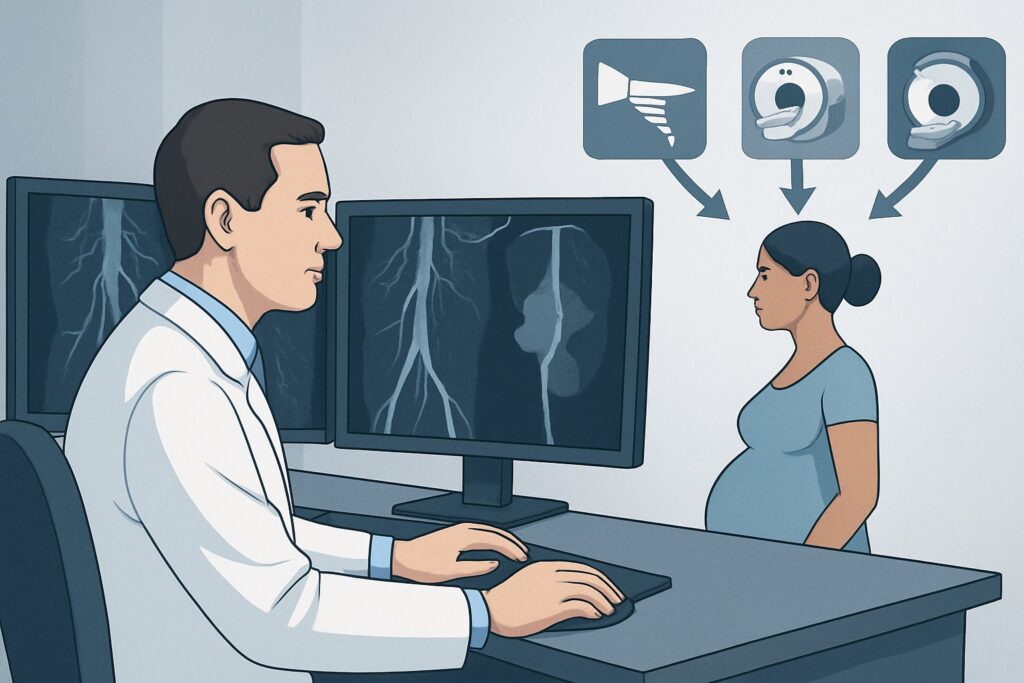
A 32-year-old patient, 28 weeks pregnant, presents to the emergency department with a painful, swollen, and discolored left leg that started two days ago. Her symptoms are severe enough to limit her ability to walk comfortably. A duplex ultrasound confirms an extensive deep vein thrombosis (DVT) involving the common femoral and iliac veins. The immediate clinical question is how to manage this acute iliofemoral DVT, balancing the urgent need for maternal treatment against the potential risks to the fetus. This article provides a detailed clinical workflow for this specific scenario, guided by the American College of Radiology (ACR) Appropriateness Criteria. For a pregnant patient with moderate to severe acute iliofemoral DVT, the ACR panel rates Anticoagulation alone as Usually appropriate.
## Who Fits This Clinical Scenario for Iliofemoral DVT in Pregnancy?
This guidance is specifically for a pregnant patient presenting with an acute iliofemoral deep vein thrombosis. The key inclusion criteria are:
- Confirmed Pregnancy: The patient is currently pregnant, a state that significantly alters both the risk of thrombosis and the safety profile of potential treatments.
- Acute Onset: Symptoms have been present for less than 14 days.
- Iliofemoral Location: The thrombus is located in the large veins of the pelvis and upper thigh (iliac and/or common femoral veins), which carries a higher risk of both pulmonary embolism (PE) and severe post-thrombotic syndrome compared to more distal DVTs.
- Moderate to Severe Symptoms: The patient experiences significant pain, swelling, and/or functional limitation, but the limb is not immediately threatened.
It is critical to distinguish this presentation from other similar but distinct clinical scenarios that require a different management approach. This workflow does not apply if:
- Symptoms are mild: Patients with minimal swelling or pain may be managed with anticoagulation, but the consideration for more invasive therapies is substantially lower.
- The patient has limb-threatening ischemia (phlegmasia cerulea dolens): This is a vascular emergency characterized by massive swelling, severe cyanosis, and potential arterial compromise. It requires immediate, aggressive intervention that goes beyond standard anticoagulation.
- The patient is not pregnant: The risk-benefit analysis for interventions like thrombolysis changes dramatically when fetal safety is not a factor.
- The DVT is chronic: If symptoms have persisted for months after initial diagnosis and treatment, the workup shifts toward managing post-thrombotic syndrome, not acute thrombus.
## What Diagnoses Are You Working Up in This Scenario?
While the diagnosis of DVT is established by ultrasound, the initial management is guided by understanding the underlying cause and potential for complications. The clinical workup is focused on characterizing the extent of the thrombosis and identifying factors that may influence treatment.
Uncomplicated Acute Iliofemoral DVT: This is the most direct diagnosis. The thrombus is confined to the iliofemoral venous system without evidence of impending limb compromise. The primary goals of treatment are to prevent thrombus propagation, reduce the risk of a life-threatening pulmonary embolism, and minimize the long-term risk of post-thrombotic syndrome (PTS).
May-Thurner Syndrome (Iliac Vein Compression): This anatomic variant is a crucial consideration, particularly for left-sided DVTs in female patients. It occurs when the right common iliac artery compresses the left common iliac vein against the lumbar spine, predisposing the patient to thrombosis. While initial management with anticoagulation remains the same, identifying this underlying condition may influence decisions about long-term care or intervention after pregnancy to prevent recurrence.
Impending Phlegmasia: The scenario specifies moderate to severe symptoms, placing the patient on a spectrum of venous outflow obstruction. Clinicians must remain vigilant for progression toward phlegmasia cerulea dolens, the most severe form of DVT. This condition involves near-total venous occlusion, leading to massive edema and cyanosis that can compromise arterial inflow and threaten limb viability. Worsening pain, rapidly expanding swelling, or new skin discoloration are red flags.
Hypercoagulable State of Pregnancy: This is not a separate diagnosis but the essential context. Pregnancy induces a physiologic prothrombotic state to minimize postpartum hemorrhage. This, combined with mechanical venous compression from the gravid uterus, dramatically increases the risk of DVT. Management must always account for this underlying state, which will persist until after delivery.
## Why Is Anticoagulation Alone Usually Appropriate for Iliofemoral DVT in Pregnancy?
For a pregnant patient with acute, symptomatic iliofemoral DVT, the ACR designates Anticoagulation alone as Usually appropriate. This recommendation prioritizes maternal and fetal safety while effectively treating the thrombosis.
The primary rationale is the favorable risk-benefit profile of anticoagulation in pregnancy. Low-molecular-weight heparin (LMWH) is the agent of choice. It is effective at preventing thrombus extension and pulmonary embolism, and crucially, its large molecular size prevents it from crossing the placental barrier, ensuring no direct anticoagulant effect on the fetus. This approach directly addresses the life-threatening risks of DVT with a well-established safety record for both mother and child.
In contrast, more invasive therapies carry higher risks in this specific population, leading to lower appropriateness ratings.
- Catheter-Directed Thrombolysis (CDT) or Pharmacomechanical Thrombectomy (PMT): Rated May be appropriate. These procedures offer faster thrombus removal and may reduce the risk of severe post-thrombotic syndrome. However, they require fluoroscopy, which involves ionizing radiation exposure to the fetus. While exposure can be minimized with abdominal shielding and careful technique, it cannot be eliminated. Furthermore, the thrombolytic drugs used can be absorbed systemically, posing a bleeding risk to both the mother and the uteroplacental unit. These interventions are typically reserved for cases with limb-threatening ischemia or for select patients with extremely severe symptoms where the potential benefits are felt to outweigh the substantial risks.
- Surgical Thrombectomy: Also rated May be appropriate. This option avoids thrombolytic drugs and can limit radiation exposure but involves the risks of anesthesia and major surgery in a pregnant patient. It is generally considered only when endovascular options are contraindicated or have failed in a patient with a threatened limb.
Given the risks of radiation and systemic drug effects associated with alternative treatments, anticoagulation alone stands as the safest and most appropriate initial management strategy for the vast majority of pregnant patients with acute iliofemoral DVT.
## What’s Next After Anticoagulation Alone? Downstream Workflow
Initiating anticoagulation is the first step in a longer management pathway that extends through pregnancy and the postpartum period. The downstream workflow depends on the patient’s clinical response.
- If symptoms improve: This is the expected outcome for most patients. Continue therapeutic LMWH throughout the remainder of the pregnancy and for at least six weeks postpartum, for a total minimum duration of three months. The patient should also be managed with graded compression stockings to reduce edema and potentially lower the risk of post-thrombotic syndrome. A multidisciplinary team involving obstetrics, hematology, and vascular medicine is essential.
- If symptoms fail to improve or worsen: If the patient’s pain and swelling do not respond to anticoagulation or progress despite adequate therapy, this signals significant venous outflow obstruction. An urgent re-evaluation is necessary. This may prompt consideration of the therapies rated May be appropriate, such as catheter-directed thrombolysis or thrombectomy. The decision to escalate care must be made by a multidisciplinary team, carefully weighing the increasing maternal limb risk against the fetal risks of intervention.
- Postpartum evaluation: After delivery, when the risks of intervention are substantially lower, further evaluation may be warranted, especially if an underlying condition like May-Thurner syndrome is suspected. For patients with significant residual symptoms, cross-sectional imaging (such as CT or MR venography) can assess for chronic thrombus or iliac vein compression. This may identify patients who could benefit from a delayed intervention, such as stenting, to restore venous patency and prevent long-term complications.
## Pitfalls to Avoid (and When to Get Help)
Managing iliofemoral DVT in pregnancy requires careful attention to detail to avoid common pitfalls.
- Underdosing Anticoagulation: Pregnant patients have an increased volume of distribution and renal clearance, which can affect LMWH levels. Weight-based dosing is standard, but monitoring with anti-Xa levels may be necessary, particularly in patients with renal insufficiency or at extremes of weight.
- Delaying Treatment: Acute DVT is a medical urgency. Delays in diagnosis or initiation of anticoagulation increase the risk of thrombus extension and pulmonary embolism.
- Ignoring Worsening Symptoms: Do not assume that worsening leg pain or swelling is a normal part of the process. This can be a sign of treatment failure or progression to phlegmasia and requires immediate reassessment.
- Failing to Plan for Delivery: A clear plan for peripartum anticoagulation management is critical. LMWH must be stopped prior to planned delivery or neuraxial anesthesia to minimize bleeding risk, and a transition to unfractionated heparin may be required.
If you observe rapidly worsening swelling, cyanosis, or severe pain out of proportion to physical findings, escalate immediately to a vascular specialist and the obstetrics team. This may represent a limb-threatening emergency requiring intervention.
## Related ACR Topics and Tools
For a comprehensive overview of all clinical variants related to this topic, please see our parent guide. Additional GigHz resources can help you apply these criteria in your daily practice.
- Parent Topic Hub: For breadth across all scenarios in Radiologic Management of Iliofemoral Venous Thrombosis, see our parent guide: Radiologic Management of Iliofemoral Venous Thrombosis: ACR Appropriateness Decoded.
- Decision Support and Reference Tools:
- ACR Appropriateness Criteria Lookup — for adjacent scenarios
- Imaging Protocol Library — for technique on the recommended study
- Radiation Dose Calculator — for cumulative dose conversations
Frequently Asked Questions
Why isn’t catheter-directed thrombolysis (CDT) the first choice if it can prevent post-thrombotic syndrome?
While CDT may reduce the risk of post-thrombotic syndrome, it is not the first choice in pregnancy due to the risks of fetal radiation exposure from fluoroscopy and maternal/placental bleeding from thrombolytic drugs. The ACR panel deems these risks significant enough that anticoagulation alone, which is very safe for the fetus, is the ‘Usually appropriate’ first-line therapy. CDT is reserved for more severe cases where benefits may outweigh these risks.
What is the preferred anticoagulant for a pregnant patient with DVT?
Low-molecular-weight heparin (LMWH), such as enoxaparin, is the preferred anticoagulant. It does not cross the placenta, has a predictable dose-response, and has a well-established safety record in pregnancy. Warfarin is teratogenic and contraindicated, and the safety of direct oral anticoagulants (DOACs) in pregnancy has not been established.
Is an IVC filter indicated for a pregnant patient with iliofemoral DVT?
An inferior vena cava (IVC) filter is generally not indicated as a primary treatment. Its use is typically reserved for patients with a contraindication to anticoagulation (e.g., active major bleeding) or in cases of recurrent pulmonary embolism despite therapeutic anticoagulation. Routine placement is not recommended.
How should this patient be monitored after starting anticoagulation?
Clinical monitoring is key. The patient should be monitored for symptom improvement (decreased pain and swelling) and for any signs of bleeding. While routine anti-Xa level monitoring is not always required, it may be considered in certain situations, such as renal insufficiency or extremes of body weight, to ensure therapeutic dosing. A multidisciplinary team involving obstetrics and hematology should follow the patient closely.
If my patient has a left-sided DVT, should I work her up for May-Thurner syndrome now?
An immediate, extensive workup for May-Thurner syndrome during pregnancy is usually not necessary, as the initial treatment—anticoagulation—remains the same regardless. The diagnosis is often suspected based on the left-sided location. Definitive imaging with CT or MR venography to confirm the iliac vein compression is typically deferred until after delivery to avoid radiation or contrast agents. The suspicion may, however, influence long-term management plans.
Reviewed by Pouyan Golshani, MD, Interventional Radiologist — May 29, 2026