What Is the Next Imaging Study for a Soft Tissue Mass After Nondiagnostic Radiograph and Ultrasound?
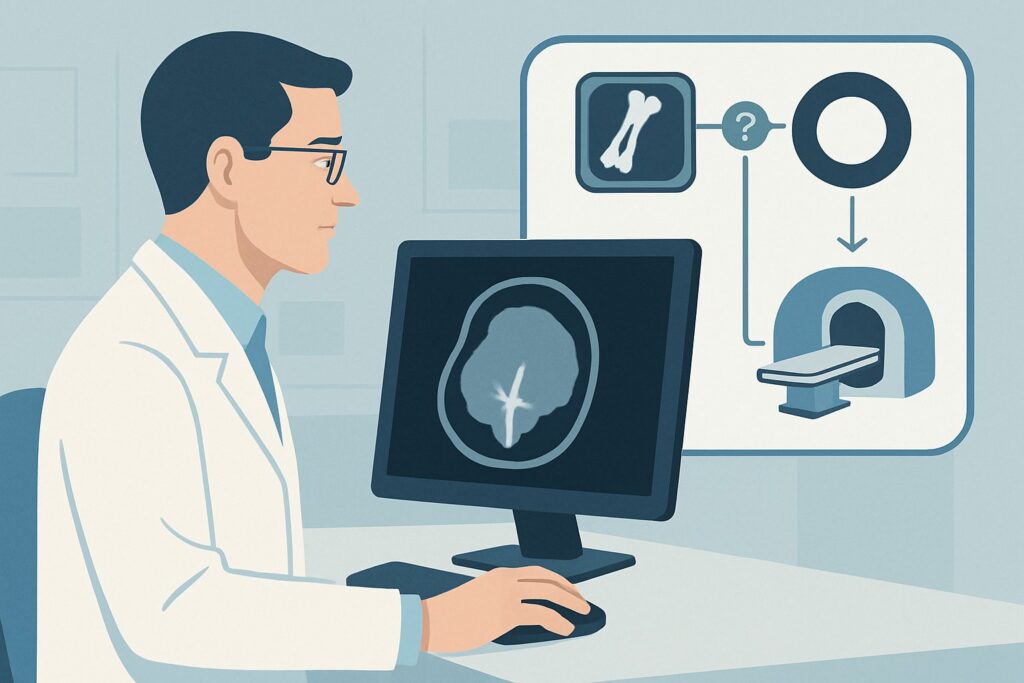
A 45-year-old patient presents with a firm, palpable mass in the posterior thigh, noticed several weeks ago. You obtain a radiograph, which shows no osseous lesion or suspicious calcifications. A subsequent noncontrast enhanced ultrasound is performed, but the sonographer and radiologist report an indeterminate, heterogeneous, deep soft tissue mass without classic features of a lipoma or cyst. You are now back at the electronic health record, faced with a critical decision: what is the next, most appropriate imaging study to order to characterize this mass and guide management? This article details the American College of Radiology (ACR) evidence-based workflow for this specific clinical scenario. For this presentation, the ACR designates MRI of the area of interest without and with IV contrast as Usually Appropriate.
Who Fits This Clinical Scenario for a Soft Tissue Mass?
This guidance applies to a specific patient population where initial imaging has been performed but has not yielded a definitive diagnosis. Understanding the inclusion and exclusion criteria is essential for applying this workflow correctly.
This workflow is for patients who:
- Present with a palpable or incidentally discovered soft tissue mass.
- Have already undergone initial imaging with both a radiograph and a noncontrast enhanced ultrasound.
- The results of both initial studies are nondiagnostic or indeterminate, failing to confidently characterize the mass as a simple benign entity like a lipoma or cyst.
This workflow does NOT apply if:
- Initial imaging has not been performed. For a patient presenting for the first time with a soft tissue mass, the workup is different. The initial choice of imaging depends on whether the mass is superficial or deep. These are covered in separate ACR appropriateness criteria variants.
- Initial imaging was diagnostic. If ultrasound confidently identifies a simple cyst, a typical lipoma, or another benign finding, further advanced imaging is often unnecessary, and the patient can proceed to observation or treatment as indicated.
- The patient has a clear contraindication to MRI. For patients with incompatible implanted devices (e.g., certain pacemakers, cochlear implants), severe claustrophobia, or an inability to remain still, an alternative pathway is required. This specific situation is addressed in the sibling scenario, “Soft tissue mass. Nondiagnostic radiograph and noncontrast enhanced ultrasound. MRI contraindicated.”
What Diagnoses Are You Working Up in This Scenario?
When initial radiographs and ultrasound are inconclusive, the differential diagnosis broadens, and the primary goal of the next imaging study is to differentiate benign from potentially malignant lesions. The inability to characterize the mass with first-line modalities raises the index of suspicion for more complex pathology.
Soft Tissue Sarcoma
This is the most consequential diagnosis to exclude. Sarcomas are rare but potentially lethal malignancies that can arise in any soft tissue. On ultrasound, they often appear as complex, heterogeneous, solid masses with internal vascularity, features that lead to an “indeterminate” classification. Advanced imaging is critical for local staging and determining if the lesion has features suspicious for malignancy, which would prompt a biopsy at a specialized center.
Benign but Atypical Tumors
Many benign soft tissue tumors can have a complex or atypical appearance on ultrasound, mimicking malignancy. Examples include schwannomas, neurofibromas, desmoid-type fibromatosis, and large intramuscular hemangiomas. While benign, these lesions often require surgical excision and benefit from precise pre-operative characterization to plan the surgical approach and avoid nerve or vessel injury.
Atypical Lipoma / Well-Differentiated Liposarcoma
While a simple lipoma is one of the most common soft tissue masses and is typically easy to diagnose on ultrasound, atypical variants can be challenging. The presence of thick septa, nodular non-fatty components, or significant vascularity makes the distinction between a benign atypical lipoma and a low-grade well-differentiated liposarcoma difficult on ultrasound alone, necessitating further evaluation.
Organized Hematoma or Abscess
In its subacute or chronic phase, a hematoma can organize and develop a complex, solid-appearing structure on ultrasound. Similarly, a complex or partially treated abscess can mimic a solid neoplasm. The patient’s history may be suggestive, but imaging with intravenous contrast is often required to distinguish these inflammatory or post-traumatic masses from a true neoplasm based on their characteristic enhancement patterns.
Why Is MRI Without and With IV Contrast Usually Appropriate for This Workup?
The American College of Radiology (ACR) rates MRI of the area of interest without and with IV contrast as Usually Appropriate for this clinical scenario. This recommendation is based on magnetic resonance imaging’s superior ability to characterize soft tissues and define the extent of a lesion, which is paramount when initial studies are inconclusive.
The power of MRI in this context lies in its multi-sequence approach.
- Pre-contrast sequences (e.g., T1-weighted, T2-weighted, fat-suppressed sequences) provide detailed anatomical information and characterize the intrinsic properties of the mass. T1-weighted images are exceptionally sensitive for identifying fat, which is key to diagnosing lipomatous tumors. T2-weighted images excel at detecting fluid and edema, helping to define cystic components and surrounding inflammation.
- Post-contrast sequences, performed after administering an intravenous gadolinium-based contrast agent, reveal the vascularity and enhancement pattern of the mass. Malignant tumors, particularly sarcomas, tend to be hypervascular and show avid, often heterogeneous enhancement. The pattern of enhancement helps differentiate tumors from non-neoplastic mimics like hematomas or abscesses and is crucial for pre-biopsy planning.
This comprehensive evaluation allows the radiologist to determine the mass’s size, precise location (e.g., subcutaneous, intramuscular, intermuscular), and its relationship to critical adjacent structures like nerves, blood vessels, and bone. This information is vital for determining the likelihood of malignancy and for planning a potential biopsy or surgical resection. Importantly, MRI achieves this superior soft tissue characterization with no ionizing radiation (adult and pediatric radiation level: O 0 mSv).
Why are other studies rated lower for this specific scenario?
- CT with IV contrast is rated May be appropriate. While CT is a valid alternative, especially when MRI is contraindicated, its soft tissue contrast resolution is inherently lower than MRI’s. It is less sensitive for differentiating various types of soft tissue and characterizing the internal architecture of a mass. It also involves ionizing radiation (radiation level: Varies).
- Image-guided biopsy is rated Usually not appropriate as the next step. This is a critical workflow principle. Biopsy is the definitive diagnostic tool, but performing it before comprehensive cross-sectional imaging is a significant pitfall. Pre-imaging biopsy can be performed at a non-representative part of the tumor, and the needle track can contaminate uninvolved tissue planes, potentially complicating a subsequent limb-sparing cancer surgery. The standard of care is to perform advanced imaging first to fully characterize the lesion and plan the safest, most effective biopsy approach.
What’s Next After MRI? Downstream Workflow
The results of the contrast-enhanced MRI will guide the subsequent steps in the patient’s management, creating a clear decision tree for the referring clinician.
- If the MRI suggests a likely malignancy (e.g., sarcoma): The immediate next step is referral to a multidisciplinary team at a center specializing in sarcoma care. This team, typically including a surgical oncologist, medical oncologist, radiation oncologist, and musculoskeletal radiologist, will review the imaging and plan an image-guided core needle biopsy. The biopsy must be meticulously planned to avoid compromising future surgical resection.
- If the MRI is diagnostic of a specific benign entity (e.g., hemangioma, neurofibroma): The workflow depends on the specific diagnosis and the patient’s symptoms. Asymptomatic, classic-appearing benign lesions may be managed with clinical follow-up. Symptomatic lesions may be referred for surgical excision or other appropriate treatment.
- If the MRI confirms a simple lipoma or cyst: No further workup is typically needed. The patient can be reassured, and if the lesion is symptomatic, they can be referred for elective excision.
- If the MRI remains indeterminate: Even with MRI’s advanced capabilities, some lesions may remain indeterminate. In these cases, the lesion is treated as potentially malignant until proven otherwise. The patient should be referred to a sarcoma center for consultation and probable biopsy, as the risk of malignancy cannot be excluded by imaging alone.
Pitfalls to Avoid (and When to Get Help)
Navigating the workup of an indeterminate soft tissue mass requires careful sequencing of diagnostic tests. Avoiding common errors can prevent diagnostic delays and ensure optimal patient outcomes.
- Pitfall 1: Premature Biopsy. Do not order a biopsy before obtaining advanced cross-sectional imaging (preferably MRI). An improperly placed biopsy can have serious negative consequences for subsequent cancer surgery.
- Pitfall 2: Ordering an Incomplete Study. Do not order an MRI “without contrast” when the indication is an indeterminate mass. Post-contrast imaging is essential for tissue characterization and is a standard part of the ACR-recommended protocol.
- Pitfall 3: Misinterpreting a “Negative” Radiograph. A normal radiograph is expected for most soft tissue masses. It effectively rules out a primary bone lesion but provides very little information about the soft tissue itself. Do not let a negative radiograph provide false reassurance.
- Pitfall 4: Accepting an “Indeterminate” Ultrasound. When an ultrasound report is inconclusive for a palpable mass, it should be considered a trigger for further action, not the end of the workup.
If the MRI report indicates features suspicious for sarcoma or remains indeterminate, the patient should be promptly referred to a surgical oncologist or orthopedic oncologist at a high-volume sarcoma center.
Related ACR Topics and Tools
For a comprehensive overview of imaging recommendations across all soft tissue mass presentations, and for tools to help you implement this guidance, please see the resources below.
- For breadth across all scenarios in Soft Tissue Masses, see our parent guide: Soft Tissue Masses: ACR Appropriateness Decoded.
- Imaging Appropriateness Selector: For exploring adjacent clinical scenarios and official ACR ratings.
- Imaging Protocol Library: For detailed technical specifications on how to perform the recommended imaging studies.
- Radiation Dose Calculator: For discussing cumulative radiation exposure with patients when considering CT as an alternative.
Frequently Asked Questions
Why can’t I just order a biopsy after the indeterminate ultrasound?
Performing a biopsy before advanced imaging like MRI is rated ‘Usually not appropriate’ by the ACR. An unplanned biopsy can contaminate clean tissue planes, making a future cancer surgery more extensive or even impossible. MRI is needed first to map the tumor’s extent and plan the safest biopsy trajectory, which should be done at a specialized center.
Is an MRI without contrast sufficient for a soft tissue mass?
For an indeterminate mass, an MRI without contrast is rated ‘May be appropriate,’ but the study ‘without and with IV contrast’ is ‘Usually Appropriate.’ The addition of a gadolinium-based contrast agent is critical for assessing the vascularity of the lesion, which helps differentiate benign from malignant tumors and distinguishes neoplasms from mimics like hematomas or abscesses.
What if my patient has a contraindication to MRI, like a pacemaker?
This is a distinct clinical scenario. The ACR provides separate guidance for ‘Soft tissue mass. Nondiagnostic radiograph and noncontrast enhanced ultrasound. MRI contraindicated.’ In that case, ‘CT of the area of interest without and with IV contrast’ becomes a ‘Usually Appropriate’ next step, as it is the best available alternative for cross-sectional imaging.
Does the size of the mass matter for this workflow?
While size is an important predictor of malignancy (lesions >5 cm are more concerning), this specific workflow applies regardless of size. The trigger for this pathway is not the size of the mass, but the fact that initial imaging (radiograph and ultrasound) was performed and returned an indeterminate result, necessitating further characterization.
If the mass is deep to the fascia, does that change the recommendation?
The location (deep vs. superficial) is a key factor in the initial imaging workup. However, in this specific scenario, the patient has already had nondiagnostic initial studies. Therefore, the recommendation for contrast-enhanced MRI as the next step holds true for both deep and superficial masses that remain indeterminate after ultrasound.
Reviewed by Pouyan Golshani, MD, Interventional Radiologist — May 26, 2026