What Is the Right First Imaging Study for Painless Second or Third Trimester Bleeding?
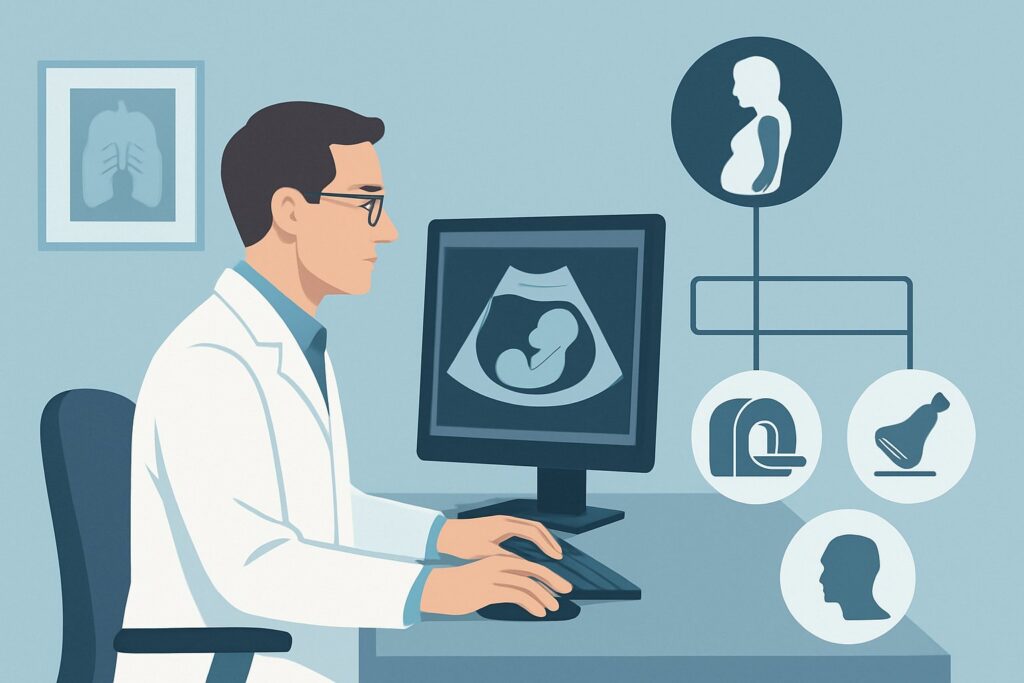
A patient, 32 weeks pregnant, presents to the obstetric triage unit after noticing a sudden, painless gush of bright red blood. She denies any trauma, contractions, or abdominal pain. Her vital signs are stable, and the fetal heart tracing is reassuring. The immediate clinical question is to identify the source of the bleeding, with the primary concern being a dangerous placental location. This is a time-sensitive scenario where choosing the correct initial imaging study is critical for both maternal and fetal well-being. This article provides a focused workflow for this exact presentation, explaining why the American College of Radiology (ACR) rates US duplex Doppler pelvis as Usually Appropriate as the initial imaging step.
Who Fits This Clinical Scenario?
This guidance is specifically for a pregnant patient in the second or third trimester (beyond 20 weeks gestation) who presents with vaginal bleeding that is characterized as painless. The bleeding can range from spotting to a significant amount, but the absence of associated abdominal pain, cramping, or uterine tenderness is the key feature that defines this clinical pathway. This article addresses the initial imaging workup for a patient without a previously known or diagnosed placental abnormality.
This workflow does not apply to several similar-appearing but distinct clinical situations:
- Painful Bleeding: If the patient presents with vaginal bleeding accompanied by abdominal pain, uterine tenderness, or high-frequency contractions, the primary concern shifts toward placental abruption. This requires a different diagnostic approach, as detailed in the ACR variant for painful second and third trimester bleeding.
- Known Placental Abnormality: If a patient has a previously diagnosed placenta previa, low-lying placenta, or vasa previa on a prior ultrasound, the imaging strategy is typically for follow-up and management planning, not initial diagnosis.
- Post-Trauma Bleeding: Vaginal bleeding after significant maternal trauma (e.g., a motor vehicle collision) has a unique differential and workup, with a high suspicion for traumatic abruption.
What Diagnoses Are You Working Up in This Scenario?
Painless late-trimester bleeding prompts an urgent evaluation for conditions that can lead to severe maternal or fetal compromise. The choice of imaging is driven by the need to rapidly confirm or exclude these key diagnoses.
Placenta Previa: This is the leading diagnosis to exclude. It occurs when the placenta partially or completely covers the internal cervical os. The classic presentation is sudden, painless, bright red vaginal bleeding as the lower uterine segment begins to thin and change in the later stages of pregnancy. Ultrasound is highly sensitive and specific for identifying the location of the placenta relative to the cervix.
Vasa Previa: A less common but potentially catastrophic condition where unprotected fetal blood vessels run across or in close proximity to the internal cervical os. If these vessels rupture, it can lead to rapid fetal exsanguination and death. Bleeding from vasa previa is fetal in origin and often occurs with cervical change or rupture of membranes. Color Doppler ultrasound is essential for this diagnosis.
Placental Abruption (Marginal): While classic placental abruption is associated with significant pain, a small separation at the edge of the placenta (a marginal abruption) can sometimes present with painless bleeding. Ultrasound has low sensitivity for detecting small abruptions, but it remains a crucial part of the initial workup to rule out previa, which is a more common cause of painless bleeding.
Benign Cervical or Vaginal Causes: Less emergent but still on the differential are sources like a cervical polyp, cervical ectropion, or early labor with “bloody show.” While imaging may not identify these, it is critical for ruling out the life-threatening placental causes before a speculum exam is considered.
Why Is US Duplex Doppler Pelvis the Recommended Initial Study?
For a patient with painless second or third trimester bleeding, ultrasound is the definitive initial imaging modality. It is safe, widely available, and provides the necessary anatomical information without exposing the mother or fetus to ionizing radiation. The ACR rates three forms of ultrasound as Usually Appropriate, with US duplex Doppler pelvis being the most comprehensive initial step.
The standard workflow often involves a combination of techniques:
- Transabdominal (TA) Ultrasound: The evaluation almost always begins with a transabdominal approach (rated Usually Appropriate). This provides a broad overview of the uterus, confirms fetal viability and position, assesses amniotic fluid volume, and, most importantly, localizes the placenta. However, it can be limited by maternal body habitus, an over-distended bladder (which can compress the lower uterine segment and mimic a previa), or a posterior placenta.
- Transvaginal (TV) Ultrasound: If the placenta appears to be low-lying or covering the cervix on the TA scan, a transvaginal ultrasound (also rated Usually Appropriate) is the gold standard for confirmation. It provides a clear, high-resolution view of the relationship between the leading edge of the placenta and the internal cervical os. Contrary to old concerns, TVUS is considered safe in the setting of suspected previa, as the probe does not enter the cervix and can be inserted under direct visualization.
- Duplex Doppler Evaluation: The addition of color and pulsed Doppler is what makes US duplex Doppler pelvis the most robust choice. This is absolutely critical for evaluating for vasa previa. Color Doppler will highlight blood flow, allowing the sonographer to visualize any fetal vessels crossing the internal os. This is a can’t-miss diagnosis, making the Doppler component essential.
An alternative, US cervix transperineal, is rated as May be appropriate. This can be a useful option if a patient declines a transvaginal scan, but it generally provides less detail than the transvaginal approach. All ultrasound modalities carry a radiation level of 0 mSv, making them the safest option in pregnancy.
What’s Next After the Ultrasound? Downstream Workflow
The results of the initial ultrasound will dictate the subsequent clinical pathway and urgency of management.
- If the study is positive for Placenta Previa: The patient requires immediate consultation with an obstetrician. Management depends on gestational age and the severity of bleeding but typically includes admission for observation, administration of antenatal corticosteroids if preterm, strict pelvic rest, and planning for a scheduled cesarean delivery, usually between 36 and 37 weeks gestation.
- If the study is positive for Vasa Previa: This is an obstetric emergency requiring immediate MFM consultation and inpatient management. The goal is to deliver the baby via scheduled cesarean section prior to the onset of labor or rupture of membranes, often between 34 and 37 weeks, to prevent catastrophic fetal hemorrhage.
- If the study is negative for Previa and Vasa Previa: With the most life-threatening placental causes ruled out, attention can turn to other etiologies. A careful speculum examination may be performed to look for cervical or vaginal lesions. If no source is found and bleeding has resolved, the patient may be discharged with close follow-up. If bleeding continues, admission for monitoring for signs of a concealed placental abruption may be warranted, even with a negative ultrasound.
Pitfalls to Avoid (and When to Get Help)
In this high-stakes scenario, several common errors can compromise patient care. Be mindful of the following:
- Performing a Digital Cervical Exam Before Imaging: Never perform a digital or speculum exam on a patient with third-trimester bleeding until placenta previa has been definitively ruled out by ultrasound. A digital exam can precipitate massive, life-threatening hemorrhage.
- Relying Solely on a Transabdominal Scan: A posterior placenta or a full bladder can make it impossible to rule out previa on a TA scan alone. If there is any doubt, proceed to a transvaginal ultrasound for a definitive view of the cervical os.
- Forgetting to Use Color Doppler: Failing to specifically evaluate the area over the cervix with color Doppler can lead to a missed diagnosis of vasa previa. Always ensure this is part of the standard protocol.
If the ultrasound findings are equivocal, or if there is a strong clinical suspicion for a significant abruption despite a negative scan, escalate immediately by consulting with a maternal-fetal medicine (MFM) specialist.
Related ACR Topics and Tools
This article covers one specific clinical scenario. For a comprehensive overview of all related presentations and for tools to assist in your clinical practice, please refer to the following resources.
- For breadth across all scenarios in Second and Third Trimester Vaginal Bleeding, see our parent guide: Second and Third Trimester Vaginal Bleeding: ACR Appropriateness Decoded.
- To explore other clinical situations, use the Imaging Appropriateness Selector.
- For detailed procedural steps on the recommended study, see the Imaging Protocol Library.
- To discuss radiation exposure with patients for other imaging modalities, use the Radiation Dose Calculator.
Frequently Asked Questions
Is a transvaginal ultrasound safe if I suspect placenta previa?
Yes. Modern evidence shows that transvaginal ultrasound is safe in patients with suspected placenta previa. The probe is inserted carefully into the vaginal canal and does not enter the cervix. It provides the most accurate measurement of the distance between the placental edge and the internal cervical os, which is critical for diagnosis and management.
What if the ultrasound is completely normal but the patient is still bleeding?
If the ultrasound rules out placenta previa and vasa previa, the next steps involve searching for other causes. This may include a careful speculum exam to look for cervical or vaginal lesions. If no source is found, a small marginal placental abruption, which is often not visible on ultrasound, should be considered. The patient typically requires continued maternal and fetal monitoring.
Why is MRI not recommended for this initial workup?
While MRI can visualize the placenta, it is not the appropriate initial study. Ultrasound is faster, less expensive, more readily available, and does not involve any potential concerns about gadolinium contrast or prolonged time in the scanner. Ultrasound is highly accurate for diagnosing placenta previa and vasa previa, making MRI unnecessary for the initial evaluation of painless bleeding.
Does a ‘low-lying placenta’ diagnosed earlier in pregnancy mean the patient has previa?
Not necessarily. Many placentas that are low-lying in the second trimester will appear to ‘migrate’ away from the cervix as the uterus grows. A diagnosis of placenta previa is typically not confirmed until the third trimester. However, a history of a low-lying placenta would increase the suspicion for previa if the patient presents with bleeding.
What is the difference between a standard pelvic ultrasound and a ‘US duplex Doppler pelvis’?
A standard pelvic ultrasound uses grayscale imaging to visualize anatomy. A US duplex Doppler pelvis adds color and spectral Doppler, which allows for the visualization and assessment of blood flow. This addition is essential in this scenario to screen for vasa previa by identifying fetal blood vessels near the cervix.
Reviewed by Pouyan Golshani, MD, Interventional Radiologist — May 26, 2026