When to Order Imaging for Acute Onset of Scrotal Pain-Without Trauma, Without Antecedent Mass: ACR Appropriateness Decoded

It’s 11 p.m. in the emergency department, and you are evaluating a 16-year-old male with a 3-hour history of severe, unilateral scrotal pain and nausea. His vitals are stable, but he is in significant distress. The clinical suspicion is high for testicular torsion, a true urologic emergency, but epididymo-orchitis is also on the differential. Every minute counts, and the choice of initial imaging is critical. Do you order a CT scan to rule out other abdominal or pelvic pathology, or go straight to ultrasound? The American College of Radiology (ACR) provides clear, evidence-based guidance to navigate this time-sensitive decision. This article decodes the ACR Appropriateness Criteria for this exact scenario, helping you choose the right test, right away.
What Does ACR Acute Onset of Scrotal Pain-Without Trauma, Without Antecedent Mass Cover?
The ACR Appropriateness Criteria for “Acute Onset of Scrotal Pain-Without Trauma, Without Antecedent Mass” provides guidance for the initial imaging of patients presenting with sudden, non-traumatic scrotal pain. This clinical scenario is a common presentation in emergency departments and outpatient clinics and applies to both adult and pediatric patients. The primary goal of imaging is to rapidly differentiate between emergent conditions requiring immediate surgical intervention, such as testicular torsion, and less urgent inflammatory or infectious conditions like epididymitis or orchitis.
This guideline specifically applies when:
- The onset of pain is acute (typically within hours to a few days).
- There is no history of recent trauma to the scrotum or pelvis.
- The patient does not have a previously known or palpable scrotal mass.
These criteria do not apply to patients with chronic scrotal pain, pain directly resulting from an injury, or the evaluation of a known testicular mass. For those presentations, different ACR guidelines should be consulted to ensure the most appropriate imaging pathway is selected.
What Imaging Should I Order for Acute Onset of Scrotal Pain-Without Trauma, Without Antecedent Mass? Recommendations by Clinical Scenario
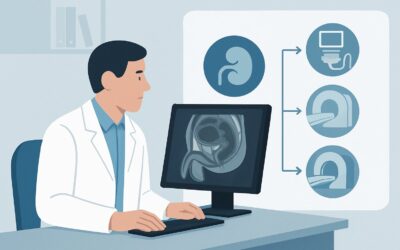
For the clinical scenario of an adult or child presenting with acute scrotal pain without trauma or a pre-existing mass, the ACR’s recommendations are focused and unambiguous. The primary objective is a rapid, accurate assessment of testicular perfusion and anatomy.
For this initial workup, the ACR rates US duplex Doppler scrotum and US scrotum as Usually Appropriate. Ultrasound is the undisputed first-line imaging modality. It is fast, widely available, non-invasive, and uses no ionizing radiation. Grayscale ultrasound provides detailed anatomic information, identifying testicular size, echotexture, and surrounding structures. The addition of color and spectral Doppler is crucial for directly visualizing and quantifying blood flow to the testis. The absence of arterial flow on Doppler imaging is the key finding in testicular torsion, while increased flow is characteristic of inflammatory conditions like epididymitis and orchitis.
Conversely, several other imaging modalities are rated as Usually Not Appropriate for the initial evaluation. These include CT pelvis (with, without, or with and without IV contrast), MRI pelvis (scrotum) (with or without IV contrast), and nuclear medicine scan scrotum. CT exposes the patient to significant ionizing radiation with inferior soft-tissue resolution of the scrotal contents compared to ultrasound. MRI, while providing excellent anatomic detail, is time-consuming, costly, and often less accessible in an emergency setting, potentially delaying the diagnosis of torsion. The nuclear medicine testicular scan has been largely supplanted by Doppler ultrasound, which offers superior anatomic detail, is faster to perform, and avoids radiation exposure.
ACR Imaging Recommendations Table
| Clinical Scenario | Procedure | ACR Rating | Adult RRL | Pediatric RRL |
|---|---|---|---|---|
| Adult or child. Acute onset of scrotal pain. Without trauma, without antecedent mass. Initial imaging. | US duplex Doppler scrotum | Usually appropriate | O 0 mSv | O 0 mSv [ped] |
| Adult or child. Acute onset of scrotal pain. Without trauma, without antecedent mass. Initial imaging. | US scrotum | Usually appropriate | O 0 mSv | O 0 mSv [ped] |
| Adult or child. Acute onset of scrotal pain. Without trauma, without antecedent mass. Initial imaging. | MRI pelvis (scrotum) without and with IV contrast | Usually not appropriate | O 0 mSv | O 0 mSv [ped] |
| Adult or child. Acute onset of scrotal pain. Without trauma, without antecedent mass. Initial imaging. | MRI pelvis (scrotum) without IV contrast | Usually not appropriate | O 0 mSv | O 0 mSv [ped] |
| Adult or child. Acute onset of scrotal pain. Without trauma, without antecedent mass. Initial imaging. | CT pelvis with IV contrast | Usually not appropriate | ☢ ☢ ☢ 1-10 mSv | ☢ ☢ ☢ ☢ 3-10 mSv [ped] |
| Adult or child. Acute onset of scrotal pain. Without trauma, without antecedent mass. Initial imaging. | CT pelvis without IV contrast | Usually not appropriate | ☢ ☢ ☢ 1-10 mSv | ☢ ☢ ☢ ☢ 3-10 mSv [ped] |
| Adult or child. Acute onset of scrotal pain. Without trauma, without antecedent mass. Initial imaging. | Nuclear medicine scan scrotum | Usually not appropriate | ☢ ☢ ☢ 1-10 mSv | ☢ ☢ ☢ 0.3-3 mSv [ped] |
| Adult or child. Acute onset of scrotal pain. Without trauma, without antecedent mass. Initial imaging. | CT pelvis without and with IV contrast | Usually not appropriate | ☢ ☢ ☢ ☢ 10-30 mSv | ☢ ☢ ☢ ☢ 3-10 mSv [ped] |
Adult vs. Pediatric Acute Onset of Scrotal Pain-Without Trauma, Without Antecedent Mass Imaging: Radiation Dose Tradeoffs
For acute scrotal pain, the imaging recommendations for adults and children are identical: ultrasound is the first-line and preferred study. This alignment is driven by the principle of As Low As Reasonably Achievable (ALARA), which is paramount in pediatric imaging. Since ultrasound uses no ionizing radiation (0 mSv), it is the safest option for evaluating the sensitive, superficial structures of the scrotum in all age groups.
The ACR ratings highlight the significant radiation burden of alternative, “Usually Not Appropriate” studies. For instance, a CT of the pelvis carries a relative radiation level (RRL) of ☢ ☢ ☢ (1-10 mSv) in adults but is elevated to ☢ ☢ ☢ ☢ (3-10 mSv) in children. This higher pediatric rating reflects the increased lifetime risk of malignancy from radiation exposure in younger patients, whose cells are more radiosensitive and have more time to manifest potential long-term effects. By strongly recommending a radiation-free modality like ultrasound, the ACR guidelines help clinicians avoid unnecessary radiation exposure in both children and adults while providing a faster, more accurate diagnosis for this time-sensitive condition.
Imaging Protocol Details for Acute Onset of Scrotal Pain-Without Trauma, Without Antecedent Mass
Once you’ve decided on the right study, the protocol matters. A well-executed Doppler ultrasound is key to a definitive diagnosis. Our protocol guides cover technique, image optimization, and key diagnostic findings for the studies recommended above. While a specific scrotal ultrasound protocol is in development, you can review our other guides to see examples of how detailed protocols can improve diagnostic quality.
Tools to Help You Order the Right Study
Navigating imaging guidelines efficiently is essential for modern clinical practice. GigHz offers a suite of free reference tools designed to support evidence-based ordering and enhance patient care.
For scenarios beyond acute scrotal pain, the Imaging Appropriateness Selector provides a searchable interface to find the right imaging for hundreds of clinical variants. To ensure the selected study is performed correctly, the Imaging Protocol Library offers detailed, step-by-step guides for a wide range of modalities. When discussing studies that involve radiation, the Radiation Dose Calculator is an invaluable tool for estimating cumulative exposure and facilitating informed conversations with patients about the risks and benefits of imaging.
What is the most important diagnosis to rule out in acute scrotal pain?
The most critical diagnosis to exclude is testicular torsion. This is a urologic emergency where the spermatic cord twists, cutting off blood supply to the testicle. If not treated with surgical detorsion within approximately 6 hours of onset, there is a high risk of testicular infarction and loss. The primary role of imaging, specifically Doppler ultrasound, is to rapidly assess for the absence of testicular blood flow, confirming or excluding this diagnosis.
Why is Doppler ultrasound preferred over a standard grayscale ultrasound?
While grayscale ultrasound is excellent for evaluating testicular anatomy, size, and echotexture, it cannot directly assess blood flow. Color and spectral Doppler are essential additions that visualize and quantify vascularity. In testicular torsion, Doppler will show absent or severely diminished arterial flow. In inflammatory conditions like epididymitis, Doppler will show increased blood flow (hyperemia). Therefore, Doppler capability is mandatory for differentiating these key conditions.
Can I order a CT scan if I’m also worried about a kidney stone or appendicitis?
If the clinical presentation is ambiguous and includes abdominal or flank pain suggesting other pathology like a kidney stone or appendicitis, a CT scan may be warranted. However, if the pain is localized to the scrotum, a CT is not the appropriate initial test. It exposes the patient to radiation and provides poor detail of the scrotal contents. The best practice is to start with a focused scrotal ultrasound. If the ultrasound is negative and clinical suspicion for another process remains high, further imaging can then be considered.
Are there any situations where an MRI of the scrotum would be appropriate?
While MRI is rated “Usually Not Appropriate” for the initial evaluation of acute scrotal pain, it can serve as a problem-solving tool in complex or equivocal cases. For example, if ultrasound findings are indeterminate, or if there is suspicion of a testicular tumor, abscess, or complex hematoma, an MRI can provide superior soft tissue characterization. However, it should not be used as a first-line test for the primary differential of torsion versus epididymitis due to its cost, time, and limited availability in an emergency setting.
What if ultrasound is unavailable at my facility after hours?
In a facility where 24/7 ultrasound is not available, a patient with high clinical suspicion for testicular torsion should be transferred immediately to a center that can perform the definitive study or has a urologist on call for emergent surgical exploration. Given the time-critical nature of testicular torsion, delaying diagnosis by ordering a suboptimal test like a CT scan is not recommended. The standard of care is prompt urologic consultation and/or definitive imaging with Doppler ultrasound.
Frequently Asked Questions
What is the most important diagnosis to rule out in acute scrotal pain?
The most critical diagnosis to exclude is testicular torsion. This is a urologic emergency where the spermatic cord twists, cutting off blood supply to the testicle. If not treated with surgical detorsion within approximately 6 hours of onset, there is a high risk of testicular infarction and loss. The primary role of imaging, specifically Doppler ultrasound, is to rapidly assess for the absence of testicular blood flow, confirming or excluding this diagnosis.
Why is Doppler ultrasound preferred over a standard grayscale ultrasound?
While grayscale ultrasound is excellent for evaluating testicular anatomy, size, and echotexture, it cannot directly assess blood flow. Color and spectral Doppler are essential additions that visualize and quantify vascularity. In testicular torsion, Doppler will show absent or severely diminished arterial flow. In inflammatory conditions like epididymitis, Doppler will show increased blood flow (hyperemia). Therefore, Doppler capability is mandatory for differentiating these key conditions.
Can I order a CT scan if I’m also worried about a kidney stone or appendicitis?
If the clinical presentation is ambiguous and includes abdominal or flank pain suggesting other pathology like a kidney stone or appendicitis, a CT scan may be warranted. However, if the pain is localized to the scrotum, a CT is not the appropriate initial test. It exposes the patient to radiation and provides poor detail of the scrotal contents. The best practice is to start with a focused scrotal ultrasound. If the ultrasound is negative and clinical suspicion for another process remains high, further imaging can then be considered.
Are there any situations where an MRI of the scrotum would be appropriate?
While MRI is rated “Usually Not Appropriate” for the initial evaluation of acute scrotal pain, it can serve as a problem-solving tool in complex or equivocal cases. For example, if ultrasound findings are indeterminate, or if there is suspicion of a testicular tumor, abscess, or complex hematoma, an MRI can provide superior soft tissue characterization. However, it should not be used as a first-line test for the primary differential of torsion versus epididymitis due to its cost, time, and limited availability in an emergency setting.
What if ultrasound is unavailable at my facility after hours?
In a facility where 24/7 ultrasound is not available, a patient with high clinical suspicion for testicular torsion should be transferred immediately to a center that can perform the definitive study or has a urologist on call for emergent surgical exploration. Given the time-critical nature of testicular torsion, delaying diagnosis by ordering a suboptimal test like a CT scan is not recommended. The standard of care is prompt urologic consultation and/or definitive imaging with Doppler ultrasound.
Reviewed by Pouyan Golshani, MD, Interventional Radiologist — June 27, 2026