When to Order Imaging for Workup of Noncerebral Systemic Arterial Embolic Source: ACR Appropriateness Decoded

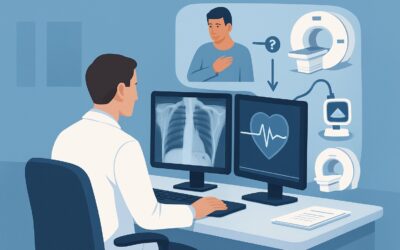
A patient presents to the emergency department with a cold, painful leg, diagnosed as acute limb ischemia. The immediate intervention is clear, but the critical question remains: where did the embolus come from? Identifying the source is essential to prevent recurrence. Choosing the right initial imaging study to find a cardiac or aortic source can be complex, involving tradeoffs between diagnostic yield, radiation exposure, and invasiveness. This guide clarifies the American College of Radiology (ACR) Appropriateness Criteria for the workup of a noncerebral systemic arterial embolic source, helping you select the most effective imaging pathway.
What Does ACR Workup of Noncerebral Systemic Arterial Embolic Source Cover?
This ACR topic focuses specifically on identifying the origin of an arterial embolus that has caused occlusion in a systemic, non-cerebral artery. The clinical scenarios assume an embolus is the suspected cause of a known arterial occlusion in the upper extremities, lower extremities, mesenteric or renal arteries, or multiple organ systems simultaneously. The primary goal of the recommended imaging is to evaluate the most common sources: the heart and the thoracic or abdominal aorta.
These guidelines do not apply to:
- The initial diagnosis of the arterial occlusion itself (e.g., a computed tomography angiography (CTA) runoff study of the lower extremities).
- Workup of cerebrovascular accidents (CVA) or transient ischemic attacks (TIA), which are covered under separate ACR criteria for cerebrovascular disease.
- Evaluation of venous thromboembolism (VTE), such as deep vein thrombosis (DVT) or pulmonary embolism (PE).
- Patients with a known or highly suspected source, where the imaging goal is characterization rather than initial identification.
What Imaging Should I Order for Workup of Noncerebral Systemic Arterial Embolic Source? Recommendations by Clinical Scenario
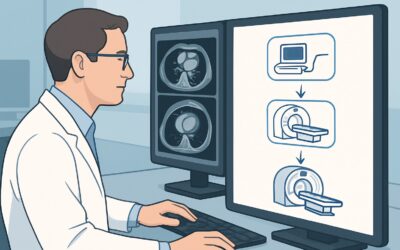
The ACR provides specific recommendations based on the location of the arterial occlusion. In nearly all scenarios, echocardiography is a primary tool due to the high prevalence of cardiac sources, while cross-sectional imaging like CTA and magnetic resonance angiography (MRA) are used to evaluate the aorta.
For a known upper extremity arterial occlusion with a suspected embolic cause, the initial workup focuses on the heart and thoracic aorta. Both Transthoracic (TTE) and Transesophageal (TEE) Echocardiography are rated Usually appropriate to assess for cardiac thrombus, vegetations, or tumors. To visualize the aortic arch and thoracic aorta, CTA Chest with IV Contrast, MRA Chest without and with IV Contrast, and cardiac MRI are also Usually appropriate. These modalities provide excellent anatomical detail of the potential aortic sources of emboli, such as mobile atheroma or aneurysmal disease.
When the occlusion is in the mesenteric or renal arterial system, the scope of the workup expands. The same cardiac evaluations—TTE, TEE, and cardiac MRI—remain Usually appropriate. However, the aortic evaluation must now include the abdomen. Therefore, CTA Chest and Abdomen with IV Contrast and MRA Chest and Abdomen without and with IV Contrast are rated Usually appropriate. These studies allow for a complete survey of the thoracoabdominal aorta, the most likely non-cardiac source for visceral emboli.
Similarly, for a known lower extremity arterial occlusion of suspected embolic origin, a comprehensive evaluation of the entire aorto-iliac system is required. Again, TTE and TEE are Usually appropriate first steps for the cardiac source. The aortic workup is extended to the pelvis, making CTA Chest Abdomen Pelvis with IV Contrast and MRA Chest Abdomen Pelvis without and with IV Contrast Usually appropriate. These extensive studies are necessary because an embolic source can be located anywhere from the aortic arch down to the iliac bifurcation.
In cases of known multiorgan system arterial occlusions, the suspicion for a central, proximal source is very high. The imaging recommendations mirror those for lower extremity occlusion, prioritizing a complete survey of the heart and the entire aorta. TTE, TEE, cardiac MRI, CTA Chest Abdomen Pelvis with IV Contrast, and MRA Chest Abdomen Pelvis without and with IV Contrast are all considered Usually appropriate to provide a comprehensive search for the embolic source.
ACR Imaging Recommendations Table
| Clinical Scenario | Top Procedure | ACR Rating | Adult RRL | Pediatric RRL |
|---|---|---|---|---|
| Known upper extremity arterial occlusion. Suspected embolic etiology. Next imaging study to determine source. | US echocardiography transthoracic resting | Usually appropriate | O 0 mSv | O 0 mSv [ped] |
| Known arterial occlusion in the mesenteric or renal arterial system or renal infarcts. Suspected embolic etiology. Next imaging study to determine source. | US echocardiography transthoracic resting | Usually appropriate | O 0 mSv | O 0 mSv [ped] |
| Known lower extremity arterial occlusion. Suspected embolic etiology. Next imaging study to determine source. | US echocardiography transthoracic resting | Usually appropriate | O 0 mSv | O 0 mSv [ped] |
| Known multiorgan system arterial occlusions. Suspected embolic etiology. Next imaging study to determine source. | US echocardiography transthoracic resting | Usually appropriate | O 0 mSv | O 0 mSv [ped] |
Adult vs. Pediatric Workup of Noncerebral Systemic Arterial Embolic Source Imaging: Radiation Dose Tradeoffs
While noncerebral arterial embolism is less common in children than adults, the principles of identifying the source remain similar. However, the choice of imaging modality requires careful consideration of radiation dose, guided by the As Low As Reasonably Achievable (ALARA) principle. The ACR provides distinct pediatric relative radiation level (RRL) estimates, reflecting techniques tailored to smaller body habitus and the heightened concern for the long-term risks of ionizing radiation.
For modalities like CTA, the pediatric dose is often in a lower range than the adult equivalent (e.g., CTA Chest is ☢ ☢ ☢ ☢ 3-10 mSv for pediatrics vs. ☢ ☢ ☢ 1-10 mSv for adults). Despite the lower absolute dose, the lifetime attributable risk of cancer from radiation exposure is significantly higher in younger patients. This underscores the importance of prioritizing non-ionizing modalities like echocardiography and MRI/MRA whenever clinically feasible in the pediatric population. When CTA is necessary for its speed and detail, protocols must be specifically optimized for pediatric patients to minimize radiation exposure without compromising diagnostic quality.
Imaging Protocol Details for Workup of Noncerebral Systemic Arterial Embolic Source
Once you have selected the most appropriate imaging study based on the clinical scenario and ACR guidance, ensuring it is performed correctly is the next critical step. The diagnostic utility of a cardiac MRI, a multiphase CTA, or a transesophageal echo depends heavily on the technical parameters, contrast timing, and specific sequences used. A well-designed protocol is essential for detecting subtle sources like a small left atrial appendage thrombus or a mobile aortic plaque. While this article focuses on choosing the right test, detailed procedural guides are available to help ensure high-quality image acquisition and interpretation for the modalities discussed.
Tools to Help You Order the Right Study
Navigating imaging guidelines and radiation safety can be streamlined with dedicated resources. The following tools are designed to support clinical decision-making for this and other scenarios.
For scenarios beyond the workup of noncerebral systemic arterial embolic source, the Imaging Appropriateness Selector provides direct access to the complete, searchable ACR guidelines, covering thousands of clinical variants across all organ systems.
To ensure the selected study is performed to the highest standard, the Imaging Protocol Library offers detailed, step-by-step protocols for a wide range of CT, MRI, and ultrasound examinations, covering patient preparation, scanner parameters, and post-processing.
When discussing imaging options with patients, especially those involving radiation, the Radiation Dose Calculator is a valuable tool. It helps estimate and track cumulative radiation exposure from various medical imaging studies, facilitating informed conversations about risks and benefits.
Frequently Asked Questions
Why is echocardiography so consistently rated “Usually Appropriate” for finding an embolic source?
The heart is the most common source of systemic arterial emboli. Conditions like atrial fibrillation (leading to left atrial appendage thrombus), recent myocardial infarction (left ventricular thrombus), valvular disease, and endocarditis (vegetations) are major causes. Transthoracic echocardiography (TTE) is a non-invasive, radiation-free, and widely available initial test that can identify many of these cardiac sources.
When should I choose CTA over MRA for evaluating the aorta as a potential embolic source?
CTA is generally faster than MRA, making it preferable for critically ill or unstable patients. It also provides superior visualization of calcified atherosclerotic plaques. MRA is an excellent alternative that avoids ionizing radiation and is preferred for patients with contraindications to iodinated contrast, such as severe allergy or significant renal impairment (though gadolinium contrast has its own considerations, such as nephrogenic systemic fibrosis).
What is the difference in role between transesophageal echo (TEE) and transthoracic echo (TTE)?
TTE is the standard initial, non-invasive echocardiogram. It provides good views of the ventricles, atria, and most valve structures. TEE is a semi-invasive procedure that involves passing an ultrasound probe into the esophagus. It provides superior, high-resolution images of posterior cardiac structures, including the left atrial appendage (the most common site of thrombus in atrial fibrillation), the mitral valve, and the thoracic aorta, making it more sensitive for detecting small thrombi or vegetations that may be missed on TTE.
Is a CTA of the chest sufficient, or do I need to include the abdomen and pelvis?
The required scan coverage depends on the clinical presentation. For an upper extremity embolus, the source is almost certainly in the heart or thoracic aorta, so a CTA of the chest is sufficient. For lower extremity, mesenteric, or renal emboli, the source could be anywhere in the thoracoabdominal aorta or even the iliac arteries. In these cases, a comprehensive CTA of the chest, abdomen, and pelvis is necessary to avoid missing a more distal aortic source.
Why is abdominal duplex ultrasound rated “Usually Not Appropriate” or only “May Be Appropriate” for finding an embolic source?
Abdominal duplex ultrasound is excellent for evaluating the abdominal aorta for aneurysms or occlusive disease. However, in the context of an embolic workup, the primary goal is to find the source of the embolus, which is most often in the heart or thoracic aorta—structures that are not visualized by a standard abdominal ultrasound. While it may identify an abdominal aortic source, it cannot rule out the more common proximal sources, making it an incomplete initial study for this indication.
Frequently Asked Questions
What imaging studies are recommended for noncerebral embolic sources?
For the workup of noncerebral systemic arterial embolic sources, echocardiography is a primary tool due to the high prevalence of cardiac sources. Both Transthoracic (TTE) and Transesophageal (TEE) echocardiography are usually appropriate to assess for cardiac thrombus, vegetations, or tumors. For aortic evaluation, computed tomography angiography (CTA) and magnetic resonance angiography (MRA) are also usually appropriate. Specifically, CTA of the chest and abdomen with IV contrast and MRA of the chest and abdomen without and with IV contrast are recommended to visualize potential aortic sources of emboli, such as mobile atheroma or aneurysmal disease.
How can echocardiography help identify embolic sources?
Echocardiography is essential in identifying embolic sources due to its ability to evaluate cardiac structures for thrombus, vegetations, or tumors. Both Transthoracic Echocardiography (TTE) and Transesophageal Echocardiography (TEE) are rated as "Usually appropriate" for assessing these cardiac sources. Given that a significant number of embolic events originate from the heart, echocardiography serves as a primary imaging tool. In conjunction with echocardiography, cross-sectional imaging such as CTA and MRA is utilized to assess the thoracic and abdominal aorta, further enhancing the diagnostic yield in cases of suspected noncerebral systemic arterial embolic sources.
When should I consider CTA versus MRA for imaging?
Consider CTA when a detailed visualization of the thoracic and abdominal aorta is required, particularly for suspected embolic sources in cases of mesenteric or renal arterial occlusions. CTA provides excellent anatomical detail and is usually appropriate for evaluating the aorto-iliac system. MRA is also suitable for similar evaluations, especially when avoiding radiation exposure is a priority. Both modalities are rated usually appropriate depending on the specific clinical scenario, such as the location of the arterial occlusion and the need for comprehensive assessment of potential embolic sources.
Are there specific clinical scenarios for ordering imaging?
Imaging is crucial for identifying the source of an embolus causing arterial occlusion in noncerebral systems. Specific clinical scenarios include acute limb ischemia, where echocardiography (TTE or TEE) is usually appropriate to assess for cardiac sources. For upper extremity occlusions, CTA or MRA of the thoracic aorta is recommended. In mesenteric or renal occlusions, imaging should include the abdomen, utilizing CTA or MRA of the chest and abdomen. For lower extremity occlusions, a comprehensive aorto-iliac evaluation is necessary, extending to the pelvis with CTA or MRA. These imaging modalities provide essential anatomical details to prevent recurrence of embolic events.
Why is identifying the embolic source crucial for treatment?
Identifying the embolic source is crucial for effective treatment of acute limb ischemia and preventing recurrence. The most common sources of arterial emboli are the heart and the thoracic or abdominal aorta. Initial imaging studies, such as echocardiography and cross-sectional imaging like CTA or MRA, are essential to locate these sources. For instance, transthoracic and transesophageal echocardiography are usually appropriate to assess for cardiac thrombus or vegetations. In cases of mesenteric or renal arterial occlusions, the imaging must extend to the abdominal aorta, highlighting the need for comprehensive evaluation to ensure accurate diagnosis and management.
Reviewed by Pouyan Golshani, MD, Interventional Radiologist — May 26, 2026