Which Imaging Best Evaluates Trochanteric Pain After a Hip Arthroplasty?
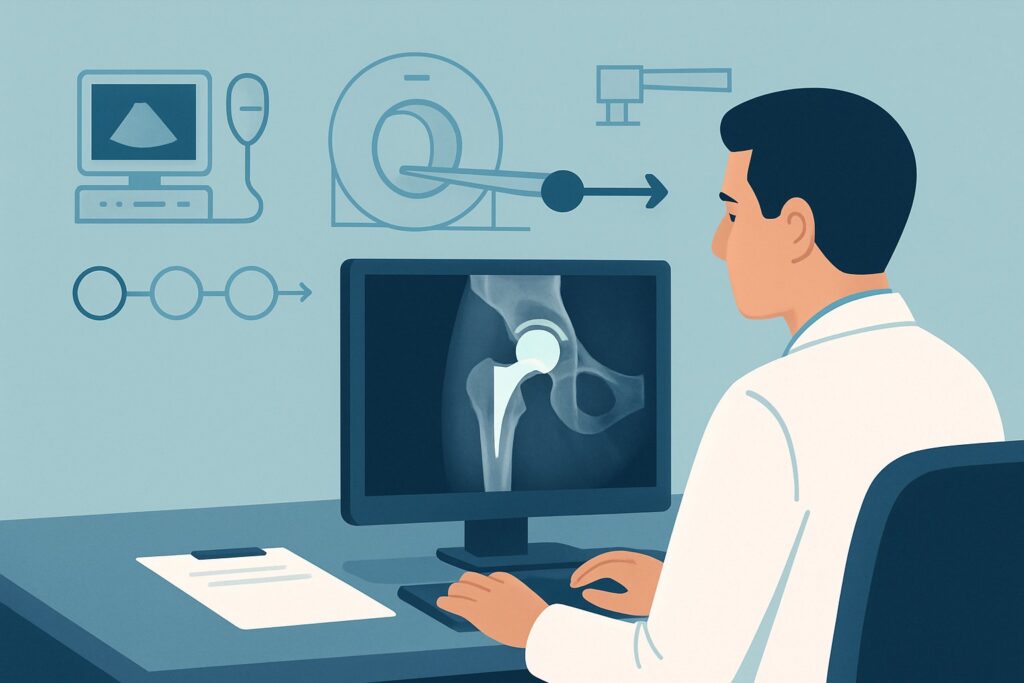
A 72-year-old patient, three years status post a left total hip arthroplasty (THA), presents to your clinic with several months of worsening lateral hip pain. The pain is sharp, localized over the greater trochanter, and exacerbated by walking, climbing stairs, and lying on their left side. A Trendelenburg gait is noted on exam. You’ve already obtained radiographs, which confirm the arthroplasty components are well-fixed and in a stable position with no signs of loosening or periprosthetic fracture. Your clinical suspicion is high for a soft tissue etiology, such as gluteal tendinopathy or trochanteric bursitis. This article details the American College of Radiology (ACR) Appropriateness Criteria for this specific scenario, guiding your choice for additional imaging. For this presentation, the ACR rates a US hip as Usually Appropriate.
Who Fits This Clinical Scenario for Trochanteric Pain After Hip Arthroplasty?
This clinical workflow is designed for a specific patient population: those with an existing total hip arthroplasty who present with pain localized to the peritrochanteric region. The crucial prerequisite is that initial evaluation with radiographs has already been completed and has not revealed an obvious cause for the pain, such as component loosening, subsidence, or periprosthetic fracture. The clinical picture should strongly suggest a soft tissue abnormality like abductor tendon injury (gluteus medius or minimus tendinopathy/tear) or trochanteric bursitis, collectively often termed greater trochanteric pain syndrome (GTPS).
This guidance does not apply to several similar-appearing but distinct clinical situations, which have their own diagnostic pathways:
- Suspected Infection: If the patient presents with systemic signs like fever, chills, or elevated inflammatory markers (ESR, CRP), or if there is a draining sinus tract, the workup must follow the ACR variant for suspected infection.
- Acute Traumatic Injury: For a patient with a recent fall or significant trauma, the primary concern is periprosthetic fracture, which follows the ACR variant for acute injury.
- Concerns for Aseptic Loosening: If the pain is more suggestive of mechanical failure (e.g., start-up pain, pain with weight-bearing throughout the joint) and radiographs are equivocal, the workup follows the ACR variant for suspected loosening with infection excluded.
- Metal-on-Metal Prostheses: Patients with metal-on-metal bearings or findings suggesting trunnionosis who present with pain require a specialized workup for adverse local tissue reaction (ALTR), a distinct ACR scenario.
What Diagnoses Are You Working Up with Lateral Hip Pain After Arthroplasty?
When a THA patient presents with well-localized lateral hip pain and normal radiographs, the differential diagnosis shifts from the implant itself to the surrounding soft tissues. The imaging study you select should be capable of differentiating among these potential causes.
Gluteal Tendinopathy or Tear (Abductor Tendinopathy)
This is the most common cause of greater trochanteric pain syndrome. The gluteus medius and minimus tendons attach to the greater trochanter and are critical for hip abduction and pelvic stability. These tendons can become inflamed (tendinopathy) or tear, either from chronic degeneration or iatrogenically during the surgical approach for the arthroplasty. A tear can lead to significant weakness and a characteristic limping gait.
Trochanteric Bursitis
Historically, most lateral hip pain was attributed to bursitis. It is now understood that inflammation of the trochanteric bursa is often a secondary finding, occurring in response to an underlying abductor tendon pathology. However, primary bursitis can occur and contribute significantly to the patient’s pain.
Iliotibial (IT) Band Thickening or Snapping Hip Syndrome
The IT band passes over the greater trochanter. Friction can lead to irritation and thickening of the band or the underlying bursa. In some cases, a “snapping” sensation can be felt or heard as the band moves over the trochanter during hip flexion and extension, which can be evaluated dynamically.
Hardware-Related Irritation
While the primary arthroplasty components may be stable, other hardware used during the procedure, such as cerclage wires, cables, or sutures used to repair the abductors, can sometimes irritate the overlying soft tissues and be a source of focal pain.
Why Is Ultrasound the Recommended Study for This Presentation?
For a patient with a hip arthroplasty and suspected peritrochanteric soft tissue pathology, both US hip and MRI hip without IV contrast are rated Usually Appropriate. However, ultrasound often serves as the superior initial choice for several practical and diagnostic reasons.
The primary advantage of ultrasound is its excellent spatial resolution for superficial soft tissues. It can clearly visualize the gluteal tendons, identify tendinosis, and characterize partial- or full-thickness tears. It is also highly sensitive for detecting fluid in the trochanteric bursae. Crucially, ultrasound is a dynamic examination. The sonographer can have the patient move their hip, allowing for real-time assessment of the IT band and tendons to identify snapping or impingement that would be missed on a static study like MRI. Furthermore, ultrasound allows for precise correlation of an imaging finding with the patient’s point of maximal tenderness. It involves no ionizing radiation (0 mSv) and is unaffected by the metallic artifact from the prosthesis, which can significantly degrade MRI quality in the immediate periprosthetic region.
Let’s compare this to other modalities rated by the ACR for this scenario:
- MRI hip without IV contrast: Also Usually Appropriate, MRI provides a superb global overview of the soft tissues and bone marrow. However, metal-induced artifact can obscure the very structures of interest—the gluteal tendon insertions on the greater trochanter. While modern metal artifact reduction sequence (MARS) protocols can mitigate this, the quality can be variable. MRI is also more costly and less accessible than ultrasound.
- CT hip (without or with contrast): Rated Usually not appropriate. CT is excellent for evaluating bone and component position but provides poor soft tissue contrast, making it unsuitable for diagnosing tendinopathy or bursitis. It also exposes the patient to significant ionizing radiation (☢☢☢ 1-10 mSv) without answering the clinical question.
- Image-guided anesthetic +/- corticosteroid injection: Rated May be appropriate. This is often used as a diagnostic and/or therapeutic follow-up step rather than a primary imaging modality. It can be performed under ultrasound guidance during the same session as the diagnostic scan.
What’s Next After US hip? Downstream Workflow
The results of the hip ultrasound will guide your subsequent management decisions. The workflow typically branches based on whether the study identifies a clear cause for the patient’s symptoms.
If the ultrasound is positive for gluteal tendinopathy or a tear:
A positive finding confirms the diagnosis of greater trochanteric pain syndrome. The next step is typically a course of conservative management, including physical therapy focused on abductor strengthening, activity modification, and NSAIDs. If significant bursitis is also present, or if pain is refractory, an ultrasound-guided corticosteroid injection (May be appropriate) can provide therapeutic relief. For large, full-thickness tears in active patients, referral to an orthopedic surgeon for consideration of surgical repair may be necessary.
If the ultrasound is negative or inconclusive:
If the ultrasound is technically limited (e.g., by large body habitus) or completely normal despite high clinical suspicion, the next logical step is to proceed with the other Usually Appropriate study: an MRI hip without IV contrast. MRI’s larger field of view may reveal a deeper source of pain, a more subtle tear, or an alternative diagnosis like a stress fracture or avascular necrosis that was not visible on ultrasound or plain films. Ensure the imaging center uses a MARS protocol to optimize image quality.
If both ultrasound and MRI are negative:
If comprehensive imaging of the peritrochanteric soft tissues is negative, it is essential to reconsider the differential diagnosis. The pain may be referred from another source. The most common mimic is lumbar radiculopathy, and a clinical evaluation of the lumbar spine should be performed, potentially followed by spine imaging if indicated.
Pitfalls to Avoid (and When to Get Help)
Navigating the workup for lateral hip pain after arthroplasty requires careful attention to the clinical details to avoid common missteps.
- Pitfall: Anchoring on “bursitis.” Avoid attributing all lateral hip pain to trochanteric bursitis. The underlying driver is most often gluteal tendinopathy, with bursitis being a secondary effect. The treatment for tendinopathy (strengthening) differs from that for simple inflammation.
- Pitfall: Forgetting dynamic assessment. When ordering an ultrasound, ensure the performing site is comfortable with dynamic maneuvers to assess for conditions like external snapping hip (IT band syndrome), which are missed on static imaging.
- Pitfall: Overlooking referred pain. Do not neglect the lumbar spine as a potential source of lateral hip and thigh pain. A thorough neurologic exam is a critical part of the initial patient assessment.
Escalate your workup immediately if red flags appear. If the patient develops systemic symptoms, rapidly worsening pain, or new erythema over the hip, shift your focus to the “infection not excluded” clinical pathway, which may require urgent consultation with orthopedics and an image-guided joint aspiration.
Related ACR Topics and Tools
For a comprehensive overview of all clinical scenarios related to imaging after total hip arthroplasty, please consult our parent guide. For additional tools to help with imaging decisions, see the resources below.
- For breadth across all scenarios in Imaging after Total Hip Arthroplasty, see our parent guide: Imaging after Total Hip Arthroplasty: ACR Appropriateness Decoded.
- ACR Appropriateness Criteria Lookup — for adjacent scenarios
- Imaging Protocol Library — for technique on the recommended study
- Radiation Dose Calculator — for cumulative dose conversations
Frequently Asked Questions
Why not just get an MRI first, since it’s also rated ‘Usually Appropriate’?
While MRI is also an excellent choice, ultrasound is often preferred as the initial study because it is less expensive, more readily available, and avoids the metal artifact from the prosthesis that can obscure the nearby gluteal tendons. Ultrasound’s ability to perform dynamic imaging and correlate findings with the exact point of pain in real-time are also significant advantages.
What if the initial radiographs weren’t normal?
This specific workflow is for patients whose initial radiographs are normal, pointing toward a soft tissue cause. If radiographs show potential signs of component loosening, subsidence, or periprosthetic fracture, the patient fits a different ACR clinical scenario, and the imaging workup would proceed down a different pathway, often involving CT or nuclear medicine studies.
Can ultrasound see through the metal hip replacement?
No, ultrasound cannot penetrate the metal components of the arthroplasty. However, for this clinical problem, the area of interest is the greater trochanter and the attached soft tissues (gluteus medius/minimus tendons, bursae), which are located on the lateral side of the hip, away from the main articulating components. This region is highly accessible to the ultrasound probe, making it an ideal modality for this indication.
Is an image-guided injection diagnostic or therapeutic?
An image-guided injection can be both. A diagnostic injection involves injecting a small amount of local anesthetic into the suspected pain generator (e.g., the trochanteric bursa or around a tendon). If the patient’s pain is relieved, it confirms the source. Adding a corticosteroid to the injection makes it therapeutic by reducing inflammation.
My patient has a pacemaker. Does that change the recommendation?
Yes, the presence of a pacemaker or other non-MRI-conditional implanted electronic device makes ultrasound an even stronger first-line choice. While many modern devices are MRI-conditional, they require specific protocols and cardiologist clearance. Ultrasound has no such contraindications and can be performed safely in any patient.
Reviewed by Pouyan Golshani, MD, Interventional Radiologist — May 30, 2026