Which Imaging Study Best Assesses Tracheomalacia in Adults Pre- or Post-Treatment?
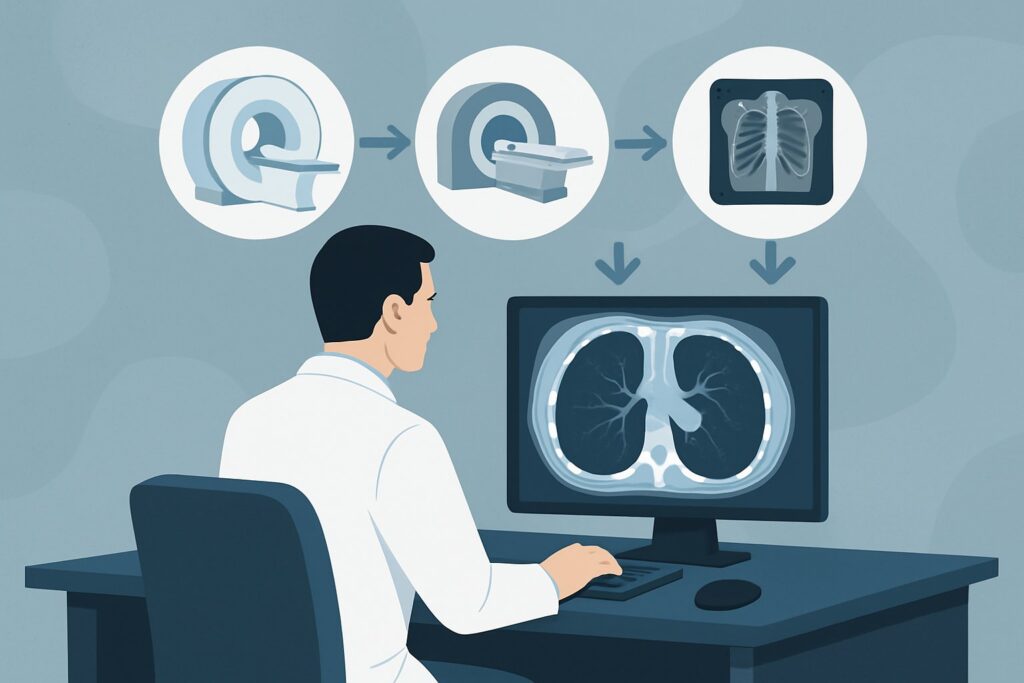
A 68-year-old male with severe chronic obstructive pulmonary disease (COPD) and a known diagnosis of tracheobronchomalacia returns to your pulmonary clinic. He underwent tracheal stenting six months ago for expiratory central airway collapse, but his symptoms of a barking cough and dyspnea on minimal exertion are recurring. You need to evaluate the stent’s integrity and assess the degree of any persistent or recurrent airway collapse before considering further intervention. The central question is which imaging study will provide a definitive, non-invasive assessment of his large airways. According to the American College of Radiology (ACR) Appropriateness Criteria, the definitive first step for this clinical scenario is a CT chest without IV contrast, which is rated Usually Appropriate.
Who Fits This Clinical Scenario?
This imaging workflow is designed for adult patients with an established or highly suspected diagnosis of tracheomalacia or bronchomalacia who require imaging for either pre- or post-treatment assessment. This includes patients being evaluated for the severity and extent of airway collapse to plan an intervention (like stenting or tracheobronchoplasty) and those who have already undergone treatment and require follow-up to assess its efficacy or investigate complications.
This guidance specifically applies when the primary question is the dynamic collapsibility of the trachea and main bronchi. It is distinct from other, similar-sounding clinical situations that require a different imaging approach:
- Initial Diagnosis of Suspected Tracheomalacia: If a patient presents with symptoms like a chronic barking cough or refractory wheezing and tracheomalacia is merely one of several possibilities, the workup may differ slightly. This workflow is for when the diagnosis is already a primary consideration.
- Suspected Tracheal or Bronchial Stenosis: This involves a fixed narrowing of the airway, not dynamic collapse. While CT is also used, the protocol and differential diagnoses are different, often focusing on causes like post-intubation injury, granulomatous disease, or malignancy.
- Assessment of Bronchiectasis: While sometimes co-occurring with bronchomalacia, bronchiectasis involves irreversible bronchial dilation. Its primary evaluation is typically done with high-resolution inspiratory CT, which may not include the dynamic expiratory imaging essential for malacia.
What Diagnoses Are You Working Up in This Scenario?
In the context of pre- or post-treatment assessment for tracheomalacia, imaging is not for initial diagnosis but for precise characterization and evaluation of treatment effects. The key questions you are trying to answer guide the differential considerations.
Quantification of Dynamic Airway Collapse: The primary goal is to measure the percentage reduction in the cross-sectional area of the airway lumen between full inspiration and dynamic expiration (often during forced exhalation or coughing). A reduction of >50% is the typical diagnostic threshold for tracheomalacia. Imaging helps determine the severity and the craniocaudal extent of the malacic segment, which is critical for planning surgical or bronchoscopic interventions.
Post-Treatment Complications: For patients who have undergone intervention, imaging is crucial for identifying causes of recurrent symptoms. This includes evaluating for airway stent complications such as migration, fracture, mucus plugging, or the development of granulation tissue at the stent margins, all of which can cause airway obstruction.
Surgical Planning or Evaluation: In patients being considered for tracheobronchoplasty, CT provides the roadmap. It delineates the length of the affected airway and the status of the posterior membrane. Post-operatively, it confirms the surgical stabilization of the airway and assesses for any residual collapse or complications at the surgical site.
Coexisting Thoracic Pathology: Symptoms may not be solely due to tracheomalacia. The CT scan provides a comprehensive assessment of the lung parenchyma, pleura, and mediastinum, helping to identify alternative or contributing causes for the patient’s symptoms, such as emphysema, interstitial lung disease, or an extrinsic compressing mass that was previously overlooked.
Why Is CT Chest Without IV Contrast the Recommended Study for This Presentation?
The ACR designates a CT chest without IV contrast as Usually Appropriate because it directly and non-invasively answers the central clinical question: is there dynamic, excessive narrowing of the large airways? The success of this study hinges on a specific protocol that includes imaging at both end-inspiration and during a dynamic expiratory maneuver.
The rationale for this recommendation is multi-faceted:
- Direct Visualization of Collapse: Paired inspiratory and expiratory images allow for precise measurement of the tracheal and bronchial cross-sectional areas. This quantitative data is essential for confirming the diagnosis, grading its severity, and planning treatment. The high spatial resolution of CT provides excellent detail of the airway wall and lumen.
- No Need for IV Contrast: For assessing intrinsic airway collapse or evaluating an existing stent, intravenous contrast is unnecessary. Omitting it avoids the risks associated with contrast administration, such as allergic reaction and contrast-induced nephropathy, without compromising the diagnostic information needed for this specific scenario.
- Radiation and Protocol Considerations: The effective radiation dose for a chest CT is moderate (☢☢☢ 1-10 mSv). Modern scanners and low-dose protocols are essential to minimize exposure, especially in patients who may require serial follow-up scans. The expiratory phase can often be performed at a much lower dose than the inspiratory phase.
Alternative studies are rated lower for clear reasons. A Radiography chest is rated Usually not appropriate because it lacks the cross-sectional detail to quantify airway collapse and is insensitive for detecting all but the most severe cases. Similarly, MRI chest is rated Usually not appropriate; while it avoids radiation, it suffers from lower spatial resolution and greater susceptibility to motion artifacts, making the dynamic component of the examination technically challenging and less reliable than CT.
While a non-contrast study is the standard, a CT chest with IV contrast (May be appropriate) can be considered if there is a specific concern for an extrinsic cause of airway narrowing, such as a vascular ring, an aberrant vessel, or a mediastinal mass that requires characterization.
Once you’ve decided on the top procedure, our protocol guide covers the technique, contrast, and reading principles: CT Chest Without Contrast.
What’s Next After CT Chest Without IV Contrast? Downstream Workflow
The results of the dynamic CT scan directly guide the subsequent clinical management. The next steps form a clear decision tree based on the imaging findings.
If the study confirms severe, symptomatic tracheobronchomalacia: For a pre-treatment evaluation, these findings would support proceeding with a planned intervention. The CT data on the location and length of the collapse will inform the choice between bronchoscopic stenting and surgical tracheobronchoplasty. For a post-treatment patient with recurrent collapse, the findings may indicate the need for stent revision, replacement, or consideration of a different therapeutic approach.
If the study shows successful treatment or stable, mild disease: In a post-treatment patient, a finding of a patent airway without significant dynamic collapse is reassuring and suggests the prior intervention was successful. Management would shift to addressing other potential causes of the patient’s symptoms (e.g., optimizing COPD therapy). In a pre-treatment evaluation, mild or borderline findings may prompt a trial of conservative management, such as non-invasive positive pressure ventilation, before committing to an invasive procedure.
If the study is negative for malacia but identifies an alternative cause: The CT may reveal another diagnosis, such as severe bronchiectasis, interstitial lung disease, or an unsuspected pulmonary embolism. The workflow then pivots to address the newly identified condition, following the appropriate clinical guidelines for that diagnosis.
If the study is indeterminate or discordant with clinical symptoms: In rare cases, CT findings may be equivocal. The next step is often direct visualization with bronchoscopy. Bronchoscopy is the invasive gold standard, allowing direct observation of airway dynamics during respiration and coughing, and it also permits therapeutic interventions during the same session.
Pitfalls to Avoid (and When to Get Help)
Several common pitfalls can compromise the diagnostic value of imaging in this scenario. Awareness of these issues is key to obtaining an accurate assessment.
- Failing to order dynamic expiratory imaging: This is the most critical error. A standard inspiratory-only chest CT will completely miss the diagnosis of tracheomalacia. The order must explicitly request paired inspiratory and dynamic (forced) expiratory scans.
- Misinterpreting physiologic narrowing: A small degree of airway narrowing during expiration is normal. It is crucial to use established quantitative criteria (>50% reduction in cross-sectional area) to avoid over-diagnosis.
- Ignoring coexisting conditions: Do not attribute all respiratory symptoms to tracheomalacia. Carefully review the entire scan for other pathologies, particularly in patients with complex histories like COPD.
- Inadequate patient coaching: The quality of the expiratory images depends on the patient’s ability to perform a forceful exhalation or cough. Poor effort can lead to an underestimation of the collapse.
If the CT findings are unclear or do not align with the patient’s severe symptoms, escalate by consulting with a thoracic radiologist for a second opinion on the images or with an interventional pulmonologist or thoracic surgeon to discuss proceeding with diagnostic bronchoscopy.
Related ACR Topics and Tools
This article focuses on a single, specific clinical scenario. For a comprehensive overview of imaging for all related presentations, from stenosis to bronchiectasis, please refer to our parent guide. Additional GigHz tools can help you navigate other imaging decisions and technical protocols.
- Parent Topic Hub: For breadth across all scenarios in Tracheobronchial Disease, see our parent guide: Tracheobronchial Disease: ACR Appropriateness Decoded.
- ACR Criteria Lookup: For adjacent or alternative clinical scenarios, use the ACR Appropriateness Criteria Lookup.
- Protocol Library: For technical details on hundreds of imaging studies, consult the Imaging Protocol Library.
- Dose Calculator: To discuss cumulative radiation exposure with your patients, utilize the Radiation Dose Calculator.
Frequently Asked Questions
Why not just use bronchoscopy for every tracheomalacia assessment?
While bronchoscopy is the gold standard for direct visualization, it is an invasive procedure with associated risks. Dynamic CT is non-invasive, provides excellent quantitative data on the degree and length of collapse, and simultaneously evaluates the surrounding lung and mediastinal structures. CT is typically used for initial assessment and follow-up, with bronchoscopy reserved for cases that are diagnostically uncertain or when a therapeutic intervention is planned.
What is the difference between this scenario and ‘initial imaging’ for suspected tracheomalacia?
This scenario applies to patients with a known or highly suspected diagnosis who need evaluation for treatment planning or follow-up. The ‘initial imaging’ scenario is for patients presenting with non-specific symptoms (e.g., chronic cough, wheeze) where tracheomalacia is on the differential but not yet established. The imaging choice is the same (dynamic CT), but the clinical context and pre-test probability are different.
Is IV contrast ever needed when assessing tracheomalacia?
For intrinsic tracheomalacia (weakness of the airway wall itself), IV contrast is not necessary. However, the ACR rates CT with IV contrast as ‘May be appropriate.’ It should be considered if there is suspicion of an extrinsic cause of airway compression, such as a vascular anomaly (e.g., vascular ring, pulmonary artery sling) or a mediastinal mass, where contrast is essential for characterization.
How is the radiation dose (1-10 mSv) managed for patients needing multiple follow-up scans?
This is a critical consideration. Radiologists should use low-dose and ultra-low-dose CT protocols, especially for the expiratory phase of the scan. The clinical need for each follow-up scan must be justified, ensuring the benefit of assessing treatment efficacy or complications outweighs the cumulative risk of radiation exposure. Each imaging decision should be made thoughtfully in the context of the patient’s overall care plan.
What specific instruction should I give the radiology department when ordering this CT?
To ensure you get a diagnostic study, the order should explicitly state: ‘CT chest without contrast, with paired inspiratory and dynamic expiratory scans for evaluation of tracheobronchomalacia.’ This signals to the technologist that a specific protocol is required, involving coaching the patient to perform a forceful exhalation or cough during the expiratory scan acquisition.
Reviewed by Pouyan Golshani, MD, Interventional Radiologist — May 30, 2026