Which Imaging Study Is Best for an Epilepsy Patient With a New Neurologic Deficit?
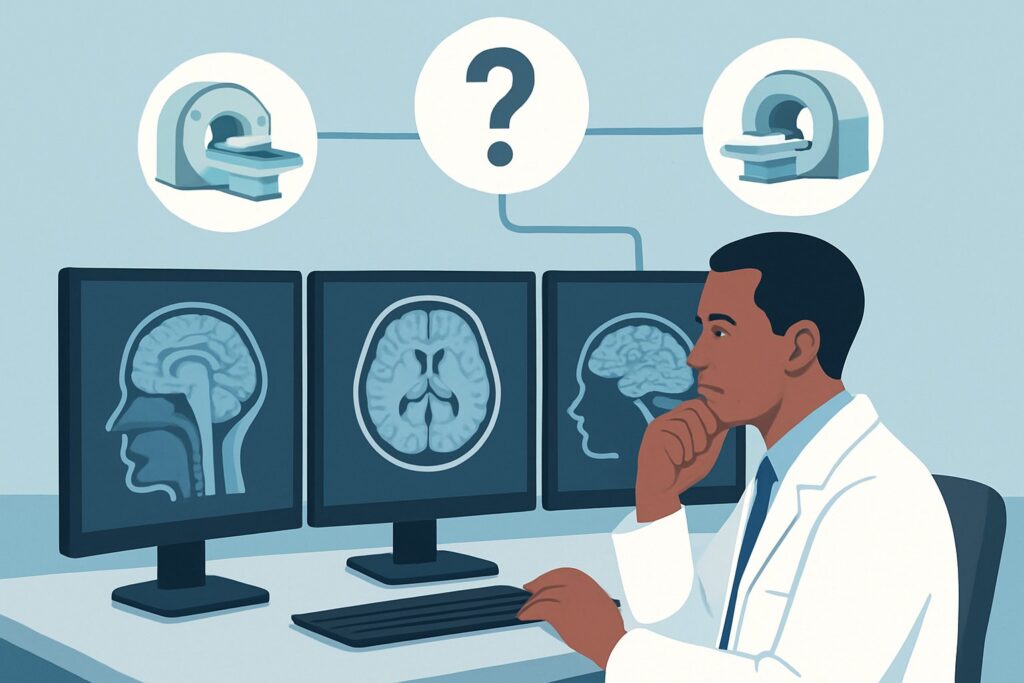
It’s 2 AM in the emergency department. A 52-year-old patient with a known diagnosis of focal epilepsy, stable on medication for years, presents after a seizure. This time was different. Instead of his typical brief focal aware seizures, he experienced a generalized tonic-clonic seizure, and now, hours later, he has a persistent expressive aphasia and is not returning to his neurologic baseline. You need to determine if a new underlying process is driving this change. The critical question is which imaging study will provide the most definitive answers without unnecessary radiation or delay. This article details the clinical workflow for this specific scenario, guided by the American College of Radiology (ACR) Appropriateness Criteria. For this presentation, the ACR rates MRI head without and with IV contrast as Usually Appropriate.
Who Fits This Clinical Scenario?
This guidance applies to a specific subset of patients: those with a previously diagnosed seizure disorder who now present with a significant clinical change. The inclusion criteria are precise:
- A known, pre-existing diagnosis of a seizure disorder or epilepsy.
- A new change in seizure semiology (e.g., a patient with focal seizures now having generalized seizures, or a new aura).
- The development of a new, persistent focal neurologic deficit (e.g., hemiparesis, aphasia, visual field cut) that does not resolve as expected postictally.
- Failure to return to their previous neurologic baseline in a typical timeframe after a seizure.
It is crucial to distinguish this scenario from others. This workflow is not for a patient experiencing their first-time, new-onset seizure. It also does not apply to patients with a known seizure disorder whose seizures are unchanged in character or frequency, for whom routine interval imaging is often not indicated. Finally, while there is overlap, patients with a known brain tumor and changing seizures may follow a more specific oncologic imaging protocol.
What Diagnoses Are You Working Up in This Scenario?
When a patient with stable epilepsy deteriorates, the imaging workup is focused on identifying a new or progressive underlying cause. The differential diagnosis is broad, but the primary goal of neuroimaging is to detect an actionable structural abnormality.
A primary concern is a new or progressive intracranial mass. This could be a primary brain tumor (like a glioma) that was previously too small to detect or has progressed, or a metastatic lesion. The change in seizure type or new deficit may be the first sign of tumor growth or associated vasogenic edema.
Another key consideration is a new vascular event. An ischemic or hemorrhagic stroke can create a new epileptogenic focus, altering a patient’s seizure pattern. A cavernous malformation or arteriovenous malformation (AVM) might have bled, causing both the new deficit and the change in seizure activity.
Inflammatory or infectious processes are also on the differential. Encephalitis (e.g., herpes simplex virus or autoimmune encephalitis) can present with seizures and focal deficits. A developing brain abscess is a critical diagnosis to exclude, as it requires urgent intervention.
Finally, the imaging may reveal progressive mesial temporal sclerosis or other subtle structural changes related to the underlying epilepsy itself, which may have evolved to a point where they are causing a clinical change.
Why Is MRI Head Without and With IV Contrast the Recommended Study?
The ACR designates MRI head without and with IV contrast as Usually Appropriate because it offers the highest diagnostic yield for the key differential diagnoses in this scenario. MRI provides superior soft-tissue contrast compared to other modalities, making it exceptionally sensitive for detecting subtle tumors, inflammation, and the sequelae of a stroke.
The addition of intravenous contrast is critical. Many of the primary concerns—such as tumors, abscesses, and active inflammation from encephalitis—demonstrate characteristic patterns of contrast enhancement. A non-contrast study could miss these pathologies entirely. The combination of pre- and post-contrast sequences provides the most comprehensive structural evaluation.
How do alternative studies compare for this specific clinical question?
- CT head without IV contrast is also rated Usually Appropriate. It is fast, widely available, and excellent for ruling out acute hemorrhage. It is often the first study performed in the emergency setting. However, its sensitivity for non-hemorrhagic strokes, small tumors, and encephalitis is significantly lower than MRI. It is a reasonable first step in an unstable patient but is often insufficient as a definitive workup.
- MRI head without IV contrast is also Usually Appropriate but is less complete than a contrast-enhanced study. While it can detect hemorrhage, large strokes, and established structural abnormalities, it may fail to characterize an enhancing mass or identify active inflammation, which is a key part of the workup.
- CT head with IV contrast is rated Usually Not Appropriate. If contrast is being used, the superior soft-tissue resolution of MRI makes it the far better choice. The information gained from a contrast-enhanced CT rarely justifies the radiation dose (ACR RRL=☢☢☢, 1-10 mSv) when a non-radiation alternative with higher diagnostic power is available.
The recommended MRI has no ionizing radiation (ACR RRL=O, 0 mSv), a significant advantage, especially in patients who may require serial imaging over their lifetime.
What’s Next After MRI? Downstream Workflow
The results of the contrast-enhanced brain MRI will guide the subsequent clinical pathway. The goal is to move from diagnosis to a targeted management plan.
- If the study is positive for a new mass: The next step is an urgent referral to neurosurgery and neuro-oncology. The patient will likely require further characterization with advanced MRI sequences (e.g., spectroscopy, perfusion) and a plan for biopsy or resection.
- If the study is positive for stroke or hemorrhage: The patient should be managed by a neurology or stroke service. This involves initiating secondary stroke prevention, managing blood pressure, and potentially adjusting antiepileptic drug therapy, as the new lesion may alter seizure thresholds.
- If the study is negative: A negative structural imaging result is reassuring but does not end the workup. The focus shifts from structural to electrical causes. The next step is typically a prolonged video-electroencephalogram (vEEG) to better characterize the new seizure semiology and correlate it with electrographic findings. Medication adjustment based on the new seizure type is also a primary consideration.
- If the study is indeterminate or shows non-specific inflammation: This may raise suspicion for autoimmune or infectious encephalitis. A lumbar puncture for cerebrospinal fluid (CSF) analysis is the critical next step. In some cases where the diagnosis remains elusive, an FDG-PET/CT brain scan, rated May be appropriate, can help identify regions of hyper- or hypometabolism suggestive of an epileptic focus or an inflammatory process.
Pitfalls to Avoid (and When to Get Help)
Navigating this clinical scenario requires avoiding several common pitfalls. First, do not accept a non-contrast CT as the definitive study if a patient’s new deficit persists; it can provide a false sense of security by missing significant underlying pathology. Second, be sure to provide a detailed clinical history to the radiologist, including the patient’s baseline seizure type and a clear description of the new semiology or deficit. This context is vital for accurate interpretation. Third, do not mistake prolonged post-ictal (Todd’s) paralysis for a new, permanent deficit without allowing adequate time for recovery, but conversely, do not delay imaging if the deficit is unusually severe or prolonged. If the MRI is negative but the clinical picture is highly concerning for a new structural lesion, escalate by discussing the case directly with the neuroradiologist to review the images and consider specialized sequences.
Related ACR Topics and Tools
This article focuses on one specific clinical variant. For a comprehensive overview of imaging for all seizure-related presentations, from new onset to surgical planning, please consult our parent guide. The following GigHz tools can also support your clinical workflow.
- For breadth across all scenarios in Seizures and Epilepsy, see our parent guide: Seizures and Epilepsy: ACR Appropriateness Decoded.
- To look up appropriateness criteria for adjacent or alternative clinical scenarios, use the Imaging Appropriateness Selector.
- For detailed procedural techniques on the recommended study, explore the Imaging Protocol Library.
- To discuss cumulative radiation exposure with patients who may have had prior CT scans, consult the Radiation Dose Calculator.
Frequently Asked Questions
Why is a non-contrast CT head also rated ‘Usually Appropriate’ if MRI is better?
A non-contrast CT head is rated ‘Usually Appropriate’ primarily for its role in the acute or emergency setting. It is extremely fast and effective at identifying acute intracranial hemorrhage, which is a critical, time-sensitive diagnosis. While MRI is more sensitive for most other causes (tumors, ischemia, inflammation), CT serves as an essential first-line tool to rule out a bleed and ensure patient stability, especially when MRI is not immediately available or is contraindicated.
My patient has a pacemaker. Can they still get the recommended MRI?
The presence of a pacemaker or other implantable electronic device requires careful consideration. Many modern devices are MRI-conditional, meaning they can be scanned safely under specific protocols. This requires coordination with the radiology department and often cardiology to have the device set to an ‘MRI mode’ before the scan and checked afterward. If the patient has an older, non-conditional device, MRI is contraindicated, and a contrast-enhanced CT would become the next best alternative.
What if the patient’s renal function is poor and I’m concerned about gadolinium contrast?
For patients with severe renal dysfunction (e.g., eGFR < 30 mL/min/1.73m²), there is a risk of nephrogenic systemic fibrosis (NSF) with certain types of gadolinium-based contrast agents. However, modern macrocyclic agents carry a much lower risk. The decision should be a risk-benefit discussion. In a patient with a new, concerning neurologic deficit where an enhancing lesion is suspected, the diagnostic benefit of contrast often outweighs the very low risk of NSF with current agents. A non-contrast MRI remains a valuable, risk-free alternative if the decision is made to avoid gadolinium.
How long should I wait for a post-ictal deficit to resolve before ordering imaging?
A post-ictal neurologic deficit, or Todd’s paralysis, typically resolves within 48 hours. If a deficit is unusually severe, persists beyond this timeframe, or is accompanied by other concerning signs (e.g., fever, severe headache), imaging should not be delayed. The clinical context is key; a new type of deficit that has never occurred before with prior seizures warrants a lower threshold for prompt imaging.
Does this guidance apply to children with a known seizure disorder and new symptoms?
Yes, the general principles apply to pediatric patients as well. MRI without and with contrast is the preferred study for the same reasons: superior soft-tissue detail and lack of ionizing radiation. The differential diagnosis in children may have different probabilities (e.g., developmental abnormalities, genetic conditions), but the need to rule out a new structural lesion remains paramount. Radiation-sparing is even more critical in children, making MRI a much stronger choice over CT when clinically feasible.
Reviewed by Pouyan Golshani, MD, Interventional Radiologist — May 26, 2026