Which Imaging Study Is Best for Suspected Proctitis or Pouchitis? An ACR-Guided Workflow
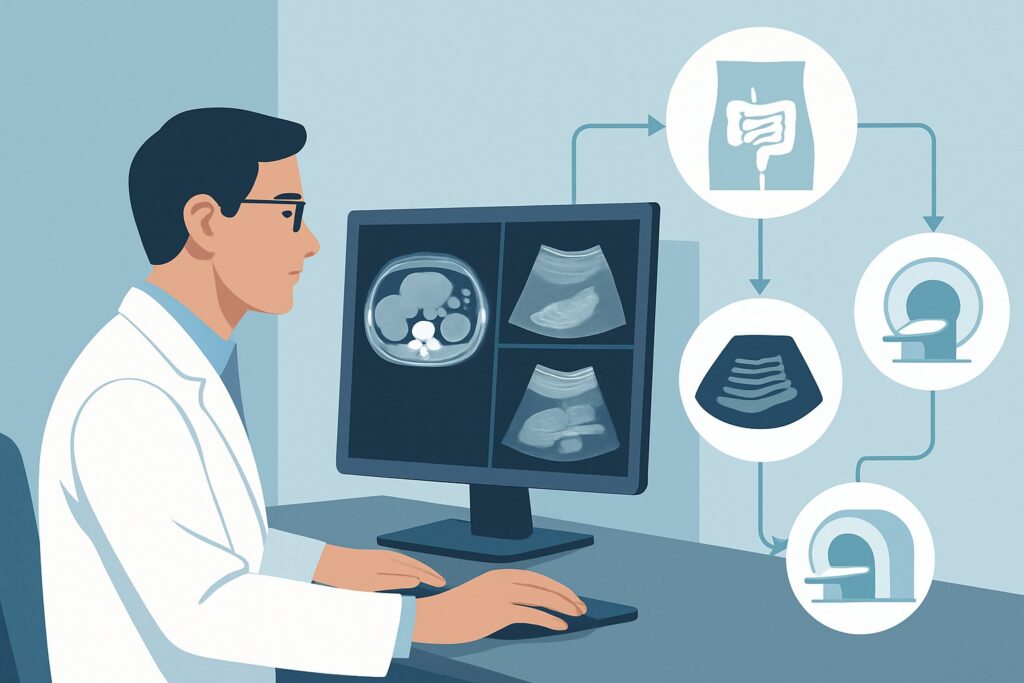
A 34-year-old man with a history of ulcerative colitis, status-post total proctocolectomy with an ileal pouch-anal anastomosis (IPAA), presents to your clinic with a two-week history of increased stool frequency, urgency, and lower abdominal cramping. You suspect pouchitis, the most common long-term complication of his surgery. Before proceeding to pouchoscopy, you consider imaging to assess for inflammation and rule out other complications. Which study provides the most diagnostic value while minimizing harm? This article provides a detailed workflow for the initial imaging of suspected proctitis or pouchitis, explaining why the American College of Radiology (ACR) rates MR enterography as Usually Appropriate for this specific clinical scenario.
Who Fits This Clinical Scenario for Suspected Proctitis or Pouchitis?
This guidance applies to patients presenting with symptoms suggestive of inflammation in the rectum (proctitis) or an ileal pouch (pouchitis). The typical patient has a known history of inflammatory bowel disease (IBD), particularly ulcerative colitis, and may have undergone a prior colectomy with an IPAA, commonly known as a J-pouch. Key clinical features include tenesmus, rectal bleeding, pelvic pain, increased stool frequency, or incontinence.
While most common in the IBD population, this scenario can also include patients without known IBD who present with symptoms of rectal inflammation, where an infectious, ischemic, or radiation-induced etiology is being considered.
It is critical to distinguish this presentation from related but distinct anorectal conditions that follow different diagnostic pathways:
- Suspected perianal abscess or fistula: If the patient presents with focal, exquisite perianal pain, a palpable fluctuant mass, or chronic purulent drainage from an external opening, the primary concern is a perianal abscess or fistula, which is a different ACR variant.
- Suspected rectovaginal or rectovesicular fistula: Symptoms like passing flatus or stool from the vagina or in the urine suggest a fistula to an adjacent organ, requiring a different imaging workup.
- Suspected acute post-operative complication: In the immediate post-operative period following proctectomy or pouch creation, concerns for an anastomotic leak or abscess are evaluated under a separate ACR variant. This article focuses on the non-acute, initial workup of inflammatory symptoms.
What Diagnoses Are You Working Up in This Scenario?
When ordering imaging for suspected proctitis or pouchitis, you are primarily evaluating for active inflammation and its complications. The differential diagnosis guides the choice of imaging modality.
Pouchitis is the leading consideration in a patient with an IPAA. It represents a nonspecific inflammation of the ileal reservoir. While often idiopathic and responsive to antibiotics, imaging is crucial to assess the severity and extent of inflammation and to look for complications like strictures or abscesses that might suggest an alternative diagnosis, such as Crohn’s disease of the pouch.
Active Inflammatory Bowel Disease (IBD) is the main differential in a patient with an intact rectum. This could be a flare of known ulcerative colitis (proctitis) or Crohn’s disease. Imaging helps determine the extent of mural inflammation, the presence of penetrating complications (fistulas, sinus tracts), and involvement of adjacent structures, which are hallmarks that can differentiate Crohn’s disease from ulcerative colitis.
Infectious Proctitis can mimic an IBD flare. Pathogens such as Clostridioides difficile, cytomegalovirus (CMV), herpes simplex virus, or sexually transmitted infections (e.g., chlamydia, gonorrhea) can cause significant rectal inflammation. While imaging findings are nonspecific, they can demonstrate the severity of inflammation and guide the urgency for endoscopic evaluation and microbiologic testing.
Ischemic or Radiation Proctitis are less common but important considerations. Ischemic proctitis typically occurs in older patients with significant atherosclerotic disease. Radiation proctitis is a consideration in any patient with a history of pelvic radiation therapy for malignancy (e.g., prostate, cervical, or rectal cancer). Imaging can reveal bowel wall thickening and mucosal changes consistent with these etiologies.
Why Is MR Enterography a Recommended Study for This Presentation?
The ACR Appropriateness Criteria rate four different studies as Usually Appropriate for the initial imaging of suspected proctitis or pouchitis: MR enterography, MRI pelvis without and with IV contrast, CT pelvis with IV contrast, and CT enterography. However, MR enterography often emerges as the preferred first choice, particularly in the IBD population.
The primary advantage of MR enterography is its superior soft-tissue contrast combined with a complete lack of ionizing radiation (0 mSv). This is a critical consideration for IBD patients, who are often young and may require multiple imaging studies throughout their lifetime. Cumulative radiation exposure is a significant concern. MRE excels at visualizing key features of active inflammation, including bowel wall thickening, mural edema (seen as T2 hyperintensity), restricted diffusion, and avid post-contrast enhancement. It can also clearly depict extra-mural disease, such as surrounding inflammatory fat stranding, abscesses, and fistulous tracts. Furthermore, the “enterography” component provides a comprehensive evaluation of the small bowel, which is essential for identifying proximal disease that might suggest Crohn’s disease rather than simple pouchitis.
How do the alternatives compare?
- CT Enterography: Also rated Usually Appropriate, CTE is a powerful alternative. It is faster and more widely available than MRE. However, its primary drawback is the substantial radiation dose (☢☢☢☢ 10-30 mSv). While it provides excellent spatial resolution and is very effective for detecting abscesses and complex fistulas, the radiation burden makes it less ideal for routine follow-up in younger patients. It remains a valuable tool when MRI is contraindicated (e.g., incompatible hardware, severe claustrophobia) or when a rapid diagnosis is critical in an unstable patient.
- MRI Pelvis without and with IV contrast: This is also Usually Appropriate and shares the radiation-free benefit of MRE. It is an excellent, focused examination if the clinical question is strictly confined to the pouch or rectum. However, it does not evaluate the more proximal small bowel, potentially missing skip lesions or other findings suggestive of Crohn’s disease.
- Fluoroscopy Contrast Enema: Rated as May be appropriate, this study is less commonly used today for this indication. While it can demonstrate mucosal abnormalities, luminal narrowing, and fistulas, it provides no information about the bowel wall itself or any extra-luminal disease. It also involves a moderate radiation dose (☢☢☢ 1-10 mSv).
For these reasons, MR enterography strikes the optimal balance of high diagnostic yield and patient safety for this clinical scenario.
What’s Next After MR Enterography? Downstream Workflow
The results of the MR enterography will guide your next steps, often in conjunction with gastroenterology or colorectal surgery. The workflow branches based on the findings.
- If the study is positive for active inflammation: A finding of mural thickening, edema, and enhancement in the pouch or rectum confirms active pouchitis or proctitis. This typically prompts medical management, such as a course of antibiotics (e.g., ciprofloxacin and metronidazole) for pouchitis or an escalation of IBD therapy (e.g., corticosteroids, biologics) for a proctitis flare. Endoscopy (pouchoscopy or flexible sigmoidoscopy) with biopsies is often performed to confirm the diagnosis, assess histologic activity, and rule out concurrent infection (like CMV) or dysplasia.
- If the study is negative: A normal MR enterography in a patient with persistent symptoms is reassuring but does not entirely rule out disease. The next step is almost always endoscopy. Imaging modalities are excellent for transmural and extra-mural disease but can miss mild, mucosa-only inflammation that is readily apparent on direct visualization.
- If the study shows a complication: Findings such as a well-defined abscess, a complex fistula, or a high-grade stricture significantly alter the management plan. An abscess typically requires drainage (either percutaneously by interventional radiology or surgically). A complex fistula or tight stricture often necessitates surgical consultation and may indicate underlying Crohn’s disease, prompting a change in long-term medical therapy. In these cases, the patient’s care path shifts from a purely medical workup to a multidisciplinary approach.
Pitfalls to Avoid (and When to Get Help)
Navigating the workup for suspected proctitis or pouchitis requires careful consideration to avoid common diagnostic errors.
- Pitfall 1: Attributing all symptoms to pouchitis. In a patient with an IPAA, automatically assuming symptoms are from simple pouchitis can lead to a missed diagnosis of Crohn’s disease of the pouch, which requires different long-term management. MRE helps avoid this by assessing for features more typical of Crohn’s, like transmural inflammation, strictures, and fistulas.
- Pitfall 2: Forgetting infectious etiologies. Do not neglect to test for infections like C. difficile or CMV, especially in patients who are immunosuppressed or not responding to standard IBD therapies. Imaging findings are nonspecific, so clinical and laboratory correlation is essential.
- Pitfall 3: Over-reliance on radiation-based imaging. Avoid reflexively ordering CT scans for every evaluation in a young IBD patient. Prioritize radiation-free modalities like MRI whenever clinically appropriate to minimize lifetime cumulative radiation dose.
- Pitfall 4: Misinterpreting post-surgical changes. The anatomy of an ileal pouch can be complex. Interpretation requires a radiologist experienced in pelvic and gastrointestinal MRI to differentiate normal post-operative anatomy from pathologic inflammation or fibrosis.
If imaging reveals a complex abscess, a fistula involving adjacent organs, or a high-grade, non-negotiable stricture, it is critical to escalate care promptly with a colorectal surgery consultation.
Related ACR Topics and Tools
For a comprehensive overview of imaging for all anorectal conditions and access to helpful clinical tools, please see the resources below.
- For breadth across all scenarios in Anorectal Disease, see our parent guide: Anorectal Disease: ACR Appropriateness Decoded.
- ACR Appropriateness Criteria Lookup — for adjacent scenarios
- Imaging Protocol Library — for technique on the recommended study
- Radiation Dose Calculator — for cumulative dose conversations
Frequently Asked Questions
Is endoscopy always required if the MR enterography is positive for pouchitis?
While a positive MRE strongly supports the diagnosis, endoscopy (pouchoscopy) is often still performed. It allows for direct visualization of the mucosa, grading of inflammatory severity, and collection of biopsies to rule out dysplasia or concurrent infections like CMV, which can influence treatment.
When is CT enterography a better choice than MR enterography for this scenario?
CT enterography is a better choice in a few specific situations: 1) If the patient has a contraindication to MRI, such as an incompatible pacemaker or severe claustrophobia. 2) In an emergency setting where the patient is unstable and speed is critical. 3) If there is a very high suspicion for an abscess that may require immediate CT-guided drainage.
Does the patient need oral contrast for an MR enterography for suspected pouchitis?
Yes, MR enterography protocols require the patient to drink a large volume of an oral contrast agent over about 45-60 minutes before the scan. This contrast distends the small bowel loops, allowing for better evaluation of the bowel wall. This is a key part of the ‘enterography’ technique.
What if my institution only offers a standard MRI of the pelvis, not MR enterography?
A standard MRI of the pelvis with and without IV contrast is also rated as ‘Usually Appropriate’ by the ACR for this indication. It is an excellent study for evaluating the pouch or rectum itself. Its main limitation is that it does not assess the more proximal small bowel, which can be a source of symptoms or reveal evidence of Crohn’s disease. If the clinical suspicion is confined to the pouch, an MRI pelvis is a very strong choice.
Can ultrasound be used to diagnose proctitis or pouchitis?
Pelvic ultrasound is rated ‘Usually not appropriate’ by the ACR for this indication. While transrectal or transvaginal ultrasound can sometimes visualize bowel wall thickening, it is highly operator-dependent, has a limited field of view, and is generally inferior to MRI or CT for assessing the extent of disease and detecting extra-mural complications. It is not a recommended initial imaging modality for this scenario.
Reviewed by Pouyan Golshani, MD, Interventional Radiologist — May 29, 2026