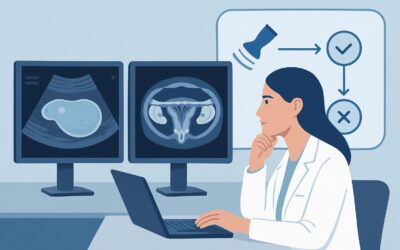
Which Initial Imaging Is Best for Postmenopausal Acute Pelvic Pain? An ACR-Guided Workflow

A 68-year-old woman presents to your clinic with a one-day history of sharp, constant suprapubic pain. Her last menstrual period was over a decade ago, and she denies any vaginal bleeding or discharge. On examination, she is afebrile with focal tenderness in the lower abdomen, but no rebound or guarding. The clinical picture is concerning, but the differential is broad. You need to select the most appropriate initial imaging study to quickly and safely narrow the diagnostic possibilities. This article provides a detailed workflow for this specific scenario, guided by the American College of Radiology (ACR) Appropriateness Criteria, which rates transabdominal pelvic ultrasound as Usually Appropriate for this presentation.
Who Fits This Clinical Scenario?
This guidance applies specifically to postmenopausal women presenting with acute pelvic pain for whom initial imaging is being considered. “Postmenopausal” is typically defined as twelve or more consecutive months of amenorrhea in a woman with an intact uterus, not due to other causes. The pain is of recent onset, distinguishing it from chronic pelvic pain, which follows a different diagnostic pathway.
This workflow is intended for patients where the clinical suspicion is focused on a gynecologic or localized pelvic etiology. It may be less applicable in cases with clear, overwhelming signs of a non-gynecologic emergency. Exclusions and alternative pathways include:
- Patients with signs of peritonitis or hemodynamic instability: These patients may require immediate surgical consultation and a rapid, comprehensive study like CT, or may proceed directly to the operating room, bypassing diagnostic imaging.
- Patients with classic symptoms of a non-gynecologic source: For example, a patient with fever, left lower quadrant pain, and leukocytosis highly suggestive of diverticulitis, or a patient with flank pain and hematuria pointing to renal colic. In these cases, CT of the abdomen and pelvis is often the more direct initial study.
- Patients with known malignancy and suspected complications: While the recommended imaging may still be appropriate, the clinical context and need for staging or evaluation of metastatic disease may alter the choice of modality.
What Diagnoses Are You Working Up in This Scenario?
In a postmenopausal woman, the differential for acute pelvic pain shifts away from the obstetric and ovulatory causes seen in younger patients. The primary goals of imaging are to identify emergent conditions and to characterize adnexal or uterine pathology, which carries a higher suspicion for malignancy in this age group.
Ovarian Torsion: While less common than in premenopausal women, ovarian torsion remains a critical, time-sensitive diagnosis. It occurs when an ovary, often enlarged by a mass, twists on its vascular pedicle, compromising blood flow. Ultrasound with Doppler is the primary modality for identifying an enlarged, edematous ovary with abnormal or absent blood flow, which is the hallmark of torsion.
Adnexal Mass Complications: A postmenopausal adnexal mass is considered malignant until proven otherwise. Acute pain can arise from hemorrhage into a cyst, rupture of a mass, or rapid growth. Ultrasound is highly effective at characterizing the size, morphology (solid vs. cystic components, septations, papillary projections), and vascularity of adnexal masses, which helps stratify risk and guide further management.
Uterine and Endometrial Pathology: Conditions like pyometra (a collection of pus in the uterine cavity) can present with acute pain, often due to cervical stenosis preventing drainage. This is a serious infection that requires prompt diagnosis and treatment. Endometrial carcinoma can also present with pain, particularly if it causes uterine distention or invades surrounding structures. Ultrasound can readily identify an intrauterine fluid collection and measure endometrial thickness, a key parameter in the postmenopausal workup.
Degenerating Uterine Fibroid: Although uterine leiomyomas (fibroids) typically shrink after menopause, they can outgrow their blood supply and undergo degeneration, causing significant acute pain. Ultrasound can identify fibroids and may show features suggestive of degeneration, though these findings can sometimes be nonspecific.
Non-Gynecologic Causes: It is crucial to remember that common abdominal pathologies like diverticulitis, appendicitis, or bowel obstruction can present with pelvic pain. While ultrasound is the preferred initial study for a suspected gynecologic source, the imager will also assess for adjacent non-gynecologic abnormalities.
Why Is Pelvic Ultrasound the Recommended Initial Study for This Presentation?
The ACR designates both US pelvis transabdominal and US pelvis transvaginal as Usually Appropriate for the initial evaluation of acute pelvic pain in a postmenopausal patient. In practice, these are complementary studies often performed in the same session. The transabdominal approach provides a broad overview of the entire pelvis and lower abdomen, while the transvaginal approach offers high-resolution detail of the uterus, endometrium, and ovaries.
The primary rationale for choosing ultrasound first is its excellent safety profile (no ionizing radiation, adult RRL=O 0 mSv) combined with its high diagnostic accuracy for the most pressing gynecologic concerns. It is the best initial modality for evaluating ovarian torsion, characterizing adnexal masses, measuring endometrial thickness, and identifying uterine pathology like pyometra or fibroids.
While CT abdomen and pelvis with IV contrast is also rated as Usually Appropriate, it is often considered a second-line or problem-solving tool in this specific context. CT is superior for evaluating the entire abdomen and pelvis, making it the study of choice if the clinical suspicion for a non-gynecologic cause (like diverticulitis or appendicitis) is high. However, it involves ionizing radiation (adult RRL=☢☢☢ 1-10 mSv) and the risks associated with IV contrast. For purely gynecologic structures, ultrasound often provides superior soft-tissue detail.
Other modalities are rated lower for initial imaging:
- MRI pelvis without and with IV contrast is rated May be appropriate. MRI is an excellent problem-solving tool, particularly for complex adnexal mass characterization when ultrasound is indeterminate. However, it is more expensive, less available, and more time-consuming than ultrasound, making it unsuitable as a first-line screening test in the acute setting.
- CT abdomen and pelvis without IV contrast is also rated May be appropriate. While it can identify some pathologies, the lack of IV contrast significantly limits its ability to evaluate vascular structures (critical for torsion), assess for inflammation, and characterize enhancing masses. It is generally reserved for patients with a contraindication to IV contrast where CT is still deemed necessary.
What’s Next After Pelvic Ultrasound? Downstream Workflow
The results of the initial pelvic ultrasound will dictate the subsequent clinical pathway. The goal is to move from a broad differential to a specific diagnosis and management plan.
If the study is positive for a surgical emergency:
If ultrasound reveals findings classic for ovarian torsion (e.g., an enlarged ovary with no Doppler flow), this constitutes a surgical emergency. The next step is an immediate consultation with a gynecologist for operative intervention to attempt to salvage the ovary.
If the study identifies a suspicious adnexal mass:
If a complex or solid adnexal mass is found, the patient requires urgent gynecologic oncology consultation. Further workup may include tumor markers (like CA-125) and often a problem-solving MRI (rated May be appropriate) to better characterize the mass and plan for surgery. The primary concern is ruling out ovarian or fallopian tube cancer.
If the study is negative or non-diagnostic:
If the ultrasound shows no clear gynecologic cause for the pain, the clinical focus should shift to non-gynecologic etiologies. If the pain persists or there are other concerning clinical signs (e.g., fever, leukocytosis), the next logical step is often a CT of the abdomen and pelvis with IV contrast (also Usually Appropriate) to search for causes like diverticulitis, appendicitis, or other bowel or urinary tract pathology.
If the study is indeterminate:
Occasionally, ultrasound findings may be unclear. For example, a complex adnexal lesion may be difficult to fully characterize, or bowel gas may obscure the ovaries. In these cases, MRI of the pelvis is the superior next step for problem-solving, providing detailed anatomical information without radiation.
Pitfalls to Avoid (and When to Get Help)
Navigating the workup for postmenopausal pelvic pain requires careful consideration to avoid common diagnostic traps.
- Stopping at a “negative” transabdominal ultrasound: A transabdominal scan alone may not adequately visualize the ovaries or endometrium, especially in obese patients. A transvaginal scan is almost always necessary for a complete evaluation unless the patient cannot tolerate it.
- Anchoring on a single finding: A patient may have degenerating fibroids, but her pain could be from a concurrent appendicitis. Always correlate the imaging findings with the patient’s specific symptoms and location of tenderness.
- Dismissing intermittent torsion: Ovarian torsion can be intermittent. A patient may have severe pain that transiently resolves. If Doppler flow is present on ultrasound but the ovary appears enlarged and edematous, torsion-detorsion should remain a high consideration.
- Delaying consultation for a suspicious mass: Any solid or complex cystic adnexal mass in a postmenopausal woman warrants prompt referral to a gynecologic oncologist. Do not adopt a “watch and wait” approach without expert consultation.
If the clinical picture worsens, if the diagnosis remains unclear after initial imaging, or if a suspicious mass is identified, escalate care by consulting with gynecology or general surgery promptly.
Related ACR Topics and Tools
For a comprehensive overview of all clinical scenarios related to this topic, please see our parent guide. For further exploration of imaging guidelines, protocols, and safety, the following resources are available:
- For breadth across all scenarios in Postmenopausal Acute Pelvic Pain, see our parent guide: Postmenopausal Acute Pelvic Pain: ACR Appropriateness Decoded.
- ACR Appropriateness Criteria Lookup — for adjacent scenarios
- Imaging Protocol Library — for technique on the recommended study
- Radiation Dose Calculator — for cumulative dose conversations
Frequently Asked Questions
Why is CT also rated ‘Usually Appropriate’ if ultrasound is the first choice?
CT and ultrasound are both rated ‘Usually Appropriate’ because the best initial test depends on the leading clinical suspicion. If the signs and symptoms point strongly to a gynecologic cause (e.g., adnexal tenderness), ultrasound is preferred due to its lack of radiation and superior detail of the ovaries and uterus. If the differential is broader and includes non-gynecologic causes like diverticulitis or appendicitis, CT provides a more comprehensive evaluation of the entire abdomen and pelvis and is the better choice.
Is a transvaginal ultrasound always necessary in this scenario?
In most cases, yes. A transabdominal ultrasound provides a wide field of view, but the transvaginal approach uses a higher frequency probe placed closer to the pelvic organs, yielding significantly better resolution of the endometrium and ovarian morphology. A complete pelvic ultrasound for this indication typically includes both components, unless the patient declines or is unable to tolerate the transvaginal portion.
What if the ultrasound is negative but my clinical suspicion for ovarian torsion remains high?
This is a challenging situation. Ovarian torsion can be intermittent, and Doppler flow can sometimes be present even with torsion. If there is a high clinical suspicion despite a non-diagnostic or seemingly normal ultrasound, an urgent gynecology consultation is critical. Further imaging with MRI or even diagnostic laparoscopy may be considered.
Does a normal endometrial stripe on ultrasound rule out uterine cancer?
In a postmenopausal woman with acute pelvic pain but no vaginal bleeding, a thin, uniform endometrial stripe (typically <4-5 mm) makes significant endometrial pathology like cancer or pyometra very unlikely. However, it does not completely exclude it, especially if a focal abnormality is seen. Any abnormal thickening or fluid collection requires further investigation, usually starting with an endometrial biopsy.
Should I order an MRI as the first imaging test for postmenopausal pelvic pain?
No, MRI is not recommended as the initial imaging test for acute pelvic pain. The ACR rates it as ‘May be appropriate.’ While MRI provides excellent detail, it is more costly, takes longer to perform, and is less accessible than ultrasound. Its primary role is as a problem-solving tool when ultrasound findings are indeterminate, particularly for characterizing a complex adnexal mass.
Reviewed by Pouyan Golshani, MD, Interventional Radiologist — June 27, 2026