Which Spine Imaging Is Best for Obtundation with Suspected Intracranial Hypotension?
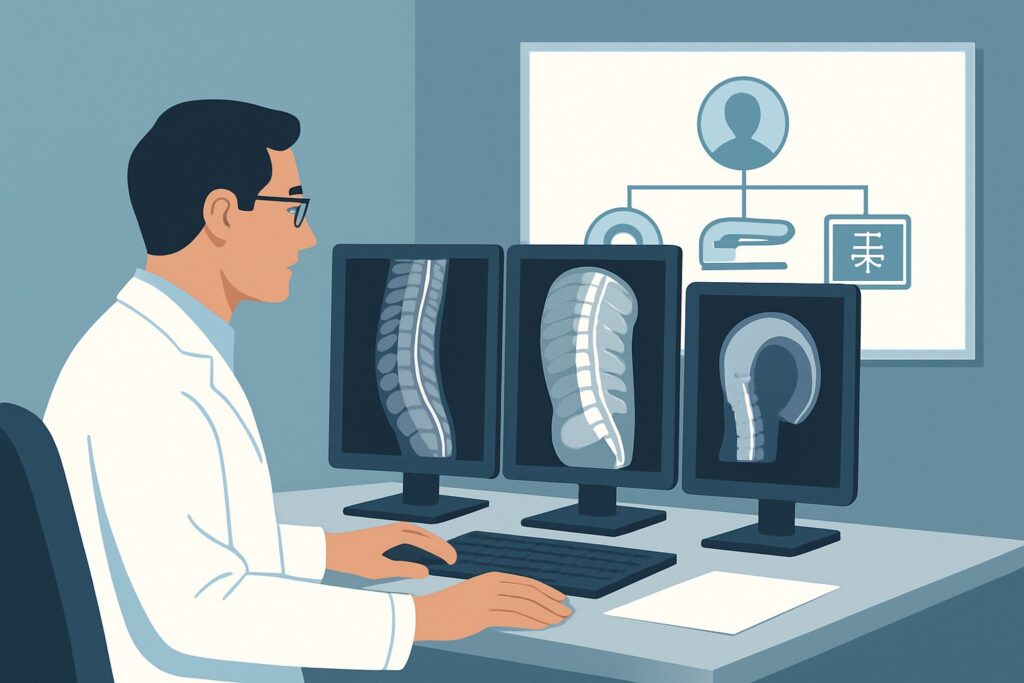
A 62-year-old patient is admitted to the intensive care unit with a progressively declining level of consciousness. An initial brain MRI, ordered to evaluate the obtundation, reveals diffuse pachymeningeal enhancement, sagging of the cerebellar tonsils, and bilateral subdural fluid collections. The findings are highly suggestive of spontaneous intracranial hypotension (SIH), but the cause—a cerebrospinal fluid (CSF) leak—is unknown. The primary team now faces a critical decision: what is the next, most effective imaging study to localize the source of the CSF leak along the entire spinal axis? This article provides a step-by-step clinical workflow for this specific, high-acuity scenario. According to the American College of Radiology (ACR) Appropriateness Criteria, the next step is clear: an MRI of the complete spine without and with IV contrast is rated Usually Appropriate.
Who Fits This Clinical Scenario?
This guidance is specifically for an adult patient presenting with a severe alteration in mental status, such as obtundation, where initial brain imaging has already raised suspicion for intracranial hypotension. The key inclusion criteria are:
- Altered Mental Status: The patient is obtunded or has a significantly decreased level of consciousness. This is a more severe presentation than the classic orthostatic headache.
- Prior Brain Imaging Findings: There are established brain imaging features of SIH, such as pachymeningeal enhancement, subdural fluid collections, engorgement of venous structures, pituitary hyperemia, or sagging of the brainstem and tonsils (the “SEEPS” mnemonic).
- Suspected Spontaneous Leak: There is no clear iatrogenic cause, such as a recent lumbar puncture or spinal surgery.
This workflow is NOT intended for patients with a different clinical presentation, even if SIH is on the differential. Exclusions include:
- Classic Orthostatic Headache: An adult with a typical postural headache but a normal neurologic exam and mental status follows a different diagnostic pathway.
- Post-Dural Puncture Headache: A patient with a headache that began within 72 hours of a known dural puncture has a presumed diagnosis and is managed differently.
- Negative Initial Imaging: A patient with a chronic headache and clinically suspected SIH, but whose initial brain and spine imaging studies were negative, requires a more advanced workup.
Correctly identifying the patient’s scenario is crucial, as these other presentations route to different recommendations within the ACR guidelines.
What Diagnoses Are You Working Up in This Scenario?
In an obtunded patient with brain imaging findings of SIH, the primary goal of subsequent imaging is to locate the underlying CSF leak. The differential diagnosis for the underlying cause and for mimicking conditions includes several key possibilities.
Spontaneous Cerebrospinal Fluid (CSF) Leak
This is the most common and direct cause you are searching for. These leaks typically occur in the spine, often from a dural tear related to a degenerative disc protrusion, a calcified bone spur, or a congenital dural weakness. The resulting loss of CSF volume leads to a cascade of compensatory changes in the cranium, causing the brain to “sag” and producing the characteristic imaging findings. Identifying the precise location of the leak is the essential first step toward definitive treatment, such as a targeted epidural blood patch.
CSF-Venous Fistula
A less common but critical diagnosis to consider is a CSF-venous fistula. In this condition, CSF drains directly from the thecal sac into an adjacent spinal epidural vein. These fistulas can cause profound intracranial hypotension but may not produce the large extradural fluid collections seen with dural tears. They are notoriously difficult to identify on standard MRI and may require more advanced dynamic imaging if initial studies are negative but clinical suspicion remains high.
Infectious or Inflammatory Meningitis
While the constellation of findings strongly suggests SIH, diffuse dural enhancement can also be seen in infectious, inflammatory, or autoimmune meningitis. The clinical picture of obtundation can overlap. While a spinal CSF leak is the primary target, the spine MRI also serves to evaluate for spinal sources of infection, such as an epidural abscess or discitis-osteomyelitis, which could present with similar severe neurologic symptoms.
Dural Metastases or Carcinomatosis
Widespread metastatic disease to the dura (carcinomatous meningitis) can produce diffuse, nodular pachymeningeal enhancement that can mimic SIH. While less likely to cause the classic brain sagging, it remains an important consideration in a patient with altered mental status and dural enhancement, particularly if there is a known history of malignancy. The spine MRI helps evaluate for osseous or epidural metastatic disease.
Why Is MRI of the Complete Spine the Recommended Study for This Presentation?
The ACR designates MRI of the complete spine without and with IV contrast as Usually Appropriate because it is the most effective non-invasive modality for localizing a spinal CSF leak. The rationale is built on its superior soft tissue contrast, lack of ionizing radiation, and ability to survey the entire potential territory of the leak.
The primary goal is to identify direct or indirect signs of a leak. The complete spine MRI protocol is designed to detect:
- Extradural Fluid Collections: This is the most direct sign of a dural tear, representing CSF that has escaped the thecal sac.
- Dural/Nerve Root Enhancement: Post-contrast images can highlight enhancement of the dura and nerve root sleeves at or near the site of the leak due to inflammation and venous congestion.
- Engorged Epidural Venous Plexus: As part of the Monro-Kellie doctrine, loss of CSF volume is compensated by an increase in intracranial and intraspinal venous blood volume, leading to prominent, enhancing epidural veins.
A non-contrast MRI of the complete spine is also rated Usually Appropriate, but the addition of gadolinium-based contrast significantly increases the conspicuity of extradural fluid and venous engorgement, making it the preferred initial study in this high-acuity setting.
Alternative studies are rated lower for specific reasons:
- CT Myelography (May be appropriate): This study is more invasive, requiring a lumbar puncture to inject intrathecal contrast, and carries a very high radiation dose (☢☢☢☢☢ 30-100 mSv). While it excels at identifying active, high-flow leaks and CSF-venous fistulas, it is typically reserved as a second-line or problem-solving tool if the MRI is non-diagnostic.
- MR Myelography (Usually not appropriate): This non-contrast, heavily T2-weighted sequence is excellent for visualizing the morphology of the thecal sac itself but is insensitive to the critical ancillary findings like extradural fluid, venous plexus engorgement, and dural enhancement. It is insufficient for localizing a leak.
The key advantage of MRI is its safety profile, with a radiation dose of 0 mSv, making it the ideal first-line examination for surveying the entire cervical, thoracic, and lumbar spine. Once you’ve decided on this study, understanding the technical details is important. While the recommended study covers the entire spine, the principles of acquisition and interpretation are well-illustrated in our protocol guide for a key component of the exam: MRI Lumbar Spine Without Contrast.
What’s Next After the Spine MRI? Downstream Workflow
The results of the complete spine MRI will guide the subsequent management of the obtunded patient. The downstream workflow depends on whether the study successfully localizes the CSF leak.
If the MRI is positive and localizes the leak:
A definitive site of extradural fluid or other clear signs of a leak points directly to the next step: targeted therapy. This typically involves an epidural blood patch (EBP) performed under fluoroscopic or CT guidance at the specific spinal level identified on the MRI. In some cases of larger or persistent leaks, consultation with neurosurgery or interventional neuroradiology for potential surgical repair or fibrin glue application may be necessary.
If the MRI is negative or non-localizing:
A negative MRI in a patient with strong clinical and brain imaging evidence of SIH presents a diagnostic challenge. The leak may be too slow to create a detectable fluid collection, or it could be a CSF-venous fistula. The next step often involves more advanced, dynamic imaging. This is the point where a CT Myelography (May be appropriate) becomes the primary consideration. A dynamic CT myelogram, which involves imaging the patient in different positions after intrathecal contrast injection, can reveal a transient or high-flow leak not visible on a static MRI.
If the MRI is indeterminate:
Sometimes, the MRI may show ambiguous findings, such as diffuse venous engorgement without a clear fluid collection. In these cases, the decision to proceed to CT myelography versus attempting a non-targeted (e.g., lumbar) EBP is based on clinical judgment, institutional expertise, and the patient’s overall stability. A consultation with neuroradiology and neurology is highly recommended to determine the optimal next step.
Pitfalls to Avoid (and When to Get Help)
In this high-stakes clinical scenario, several common pitfalls can delay diagnosis or lead to suboptimal outcomes. Be mindful of the following:
- Ordering an Incomplete Study: A CSF leak can occur anywhere from the skull base to the sacrum. Ordering an MRI of only the lumbar or cervical spine is a frequent error that can miss the pathology entirely. Always specify “complete spine.”
- Omitting IV Contrast: While a non-contrast study is also rated highly, omitting gadolinium can reduce the sensitivity for detecting subtle extradural fluid collections and associated enhancement, making localization more difficult.
- Misinterpreting Tarlov Cysts: Large perineural (Tarlov) cysts are common incidental findings. While they can rarely be the source of a leak, they are often red herrings. The key is to look for evidence of cyst rupture or adjacent extradural fluid.
- Stopping the Workup After a Negative MRI: Given the severe presentation (obtundation), a negative MRI should not end the investigation. If clinical suspicion remains high, this is a critical moment to escalate care and consult with neuroradiology to discuss proceeding with CT myelography or other advanced techniques.
Related ACR Topics and Tools
For a comprehensive overview of all clinical variants related to intracranial hypotension, as well as tools to help with study selection and patient communication, the following resources are available.
- For breadth across all scenarios in Imaging of Suspected Intracranial Hypotension, see our parent guide: Imaging of Suspected Intracranial Hypotension: ACR Appropriateness Decoded.
- To explore other clinical scenarios and their corresponding ACR recommendations, use the ACR Appropriateness Criteria Lookup.
- For detailed technical specifications on imaging studies, browse the Imaging Protocol Library.
- To discuss radiation exposure from alternative studies like CT myelography, use the Radiation Dose Calculator.
Frequently Asked Questions
Why not go straight to CT myelography if it’s better for high-flow leaks?
CT myelography is more invasive, requiring a lumbar puncture, and delivers a very high dose of ionizing radiation. MRI of the complete spine is non-invasive, has no radiation, and is highly effective at identifying the majority of CSF leaks, particularly those associated with extradural fluid collections. Therefore, MRI is the appropriate first-line study, with CT myelography reserved for cases where MRI is negative or non-diagnostic.
Does the patient need to be able to lie flat for the entire MRI scan?
Yes, the patient will need to lie supine for the duration of the scan, which can be lengthy for a complete spine MRI (often 45-60 minutes). For an obtunded patient, this is typically manageable with appropriate monitoring. However, their clinical stability must be considered before sending them to the MRI scanner.
What if the brain MRI showed dural enhancement but no brain ‘sagging’?
The full constellation of findings (the ‘SEEPS’ mnemonic) is not required. Diffuse, non-nodular pachymeningeal enhancement in the setting of obtundation is a strong indicator of intracranial hypotension and is sufficient to justify proceeding with the complete spine MRI to search for a leak. The absence of brain sag does not rule out the diagnosis.
Is there a role for radionuclide cisternography in this scenario?
No. According to the ACR Appropriateness Criteria for this specific scenario, radionuclide cisternography (DTPA cisternography) is rated ‘Usually Not Appropriate.’ While historically used, it has poor spatial resolution and is inferior to both MRI and CT myelography for localizing the precise site of a spinal CSF leak, which is the critical information needed for targeted treatment.
If a leak is found in the thoracic spine, is a thoracic-only blood patch performed?
Yes. The goal of the imaging is to allow for a targeted epidural blood patch (EBP). If the leak is clearly localized to a specific level in the thoracic or cervical spine, the interventional radiologist or anesthesiologist will perform the EBP at that site under imaging guidance. This is more effective and carries less risk than a non-targeted ‘blind’ lumbar patch.
Reviewed by Pouyan Golshani, MD, Interventional Radiologist — May 30, 2026