Why Is Initial Imaging Not Recommended for Low-Risk Asymptomatic CAD Patients?
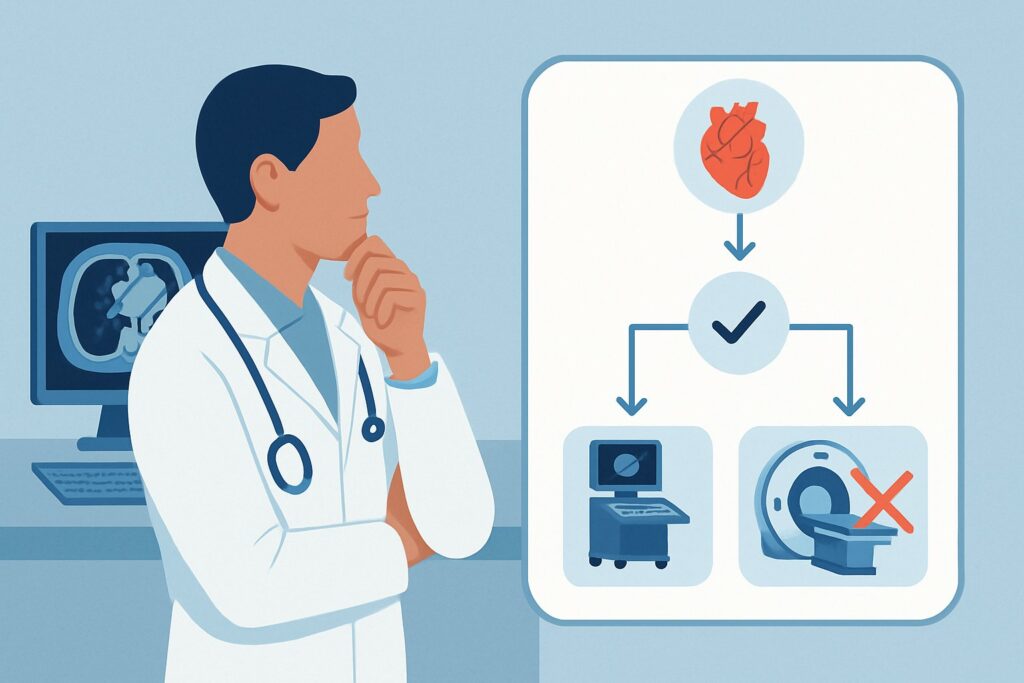
A 46-year-old executive sits in your office for an annual physical. He is active, a non-smoker, and has no personal history of heart disease. His blood pressure is well-controlled, and his recent lipid panel is only mildly abnormal. He has no chest pain, shortness of breath, or other cardiac symptoms. “I’ve been reading about those heart scans,” he says. “My friend got one. Should I get one too, just to be safe?” You are now faced with a common clinical question: what is the role of imaging in an asymptomatic, low-risk patient for coronary artery disease (CAD)? This article provides a detailed workflow for this specific scenario, explaining why the American College of Radiology (ACR) finds that nearly all forms of initial cardiac imaging, including a resting transthoracic echocardiogram, are Usually not appropriate.
Who Fits This Clinical Scenario?
This guidance applies specifically to adult patients who are asymptomatic and have a low calculated risk for coronary artery disease. Defining “low risk” is crucial. This is typically determined using a validated risk calculator, such as the ACC/AHA Atherosclerotic Cardiovascular Disease (ASCVD) Risk Estimator. A low-risk designation generally corresponds to a 10-year risk of a major adverse cardiac event of less than 5%.
Inclusion criteria for this scenario are straightforward:
- No symptoms suggestive of cardiac ischemia (e.g., no chest pain, dyspnea on exertion, anginal equivalents).
- A low 10-year ASCVD risk score.
- This is the initial consideration for imaging; the patient has not had prior screening for CAD.
It is critical to distinguish this patient from those in similar but distinct clinical situations. This guidance does not apply if:
- The patient is symptomatic: Any patient with chest pain, shortness of breath, or other potential anginal symptoms requires a different diagnostic workup entirely.
- The patient has an intermediate or high ASCVD risk score: As risk increases, the pre-test probability of disease changes, and the utility of certain imaging studies may shift. These scenarios are covered in separate ACR Appropriateness Criteria variants. For example, a patient with a 10-year ASCVD risk of 15% falls into a different decision-making pathway.
What Diagnoses Are You Working Up in This Scenario?
In an asymptomatic, low-risk individual, the primary goal of considering imaging is not to diagnose an acute condition but to screen for subclinical atherosclerosis. The fundamental question is whether there is evidence of coronary artery plaque buildup that has not yet caused symptoms. Identifying this early could theoretically prompt more aggressive risk factor modification. However, the clinical challenge is that in a low-risk population, the prevalence of significant subclinical disease is low.
While less of a primary target in this specific screening context, imaging could incidentally detect other structural cardiac abnormalities. For instance, an echocardiogram might reveal previously unknown valvular heart disease (e.g., a bicuspid aortic valve) or cardiomyopathy (e.g., mild left ventricular hypertrophy). While these are important findings, they are not the primary indication for ordering a CAD screening study. The low pre-test probability of finding clinically significant, actionable disease of any type is the central reason that routine screening imaging is discouraged in this population.
The core tension is balancing the potential benefit of detecting occult disease against the significant risks of false positives, incidentalomas, patient anxiety, radiation exposure (with certain tests), and triggering a cascade of further, more invasive, and potentially unnecessary testing.
Why Is Imaging Usually Not Appropriate for This Presentation?
For an asymptomatic, low-risk patient, the ACR Appropriateness Criteria rates all common initial imaging modalities as Usually not appropriate. This recommendation is grounded in the principle of avoiding low-value care, where the potential harms and costs of testing outweigh the likely benefits.
Let’s examine the rationale for several key modalities:
- US Echocardiography Transthoracic Resting: This study is rated Usually not appropriate. An echocardiogram is excellent for assessing cardiac structure, ejection fraction, and regional wall motion. However, in an asymptomatic patient without ischemia, regional wall motion is expected to be normal. The test does not directly visualize coronary artery plaque. Therefore, a normal result is expected and does not change management, which is already focused on lifestyle optimization based on the patient’s low-risk profile. It provides no radiation (0 mSv) but has a very low diagnostic yield for subclinical CAD.
- CT Coronary Calcium (CACS): This study is also rated Usually not appropriate. A calcium score directly quantifies calcified atherosclerotic plaque in the coronary arteries. While a score of zero has a high negative predictive value, a zero score is the most likely outcome in a low-risk individual. This result merely confirms the low-risk assessment and does not alter the recommendation for lifestyle management. Conversely, a non-zero score in this population can create significant patient anxiety and may lead to a cascade of further testing (like stress tests or CTA) without clear evidence that this pathway improves long-term outcomes compared to standard risk factor management. The test also involves radiation (☢☢☢ 1-10 mSv).
- CTA Coronary Arteries with IV Contrast: This is rated Usually not appropriate. Coronary CTA provides detailed anatomical images of the coronary arteries and can detect both calcified and non-calcified plaque. However, it involves a higher radiation dose (☢☢☢ 1-10 mSv) and the use of iodinated contrast. Given the low pre-test probability of significant stenosis in this population, the risk of false positives, incidental findings, and the potential harms of radiation and contrast outweigh the benefits.
The consensus is that for low-risk, asymptomatic patients, clinical management should be guided by risk factor assessment and lifestyle counseling, not by screening imaging. The potential for a test to generate a “positive” result that leads to more tests, without a proven benefit on patient outcomes, is a primary driver of these recommendations.
What’s Next? Downstream Workflow
Given that the recommended path is to forgo initial imaging, the downstream workflow is clinical, not radiological. The focus should be on primary prevention and risk factor optimization.
- If No Imaging is Performed (Recommended Path): The next step is a clear, evidence-based conversation with the patient about shared decision-making. Explain the rationale for not performing a scan, focusing on the low pre-test probability of disease and the risks of over-testing. Reinforce the importance of lifestyle modifications (diet, exercise, smoking cessation) and manage borderline risk factors like lipids and blood pressure according to established primary prevention guidelines. Schedule regular follow-up to periodically reassess their ASCVD risk score as they age or if risk factors change.
- If a Study is Performed Against Guidelines:
- If Negative: If a CACS is performed and the score is zero, or a resting echo is normal, this can provide reassurance. However, it is critical to counsel the patient that a negative result does not confer immunity from future events and that lifestyle management remains the cornerstone of prevention.
- If Positive/Indeterminate: This is the cascade the guidelines aim to prevent. A positive calcium score (e.g., >0) or an indeterminate finding on another study in a low-risk patient presents a clinical dilemma. It often triggers further evaluation, potentially with functional stress testing or even coronary CTA, and may lead to initiation of medical therapy (e.g., statins) that might not have been otherwise indicated. This path should be navigated carefully with a clear understanding that the initial test was outside of standard guidelines.
The most appropriate downstream action for this patient scenario is to re-engage on the fundamentals of cardiovascular health, not to pursue a diagnostic test in search of a disease that is unlikely to be present in a clinically significant form.
Pitfalls to Avoid (and When to Get Help)
Navigating this scenario requires careful clinical judgment. Here are common pitfalls to avoid:
- Underestimating the Power of Reassurance: Do not dismiss a patient’s request for a scan. Instead, use it as an opportunity for education and shared decision-making, explaining the “why” behind the recommendation to defer imaging.
- Miscalculating Clinical Risk: Ensure you are using a validated tool like the ASCVD risk calculator. A single factor, like a strong family history of premature CAD, might move a patient into an intermediate-risk category where the imaging discussion changes.
- Ordering a Test to “Just Be Sure”: In a low-risk population, this approach often causes more harm than good by initiating a cascade of unnecessary follow-up tests and procedures.
- Ignoring a Change in Symptoms: The “asymptomatic” status is key. If a patient develops any symptoms suggestive of ischemia between visits, the entire workup must be re-evaluated immediately, and this guidance no longer applies.
If you are uncertain about a patient’s risk stratification or if they have confounding clinical factors, a consultation with a cardiologist can be invaluable before ordering any advanced cardiac imaging.
Related ACR Topics and Tools
For a comprehensive overview of imaging recommendations across all risk strata for this condition, please consult the parent topic article. Additional tools from GigHz can help you apply these guidelines in your practice.
- For breadth across all scenarios in Asymptomatic Patient at Risk for Coronary Artery Disease, see our parent guide: Asymptomatic Patient at Risk for Coronary Artery Disease: ACR Appropriateness Decoded.
- To explore other clinical scenarios, use the Imaging Appropriateness Selector.
- For details on how specific studies are performed, visit the Imaging Protocol Library.
- To discuss radiation exposure with patients, the Radiation Dose Calculator can help frame the conversation.
Frequently Asked Questions
What ASCVD risk score is considered ‘low risk’?
Generally, a 10-year risk for a hard atherosclerotic cardiovascular disease event of less than 5% is considered low risk. This is the population for whom this specific guidance applies.
What if my low-risk patient has a strong family history of premature coronary artery disease?
A first-degree relative with premature CAD (male <55 years, female <65 years) is a significant risk-enhancing factor. Its presence may be reason to re-classify the patient as intermediate-risk, even with a low calculated score. In that case, a different ACR variant and imaging recommendation (such as a CT for coronary calcium) may become appropriate.
Why is a CT calcium score ‘Usually not appropriate’ if it can directly detect plaque?
In a low-risk population, the pre-test probability of finding significant calcification is very low. A score of zero is the most likely outcome, which does not change clinical management (lifestyle counseling). A positive score can lead to a cascade of further testing and patient anxiety, without clear evidence that this approach improves outcomes over standard risk factor management in this group.
Does a normal resting EKG confirm that no imaging is needed?
A resting electrocardiogram (EKG) is a part of the standard cardiovascular risk assessment. In an asymptomatic, low-risk patient, a normal EKG reinforces the clinical assessment. It does not, by itself, rule out coronary artery disease, but it supports the guideline recommendation to defer further screening imaging.
When should I reconsider imaging for this patient in the future?
You should plan to periodically re-calculate the patient’s cardiovascular risk score (e.g., every 4-6 years, per guidelines). If their risk profile changes and they move into the intermediate- or high-risk category, the discussion about imaging should be revisited. Furthermore, if the patient develops any symptoms suggestive of cardiac ischemia at any time, an immediate diagnostic workup is warranted, and this screening guidance no longer applies.
Reviewed by Pouyan Golshani, MD, Interventional Radiologist — May 26, 2026