First-Time Acute Flank Pain: Why Is CT Without Contrast the Right Initial Imaging?
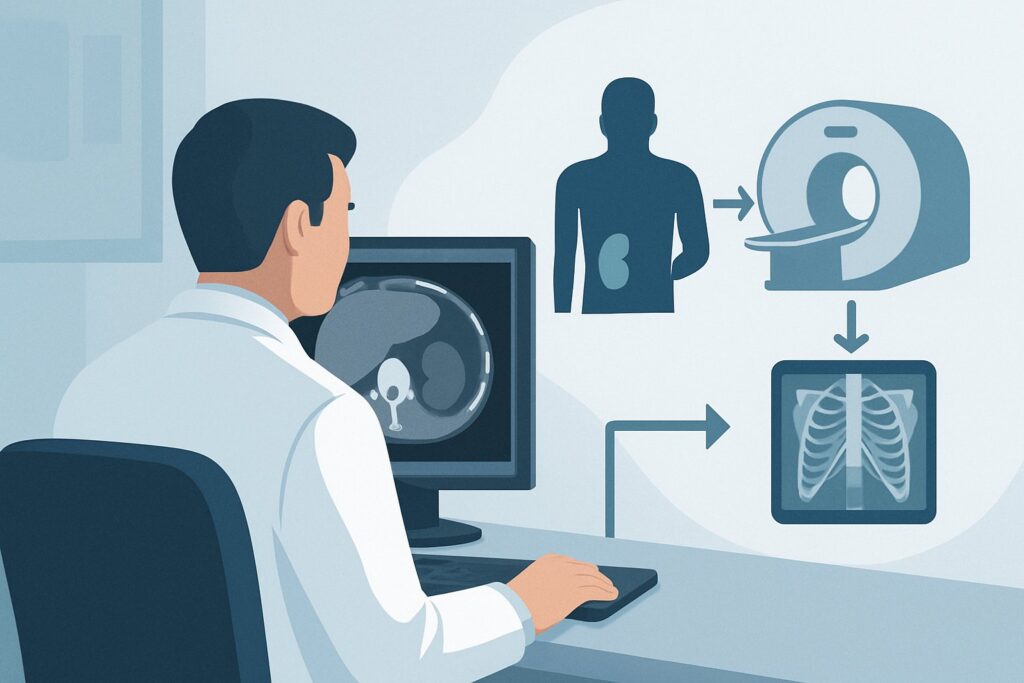
It’s 10 PM in the emergency department, and you’re evaluating a 45-year-old male writhing in pain. He describes a sudden, severe, colicky pain radiating from his right flank to his groin, accompanied by nausea. His urinalysis shows microscopic hematuria. You strongly suspect a kidney stone, but he has no prior history of urolithiasis. The immediate question is which imaging study will provide a definitive diagnosis quickly and safely, guiding the next steps in his care. For this specific presentation, the American College of Radiology (ACR) designates one study as the clear first choice. This workflow details why CT abdomen and pelvis without IV contrast is rated Usually Appropriate and how to navigate the diagnostic pathway for a patient with a first-time suspected stone.
Who Fits This Clinical Scenario?
This guidance is specifically for patients presenting with acute onset flank pain where urolithiasis (a kidney or ureteral stone) is the primary clinical suspicion, and the patient has no known history of stone disease. This “stone-naive” presentation is critical, as the diagnostic goals are to confirm the presence, size, and location of a calculus, identify any complications like hydronephrosis, and evaluate for alternative diagnoses.
This workflow applies to the initial imaging decision for an adult patient. Key inclusion criteria are:
- Acute, often severe, flank pain (unilateral).
- Clinical suspicion for urolithiasis (e.g., based on pain character, hematuria).
- No documented history of kidney stones, or a very remote history with no recent imaging.
Conversely, this guidance does not apply to several similar-appearing but distinct clinical situations. If your patient has known, recently diagnosed stone disease and is presenting with recurrent symptoms, a different imaging strategy may be warranted. Similarly, pregnant patients with suspected stones require a unique, radiation-minimizing approach. This workflow also does not cover the next steps for a patient whose initial CT scan was inconclusive. Each of these scenarios has its own dedicated ACR pathway.
What Diagnoses Are You Working Up in This Scenario?
While a ureteral stone is the leading diagnosis, the initial imaging study must also be capable of identifying or excluding other serious conditions that can mimic renal colic. The differential diagnosis is broad and includes both urologic and non-urologic causes.
Urolithiasis is the most common cause of this presentation. An obstructing stone, typically at the ureteropelvic junction (UPJ), pelvic brim, or ureterovesical junction (UVJ), causes acute distension of the upstream collecting system, leading to severe visceral pain.
Pyelonephritis, an infection of the kidney, can also cause flank pain, fever, and nausea. While often a clinical diagnosis, imaging can be crucial to rule out complications like a renal abscess or an obstructing stone causing a secondary infection (pyonephrosis), which is a urologic emergency.
Appendicitis, particularly with a retrocecal appendix, can present with right flank or back pain that mimics a right-sided kidney stone. A non-contrast CT can often visualize secondary signs of appendicitis even without IV contrast, such as an appendicolith or periappendiceal inflammation.
Diverticulitis is a key consideration for left-sided flank pain, especially in older patients. Inflammation of a colonic diverticulum can cause pain that radiates to the flank, and a non-contrast CT can reveal characteristic findings like colonic wall thickening and pericolic fat stranding.
Less common but critical mimics include ovarian torsion in females, leaking abdominal aortic aneurysm (AAA), or renal vein thrombosis. The chosen imaging study should ideally be able to detect signs of these life-threatening conditions, even if it’s not the definitive test for them.
Why Is CT Abdomen and Pelvis Without IV Contrast the Recommended Study for This Presentation?
For a patient with a first-time presentation of suspected renal colic, the ACR rates CT abdomen and pelvis without IV contrast as Usually Appropriate. This recommendation is based on its exceptional diagnostic performance, speed, and ability to evaluate for alternative diagnoses.
The primary advantage of non-contrast CT (NCCT) is its high sensitivity and specificity for detecting calcifications anywhere along the urinary tract. It can identify stones as small as 1 mm, regardless of their composition (with the rare exception of pure matrix stones or those caused by certain medications). It also precisely localizes the stone and measures its size, which are critical factors for determining management. Furthermore, NCCT is excellent for identifying secondary signs of obstruction, such as hydronephrosis, hydroureter, and perinephric fat stranding.
Why are other common modalities rated lower for this specific initial workup?
- Ultrasound (US kidneys and bladder retroperitoneal) is rated May be appropriate. While it has the major advantage of using no ionizing radiation, its utility is limited. Ultrasound is excellent for detecting hydronephrosis (an indirect sign of obstruction) and stones within the kidney or at the very top (UPJ) or bottom (UVJ) of the ureter. However, it is notoriously poor at visualizing stones in the mid-ureter due to overlying bowel gas. Its performance is also highly operator-dependent.
- Radiography (KUB) is also rated May be appropriate. A plain abdominal radiograph can only visualize radiopaque (calcium-containing) stones and has significantly lower sensitivity than CT. It is often obscured by bowel gas and stool and provides no information about renal function or alternative non-urologic diagnoses.
The radiation dose for a standard non-contrast CT for stones is categorized as moderate (ACR Relative Radiation Level ☢☢☢, 1-10 mSv). Many institutions now employ low-dose protocols that can substantially reduce this exposure while maintaining high diagnostic accuracy for stone detection. Intravenous contrast is not only unnecessary but is rated Usually not appropriate because it can obscure small calcifications, making them harder to detect.
Once you’ve decided on this study, ensuring the correct protocol is ordered is key. For a detailed guide on the technique, patient preparation, and interpretation principles, see our complete protocol guide: CT Abdomen/Pelvis Without Contrast (Renal Stone).
What’s Next After CT Abdomen and Pelvis Without IV Contrast? Downstream Workflow
The results of the non-contrast CT will dictate your immediate next steps. The clinical pathway typically branches into one of three directions.
1. Positive for an Uncomplicated Obstructing Stone: If the CT confirms a stone of a size likely to pass spontaneously (typically <5-7 mm) without signs of high-grade obstruction or infection, the patient can often be managed as an outpatient. This usually involves pain control, hydration, and medical expulsive therapy (e.g., alpha-blockers). A referral to urology for follow-up is standard practice.
2. Positive for a Complicated Stone or High-Grade Obstruction: If the stone is large (>10 mm), associated with severe hydronephrosis, or if there are concurrent signs of infection (fever, leukocytosis), this constitutes a urologic emergency. An immediate consultation with a urologist is required for potential intervention, such as ureteral stent placement or percutaneous nephrostomy tube drainage.
3. Negative for Stone Disease: If the CT is negative for urolithiasis, the report should be carefully reviewed for an alternative diagnosis. If the scan identifies appendicitis, diverticulitis, or another acute process, the patient’s care should be redirected to the appropriate service (e.g., general surgery). If the scan is entirely negative and the patient’s symptoms persist, a re-evaluation of the clinical picture is necessary. This may involve further laboratory testing or considering other imaging modalities to investigate less common causes of flank pain, depending on the evolving clinical scenario.
Pitfalls to Avoid (and When to Get Help)
In the workup of a first-time suspected kidney stone, several common pitfalls can lead to diagnostic errors or delays in care.
- Mistaking a phlebolith for a ureteral stone: Pelvic phleboliths (calcified veins) are common and can be mistaken for a distal ureteral stone. Look for the “soft tissue rim sign” around a ureteral stone, which is absent in a phlebolith.
- Ordering the wrong CT protocol: Inadvertently ordering a CT with IV contrast is a frequent error. This can obscure the very stone you are looking for. Always specify “non-contrast” or “renal stone protocol.”
- Fixating on stones: Don’t forget to scrutinize the rest of the abdomen and pelvis for alternative diagnoses. A leaking AAA or early appendicitis can be missed if the search is too narrow.
- Ignoring secondary signs: The absence of a visible stone does not rule out a recently passed stone. Perinephric stranding and mild hydroureter can be clues that a stone has just passed through the UVJ.
Escalate immediately for a urology consultation if the patient has a known solitary kidney with an obstructing stone, bilateral obstructing stones, or any signs of sepsis (fever, hypotension, leukocytosis) in the setting of an obstructing stone.
Related ACR Topics and Tools
This article covers one specific scenario in depth. For a broader view of all clinical variants and imaging options for this condition, or to explore related tools for your practice, please see the resources below.
- For breadth across all scenarios in Acute Onset Flank Pain-Suspicion of Stone Disease (Urolithiasis), see our parent guide: Acute Onset Flank Pain-Suspicion of Stone Disease (Urolithiasis): ACR Appropriateness Decoded.
- To explore other clinical scenarios and their ACR-recommended imaging pathways, use the ACR Appropriateness Criteria Lookup.
- To review detailed procedural steps for hundreds of imaging studies, visit the Imaging Protocol Library.
- To help discuss radiation exposure with patients, use the Radiation Dose Calculator.
Frequently Asked Questions
Why not start with an ultrasound to avoid radiation, especially in a younger patient?
Ultrasound is rated ‘May be appropriate’ and is a reasonable first choice in patients where radiation avoidance is a high priority (e.g., younger patients, those with multiple prior CTs). However, the ACR designates non-contrast CT as ‘Usually Appropriate’ because of its superior accuracy. Ultrasound often misses stones in the mid-ureter and is less effective at identifying alternative non-urologic diagnoses. A negative or equivocal ultrasound in a patient with high clinical suspicion often requires a follow-up CT anyway, potentially delaying the diagnosis.
If a patient had a single kidney stone 15 years ago but none since, do they still fit this ‘no history’ scenario?
Yes, a very remote history with no intervening events or imaging generally fits this workflow. The key distinction is between a ‘stone-naive’ patient versus a known ‘recurrent stone former.’ A patient with a single, remote episode is diagnostically similar to a first-timer, as the pre-test probability of an alternative diagnosis is higher and there is no recent imaging for comparison.
What should I do if my clinical suspicion for a kidney stone is very high, but the non-contrast CT is negative?
First, carefully review the CT report and images with the radiologist to ensure no subtle signs of a recently passed stone (like perinephric stranding) were missed. If the scan is truly negative, reconsider the differential diagnosis. The pain could be from a non-obstructing renal calculus (not typically painful), musculoskeletal strain, or another cause. If symptoms persist, further workup may be needed, which could include a CT Urogram (CTU) if a urothelial abnormality is suspected, though this is a separate clinical question.
Why is a CT with IV contrast rated ‘Usually not appropriate’ for an initial stone search?
Intravenous contrast opacifies the renal collecting system, ureters, and bladder. While this is useful for evaluating function and anatomy (as in a CT Urogram), the dense contrast material can obscure or ‘hide’ small, calcified stones within the ureter, making them invisible to the radiologist. Since the primary goal is stone detection, non-contrast imaging is the superior technique.
Are there low-dose CT protocols for kidney stones, and should I request one?
Yes, low-dose and ultra-low-dose CT protocols for urolithiasis are widely available and have been shown to maintain very high diagnostic accuracy for stone detection while significantly reducing the radiation dose, often to a level comparable to a few abdominal radiographs. It is always good practice to use the lowest possible radiation dose that achieves the diagnostic goal (the ALARA principle). You can and should inquire if your institution’s ‘renal stone protocol’ is a low-dose technique.
Reviewed by Pouyan Golshani, MD, Interventional Radiologist — May 30, 2026