How Should You Image an Asymptomatic Cervical Bruit or High-Risk Patient?
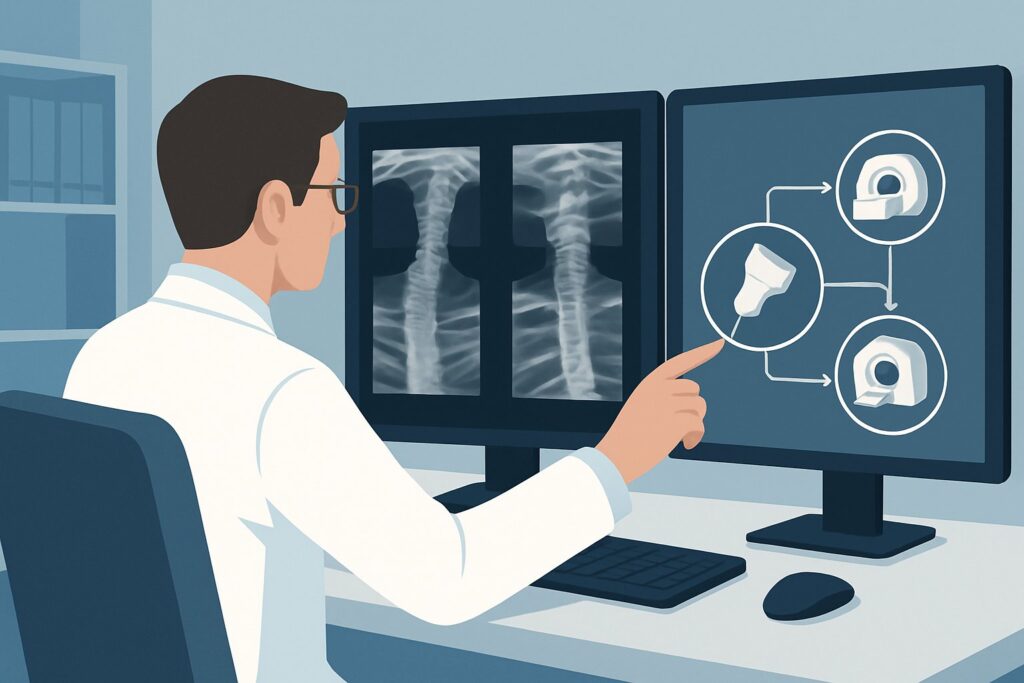
A 68-year-old man with a history of hypertension and hyperlipidemia presents for his annual physical. He feels well and denies any focal weakness, numbness, vision changes, or speech difficulties. On physical examination, you auscultate a soft, right-sided cervical bruit. You know this finding can be a marker for underlying carotid artery stenosis, a significant risk factor for ischemic stroke, even in the absence of symptoms. The immediate clinical question is how to evaluate this finding safely and effectively. What is the appropriate first imaging study to order? For this specific scenario, the American College of Radiology (ACR) rates US duplex Doppler carotid artery as Usually Appropriate, making it the recommended initial test to assess for clinically significant stenosis.
Who Fits the Asymptomatic Cervical Bruit or High-Risk Scenario?
This imaging workflow is designed for a specific patient population: those who are entirely asymptomatic from a neurologic standpoint. The key inclusion criteria are the presence of a structural lesion suspected on physical examination (most commonly a cervical bruit) or the presence of significant risk factors for cerebrovascular disease without a bruit. These risk factors often include a strong smoking history, diabetes mellitus, hypertension, hyperlipidemia, and known atherosclerotic disease elsewhere, such as coronary artery or peripheral arterial disease.
It is critical to distinguish this scenario from others that present similarly but require a different, often more urgent, imaging pathway. This guidance does not apply to:
- Patients with active neurologic symptoms. A patient describing a recent episode of transient monocular blindness, focal weakness, or aphasia is experiencing a Transient Ischemic Attack (TIA). This is a distinct clinical scenario requiring a more comprehensive and immediate evaluation, often including brain imaging.
- Patients with a new, fixed neurologic deficit. A patient presenting with a new, persistent focal deficit is suspected of having an acute stroke. The imaging priority shifts to the brain parenchyma to rule out hemorrhage and assess for ischemia, typically starting with a non-contrast CT of the head.
This workflow is exclusively for the non-urgent, outpatient evaluation of an asymptomatic individual to screen for underlying carotid artery disease that may warrant medical or procedural intervention to mitigate future stroke risk.
What Diagnoses Are You Working Up in This Scenario?
When ordering imaging for an asymptomatic cervical bruit or in a high-risk patient, the primary goal is to identify and quantify conditions that predispose to ischemic stroke. The differential diagnosis guides the choice of imaging modality.
The most common and clinically significant diagnosis is atherosclerotic carotid artery stenosis. Plaque buildup, typically at the carotid bifurcation, can narrow the arterial lumen. This turbulent flow is what produces the audible bruit. The critical task of imaging is not just to detect the plaque but to accurately grade the degree of stenosis, as this determination (e.g., >50%, >70%) directly influences recommendations for medical management versus procedural intervention like carotid endarterectomy or stenting.
A less common but important consideration, particularly in younger or middle-aged women, is fibromuscular dysplasia (FMD). This non-atherosclerotic, non-inflammatory vascular disease can cause stenosis, aneurysm, or dissection in the carotid and vertebral arteries. It often presents with a characteristic “string of beads” appearance on cross-sectional imaging and can also be a source of a cervical bruit.
Other potential causes of a bruit are often related to anatomy or referred sounds. Carotid artery tortuosity or kinking can create turbulent flow without significant stenosis. In some cases, a loud cardiac murmur, such as from aortic stenosis, can be transmitted up into the neck and be mistaken for a primary carotid bruit. While rare, an arteriovenous fistula (AVF) can also produce a bruit due to high-flow shunting, though this is an uncommon finding in this clinical context.
Why Is US Duplex Doppler the Recommended Study for This Presentation?
For the initial evaluation of an asymptomatic patient with a suspected carotid lesion, the ACR designates US duplex Doppler carotid artery as Usually Appropriate. This recommendation is based on an optimal balance of diagnostic accuracy, safety, and cost-effectiveness for a screening or first-line investigation.
The primary strength of carotid duplex ultrasound is its dual-modality nature. The B-mode (grayscale) imaging provides an anatomic assessment of the vessel wall, identifying the presence and morphology of atherosclerotic plaque. The Doppler component provides crucial hemodynamic data by measuring blood flow velocities. The peak systolic and end-diastolic velocities are used in validated criteria (e.g., the Society of Radiologists in Ultrasound consensus criteria) to accurately grade the degree of stenosis. This ability to provide physiologic information about flow limitation is a key advantage over purely anatomic imaging modalities.
Furthermore, ultrasound is completely non-invasive. It involves no ionizing radiation (adult RRL=O 0 mSv) and does not require intravenous contrast, eliminating the risks of contrast-induced nephropathy or allergic reaction. Its wide availability and lower cost make it an ideal first-line tool.
Other advanced imaging studies, while powerful, are generally reserved for specific follow-up situations in this scenario:
- CTA neck with IV contrast is also rated Usually Appropriate but is not typically the first choice. It provides excellent anatomic detail of the entire neck vasculature, which is valuable for pre-procedural planning if an intervention is considered. However, it involves both ionizing radiation (adult RRL=☢☢☢ 1-10 mSv) and iodinated contrast, making it less ideal for initial screening.
- Arteriography cervicocerebral is rated Usually Not Appropriate for this indication. As an invasive procedure with risks of stroke, vessel dissection, and access site complications, its use is now almost exclusively limited to therapeutic interventions, not initial diagnosis.
Once you’ve decided on the initial study, understanding the technical aspects is key to a high-quality result. Our protocol guide covers the technique, interpretation, and reporting principles in detail: US Carotid Doppler.
What’s Next After US Duplex Doppler Carotid Artery? Downstream Workflow
The results of the carotid ultrasound will guide the subsequent clinical pathway. The decision tree branches based on whether the study is negative, positive for significant stenosis, or indeterminate.
If the study is negative or shows minimal (<50%) stenosis: For most patients, this result is reassuring. The focus shifts to aggressive medical management of their underlying vascular risk factors. This includes optimizing blood pressure, lipid-lowering therapy (statins), antiplatelet therapy (e.g., aspirin), and lifestyle modifications like smoking cessation and diet. Repeat surveillance imaging may be considered in several years, depending on the patient’s overall risk profile.
If the study is positive for moderate to severe stenosis (typically ≥50%): The next step is to determine if the patient is a candidate for intervention. This decision is complex and depends on the precise degree of stenosis, patient life expectancy, surgical risk, and shared decision-making. For hemodynamically significant stenosis (often defined as ≥70% in asymptomatic patients, though thresholds vary), a referral to a vascular surgeon or interventionalist is warranted. Confirmatory imaging with CTA or MRA is often performed before any procedure to confirm the degree of stenosis and plan the intervention.
If the study is indeterminate or technically limited: Occasionally, factors like heavy vessel calcification, a high carotid bifurcation, or patient body habitus can limit the diagnostic quality of an ultrasound. In these cases, a non-invasive cross-sectional imaging study is the appropriate next step. Both MRA neck without and with IV contrast and CTA neck with IV contrast are rated Usually Appropriate and can provide the definitive anatomic and stenosis assessment needed to guide management.
Pitfalls to Avoid (and When to Get Help)
Navigating the workup of an asymptomatic bruit requires careful attention to clinical context to avoid common errors.
- Misclassifying the patient: The most critical pitfall is applying this asymptomatic workflow to a patient who has had a TIA or minor stroke. Any recent neurologic symptom moves the patient into a higher-acuity category requiring a more urgent and comprehensive workup, including brain imaging.
- Over-reliance on the bruit: While a bruit prompts investigation, its absence does not rule out significant stenosis. High-grade, “flow-limiting” stenoses may not produce a bruit. Clinical decisions for screening should be based on the overall risk factor profile, not just the presence or absence of a bruit.
- Ignoring bilateral disease: Ensure the ordered ultrasound evaluates both carotid arteries thoroughly. The presence of disease on one side increases the pre-test probability of disease on the other.
If the ultrasound results are equivocal or if they are discordant with a high clinical suspicion, escalation to a vascular specialist and consideration of cross-sectional imaging (CTA or MRA) is the appropriate next step.
Related ACR Topics and Tools
This article focuses on a single clinical scenario. For a comprehensive overview of imaging for all related presentations, from TIA to acute stroke and hemorrhage, please consult our parent guide. Additional tools can help you explore adjacent scenarios, understand imaging protocols, and discuss radiation dose with patients.
- For breadth across all scenarios in Cerebrovascular Disease, see our parent guide: Cerebrovascular Disease: ACR Appropriateness Decoded.
- Imaging Appropriateness Selector — for adjacent scenarios
- Imaging Protocol Library — for technique on the recommended study
- Radiation Dose Calculator — for cumulative dose conversations
Frequently Asked Questions
Does the absence of a cervical bruit mean there is no significant carotid stenosis?
No. While a bruit is a specific indicator of turbulent blood flow, its sensitivity is limited. A very high-grade stenosis (>90%) may have such low flow that it no longer produces an audible bruit. Therefore, in patients with a high-risk profile for atherosclerotic disease, the absence of a bruit does not exclude the possibility of clinically significant carotid stenosis.
If the carotid ultrasound is normal, is any other imaging of the neck arteries needed?
For a technically adequate and completely normal carotid ultrasound in an asymptomatic patient, no further arterial imaging is typically necessary. The clinical focus should be on primary prevention through aggressive medical management of vascular risk factors like hypertension, hyperlipidemia, and diabetes.
Why isn’t MRA or CTA recommended as the first-line test for an asymptomatic bruit?
While MRA and CTA are excellent tests, US duplex Doppler is preferred for initial screening because it is non-invasive, uses no radiation or iodinated contrast, is less expensive, and provides unique hemodynamic (blood flow) data that is critical for grading stenosis. MRA and CTA are typically reserved for cases where ultrasound is inconclusive or for pre-procedural planning after a significant stenosis has been identified.
Should I screen all patients with risk factors for carotid stenosis, even without a bruit?
This is a topic of ongoing debate with varying society guidelines. The U.S. Preventive Services Task Force (USPSTF) recommends against screening for asymptomatic carotid artery stenosis in the general adult population. However, screening may be considered on a case-by-case basis for individuals with multiple, significant risk factors (e.g., known peripheral artery disease, coronary artery disease, multiple traditional risk factors), following a shared decision-making conversation about the potential benefits and harms of detection and treatment.
What degree of stenosis found on ultrasound is considered ‘significant’ in an asymptomatic patient?
The threshold for intervention in asymptomatic patients is generally higher than for symptomatic patients. Most clinical trials have defined significant stenosis as ≥60% or ≥70% for consideration of carotid endarterectomy or stenting. However, any finding of moderate stenosis (≥50%) typically warrants referral to a vascular specialist to discuss intensive medical management and potential further evaluation or intervention based on the patient’s specific clinical profile and life expectancy.
Reviewed by Pouyan Golshani, MD, Interventional Radiologist — May 26, 2026