Initial Imaging for a Nonsuperficial Soft Tissue Mass: An ACR-Guided Workflow
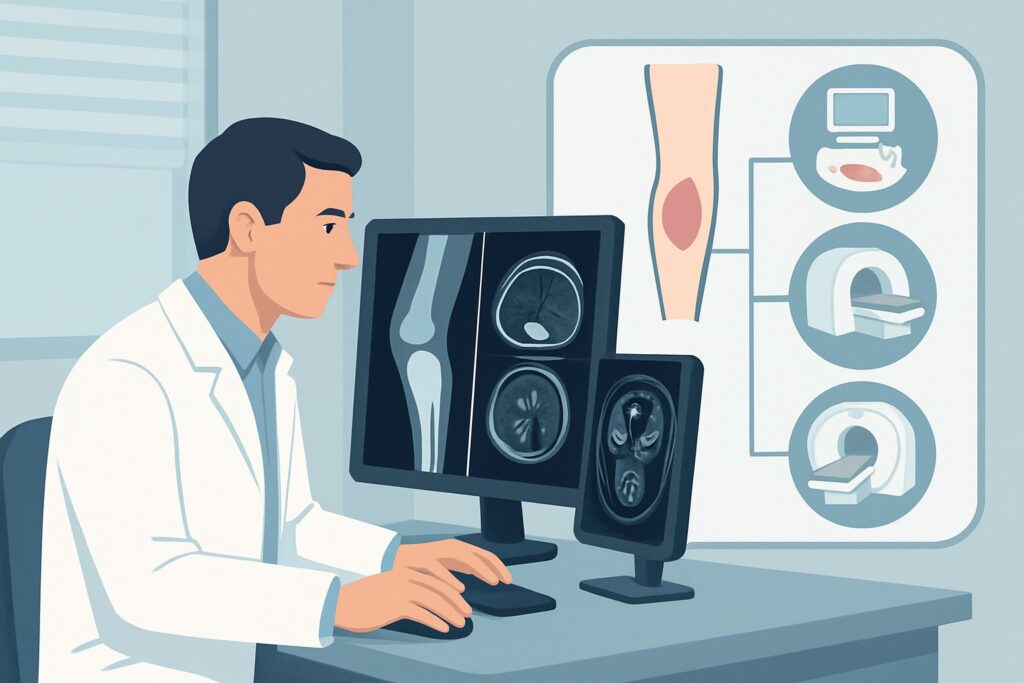
A 52-year-old patient presents to your clinic with a firm, non-tender mass in their proximal thigh that they first noticed a month ago. On examination, the mass feels fixed and deep to the fascia, measuring approximately 6 cm. There is no history of significant trauma, fever, or overlying skin changes. You are now faced with the critical decision of selecting the most appropriate initial imaging study to evaluate this nonsuperficial (deep) soft tissue mass. This article provides a focused, evidence-based workflow for this specific clinical scenario, detailing why the American College of Radiology (ACR) designates one study as the best first step. For this presentation, the ACR Appropriateness Criteria rate ‘Radiography area of interest’ as Usually Appropriate.
Who Fits This Clinical Scenario for a Deep Soft Tissue Mass?
This guidance applies specifically to adult patients presenting for initial imaging of a soft tissue mass that is located deep to the superficial fascia. This includes masses that are intramuscular, intermuscular, or within other deep compartments of the extremities, trunk, head, or neck. The key determining factor is the deep location, which carries a higher pre-test probability of malignancy compared to superficial lesions. The patient typically presents with a palpable lump, localized swelling, or a mass discovered incidentally on physical examination, without a clear traumatic or infectious etiology.
It is crucial to distinguish this scenario from similar but distinct clinical presentations that follow different diagnostic pathways:
- Superficial Masses: If the mass is clearly subcutaneous—mobile, located within the superficial fat, and not fixed to the underlying fascia—it falls under the Superficial soft tissue mass variant. These are more likely to be benign (e.g., lipoma, sebaceous cyst) and may be appropriately evaluated with ultrasound first.
- Post-Imaging Workup: This article addresses the initial imaging choice. If you have already obtained a radiograph and a noncontrast ultrasound that were nondiagnostic, you have advanced to a different decision point covered by the “Soft tissue mass. Nondiagnostic radiograph and noncontrast enhanced ultrasound. Next imaging study” scenario.
- Acute Trauma: A mass arising immediately after significant, known trauma is more likely a hematoma or muscle injury and may be evaluated differently, often starting with ultrasound.
What Diagnoses Are You Working Up in This Scenario?
The primary goal of initial imaging for a deep soft tissue mass is to characterize the lesion and, most importantly, to assess for features suggestive of malignancy. While the majority of soft tissue masses are benign, the differential for a deep mass is broad and includes several consequential diagnoses.
Soft Tissue Sarcoma: This is the most critical diagnosis to consider and exclude. Sarcomas are rare but potentially lethal malignancies that often present as painless, enlarging deep masses. Any deep-seated mass larger than 5 cm should be considered a potential sarcoma until proven otherwise. Initial imaging seeks to identify aggressive features like bone erosion, periosteal reaction, or specific types of matrix mineralization (e.g., osteoid in extraskeletal osteosarcoma) that would prompt urgent referral to a sarcoma center.
Benign Neoplasms: Many benign tumors can occur in deep locations. Intramuscular lipomas are common and may be suspected if the mass is soft and slow-growing. Vascular malformations or hemangiomas can also present as deep masses; the presence of phleboliths (calcified thrombi) on a radiograph is a highly specific sign for these lesions. Other benign entities include nerve sheath tumors (schwannomas, neurofibromas) and desmoid tumors (aggressive fibromatosis), which are locally aggressive but do not metastasize.
Chronic Hematoma or Myositis Ossificans: A remote or unrecognized injury can lead to a chronic, organizing hematoma that presents as a firm mass. Over time, this can calcify or ossify, a condition known as myositis ossificans. Radiographs are excellent for detecting the characteristic peripheral, well-organized ossification that distinguishes this benign process from the chaotic mineralization sometimes seen in sarcomas.
Abscess or Other Inflammatory Mass: While less common in the absence of systemic symptoms like fever or local signs of inflammation, a deep abscess can mimic a neoplasm. Radiographs are generally low-yield for this diagnosis but can occasionally reveal soft tissue gas, a foreign body, or adjacent osteomyelitis.
Why Is Radiography the Recommended First Study for a Deep Soft Tissue Mass?
For the initial evaluation of a nonsuperficial soft tissue mass, the ACR rates Radiography area of interest as Usually Appropriate. This recommendation may seem counterintuitive in an era of advanced cross-sectional imaging, but it is based on a sound, cost-effective, and clinically valuable rationale. A simple radiograph serves as a crucial screening tool that can provide definitive information or guide the next steps in the workup.
The primary value of radiography is its ability to assess for bone involvement and matrix mineralization. It can quickly identify aggressive features such as cortical erosion, destruction, or a periosteal reaction, which immediately raise the suspicion of malignancy and necessitate further, more advanced imaging like MRI. Furthermore, radiographs are highly sensitive for detecting specific types of calcification or ossification that can clinch a diagnosis. The presence of phleboliths points toward a vascular malformation, while the well-circumscribed peripheral ossification of myositis ossificans is often pathognomonic. Identifying a fat-containing lesion (radiolucency) can suggest a lipoma.
In contrast, several other modalities are rated lower for this specific initial step:
- MRI without and with IV contrast is rated Usually Not Appropriate as the first-line study. While MRI is the definitive modality for characterizing soft tissue masses, ordering it before a radiograph is inefficient. A radiograph may provide a diagnosis (e.g., myositis ossificans), obviating the need for a more expensive and time-consuming MRI. If the radiograph is suspicious, MRI is the appropriate next step, but not the first.
- Ultrasound (US) area of interest is rated May Be Appropriate. Ultrasound is excellent for superficial masses but its utility for deep lesions is limited by operator dependence, patient body habitus, and reduced resolution at depth. While it can confirm the cystic or solid nature of a mass, it provides no information about bone involvement and is less specific for characterizing tissue composition than MRI.
The radiation dose from radiography is variable but generally low (ACR RRL=Varies). It is a fast, widely available, and inexpensive test that provides foundational information. By starting with this simple study, clinicians can triage patients effectively, avoiding unnecessary advanced imaging in some cases and ensuring the correct advanced modality is chosen when needed.
What’s Next After Radiography? Downstream Workflow
The results of the initial radiograph will directly guide your next steps. The downstream workflow is a clear decision tree based on the radiographic findings.
- If the radiograph is diagnostic: In some cases, the radiograph provides a definitive benign diagnosis. For example, the classic appearance of myositis ossificans (peripheral ossification) or phleboliths within a mass (hemangioma) may require no further imaging. A well-defined radiolucent mass consistent with a lipoma may also be considered benign, though further characterization with MRI is often pursued for deep lesions.
- If the radiograph shows aggressive features: Any signs of bone erosion, cortical destruction, periosteal reaction, or suspicious matrix mineralization are red flags for malignancy. The immediate next step is to order an MRI of the area of interest, both without and with IV contrast. This is the optimal study for local staging, defining the extent of the tumor, and planning for a biopsy. The patient should be urgently referred to a musculoskeletal oncologist or a sarcoma center.
- If the radiograph is negative or nonspecific: This is a very common outcome, as most soft tissue masses are not visible on radiographs. A normal radiograph does not exclude a sarcoma. In this situation, the mass is considered indeterminate, and the workup proceeds to the next clinical scenario: “Soft tissue mass. Nondiagnostic radiograph…” The next recommended step is typically an MRI without and with IV contrast to fully characterize the lesion. Ultrasound may be considered in some contexts but MRI remains the problem-solving modality of choice for deep, radiographically occult masses.
Pitfalls to Avoid (and When to Get Help)
When evaluating a deep soft tissue mass, several common pitfalls can delay diagnosis or lead to inappropriate management. Be mindful of the following:
- Dismissing a Normal Radiograph: Do not stop the workup if the radiograph is negative. A normal x-ray provides valuable information (ruling out bone involvement or key calcifications) but does not rule out a soft tissue sarcoma. An indeterminate deep mass with a normal radiograph requires further imaging.
- Premature Biopsy: Never perform a biopsy (needle or excisional) of an indeterminate deep soft tissue mass before obtaining advanced cross-sectional imaging (preferably MRI). An improperly placed biopsy tract can contaminate uninvolved tissue compartments, potentially compromising limb-salvage surgery.
- Misinterpreting the Location: Failing to recognize that a mass is deep versus superficial is a critical error. Deep masses have a significantly higher likelihood of being malignant and must be worked up more aggressively.
- Accepting “Hematoma” as a Diagnosis Without Imaging: In the absence of clear, significant trauma, do not assume a deep mass is a simple hematoma. Many sarcomas are initially misdiagnosed this way, leading to critical delays in treatment.
If any radiographic findings are suspicious for malignancy or if the mass continues to grow, escalate care immediately with an urgent referral to a musculoskeletal oncology specialist.
Related ACR Topics and Tools
For a comprehensive overview of imaging recommendations across all soft tissue mass scenarios, from superficial lesions to post-operative follow-up, please consult our parent topic guide. For additional resources to help refine your imaging orders, the following tools are available.
- For breadth across all scenarios in Soft Tissue Masses, see our parent guide: Soft Tissue Masses: ACR Appropriateness Decoded.
- To explore adjacent clinical scenarios, use the ACR Appropriateness Criteria Lookup.
- For detailed technical parameters of the recommended study, see the Imaging Protocol Library.
- To discuss cumulative radiation exposure with patients, consult the Radiation Dose Calculator.
Frequently Asked Questions
Why not just order an MRI first for a deep soft tissue mass, since it’s the most sensitive test?
While MRI is the definitive study for characterizing a soft tissue mass, the ACR rates it as ‘Usually Not Appropriate’ for the *initial* step. A preliminary radiograph is a low-cost, low-radiation screening tool that can sometimes provide a definitive benign diagnosis (like myositis ossificans or a hemangioma with phleboliths), avoiding the need for a more expensive MRI. It also provides crucial information about bone involvement that is complementary to MRI.
If the radiograph is completely normal, can I reassure the patient and stop the workup?
No. A normal radiograph is a common finding and does not exclude a soft tissue sarcoma or other significant pathology. Its primary role is to rule out bone pathology and specific types of mineralization. For any palpable, persistent, or growing deep soft tissue mass with a normal radiograph, the workup must continue, typically with an MRI.
Is ultrasound a reasonable alternative to a radiograph for a deep mass?
The ACR rates ultrasound as ‘May Be Appropriate’. It can be useful for determining if a mass is cystic or solid and for guiding a biopsy. However, its effectiveness is limited for deep lesions due to decreased resolution and potential obscuration by overlying structures. Critically, it cannot evaluate for bone erosion or periosteal reaction, which is a key strength of radiography. Therefore, radiography is the preferred initial test.
Does this guidance apply to pediatric patients?
Yes, the general principle of starting with radiography for a deep soft tissue mass also applies to children. The differential diagnosis in pediatrics includes other considerations (e.g., rhabdomyosarcoma), and minimizing radiation is a higher priority. Radiography remains a valuable first step, and subsequent imaging choices should be made in consultation with a pediatric radiologist.
What specific views should I order for the radiograph?
You should order at least two orthogonal views (e.g., anteroposterior [AP] and lateral) of the specific area of interest. Clearly communicate the location of the palpable mass to the radiology department, often by marking the patient’s skin with a radiopaque marker (like a vitamin E capsule or a paper clip), to ensure the area is properly imaged and correlated.
Reviewed by Pouyan Golshani, MD, Interventional Radiologist — June 27, 2026