Should You Order MRI for Acute Shoulder Pain After Suspected Dislocation or Instability?
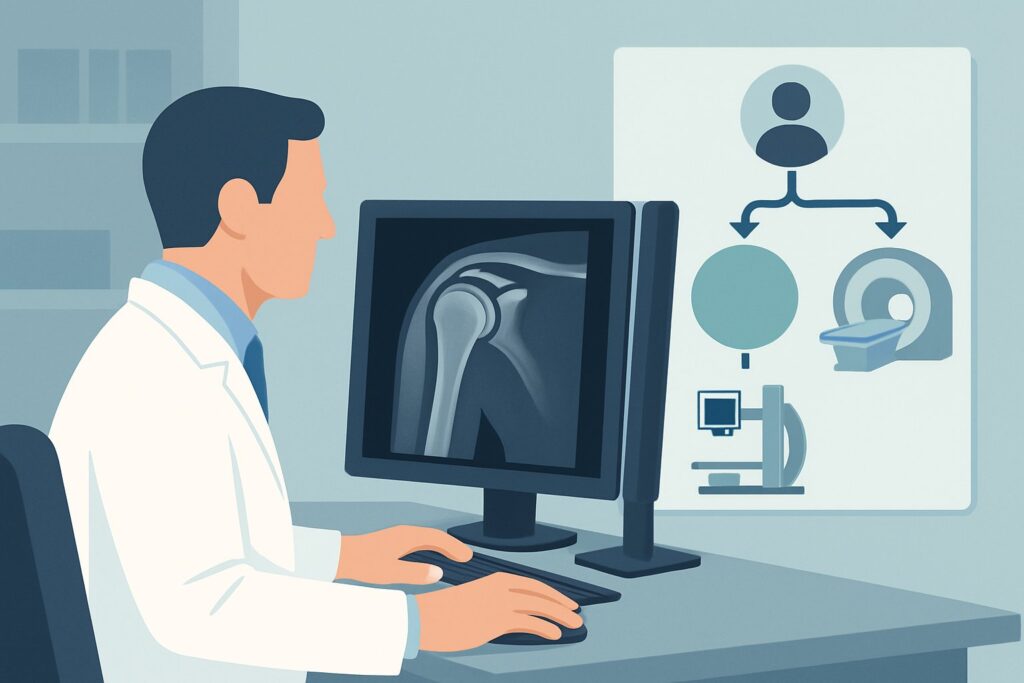
A 24-year-old patient presents to the emergency department after a fall during a basketball game, reporting their shoulder “popped out and back in.” The physical exam reveals a positive apprehension test. You’ve obtained initial radiographs, which are negative for an obvious fracture or dislocation, but your clinical suspicion for soft tissue injury related to instability remains high. What is the most appropriate next imaging study to evaluate for labral, ligamentous, or rotator cuff damage? This article details the American College of Radiology (ACR) workflow for this exact scenario. For an adult with acute shoulder pain and clinical findings of dislocation or instability, MRI shoulder without IV contrast is rated Usually Appropriate.
Who Fits This Clinical Scenario for Acute Shoulder Instability?
This guidance applies specifically to adult patients presenting with acute shoulder pain where the clinical picture points strongly toward glenohumeral instability. The key inclusion criteria are a history or physical examination consistent with dislocation or instability, regardless of the findings on initial radiographs (which may be positive, negative, or indeterminate).
This workflow is designed for the patient who has already had initial radiographs and requires further characterization of potential soft tissue and osseous injuries that perpetuate instability.
It is crucial to distinguish this scenario from others:
- No signs of instability: If a patient has acute shoulder pain without a clear history or exam findings of instability, their workup begins with the initial imaging variant for undifferentiated shoulder pain.
- Suspected occult fracture: If the primary concern after negative radiographs is a hidden fracture (e.g., due to high-energy trauma or focal bony tenderness), the imaging workup follows a different path focused on bone detail.
- Obvious, displaced fracture: If radiographs clearly show a significant fracture of the proximal humerus, scapula, or clavicle, the next imaging step is typically for surgical planning, not instability assessment.
What Diagnoses Are You Working Up in This Scenario?
After a shoulder dislocation or subluxation event, the primary goal of advanced imaging is to identify the specific structural damage that contributes to instability and may require surgical repair. The differential diagnosis is focused on the sequelae of glenohumeral joint trauma.
Bankart Lesion and Bony Variants: This is a tear of the anterior-inferior glenoid labrum, the most common injury following an anterior shoulder dislocation. Imaging must assess if the tear involves the periosteum (a classic Bankart) or includes a fracture of the glenoid rim (a bony Bankart). The size of any bony fragment is critical for surgical decision-making.
Hill-Sachs Lesion: This is a compression fracture or impaction deformity of the posterosuperior humeral head, which occurs as it impacts the anterior glenoid during dislocation. A large, “engaging” Hill-Sachs lesion can be a significant cause of recurrent instability.
Associated Labral and Ligamentous Tears: Beyond the classic Bankart, dislocations can cause other injuries. These include SLAP (Superior Labrum Anterior to Posterior) tears, HAGL (Humeral Avulsion of the Glenohumeral Ligament) lesions, or posterior labral tears in cases of posterior dislocation. Identifying the full extent of soft tissue damage is essential.
Rotator Cuff Tears: While more common in older patients, acute, full-thickness rotator cuff tears can occur in conjunction with a traumatic dislocation, particularly in patients over 40. Failure to diagnose a concurrent cuff tear can lead to poor functional outcomes.
Why Is MRI Shoulder without IV Contrast the Recommended Study for This Presentation?
The ACR designates MRI shoulder without IV contrast as Usually Appropriate for evaluating acute shoulder instability because it provides excellent soft tissue contrast to diagnose the key injuries without the need for an invasive procedure or ionizing radiation. It is highly sensitive and specific for detecting labral tears, ligamentous avulsions, and rotator cuff pathology that define the post-dislocation anatomy.
MRI excels at visualizing bone marrow edema, which can highlight the location of occult or non-displaced fractures like a Hill-Sachs or bony Bankart lesion that may be subtle on radiographs. This comprehensive assessment of both soft tissue and bone makes it the ideal one-stop-shop study in the acute setting.
Let’s consider the alternatives and why they are rated lower for this specific scenario:
- MR Arthrography: Rated May be appropriate (Disagreement), this study involves injecting intra-articular contrast. While it can increase the sensitivity for subtle labral tears by distending the joint capsule, it is more invasive, time-consuming, and often unnecessary in the acute setting where joint effusion from the injury frequently provides natural contrast. The panel notes disagreement, reflecting varying institutional preferences.
- CT Shoulder without IV Contrast: Also rated May be appropriate (Disagreement), CT provides superior evaluation of bone, making it excellent for characterizing the size and morphology of a bony Bankart or Hill-Sachs lesion, which is critical for surgical planning. However, it offers poor visualization of the non-calcified labrum, ligaments, and rotator cuff tendons. It is a reasonable alternative if MRI is contraindicated or if the primary question is bony integrity. It involves a radiation dose of 1-10 mSv.
- Ultrasound (US) Shoulder: Rated Usually not appropriate, US is excellent for evaluating the rotator cuff but has significant limitations in visualizing the deep structures of the joint, including the labrum and glenohumeral ligaments, which are the primary structures of interest in instability.
Once you’ve decided on the top-rated procedure, our protocol guide covers the technique and reading principles in detail: MRI Shoulder Without Contrast.
What’s Next After MRI Shoulder without IV Contrast? Downstream Workflow
The results of the MRI will directly guide the next steps in management, which typically involve a consultation with an orthopedic surgeon.
- Positive for Significant Structural Injury: If the MRI confirms a Bankart lesion, a large engaging Hill-Sachs lesion, a significant bony Bankart, or a full-thickness rotator cuff tear, the patient should be referred to orthopedics for surgical evaluation. The findings on the MRI will be crucial for determining the type and timing of the repair (e.g., arthroscopic vs. open).
- Negative or Minimal Findings: If the MRI is negative for a significant structural tear, the patient’s instability may be managed non-operatively. The next step is typically a referral to physical therapy for a comprehensive rehabilitation program focused on strengthening the dynamic stabilizers of the shoulder, such as the rotator cuff and periscapular muscles.
- Indeterminate Results: In the rare case that a non-contrast MRI is equivocal for a labral tear, one of the “May be appropriate” studies could be considered. An MR arthrogram may be pursued to better delineate the labrum. If the primary ambiguity relates to the extent of a glenoid or humeral head fracture, a CT scan without contrast would be the logical next step to clarify the bony anatomy for surgical planning.
Pitfalls to Avoid (and When to Get Help)
Navigating the workup for acute shoulder instability requires careful attention to the clinical context to avoid common errors.
A primary pitfall is delaying advanced imaging in a young, active patient after a first-time dislocation. Early diagnosis of a repairable lesion can improve long-term outcomes and reduce the risk of recurrence. Another error is ordering a CT scan when the primary clinical question is about the labrum or rotator cuff; CT is a bone-first modality and will likely miss the key soft tissue injuries. Finally, be cautious not to overlook a posterior dislocation, which is less common and can be subtle on initial AP radiographs; an axillary or Velpeau view is critical. If there is any concern for neurovascular compromise post-injury or post-reduction, this constitutes a clinical emergency requiring immediate orthopedic consultation.
Related ACR Topics and Tools
This article is a deep dive into one specific clinical scenario. For a comprehensive overview of imaging for all presentations of acute shoulder pain, refer to our parent guide. The tools below can help you apply appropriateness criteria to other scenarios and understand the technical details of the recommended studies.
- Parent Topic Hub: For breadth across all scenarios in Acute Shoulder Pain, see our parent guide: Acute Shoulder Pain: ACR Appropriateness Decoded.
- ACR Lookup Tool: ACR Appropriateness Criteria Lookup
- Protocols Library: Imaging Protocol Library
- Dose Calculator: Radiation Dose Calculator
Frequently Asked Questions
Why not just get an MR arthrogram on everyone with suspected instability?
While MR arthrography can be slightly more sensitive for subtle labral tears, it is an invasive procedure that requires injecting contrast into the joint. In the acute setting, the joint effusion from the injury itself often acts as a natural contrast agent, making a non-contrast MRI sufficient. The ACR panel’s ‘May be appropriate (Disagreement)’ rating reflects that it’s a reasonable option but not the standard first choice.
My patient has a pacemaker. Can I order a CT instead of an MRI?
Yes. If a patient has a contraindication to MRI, such as a non-compatible pacemaker or other metallic implant, CT shoulder without IV contrast is a reasonable alternative, rated ‘May be appropriate’. It provides excellent detail of bony injuries like Hill-Sachs and bony Bankart lesions, which is crucial for surgical planning, though it is limited for evaluating soft tissues like the labrum and rotator cuff.
The initial radiograph showed a reduced anterior dislocation. Do I still need an MRI?
Yes. The radiograph confirms the instability event, but the MRI is necessary to characterize the resulting soft tissue and osseous damage. The MRI will identify the specific structures that were torn or fractured during the dislocation (e.g., Bankart lesion, HAGL lesion, rotator cuff tear), which is critical information for determining whether the patient needs surgery.
How soon after the injury should the MRI be performed?
While not typically an emergency, the MRI should be performed in a timely manner, often within a few weeks of the injury. Performing the scan in the acute or subacute phase can be advantageous, as the inflammation and joint effusion can help highlight the areas of injury. Delaying the scan can make it harder to distinguish acute from chronic changes.
Does this guidance apply to chronic, multidirectional instability without a specific traumatic event?
No, this guidance is specifically for acute shoulder pain following a traumatic instability event. Patients with chronic, atraumatic, or multidirectional instability often have underlying capsular laxity rather than a specific structural tear. Their workup and management may differ and often begin with an extended course of physical therapy.
Reviewed by Pouyan Golshani, MD, Interventional Radiologist — May 30, 2026