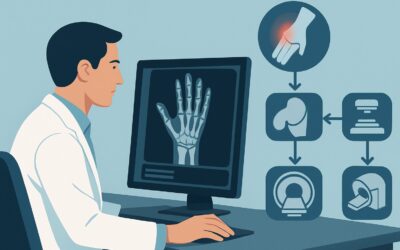
Suspect Gout with Normal X-rays? Which Imaging Study to Order Next

A 58-year-old man presents with his third episode of severe, debilitating pain in his right great toe over the past two years. The joint is swollen, erythematous, and exquisitely tender to palpation. His serum uric acid level is 8.9 mg/dL. You strongly suspect gout, but the initial radiographs show only mild soft tissue swelling with no erosions or other specific findings. You need to confirm the diagnosis to initiate long-term urate-lowering therapy, but the acute flare has subsided enough that a joint aspiration may yield a dry tap. This clinical workflow article addresses the next imaging step in this common scenario: chronic extremity joint pain with suspected gout when radiographs are normal or inconclusive. According to the American College of Radiology (ACR) Appropriateness Criteria, the next study, US area of interest, is rated Usually Appropriate.
Who Fits This Clinical Scenario?
This guidance is for clinicians evaluating a patient with chronic or recurrent extremity joint pain where gout is the leading diagnosis, but initial radiographs are unrevealing. The key inclusion criteria are:
- A history of intermittent, inflammatory mono- or oligoarthritis, often with a classic distribution (e.g., first metatarsophalangeal joint, midfoot, knee).
- Clinical suspicion for gout is high, potentially supported by hyperuricemia.
- Initial plain radiographs of the affected joint(s) are normal, inconclusive, or show only non-specific findings like soft tissue swelling or an effusion.
This workflow is specifically not for patients where the primary suspicion is for a different condition, even if symptoms overlap. Exclude patients from this pathway if:
- Septic arthritis is suspected: An acutely hot, swollen joint with fever or systemic signs of infection requires immediate joint aspiration, not advanced imaging as a first step.
- Inflammatory arthritis (e.g., Rheumatoid Arthritis) is the lead diagnosis: A patient with symmetric polyarthritis, positive serologies (RF, anti-CCP), and a different joint distribution pattern fits a separate ACR variant.
- Pseudogout (CPPD) is more likely: While a mimic, a presentation centered on the knee or wrist, especially with radiographic evidence of chondrocalcinosis elsewhere, follows a different diagnostic track.
What Diagnoses Are You Working Up in This Scenario?
When initial radiographs are negative in a patient with suspected gout, advanced imaging aims to visualize the direct and indirect effects of monosodium urate (MSU) crystal deposition to confirm the diagnosis and rule out key mimics.
Gout is the primary diagnosis under consideration. Radiographs are insensitive in early or intermittent disease. Erosions, a classic radiographic finding, are a late-stage manifestation of chronic, untreated gout. Advanced imaging can detect crystal deposition on cartilage surfaces or within soft tissues (tophi) long before bony changes occur, allowing for a definitive diagnosis and earlier treatment to prevent joint damage.
Calcium Pyrophosphate Dihydrate (CPPD) Crystal Deposition Disease (Pseudogout) is a significant mimic. It is another crystal arthropathy that can cause acute flares of inflammatory arthritis. While it classically affects the knees and wrists and can be identified by chondrocalcinosis on radiographs, its presentation can overlap with gout, and radiographic findings may be absent. Advanced imaging can help differentiate the type of crystal deposition.
Erosive Osteoarthritis can present with inflammatory episodes and affect joints common in gout, such as those in the hands and feet. However, the underlying pathology is degenerative with an inflammatory component, not crystal-driven. Imaging can help identify characteristic features like central “gull-wing” erosions that distinguish it from the eccentric, overhanging-edge erosions of gout.
Seronegative Spondyloarthropathies, such as psoriatic arthritis, can also present as an asymmetric oligoarthritis or dactylitis (“sausage digit”) that can be mistaken for a gouty flare. Imaging in this context is used to look for features more suggestive of an enthesitis-driven process, such as synovitis, tenosynovitis, and bone edema, rather than specific crystal deposits.
Why Is US of the Area of Interest the Recommended Study for This Presentation?
When radiographs are inconclusive for suspected gout, the ACR rates US area of interest as Usually Appropriate. This recommendation is based on ultrasound’s unique ability to directly visualize signs of MSU crystal deposition with high sensitivity and specificity, without using ionizing radiation.
Ultrasound can identify several pathognomonic or highly specific features of gout:
- The Double Contour Sign: This appears as a hyperechoic, irregular line of MSU crystals deposited on the surface of the hyaline cartilage, parallel to the hyperechoic subchondral bone. This is highly specific for gout.
- Tophi: These are aggregates of MSU crystals that appear as hyperechoic, heterogeneous masses, which may be surrounded by a hypoechoic halo. They can be found in synovium, tendons, or subcutaneous tissues.
- “Snowstorm” Appearance: This refers to mobile, hyperechoic aggregates within synovial fluid or a tophus, representing floating crystals.
The ACR also rates CT area of interest without IV contrast as Usually Appropriate. Specifically, Dual-Energy CT (DECT) is a powerful problem-solving tool. DECT uses two different x-ray energy levels to differentiate materials by their atomic numbers. It can specifically identify and color-code urate deposits, making it highly specific for diagnosing gout. However, it involves ionizing radiation (adult RRL = Varies) and is less widely available and more costly than ultrasound.
Conversely, other modalities are rated lower. MRI area of interest without IV contrast is considered Usually not appropriate. While MRI is excellent for evaluating synovitis, bone marrow edema, and soft tissue inflammation, these findings are non-specific and can be seen in any inflammatory arthritis. MRI cannot reliably distinguish MSU crystals from other causes of inflammation, making it a poor choice for confirming a specific diagnosis of gout. Similarly, a Bone scan whole body is Usually not appropriate due to its very low specificity for this indication and its associated radiation dose (adult RRL = ☢☢☢ 1-10 mSv).
What’s Next After US of the Area of Interest? Downstream Workflow
The results of the ultrasound will guide your next clinical steps, moving you from suspicion to diagnosis and management.
If the study is positive for gout: The presence of a definitive double contour sign or characteristic tophi confirms the diagnosis. The next step is to initiate or adjust urate-lowering therapy (e.g., allopurinol, febuxostat) according to clinical guidelines, along with patient education on diet and lifestyle modifications. No further diagnostic imaging is typically required.
If the study is negative: A negative ultrasound in the face of persistent, high clinical suspicion for gout does not entirely rule it out. The gold standard for diagnosis remains synovial fluid analysis. The next logical step would be to pursue Image-guided aspiration area of interest, which the ACR rates as May be appropriate. Aspiration under ultrasound guidance can improve the yield, especially from smaller joints or when fluid is minimal. If aspiration is also negative or not feasible, you must reconsider the differential diagnosis and potentially pivot the workup toward an alternative, such as inflammatory arthritis.
If the study is indeterminate: Sometimes, ultrasound may show non-specific findings like synovitis or a joint effusion without the classic signs of gout. In this situation, the diagnosis remains uncertain. As with a negative study, the most direct path to a definitive diagnosis is joint aspiration to look for negatively birefringent MSU crystals under polarized light microscopy. If that is unrevealing, a DECT scan could be considered as a highly specific, non-invasive alternative to confirm or exclude urate deposition.
Pitfalls to Avoid (and When to Get Help)
Navigating the workup for suspected gout requires avoiding several common pitfalls that can delay diagnosis or lead to misinterpretation.
- Operator Dependence of Ultrasound: The accuracy of musculoskeletal ultrasound is highly dependent on the skill and experience of the sonographer. The double contour sign can be subtle and requires proper technique to visualize. Ensure your imaging is performed at a center with expertise in musculoskeletal ultrasound.
- Over-reliance on Serum Uric Acid: A normal or even low serum uric acid level does not exclude gout, as levels can drop during an acute flare. Clinical suspicion should remain high based on the patient’s history and exam.
- Confusing CPPD with Gout on US: CPPD crystals can also deposit on cartilage, but they typically form a thin, hyperechoic line within the cartilage layer, as opposed to the thicker, superficial layer seen in gout’s double contour sign. This distinction is critical but can be challenging.
If a patient presents with signs of systemic illness, high fever, or rapidly progressive erythema suggesting cellulitis, escalate immediately. An urgent joint aspiration is mandatory to rule out septic arthritis, which is a true medical emergency.
Related ACR Topics and Tools
This article focuses on a single clinical scenario. For a comprehensive overview of imaging for all related presentations, or to explore the technical details of the recommended studies, the following resources are essential.
- For breadth across all scenarios in Chronic Extremity Joint Pain-Suspected Inflammatory Arthritis, Crystalline Arthritis, or Erosive Osteoarthritis, see our parent guide: Chronic Extremity Joint Pain-Suspected Inflammatory Arthritis, Crystalline Arthritis, or Erosive Osteoarthritis: ACR Appropriateness Decoded.
- To explore adjacent clinical scenarios and their corresponding ACR ratings, use the ACR Appropriateness Criteria Lookup.
- For detailed technical guidance on performing the recommended studies, consult the Imaging Protocol Library.
- To discuss cumulative radiation exposure with patients when considering CT, use the Radiation Dose Calculator.
Frequently Asked Questions
Why not just perform a joint aspiration first instead of ordering an ultrasound?
Joint aspiration with polarized light microscopy is the gold standard for diagnosing gout. However, it may not always be feasible. The patient may decline the procedure, the affected joint may be too small or difficult to access (e.g., midfoot), or the attempt may result in a ‘dry tap,’ especially between flares. In these cases, non-invasive imaging like ultrasound serves as an excellent alternative to confirm the diagnosis.
Can ultrasound be used to monitor treatment response in gout?
Yes, ultrasound is emerging as a valuable tool for monitoring treatment. Studies have shown that with effective urate-lowering therapy, the size of tophi and the prominence of the double contour sign can decrease over time. This provides objective evidence of treatment response beyond just serum uric acid levels.
What is Dual-Energy CT (DECT) and when should I order it for suspected gout?
Dual-Energy CT is an advanced CT technique that can differentiate materials based on how they absorb two different x-ray energy levels. It is highly specific for identifying and quantifying monosodium urate deposits. While ultrasound is the recommended initial advanced imaging study, DECT is an outstanding problem-solver when ultrasound is equivocal, when multiple joints need to be assessed, or in complex cases with overlapping diagnoses.
If the ultrasound is positive for gout, do I still need to check a serum uric acid level?
Yes. While a positive ultrasound can confirm the diagnosis of gouty arthritis, a baseline serum uric acid level is essential for managing the disease. It establishes the patient’s baseline urate burden and is the primary target for monitoring the efficacy of urate-lowering therapy over the long term.
Does the timing of the ultrasound matter? Should it be done during a flare or between flares?
Ultrasound can detect the signs of gout both during and between flares. The double contour sign and tophi are chronic changes that persist. However, imaging during a flare may also show active inflammation, such as synovitis and increased Doppler signal, which can add to the clinical picture but are not specific to gout. For the sole purpose of diagnosing crystal deposition, the timing is less critical than for a joint aspiration.
Reviewed by Pouyan Golshani, MD, Interventional Radiologist — May 30, 2026