
Suspected PAVM with Neurologic Symptoms: Why Is Contrast Echo the First Step?
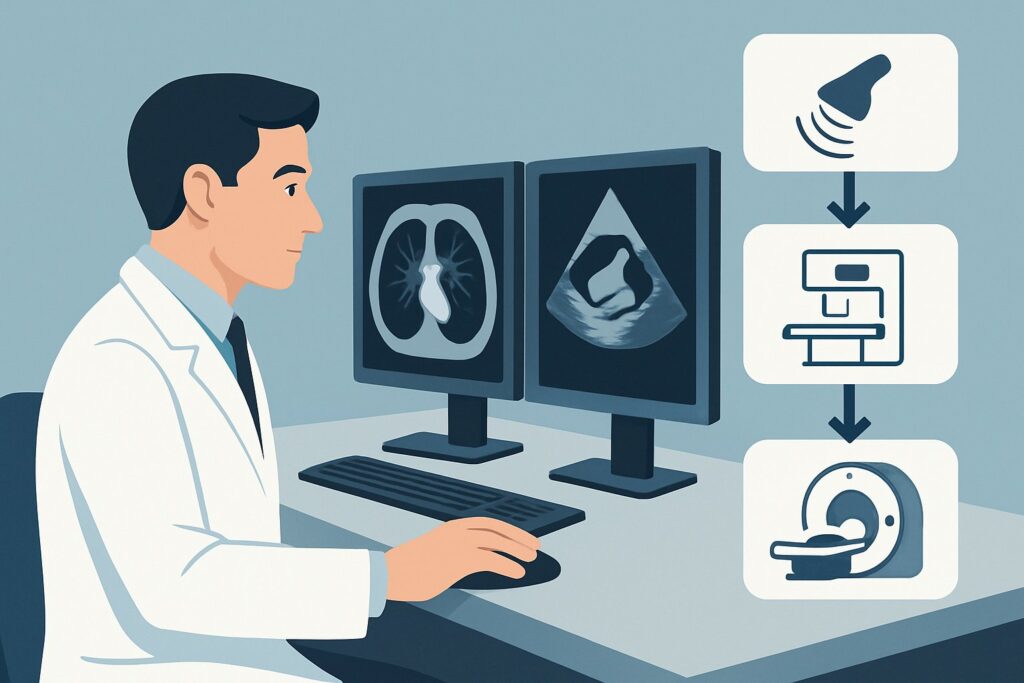
A 45-year-old patient presents to the emergency department after experiencing a transient ischemic attack (TIA). As part of a comprehensive workup, a chest radiograph is obtained, which reveals a well-circumscribed, 2 cm nodule in the right lower lobe. The clinical team suspects a paradoxical embolic event, raising the possibility of a pulmonary arteriovenous malformation (PAVM) as the underlying cause. You are now faced with a critical decision: which imaging study will most effectively and safely confirm or exclude this diagnosis? This article provides a detailed workflow for this specific scenario, explaining why the American College of Radiology (ACR) rates US echocardiography transthoracic with IV contrast as Usually Appropriate for this presentation.
Who Fits This Clinical Scenario?
This guidance is specifically for an adult patient presenting with new-onset, severe neurologic symptoms and an incidental lung nodule on chest radiography. The core of the scenario is the suspicion that the lung nodule represents a PAVM, which has caused a paradoxical embolus leading to the neurologic event.
Inclusion criteria for this workflow:
- Patient is an adult.
- The primary presentation includes a neurologic event such as a transient ischemic attack, seizure, brain abscess, or unexplained altered sensorium.
- A chest radiograph has been performed and shows a lung nodule or opacity suspicious for a vascular anomaly.
- There is clinical suspicion for a right-to-left shunt, specifically a PAVM.
It is crucial to distinguish this presentation from similar, but distinct, clinical situations that follow different diagnostic pathways. This guidance does not apply if:
- The patient presents primarily with symptoms of Hereditary Hemorrhagic Telangiectasia (HHT), such as recurrent epistaxis, hemoptysis, or known family history, without an acute neurologic event.
- The patient is asymptomatic, and the lung nodule was found incidentally on imaging performed for another reason.
- The patient has a known, previously treated PAVM and is presenting for routine surveillance imaging.
These related scenarios are addressed in separate ACR Appropriateness Criteria variants and require a different approach to imaging selection.
What Diagnoses Are You Working Up in This Scenario?
When a patient presents with concurrent neurologic symptoms and a lung nodule, the differential diagnosis is broad, but the suspicion of a paradoxical embolus narrows the focus. The imaging choice is designed to efficiently evaluate the most likely and most consequential possibilities.
Pulmonary Arteriovenous Malformation (PAVM)
This is the primary diagnosis of concern. A PAVM is an abnormal, low-resistance connection between a pulmonary artery and a pulmonary vein, which bypasses the lung’s capillary bed. This creates a right-to-left shunt, allowing deoxygenated, unfiltered venous blood to enter the systemic arterial circulation. Small thrombi that would normally be filtered out by the lungs can pass through this shunt and travel to the brain, causing ischemic stroke, TIA, or brain abscess.
Septic Emboli from Endocarditis
Infective endocarditis can shower septic emboli into the circulation. These can lodge in the lungs, creating nodules or cavitary lesions, and can also travel to the brain, causing embolic strokes or brain abscesses. The clinical context of fever, new heart murmur, or intravenous drug use would increase suspicion for this diagnosis.
Metastatic Disease
A lung nodule could represent a primary lung cancer or a metastasis from an unknown primary tumor. A concurrent brain lesion causing the neurologic symptoms would then represent a brain metastasis. While possible, this is less likely to present as a TIA and more commonly causes seizures or progressive focal deficits.
Pulmonary Infarct
A pulmonary embolism can lead to a wedge-shaped opacity or nodule on chest radiography (a Hampton’s hump), representing a pulmonary infarct. If the patient also has an intracardiac shunt (e.g., a patent foramen ovale), a paradoxical embolus to the brain could occur simultaneously.
Why Is Transthoracic Echocardiography with IV Contrast the Recommended First Study?
For an adult with suspected PAVM presenting with neurologic symptoms, the ACR designates US echocardiography transthoracic with IV contrast as a Usually Appropriate initial imaging study. This is often referred to as an agitated saline “bubble study.” The rationale is based on its ability to answer the most pressing physiological question: is there a right-to-left shunt?
The procedure involves injecting microbubbles (agitated saline) into a peripheral vein and observing their path with echocardiography. In a normal circulatory system, these microbubbles are larger than the pulmonary capillaries and are filtered out in the lungs, never appearing in the left side of the heart. If a shunt exists, the bubbles bypass the capillary bed and are visualized in the left atrium and ventricle. The timing of their appearance is key: bubbles appearing within 1-2 cardiac cycles suggest an intracardiac shunt (like a PFO), while bubbles appearing later (typically 3-5 cycles) are highly indicative of an intrapulmonary shunt, such as a PAVM.
This study is favored because it is:
- Functionally Definitive: It provides a clear “yes” or “no” answer to the presence of a significant right-to-left shunt, which is the mechanism of injury in this scenario.
- Non-Invasive and Safe: It involves no ionizing radiation (0 mSv) and uses agitated saline, avoiding the risks associated with iodinated or gadolinium-based contrast agents.
- Widely Available: Most hospitals have the capability to perform contrast-enhanced transthoracic echocardiography quickly.
While contrast echo is excellent for functional screening, other studies are also rated Usually Appropriate and are typically used as follow-up or problem-solving tools. It is important to understand why they are not always the first choice.
- CTA pulmonary arteries with IV contrast: This study is also Usually Appropriate and provides superb anatomic detail of a PAVM, defining the feeding artery and draining vein, which is essential for treatment planning. However, it involves ionizing radiation (1-10 mSv) and iodinated contrast. It is often the next step after a positive bubble study to map the anatomy before embolization.
- MRA pulmonary arteries without and with IV contrast: Also rated Usually Appropriate, MRA avoids radiation but may have lower spatial resolution than CTA for small PAVMs and is more susceptible to motion artifact. It is a strong alternative, particularly in patients with contraindications to iodinated contrast.
A study rated lower, such as Arteriography pulmonary (May be appropriate), is an invasive procedure with higher radiation (10-30 mSv) and is now reserved almost exclusively for therapeutic intervention (embolization) rather than initial diagnosis.
What’s Next After Transthoracic Echocardiography? Downstream Workflow
The results of the contrast-enhanced echocardiogram will guide the subsequent management and imaging pathway. The workflow is designed to confirm the diagnosis, define the anatomy for treatment, and screen for associated conditions.
If the bubble study is POSITIVE for a late-appearing shunt (suggesting PAVM):
- Next Step: The immediate next step is to obtain a high-resolution, cross-sectional imaging study to define the anatomy of the PAVM(s). CTA pulmonary arteries with IV contrast is the most common choice. It will identify the number, size, and location of all PAVMs and delineate the feeding arteries, which is critical for planning endovascular treatment.
- Further Workup: Given the strong association between PAVMs and Hereditary Hemorrhagic Telangiectasia (HHT), a positive finding should trigger a clinical evaluation for HHT based on the Curacao criteria.
- Treatment: Patients with a feeding artery diameter of 2-3 mm or greater are typically referred to an Interventional Radiologist for transcatheter embolization to occlude the shunt and prevent future paradoxical embolic events.
If the bubble study is NEGATIVE (no shunt detected):
- Next Step: A PAVM is effectively ruled out as the cause of the neurologic event. The diagnostic focus should shift to the other differential diagnoses. The workup for the lung nodule and neurologic symptoms should proceed independently. This may involve a standard CT chest with IV contrast to characterize the nodule and dedicated neuroimaging (e.g., MRI brain) to evaluate for other causes of the TIA or seizure.
If the bubble study is INDETERMINATE or EQUIVOCAL:
- Next Step: If the study is technically limited or the results are unclear, proceeding to CTA pulmonary arteries with IV contrast is a reasonable next step. It can directly visualize a PAVM, even if the functional shunt was not clearly demonstrated on echocardiography.
Pitfalls to Avoid (and When to Get Help)
Navigating this clinical scenario requires careful attention to the details of the imaging request and interpretation. Here are several common pitfalls to avoid:
- Ordering a Non-Contrast Echocardiogram: A standard transthoracic echocardiogram without agitated saline contrast (Usually Not Appropriate) cannot detect an intrapulmonary shunt and is the wrong test for this indication. The “with IV contrast” part of the order is essential.
- Misinterpreting Bubble Timing: Failing to differentiate between an early-appearing (intracardiac) and late-appearing (intrapulmonary) shunt can lead to an incorrect diagnosis and an unnecessary workup for PAVM.
- Stopping After the Echo: A positive bubble study is a screening test. It confirms a shunt but does not provide the anatomic detail needed for treatment. Failure to proceed to CTA or MRA for characterization is a critical omission.
- Ignoring the HHT Connection: Once a PAVM is diagnosed, the workup is not complete. Overlooking the need to screen the patient and potentially their family for HHT is a significant pitfall that can miss other life-threatening vascular malformations.
If the diagnosis remains uncertain after initial imaging or if multiple complex PAVMs are identified, consultation with a pulmonologist, interventional radiologist, or a specialized HHT center is warranted.
Related ACR Topics and Tools
For a comprehensive overview of imaging for all PAVM-related scenarios and to explore the evidence behind these recommendations, please refer to the main ACR topic guide. The following GigHz tools can also assist in your clinical workflow, from selecting the right study to discussing radiation dose with your patients.
- For breadth across all scenarios in Pulmonary Arteriovenous Malformation (PAVM), see our parent guide: Pulmonary Arteriovenous Malformation (PAVM): ACR Appropriateness Decoded.
- ACR Appropriateness Criteria Lookup — for adjacent scenarios
- Imaging Protocol Library — for technique on the recommended study
- Radiation Dose Calculator — for cumulative dose conversations
Frequently Asked Questions
Why not go straight to a CTA of the chest in a patient with a TIA and a lung nodule?
While a CTA is also rated ‘Usually Appropriate’ and provides excellent anatomic detail, a transthoracic echocardiogram with agitated saline contrast (bubble study) is often preferred first because it is a non-radiation, functional test that directly confirms the presence of a right-to-left shunt, the underlying physiologic problem. If the bubble study is negative, a PAVM is unlikely, and the patient is spared the radiation and contrast dose of a CTA. If positive, the CTA is then used as a more targeted, pre-procedural planning study.
What if the bubble study shows an early shunt (within 1-2 heartbeats)?
An early-appearing shunt after agitated saline injection is indicative of an intracardiac shunt, most commonly a patent foramen ovale (PFO) or an atrial septal defect (ASD). While this can also cause a paradoxical embolus, it is a different diagnosis from a PAVM. The workup would then shift towards cardiology and neurology to determine the clinical significance of the PFO and whether closure is indicated.
Can an MRA be used instead of a CTA after a positive bubble study?
Yes, MRA of the pulmonary arteries with IV contrast is also rated ‘Usually Appropriate’ and is an excellent alternative to CTA, especially in patients with a severe allergy to iodinated contrast or in whom radiation dose is a primary concern (e.g., younger patients). It provides good anatomic detail for treatment planning, though CTA is often faster and may offer slightly better spatial resolution for very small feeding vessels.
Does the size of the lung nodule on the initial chest radiograph matter?
The size can be a clue, but it does not change the initial imaging recommendation. Most PAVMs appear as well-defined, round or oval nodules, often in the lower lobes. Very large nodules are more likely to be symptomatic or represent complex PAVMs. However, even a small nodule can represent a PAVM with a hemodynamically significant shunt, so any suspicious nodule in this clinical context warrants a workup starting with a contrast echocardiogram.
If the patient has a brain abscess instead of a TIA, does the imaging algorithm change?
No, the initial imaging algorithm to investigate for a PAVM remains the same. A brain abscess is a known and severe complication of a right-to-left shunt from a PAVM. The shunt allows bacteria from the venous circulation to bypass the filtering function of the lungs and seed the brain, leading to abscess formation. The urgency of the workup is even higher in the case of a brain abscess.
Reviewed by Pouyan Golshani, MD, Interventional Radiologist — May 30, 2026


