What Imaging Is Best for a Palpable Scrotal Mass After Trauma or Infection?
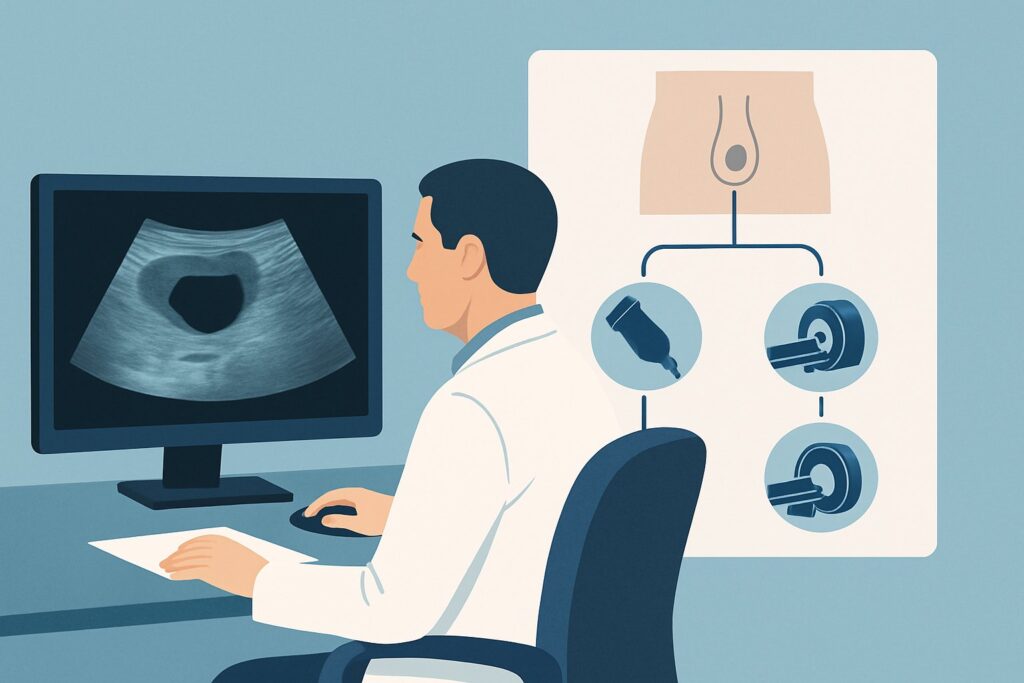
A 24-year-old male presents to the urgent care clinic on a Saturday afternoon with a three-day history of a painful, palpable lump in his left scrotum. He mentions a minor straddle injury while mountain biking last week, which he initially ignored. Now, the area is swollen, tender, and he feels a distinct abnormality. The immediate clinical question is how to differentiate between a post-traumatic hematoma, a testicular injury, or a secondary infection. This scenario requires a rapid, accurate, and safe imaging modality to guide management. According to the American College of Radiology (ACR) Appropriateness Criteria, for a newly diagnosed palpable scrotal abnormality with a history of trauma or infection, US duplex Doppler scrotum is rated Usually Appropriate as the initial imaging study.
Who Fits This Clinical Scenario?
This clinical workflow is designed for patients presenting with a newly diagnosed, palpable scrotal abnormality where the history strongly suggests an underlying traumatic or infectious cause. This includes patients with a clear history of recent blunt or penetrating trauma to the scrotum, such as from a sports injury, fall, or assault. It also applies to patients with clinical signs and symptoms of infection, such as fever, dysuria, scrotal erythema, warmth, and tenderness, which may point toward epididymitis or orchitis.
This guidance is specifically for the initial imaging evaluation. It is crucial to distinguish this presentation from related but distinct clinical scenarios:
- No History of Trauma or Infection: If a patient presents with a new palpable scrotal mass but has no preceding trauma or signs of infection, the workup prioritizes ruling out malignancy. This follows a different ACR variant.
- Acute Scrotal Pain Without a Palpable Mass: In cases of sudden, severe scrotal pain without a clearly palpable abnormality, the primary concern is testicular torsion. While ultrasound is also the imaging modality of choice, the clinical urgency and focus are different.
- Chronic or Incidental Findings: This workflow does not apply to long-standing, stable scrotal masses or incidental findings discovered on physical exam for an unrelated reason.
What Diagnoses Are You Working Up in This Scenario?
When a patient presents with a palpable scrotal abnormality after trauma or with signs of infection, the differential diagnosis is focused on acute, treatable conditions. The goal of imaging is to confirm the suspected diagnosis, assess its severity, and rule out more serious complications that may require surgical intervention.
In the context of trauma, the primary considerations include a hematocele (blood collection within the tunica vaginalis), a scrotal wall or testicular hematoma, or the more urgent diagnosis of testicular fracture or rupture. A rupture, which is a tear in the tunica albuginea, is a urologic emergency requiring prompt surgical exploration to salvage the testis. Ultrasound is highly effective at identifying these traumatic injuries.
In the context of infection, the differential is centered on inflammatory conditions. Epididymitis (inflammation of the epididymis) is the most common cause of acute scrotal pain in adults. It can progress to involve the testicle, a condition known as epididymo-orchitis. Imaging helps confirm the diagnosis, assess for complications like abscess formation or a pyocele (pus collection within the tunica vaginalis), and differentiate it from other causes of pain and swelling.
Why Is US Duplex Doppler Scrotum the Recommended Study for This Presentation?
The ACR designates US duplex Doppler scrotum as Usually Appropriate because it is a fast, non-invasive, and highly accurate modality for evaluating the key differential diagnoses in this scenario, all without using ionizing radiation.
The B-mode (grayscale) component of the ultrasound provides excellent anatomic detail, allowing for the direct visualization of testicular parenchyma, the epididymis, and surrounding structures. It can readily identify fluid collections like hydroceles, hematoceles, or pyoceles, and can detect contour abnormalities or parenchymal heterogeneity suggestive of testicular fracture or rupture. For infectious processes, it can show an enlarged, hypoechoic epididymis or testicle.
The addition of color and spectral Doppler is critical. It provides a real-time assessment of blood flow, which is essential for distinguishing between various pathologies. In epididymitis or orchitis, Doppler will demonstrate hyperemia (increased blood flow). Conversely, an abscess or a mature hematoma will appear as an avascular collection. In the setting of trauma, Doppler confirms testicular viability by demonstrating intact arterial and venous flow, a crucial factor in determining the need for surgical intervention.
Alternative imaging modalities are rated lower for good reason:
- CT of the pelvis is rated Usually Not Appropriate. It exposes the patient to significant ionizing radiation (adult RRL ☢☢☢ 1-10 mSv) with inferior soft-tissue resolution of the scrotal contents compared to ultrasound. It has a very limited role in the initial evaluation of a primary scrotal abnormality.
- MRI of the pelvis (scrotum) is rated May Be Appropriate. It is not a first-line tool but serves as a powerful problem-solver when ultrasound findings are equivocal or indeterminate. For example, MRI can help differentiate a complex hematoma from a tumor or better delineate the extent of a testicular rupture if ultrasound is inconclusive. However, it is more costly, less available, and more time-consuming than ultrasound.
What’s Next After US Duplex Doppler Scrotum? Downstream Workflow
The results of the scrotal ultrasound will directly guide the next steps in patient management. The workflow branches based on whether the findings are consistent with trauma, infection, or are indeterminate.
- If the study confirms an infectious process (e.g., epididymo-orchitis): The patient can typically be managed as an outpatient with appropriate antibiotics and analgesia. If a drainable abscess or pyocele is identified, an urgent urology consultation is warranted for consideration of surgical or percutaneous drainage.
- If the study reveals a traumatic injury: For non-operative injuries like a small, contained hematoma or a simple hematocele, conservative management with scrotal support, ice, and pain control is appropriate. However, if the ultrasound demonstrates findings suspicious for testicular rupture (e.g., loss of the normal testicular contour, a visible tear in the tunica albuginea), this constitutes a surgical emergency, and immediate urologic consultation for operative exploration is necessary.
- If the study is negative or indeterminate: If the ultrasound is normal despite a persistent palpable abnormality, or if the findings are equivocal (e.g., a complex cystic structure that cannot be confidently characterized), further evaluation is needed. This may involve close clinical follow-up with a repeat ultrasound in a few weeks to ensure resolution. If suspicion for an underlying occult process remains, an MRI of the scrotum (May be appropriate) can be considered to provide superior tissue characterization.
Pitfalls to Avoid (and When to Get Help)
Several pitfalls can complicate the workup of a palpable scrotal abnormality after trauma or infection. First, failing to obtain a duplex Doppler study and ordering only a grayscale “US scrotum” can miss critical information about testicular perfusion, potentially delaying the diagnosis of a complication. Second, underestimating the possibility of testicular rupture in the setting of trauma can lead to delayed surgical intervention and reduced testicular salvage rates. Third, misinterpreting a complex hematocele or abscess as a primary testicular tumor can lead to unnecessary anxiety and intervention. Finally, if the clinical picture suggests testicular torsion (acute, severe pain with a high-riding testis) despite a history of minor trauma, the workup must proceed with extreme urgency. If there is any ambiguity on ultrasound or a high clinical suspicion for testicular rupture or torsion, immediate consultation with a urologist is the most appropriate next step.
Related ACR Topics and Tools
For a comprehensive overview of imaging for all presentations of a new scrotal mass, please refer to our parent topic guide. For further exploration of imaging guidelines, protocols, and radiation safety, the following GigHz resources are available:
- For breadth across all scenarios in Newly Diagnosed Palpable Scrotal Abnormality, see our parent guide: Newly Diagnosed Palpable Scrotal Abnormality: ACR Appropriateness Decoded.
- ACR Appropriateness Criteria Lookup — for adjacent scenarios
- Imaging Protocol Library — for technique on the recommended study
- Radiation Dose Calculator — for cumulative dose conversations
Frequently Asked Questions
Why is duplex Doppler necessary if I can already feel the lump?
While the physical exam identifies the abnormality, duplex Doppler ultrasound provides critical information that the exam cannot. It assesses blood flow, which helps differentiate between an inflammatory process like epididymitis (high flow), a hematoma or abscess (no flow), and testicular torsion (absent flow). It also confirms the viability of the testicle after trauma, which is essential for management decisions.
If the patient has a fever and scrotal pain, do I even need an ultrasound before starting antibiotics?
While uncomplicated epididymitis can often be treated based on clinical findings, imaging is highly recommended. Ultrasound confirms the diagnosis and, more importantly, rules out complications like an abscess or pyocele that require drainage in addition to antibiotics. It also excludes other causes of pain and swelling that can mimic infection, such as a testicular tumor with secondary inflammation.
How soon after trauma should imaging be performed?
Imaging should be performed as soon as possible after trauma if there is significant pain, swelling, or a palpable abnormality. The primary goal is to rule out a testicular rupture, which is a urologic emergency. The testicular salvage rate decreases significantly if surgical repair is delayed beyond 72 hours, making prompt evaluation critical.
Is CT ever appropriate for a scrotal issue?
For a primary scrotal abnormality, CT is rated ‘Usually Not Appropriate’ by the ACR. Its role is limited to specific situations, such as staging a known testicular cancer to look for retroperitoneal lymph node metastasis or evaluating severe pelvic trauma where scrotal injury is just one component of a larger, multi-system injury. It is not a first-line tool for a palpable scrotal mass.
What if the ultrasound shows a complex mass that could be either a hematoma or a tumor?
This is a situation where MRI of the scrotum, rated ‘May be appropriate’, becomes a valuable problem-solving tool. MRI offers superior soft-tissue contrast and can often differentiate between blood products in a hematoma and the solid, enhancing tissue of a tumor. A urology consultation is essential in these indeterminate cases for further management planning, which may include follow-up imaging or surgical exploration.
Reviewed by Pouyan Golshani, MD, Interventional Radiologist — May 29, 2026