What Imaging Is Best for a Suspected Periprosthetic Fracture After Knee Arthroplasty?
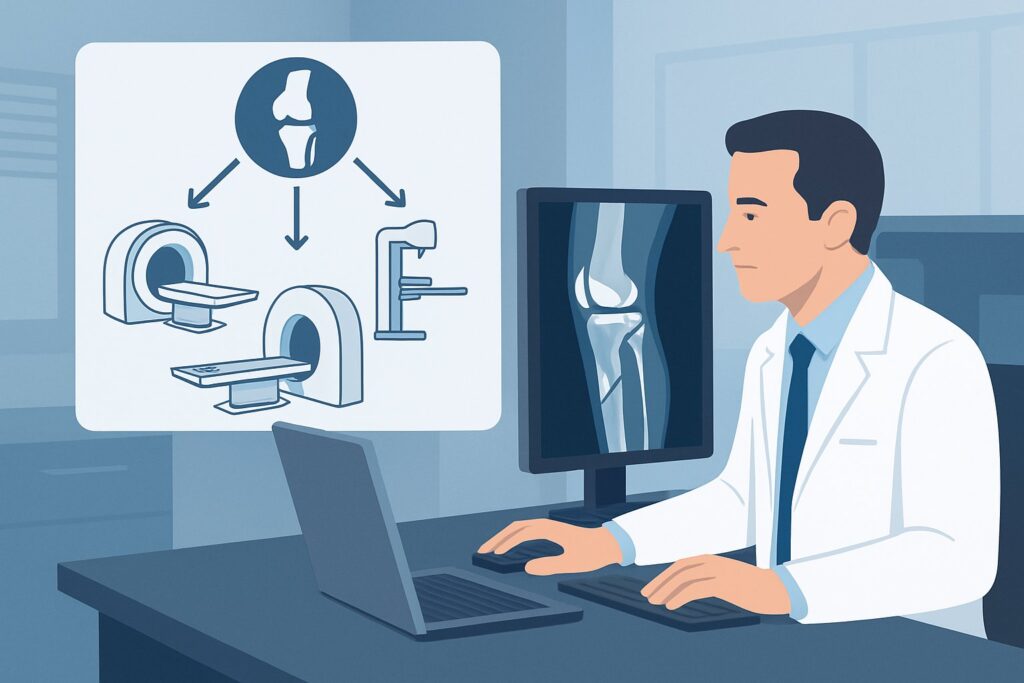
An 82-year-old patient with a total knee arthroplasty (TKA) from five years ago presents to the emergency department after a fall, reporting acute, severe knee pain and inability to bear weight. Standard anteroposterior and lateral radiographs of the knee are obtained, but significant hardware artifact from the implant makes it difficult to definitively exclude a subtle, non-displaced periprosthetic fracture at the bone-implant interface. Your clinical suspicion for a fracture remains high. This article details the American College of Radiology (ACR) recommended imaging workflow for this specific scenario. For a patient with suspected periprosthetic or hardware fracture after TKA whose radiographs are inconclusive, a CT knee without IV contrast is rated as Usually Appropriate.
## Who Fits This Clinical Scenario?
This guidance applies to a specific patient population: individuals with a prior total knee arthroplasty who present with pain, particularly after a traumatic event, where there is a direct clinical suspicion for a fracture involving the prosthesis or the surrounding bone. The key inclusion criterion is that initial radiographs have already been performed and are either negative or equivocal, yet the clinical concern for fracture persists due to the mechanism of injury or physical exam findings (e.g., focal tenderness, instability, crepitus).
This workflow is distinct from other common post-TKA pain scenarios. It does not apply if:
- Infection is the primary concern: If the patient presents with systemic signs like fever, chills, or local signs like erythema, warmth, and a draining sinus, the workup should follow the pathway for suspected infection, which involves different imaging and laboratory tests.
- The pain is chronic and insidious: For patients with long-standing, gradually worsening pain without a clear traumatic trigger, the primary differential shifts toward aseptic loosening, osteolysis, or instability. While CT can play a role, the initial imaging considerations and potential alternatives may differ.
- Component malrotation is suspected: If the clinical question is specifically about the rotational alignment of the femoral or tibial components, a specialized CT protocol designed to measure rotation is required, which represents a separate clinical variant.
## What Diagnoses Are You Working Up in This Scenario?
When a post-TKA patient has acute pain after trauma, the differential diagnosis is focused on mechanical failure. The primary goal of advanced imaging is to confirm or exclude diagnoses that are often obscured by hardware on plain films and require urgent orthopedic consultation.
Periprosthetic Femur or Tibia Fracture: This is the most common and consequential diagnosis in this setting. Fractures can occur in the supracondylar femur, tibial plateau, or patella. They are often subtle and non-displaced, running adjacent to the implant stems or cement mantle. Radiographs can easily miss these fracture lines due to the overlying high-density hardware, making cross-sectional imaging essential for definitive diagnosis and surgical planning.
Prosthesis or Hardware Fracture: While less common than bone fractures, components of the knee prosthesis itself can fail. This includes fracture of the tibial post in posterior-stabilized designs, fracture of the metal femoral or tibial components, or fracture of the polyethylene liner. These failures can lead to acute instability and pain and are often very difficult or impossible to visualize on radiographs alone.
Acute Implant Loosening or Subsidence: Trauma can acutely destabilize a previously well-fixed implant, causing it to loosen from the bone or subside (sink) into the weaker metaphyseal bone. While this is a form of aseptic loosening, its acute, post-traumatic nature places it within this workup. CT can reveal new radiolucent lines at the bone-cement or bone-implant interface or demonstrate a change in component position compared to prior studies.
## Why Is CT Knee Without IV Contrast the Recommended Study for This Presentation?
The ACR Appropriateness Criteria panel designates CT knee without IV contrast as Usually Appropriate for this scenario because it directly addresses the primary clinical question with high diagnostic accuracy, speed, and accessibility.
The core strength of Computed Tomography (CT) is its superior ability to visualize bone detail and define fracture patterns in three dimensions, even in the presence of metallic hardware. Modern CT scanners employ sophisticated metal artifact reduction (MAR) algorithms that significantly clean up the image, reducing the streaking and beam hardening artifacts that previously limited CT’s utility around implants. This allows for clear visualization of subtle fracture lines, bone fragmentation, and component position that are invisible on radiographs.
In contrast, other imaging modalities are rated lower for this specific indication:
- MRI knee without IV contrast is rated May be appropriate. While MRI offers excellent soft tissue contrast, it is highly susceptible to magnetic field distortion from the metallic components of the TKA. This creates large signal voids and geometric distortion that can completely obscure the periprosthetic bone, making it unreliable for fracture detection at the bone-implant interface.
- A 3-phase bone scan is also rated May be appropriate. Nuclear medicine bone scans are very sensitive to areas of increased bone turnover, which will be present in a fracture. However, they are not specific; increased uptake can also be seen with infection, loosening, or normal postoperative remodeling. Furthermore, a bone scan provides poor anatomical detail, making it difficult to characterize a fracture for surgical planning.
From a safety and logistics perspective, non-contrast CT is an ideal choice. It avoids the risks associated with intravenous contrast media (e.g., allergic reaction, contrast-induced nephropathy). The radiation dose is also very low, with a relative radiation level of ☢ (<0.1 mSv), which is a fraction of the dose from many other common CT examinations. ## What's Next After CT Knee Without IV Contrast? Downstream Workflow The results of the CT scan will guide the immediate next steps in patient management, typically in consultation with an orthopedic surgeon.
- If the CT is positive for a fracture: The patient requires urgent orthopedic evaluation. The CT images are critical for classifying the fracture (e.g., using the Vancouver or Rorabeck classification systems), assessing bone stock, and determining the stability of the implant. This information directly informs the decision between non-operative management (for stable, non-displaced fractures) and surgical intervention (e.g., open reduction and internal fixation or revision arthroplasty).
- If the CT is negative for fracture: If the scan definitively excludes a periprosthetic or hardware fracture, the diagnostic focus shifts. The patient’s pain may be due to a severe soft tissue injury (e.g., ligamentous or musculotendinous tear), acute exacerbation of aseptic loosening, or synovitis. If high clinical suspicion for a soft tissue cause remains, an MRI (if deemed safe with the specific implant) could be considered. If the concern shifts to chronic loosening, the workup may proceed down the pathway for that specific ACR scenario, potentially involving nuclear medicine studies.
- If the CT is indeterminate: In the rare case that severe metal artifact still obscures the area of interest, further imaging may be needed. A 3-phase bone scan could be used as a sensitive, albeit non-specific, problem-solving tool to confirm the presence of abnormal metabolic activity at the site of pain.
## Pitfalls to Avoid (and When to Get Help)
Navigating the workup for a suspected periprosthetic fracture requires careful attention to imaging technique and clinical context.
- Failing to request Metal Artifact Reduction (MAR): Standard CT protocols are not optimized for imaging near metal. Always specify that the exam is for a periprosthetic fracture and request that MAR sequences be used.
- Over-reliance on radiographs: A negative radiograph does not rule out a fracture, especially in a patient with a compelling history of trauma and a painful, unstable knee. Maintain a low threshold for ordering a CT.
- Misinterpreting lucency: Not all lucent lines around an implant represent loosening or fracture. Well-defined, non-progressive lines (“pedestals”) can be normal. Compare with prior imaging whenever possible.
- Ignoring the soft tissues: While CT is optimized for bone, a careful review of the soft tissue windows may reveal hematomas or other secondary signs of injury that can increase suspicion for an occult fracture.
If the CT is negative but the patient has clear signs of mechanical instability on exam, escalate immediately to an orthopedic surgeon, as this may indicate a polyethylene failure or ligamentous injury not fully appreciated on static imaging.
## Related ACR Topics and Tools
This article covers one specific variant within the broader topic of post-TKA imaging. For a comprehensive overview of all clinical scenarios, from routine follow-up to suspected infection, please consult our parent guide. The following resources can also help you apply these guidelines in your practice.
- For breadth across all scenarios in Imaging After Total Knee Arthroplasty, see our parent guide: Imaging After Total Knee Arthroplasty: ACR Appropriateness Decoded.
- To explore other clinical situations, use the ACR Appropriateness Criteria Lookup.
- For technical details on performing the recommended study, see the Imaging Protocol Library.
- To discuss radiation exposure with your patients, use the Radiation Dose Calculator.
Frequently Asked Questions
Why not order an MRI instead of a CT to look for a periprosthetic fracture?
While MRI provides excellent soft tissue detail, the metallic components of a total knee arthroplasty cause significant artifacts that distort the magnetic field. This creates large black voids on the image, obscuring the bone right next to the implant where fractures most often occur. CT with metal artifact reduction protocols is specifically designed to minimize these artifacts and provide clear visualization of the bone, making it the superior test for this question.
Do I need to specifically request a ‘metal artifact reduction’ (MAR) protocol when ordering the CT?
Yes, this is critical. A standard CT protocol will produce significant streaking artifacts that can obscure the diagnosis. Explicitly stating the indication (e.g., ‘rule out periprosthetic fracture’) and requesting a metal artifact reduction protocol ensures the radiology department uses the appropriate software and scanning parameters to generate the highest quality images.
What should I do if the initial radiographs look completely normal but my clinical suspicion for a fracture is high?
This is the precise indication for ordering a CT scan. Radiographs have limited sensitivity for non-displaced or hairline fractures, especially when hardware obscures the view. If the patient’s mechanism of injury, pain level, and physical exam findings strongly suggest a fracture, proceeding to CT is the ACR-recommended next step.
Can a non-contrast CT of the knee diagnose a periprosthetic infection?
Not directly. A CT scan can show secondary signs that might be associated with infection, such as bone destruction (osteolysis), fluid collections, or sinus tracts. However, these findings are not specific to infection and can also be seen with aseptic loosening. The definitive imaging workup for suspected infection typically involves nuclear medicine studies, such as a tagged white blood cell scan, which is a different ACR clinical scenario.
Is a 3-phase bone scan a reasonable alternative to CT in this scenario?
The ACR rates a 3-phase bone scan as ‘May be appropriate’. It is highly sensitive for detecting abnormal bone activity, so a negative scan can help rule out a fracture. However, it is not specific—increased uptake can be caused by fracture, loosening, or infection. CT is preferred because it provides precise anatomical detail of the fracture pattern, which is essential for surgical planning.
Reviewed by Pouyan Golshani, MD, Interventional Radiologist — June 27, 2026