What Imaging Is Best for Suspected Cardiac Injury in a Stable Blunt Trauma Patient?

A 34-year-old male arrives in the emergency department after a high-speed motor vehicle collision where he was the restrained driver and the steering wheel deformed on impact. His vital signs are stable, and while he has anterior chest wall tenderness, his initial FAST exam is negative. An ECG shows nonspecific T-wave inversions in the anterior leads. You suspect a potential blunt cardiac injury, but the patient is not in shock. The immediate question is which imaging study will most effectively and safely evaluate for myocardial contusion, pericardial effusion, or valvular damage. This article provides a focused clinical workflow for this exact scenario, guided by the American College of Radiology (ACR) Appropriateness Criteria, which rate a resting transthoracic echocardiogram as Usually Appropriate for this presentation.
Who Fits This Clinical Scenario for Suspected Cardiac Injury?
This guidance applies specifically to the hemodynamically stable patient who has sustained blunt chest trauma and in whom there is a reasonable clinical suspicion for cardiac injury.
Inclusion criteria for this workflow:
- Mechanism: Motor vehicle collision (especially with steering wheel or dashboard impact), significant fall from height, direct blow to the chest, or blast injury.
- Hemodynamic Stability: The patient is not hypotensive, tachycardic out of proportion to pain, or showing signs of shock. They are maintaining adequate end-organ perfusion.
- Clinical Suspicion: The decision to image is often triggered by findings such as sternal fracture, multiple anterior rib fractures, an abnormal screening electrocardiogram (ECG), a new arrhythmia, or elevated cardiac biomarkers (e.g., troponin).
Exclusion criteria (patients who require a different pathway):
- Hemodynamically Unstable Patients: A patient with hypotension, persistent tachycardia, or signs of cardiogenic shock falls into a different ACR scenario. Their workup is more urgent and often begins with a bedside extended FAST (eFAST) exam to rapidly look for pericardial tamponade, followed by immediate resuscitation and potential surgical consultation. This is a critical distinction, as the stable patient allows for a more deliberate diagnostic approach.
- Penetrating Trauma: Gunshot wounds or stab wounds to the chest follow entirely different surgical and imaging algorithms and are not covered by this guidance.
What Diagnoses Are You Working Up With Suspected Cardiac Injury?
When ordering imaging for a stable patient with suspected blunt cardiac injury, you are primarily investigating a spectrum of potential injuries that vary in severity and frequency. The goal is to identify consequential damage that requires intervention or a higher level of monitoring.
Myocardial Contusion: This is the most common form of blunt cardiac injury, representing a “bruise” to the heart muscle. While often clinically silent, it can lead to arrhythmias, conduction abnormalities, or transient ventricular dysfunction. Imaging may reveal regional wall motion abnormalities or myocardial thickening.
Pericardial Effusion and Tamponade: Bleeding into the pericardial space can occur from injury to the epicardium or a coronary vessel. In a stable patient, a small, non-compressing effusion may be present. The critical goal of imaging is to rule out a larger effusion causing hemodynamic compromise (cardiac tamponade), which would manifest as diastolic right ventricular collapse on echocardiography.
Valvular Injury: Though less common, severe deceleration forces can cause rupture of the chordae tendineae, papillary muscles, or valve leaflets. The aortic valve is most commonly injured, followed by the mitral and tricuspid valves. This can lead to acute, severe regurgitation, which imaging can readily detect.
Coronary Artery Injury: This is a rare but life-threatening complication, including dissection or thrombosis of a coronary artery, which can lead to myocardial infarction. While echocardiography may show a resultant wall motion abnormality, a dedicated Coronary CTA is the definitive imaging test if suspicion is high.
Ventricular or Septal Rupture: A full-thickness tear in the myocardial free wall is typically fatal and presents with profound instability. However, a contained rupture or a traumatic ventricular septal defect (VSD) can occasionally present in a patient who is initially stable.
Why Is Transthoracic Echocardiography the Recommended First Study?
For a hemodynamically stable patient with suspected blunt cardiac injury, the ACR designates US echocardiography transthoracic resting as Usually Appropriate. This recommendation is based on the modality’s excellent diagnostic capability, safety profile, and accessibility.
The primary rationale for choosing a transthoracic echocardiogram (TTE) is its ability to directly answer the most pressing clinical questions without exposing the patient to ionizing radiation (0 mSv). TTE provides a real-time, dynamic assessment of cardiac structure and function. It is highly sensitive for detecting pericardial effusions, evaluating global and regional ventricular function to identify wall motion abnormalities suggestive of contusion, and visualizing valvular structures to rule out acute regurgitation or flail leaflets. As a portable study, it can often be performed at the patient’s bedside in the emergency department or trauma bay.
How do alternative studies compare for this specific scenario?
- CT Chest with IV Contrast: This study is also rated Usually Appropriate. It is excellent for evaluating the great vessels, lungs, and bony thorax, and is often performed as part of a broader trauma “pan-scan.” While it can identify a large pericardial effusion, it is less sensitive than TTE for subtle wall motion abnormalities, valvular pathology, and cardiac function. It also involves both iodinated contrast and significant ionizing radiation (☢☢☢ 1-10 mSv). TTE is more specific to the cardiac functional question.
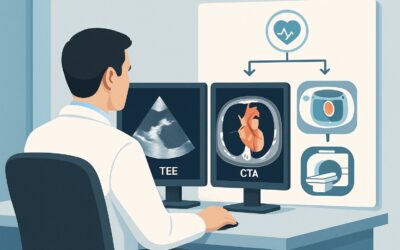
- US Echocardiography Transesophageal: Transesophageal echocardiography (TEE) is rated May be appropriate. It provides superior image quality, especially for posterior cardiac structures and the thoracic aorta. However, it is more invasive, requires patient sedation, and is not a first-line screening tool. TEE is typically reserved for cases where TTE provides poor acoustic windows (e.g., due to obesity, chest wall injury, or subcutaneous emphysema) or when there is a high suspicion of aortic or valvular injury that is not clearly defined on the initial TTE.
In practice, the choice between TTE and CT is often complementary. If the patient is already undergoing a CT scan for other suspected injuries, the cardiac structures will be grossly evaluated. However, if the primary concern is cardiac-specific injury in a stable patient, TTE is the most direct, safe, and functionally informative first step.
What’s Next After Echocardiography? Downstream Workflow for Stable Cardiac Trauma
The results of the transthoracic echocardiogram, in conjunction with serial ECGs and cardiac biomarkers, will guide the subsequent management plan.
- If the TTE is positive: The next step depends on the specific finding.
- Significant Pericardial Effusion with Tamponade Physiology: This is a clinical emergency requiring an immediate cardiology consultation for potential pericardiocentesis.
- Wall Motion Abnormality or Depressed Ejection Fraction: This finding, suggestive of significant myocardial contusion, warrants admission to a monitored setting (telemetry or intensive care unit). Management includes continuous cardiac monitoring for arrhythmias, serial troponin measurements, and supportive care.
- Acute Valvular Regurgitation or Structural Damage: This requires urgent consultation with both cardiology and cardiothoracic surgery to determine the need for and timing of surgical repair.
- If the TTE is negative: A normal echocardiogram is highly reassuring. If the patient’s ECG is normal, serial troponins are negative, and there are no other injuries requiring admission, a blunt cardiac injury can often be safely ruled out. The patient may be eligible for discharge with clear follow-up instructions. If troponins are mildly elevated but the TTE is normal, a period of observation with continued monitoring is typically indicated.
- If the TTE is indeterminate or limited: Poor acoustic windows can limit the diagnostic utility of a TTE. If clinical suspicion for a significant injury remains high despite a limited study, the next step is to consider one of the modalities rated May be appropriate, such as a transesophageal echocardiogram (TEE) for a more detailed structural assessment.
Pitfalls to Avoid in Stable Blunt Cardiac Injury Workup
Navigating the workup for suspected blunt cardiac injury requires careful integration of multiple data points. Here are several common pitfalls to avoid:
- Prematurely Ruling Out Injury: A single normal ECG or a single negative troponin level on arrival does not definitively exclude a cardiac injury. Serial testing over several hours is crucial, as biomarker levels can take time to rise.
- Ignoring a “Limited” Echocardiogram Report: If an echocardiogram report states the study was technically difficult or that certain structures were not well visualized, do not interpret it as a normal study. In a patient with high-risk features, this should prompt consideration of alternative imaging like a TEE.
- Attributing All ECG Changes to Contusion: In patients with risk factors, remember that the trauma could have precipitated an acute coronary syndrome (ACS) unrelated to a direct contusion. Maintain a broad differential.
- Delaying Consultation: If the TTE reveals any significant structural damage, ventricular dysfunction, or a hemodynamically significant effusion, do not delay consultation with cardiology or cardiothoracic surgery while awaiting further tests.
If a patient who was initially stable develops hypotension, new arrhythmias, or worsening chest pain, escalate care immediately. This represents a transition to the hemodynamically unstable patient scenario, which requires rapid re-evaluation and a more aggressive management pathway.
Related ACR Topics and Tools
For a comprehensive overview of all clinical variants and imaging modalities related to this topic, or to explore tools for other clinical scenarios, the following resources are available.
- For breadth across all scenarios in Blunt Chest Trauma-Suspected Cardiac Injury, see our parent guide: Blunt Chest Trauma-Suspected Cardiac Injury: ACR Appropriateness Decoded.
- To look up appropriateness criteria for other clinical presentations, use the ACR Appropriateness Criteria Lookup tool.
- For detailed technical parameters of imaging studies, refer to the Imaging Protocol Library.
- To discuss cumulative radiation exposure with patients, the Radiation Dose Calculator can be a helpful aid.
Frequently Asked Questions
If the patient is stable, why not just rely on serial ECGs and troponins alone?
While serial ECGs and troponins are essential screening tools, they have limitations. A patient can have a significant structural injury, such as a small pericardial effusion or a traumatic valvular insufficiency, with normal or nonspecific biomarkers and ECG findings. Echocardiography provides a direct anatomical and functional assessment that these other tests cannot, making it a crucial component of the workup in patients with a concerning mechanism of injury or physical exam findings.
The patient is already getting a trauma pan-scan (CT of head, neck, chest, abdomen/pelvis). Do I still need a separate echocardiogram?
It depends on the primary concern. A contrast-enhanced chest CT can identify large pericardial effusions and major great vessel injuries. However, it is not the ideal study for assessing cardiac valve function, subtle wall motion abnormalities, or calculating ejection fraction. If your clinical suspicion for a specific functional cardiac injury (like contusion or valvular tear) is high, a dedicated TTE is still warranted even if a CT is also being performed. The two tests provide complementary information.
What if the patient becomes hemodynamically unstable during the workup?
If a patient’s condition deteriorates, the clinical scenario changes, and so does the imaging algorithm. The immediate priority is resuscitation. The imaging focus shifts to a rapid bedside eFAST (extended Focused Assessment with Sonography for Trauma) exam to look for pericardial tamponade or other sources of shock. This patient now fits the ‘Suspected cardiac injury following blunt trauma, hemodynamically unstable patient’ ACR variant, which prioritizes immediate, life-saving interventions over more time-consuming diagnostics.
Are there any situations where a cardiac MRI would be appropriate in the acute setting?
In the acute trauma setting, cardiac MRI is rated as ‘Usually not appropriate’ by the ACR. While MRI is an excellent tool for characterizing myocardial tissue (e.g., detecting edema from a contusion) and assessing function, it is time-consuming, requires a stable and cooperative patient, and is not readily available in most emergency departments. Its role is generally reserved for subacute or chronic evaluation of post-traumatic cardiac complications if questions remain after initial imaging.
Does a sternal fracture automatically mean the patient has a cardiac injury?
No, a sternal fracture does not automatically equate to a cardiac injury, but it significantly increases the clinical suspicion. It serves as a marker for a high-energy impact to the anterior chest. In a patient with an isolated, non-displaced sternal fracture but normal ECG and troponins, the risk of a clinically significant cardiac injury is low. However, its presence should lower the threshold to perform an echocardiogram if any other concerning signs or symptoms are present.
Reviewed by Pouyan Golshani, MD, Interventional Radiologist — May 29, 2026