What Initial Imaging Should You Order for High-Probability Acute Coronary Syndrome?
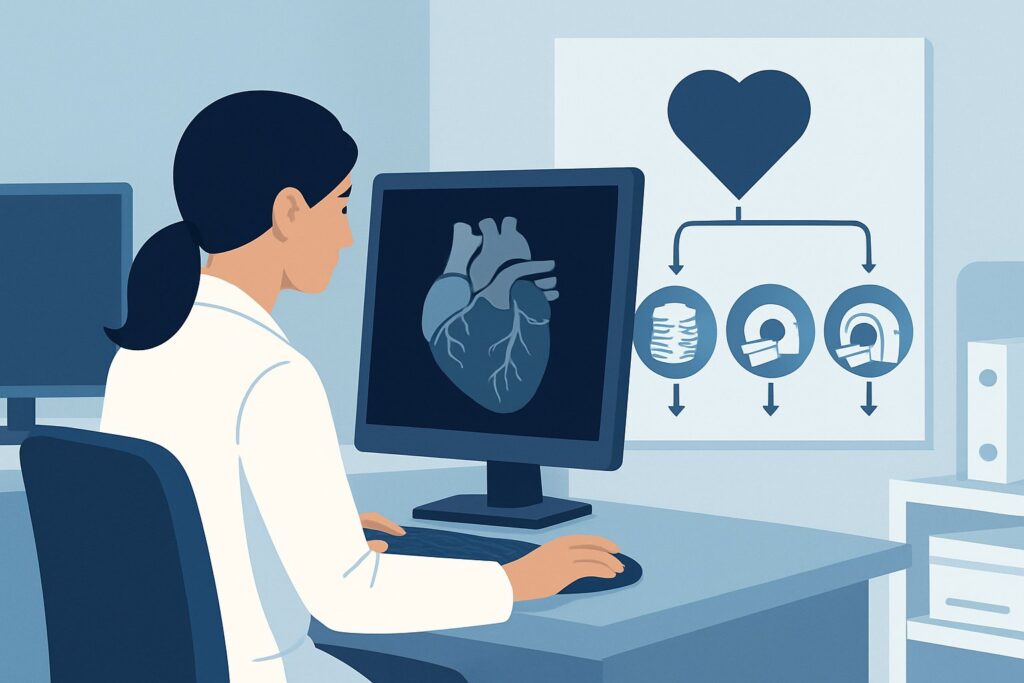
A 64-year-old man with a history of hypertension and diabetes presents to the emergency department at 2 a.m. with 45 minutes of crushing, substernal chest pain radiating to his left arm, accompanied by diaphoresis and nausea. His initial EKG shows ST-segment elevations in the anterior leads, and the cardiology team is being activated for emergent intervention. As the primary clinician, you are initiating medical therapy, but you must also decide on the appropriate initial imaging to obtain without delaying definitive care. This article details the American College of Radiology (ACR) guided workflow for initial imaging in a patient with a high probability of acute coronary syndrome (ACS). For this specific scenario, a chest radiograph is rated Usually Appropriate as the first imaging step.
## Who Fits the High-Probability Acute Coronary Syndrome Scenario?
This clinical workflow applies to patients presenting with signs and symptoms strongly suggestive of acute coronary syndrome, particularly ST-segment elevation myocardial infarction (STEMI) or high-risk non-ST-segment elevation myocardial infarction (NSTEMI). These individuals typically exhibit a constellation of high-risk features, including:
- Classic Symptoms: Substernal chest pain or pressure described as crushing, squeezing, or heavy, often radiating to the jaw, shoulder, or arm.
- Diagnostic EKG Changes: ST-segment elevation or depression, new T-wave inversions, or a new left bundle branch block.
- Elevated Cardiac Biomarkers: A positive initial or rising serial troponin level.
- Hemodynamic Instability: The presence of hypotension, acute heart failure, or new, severe mitral regurgitation.
It is crucial to distinguish this high-probability cohort from other presentations. This guidance does not apply to patients who fit the low to intermediate probability for ACS scenario, where symptoms may be atypical, EKG findings are non-diagnostic, and initial cardiac biomarkers are negative. Furthermore, if the leading diagnosis is suspected to be acute aortic dissection or pulmonary embolism, a different imaging algorithm (typically involving CT angiography of the chest) would take precedence.
## What Diagnoses Are You Working Up in This Scenario?
In a patient with a high probability of ACS, the primary goal of initial imaging is not to diagnose the coronary occlusion itself, but to rapidly evaluate for life-threatening alternative diagnoses and assess for immediate complications of the myocardial infarction.
The foremost diagnosis is Acute Coronary Syndrome (ACS). While the chest radiograph cannot visualize coronary arteries, it is essential for evaluating the consequences of a large myocardial infarction, such as cardiogenic pulmonary edema.
A key alternative diagnosis is Acute Aortic Dissection. This is a can’t-miss diagnosis that can mimic ACS. While CT angiography is the definitive test, a chest radiograph can reveal a widened mediastinum or abnormal aortic contour, which would immediately raise suspicion and drastically alter the management plan away from anticoagulation and toward surgical intervention.
Another critical consideration is Acute Heart Failure. A significant MI can impair left ventricular function, leading to acute cardiogenic pulmonary edema. The chest radiograph is the fastest and most effective way to identify signs of vascular congestion, Kerley B lines, pleural effusions, and cardiomegaly, which informs resuscitation and ventilator management.
Less common but important considerations include Pneumothorax, which can cause sudden, sharp chest pain and is easily identified on a chest radiograph. Other pulmonary pathologies like Pneumonia or a large Pleural Effusion can also present with chest pain and are readily diagnosed with this initial study.
## Why Is a Chest Radiograph the Recommended Initial Study for High-Probability ACS?
For a patient with a high clinical probability of ACS, the ACR designates both Radiography chest and Arteriography coronary as Usually Appropriate. This reflects a parallel, not sequential, workflow. The chest radiograph serves as the initial diagnostic imaging study, while coronary arteriography is the definitive diagnostic and therapeutic procedure.
The rationale for obtaining a chest radiograph is its ability to provide critical information quickly, safely, and at the bedside without delaying the patient’s path to reperfusion therapy. A portable anteroposterior (AP) chest x-ray is rapid, universally available, and delivers a very low radiation dose (☢ <0.1 mSv). Its primary value lies in its ability to:
- Rule out mimics: It can swiftly identify non-cardiac causes of chest pain like pneumothorax or pneumonia.
- Screen for aortic dissection: A widened mediastinum on a chest radiograph is a critical finding that demands immediate investigation with CTA before proceeding with therapies for ACS.
- Assess for complications: It is the best initial test to evaluate for pulmonary edema secondary to acute heart failure, a common and serious complication of MI.
Why are other advanced imaging studies not the first choice?
- CTA Coronary Arteries: While rated May be appropriate, this study is generally not the correct initial test in a high-probability ACS patient. Time is muscle, and the delay required to perform a CTA is unacceptable when the patient needs emergent cardiac catheterization. CTA is better suited for patients in the low-to-intermediate risk category. It also involves a higher radiation dose (☢☢☢ 1-10 mSv) and intravenous contrast.
- CT Coronary Calcium: This study is rated Usually not appropriate in the acute setting. A calcium score quantifies chronic, calcified plaque burden and provides no information about acute plaque rupture, which is the cause of ACS.
In practice, the chest radiograph is often obtained with a portable machine in the emergency department bay while the cath lab team is being activated, ensuring no time is lost.
## What’s Next After the Chest Radiograph? Downstream Workflow
The results of the initial chest radiograph directly influence the immediate next steps in patient management, often in parallel with preparations for cardiac catheterization.
- Normal Chest Radiograph: If the radiograph is unremarkable, it increases the specificity for an uncomplicated ACS. The workflow proceeds directly to the cardiac catheterization lab for coronary arteriography to diagnose and treat the culprit lesion.
- Findings of Pulmonary Edema: If the radiograph shows signs of acute heart failure (e.g., vascular congestion, effusions), this signals a more severe MI with hemodynamic consequences. This finding prompts aggressive medical management with diuretics and possibly non-invasive positive pressure ventilation, and it alerts the cardiology team to a higher-risk patient who may require mechanical circulatory support.
- Findings Suggesting Aortic Dissection: If the radiograph reveals a widened mediastinum or an abnormal aortic knob, all plans for ACS-directed therapy (especially antiplatelet and anticoagulant agents) must be halted immediately. The next step is an emergent CT angiography of the chest, abdomen, and pelvis to confirm or rule out dissection. This is a critical pivot point in the diagnostic algorithm.
- Unexpected Findings: If an alternative diagnosis like a large pneumothorax is found, the appropriate intervention (e.g., chest tube placement) becomes the immediate priority, which may occur before or concurrently with cardiac catheterization, depending on the patient’s stability.
## Pitfalls to Avoid (and When to Get Help)
In the high-stakes environment of a potential ACS, several pitfalls can compromise patient care.
- Delaying Reperfusion for Imaging: The single most critical error is delaying activation of the cath lab to obtain non-essential imaging. The portable chest radiograph should be performed in parallel with, not prior to, the cardiology consultation and cath lab activation.
- Over-reliance on the Radiograph: A normal chest x-ray does not rule out ACS. The diagnosis of ACS is based on the clinical presentation, EKG, and cardiac biomarkers. The radiograph’s role is to assess for complications and mimics.
- Misinterpreting a Widened Mediastinum: While a widened mediastinum is a classic sign of aortic dissection, it can be technically difficult to assess on a portable, supine AP film. A low threshold for pursuing CT angiography is essential if there is any clinical or radiographic concern for dissection.
If the patient is hemodynamically unstable or the diagnosis remains unclear despite initial tests, escalate immediately by involving critical care and cardiothoracic surgery specialists early in the process.
## Related ACR Topics and Tools
For a comprehensive overview of imaging for all clinical variants of chest pain, please consult the parent topic guide. Additional GigHz tools can help you apply these guidelines in your practice.
- For breadth across all scenarios in Chest Pain-Possible Acute Coronary Syndrome, see our parent guide: Chest Pain-Possible Acute Coronary Syndrome: ACR Appropriateness Decoded.
- To explore other clinical scenarios and their corresponding ACR recommendations, use the ACR Appropriateness Criteria Lookup.
- For details on imaging techniques and parameters, browse the Imaging Protocol Library.
- To help discuss radiation exposure with patients, reference the Radiation Dose Calculator.
Frequently Asked Questions
Why is coronary arteriography also ‘Usually Appropriate’ if a chest x-ray is the initial study?
They serve different, parallel purposes. The chest radiograph is the initial diagnostic imaging test to rule out mimics and assess for complications like heart failure. Coronary arteriography is the definitive diagnostic and therapeutic procedure to identify and treat the blocked coronary artery. In a high-probability ACS case, the workflow involves getting the chest x-ray while simultaneously preparing the patient for the catheterization lab.
If the patient has a high probability of ACS, why not just skip the chest x-ray and go straight to the cath lab?
While speed is critical, the chest x-ray provides vital information that can prevent catastrophic errors. For example, if the patient’s chest pain is actually from an aortic dissection, giving them anticoagulants for a presumed ACS could be fatal. A widened mediastinum on a quick, portable x-ray can avert this. It also provides a rapid baseline assessment of cardiopulmonary status.
Should I order a 2-view (PA and lateral) chest radiograph for this patient?
No. In this emergent setting, a single-view portable anteroposterior (AP) chest radiograph is sufficient. The priority is to obtain critical information without moving an unstable patient or delaying definitive care. A 2-view study is better for stable, outpatient evaluations.
What if my patient has renal insufficiency? Is a chest x-ray still the right first step?
Yes. A standard chest radiograph does not use intravenous contrast and is perfectly safe for patients with renal insufficiency. This is another advantage over CT angiography, which requires iodinated contrast that can pose a risk of contrast-induced nephropathy.
Does a normal chest x-ray rule out aortic dissection?
No, a normal chest x-ray does not definitively rule out aortic dissection. Up to 10-20% of patients with aortic dissection may have a normal-appearing mediastinum on their initial chest radiograph. If clinical suspicion for dissection remains high (e.g., tearing pain, pulse deficit, neurological symptoms), you must proceed to CT angiography regardless of the chest x-ray findings.
Reviewed by Pouyan Golshani, MD, Interventional Radiologist — May 29, 2026