What Is the Best Imaging for Pre-Glenn Single Ventricle Evaluation After Echocardiography?
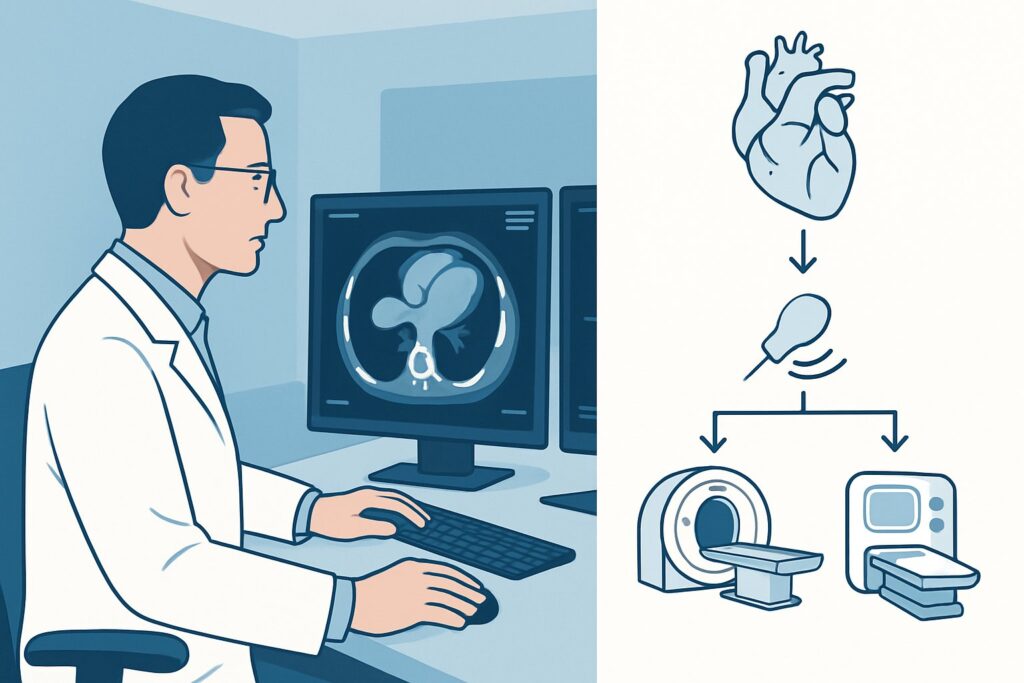
A pediatric cardiology fellow reviews the chart of a 4-month-old with hypoplastic left heart syndrome, status post-Norwood procedure. The patient is stable and growing, now being considered for stage 2 palliation—the bidirectional Glenn procedure. The recent transthoracic echocardiogram provided excellent views of ventricular function but left questions about the precise anatomy of the branch pulmonary arteries and the superior vena cava. With the surgical planning conference approaching, the team needs definitive imaging to ensure the patient is a suitable candidate. This article provides a clinical workflow for this exact scenario: choosing the next imaging study for a child with single ventricle physiology when echocardiography is incomplete prior to stage 2 palliation. According to the American College of Radiology (ACR) Appropriateness Criteria, multiple advanced imaging modalities, including `Arteriography coronary with ventriculography`, are rated Usually Appropriate.
Who Fits This Clinical Scenario?
This guidance applies to a specific pediatric population: children with known single ventricle physiology who are being evaluated for stage 2 surgical palliation.
Inclusion Criteria:
- Patient: A child, typically between 3 and 6 months of age.
- Condition: Known single ventricle heart disease. This includes a spectrum of complex congenital defects such as hypoplastic left heart syndrome (HLHS), tricuspid atresia, or double inlet left ventricle.
- History: The patient has typically undergone stage 1 palliation (e.g., a Norwood procedure with a Blalock-Taussig-Thomas or Sano shunt).
- Clinical Question: The patient is being evaluated for stage 2 palliation, most commonly the bidirectional Glenn or hemi-Fontan procedure.
- Imaging Prerequisite: A transthoracic echocardiogram (TTE) has already been performed but was incomplete or inadequate for full surgical planning.
Exclusion Criteria:
This workflow is not intended for patients in different clinical situations, even if they have single ventricle physiology. Key exclusions include:
- Pre-Stage 3 Evaluation: A child being evaluated for stage 3 palliation (the Fontan procedure) has different anatomical and hemodynamic questions. This is a distinct scenario in the ACR guidelines.
- Postoperative Complications: Patients who have already undergone the Glenn procedure and are being evaluated for complications like shunt thrombosis or stenosis follow a different diagnostic pathway.
- Biventricular Physiology: This guidance does not apply to patients with two functional ventricles, such as those with repaired tetralogy of Fallot or transposition of the great arteries, who have their own specific ACR criteria.
What Anatomic and Physiologic Questions Are You Working Up?
In this preoperative setting, imaging is not about discovering a new diagnosis but about answering critical questions that determine surgical candidacy and strategy. The “differential” consists of key anatomical and physiological variables that must be precisely defined.
Pulmonary Artery Anatomy and Pressure
The most critical question is the status of the pulmonary arteries (PAs). The Glenn procedure relies on passive, low-pressure flow from the superior vena cava (SVC) into the PAs. Therefore, surgeons must know the size and morphology of the branch PAs. Significant stenosis or hypoplasia can lead to high SVC pressure and Glenn failure. Imaging aims to measure PA diameters to calculate indices like the Nakata index and to identify any distortion from the prior stage 1 surgery. Catheterization can directly measure PA pressures, a crucial piece of hemodynamic data.
Systemic Venous Drainage
The surgeon must have a complete map of the systemic venous return. The presence of a persistent left SVC, its drainage site (coronary sinus vs. left atrium), and the presence of a bridging innominate vein are essential details. A bilateral Glenn procedure may be required if a large, bilateral SVC configuration is present.
Atrioventricular Valve Function
The single functional ventricle must pump blood to the body for the patient’s entire life, and the health of the atrioventricular (AV) valve is paramount. Significant AV valve regurgitation increases volume load on the single ventricle and is a major risk factor for long-term heart failure. Advanced imaging can quantify the degree of regurgitation more accurately than an incomplete TTE.
Ventricular Function and Aortic Arch Integrity
Finally, a comprehensive assessment of single ventricle systolic and diastolic function is necessary. The prior stage 1 procedure (Norwood) involves reconstruction of the aorta. Imaging must confirm there is no significant recoarctation or obstruction of the aortic arch, which would need to be addressed at the time of the Glenn surgery.
Why Is Cardiac Catheterization a Primary Recommended Study for This Presentation?
When echocardiography is inconclusive, the ACR rates several advanced imaging modalities as Usually Appropriate, including cardiac MRI, cardiac CT, and cardiac catheterization (arteriography). While non-invasive options are powerful, cardiac catheterization holds a unique role by providing both high-resolution anatomical imaging and essential, direct hemodynamic measurements.
The key advantage of catheterization is its ability to directly measure pressures in the pulmonary arteries, ventricle, and aorta. This data is not just diagnostic; it is prognostic. A mean PA pressure above a certain threshold (e.g., 15-18 mmHg) may be a contraindication for the Glenn procedure. This information cannot be obtained from CT or MRI.
Furthermore, catheterization allows for intervention. If a discrete stenosis is found in a branch pulmonary artery or the aortic arch, balloon angioplasty, sometimes with stent placement, can be performed in the same session, potentially optimizing the patient’s anatomy for surgery.
Comparison to Alternatives:
- MRI heart function and morphology without and with IV contrast: Also rated Usually Appropriate. Cardiac MRI is an excellent non-radiation alternative for assessing ventricular volumes, function, valve regurgitation, and vessel anatomy. However, it requires general anesthesia in this age group and does not provide direct pressure measurements. It is often the preferred non-invasive modality when hemodynamics are not the primary question.
- CTA chest with IV contrast: Also rated Usually Appropriate. Cardiac CT provides superb spatial resolution for vascular anatomy, especially the PAs and aortic arch, with very rapid acquisition times. Its main drawbacks are the use of ionizing radiation (pediatric RRL ☢☢☢☢, 3-10 mSv) and iodinated contrast. Like MRI, it cannot measure pressures.
While a general cardiac CTA is appropriate, a dedicated coronary CTA is rated Usually Not Appropriate as the primary goal is not coronary assessment. However, for a deep dive into the technical principles of cardiac CT imaging, our protocol guide provides a useful reference: CTA Coronary Arteries (CCTA).
What’s Next After Cardiac Catheterization? Downstream Workflow
The results of the preoperative evaluation directly guide the multidisciplinary team—cardiologists, surgeons, and anesthesiologists—in formulating the patient’s management plan.
- If the study confirms favorable anatomy and hemodynamics: The patient is deemed a good candidate for the Glenn procedure. Key findings would include adequately sized, non-stenotic branch pulmonary arteries, low PA pressures, no significant AV valve regurgitation, and preserved ventricular function. The patient proceeds to surgical scheduling.
- If the study reveals correctable issues: The workflow may involve intervention. For example, if a significant branch PA stenosis is identified, the team may perform balloon angioplasty during the same catheterization. If successful, the patient can then proceed to surgery. If aortic arch obstruction is found, the surgical plan will be modified to include arch repair at the time of the Glenn.
- If the study reveals prohibitive findings: In some cases, the findings may preclude a standard Glenn procedure. Examples include severely hypoplastic or distorted pulmonary arteries, irreversible pulmonary hypertension (high PA pressures and resistance), or severe, uncorrectable AV valve regurgitation. This is a critical juncture. The team must consider higher-risk surgical options, medical management (such as PA vasodilators), or, in rare and severe cases, evaluation for cardiac transplantation.
Pitfalls to Avoid (and When to Get Help)
Navigating the preoperative workup for stage 2 single ventricle palliation requires careful planning to avoid common errors.
- Incomplete Hemodynamic Data: Relying solely on non-invasive imaging (CT/MRI) when there is any question about pulmonary artery pressures can lead to surgical complications. If PA pressures are a concern, catheterization is necessary.
- Ignoring Venous Anomalies: Failing to fully delineate all systemic and pulmonary venous connections can lead to unexpected challenges in the operating room. Ensure the imaging protocol is designed to map the entire venous return.
- Radiation Dose Management: When choosing CT, ensure pediatric-specific, low-dose protocols are used. The principle of ALARA (As Low As Reasonably Achievable) is paramount in this population, who will require multiple imaging studies over their lifetime.
- Anesthesia Risks: Both MRI and cardiac catheterization require general anesthesia in infants. The risks of anesthesia must be weighed against the diagnostic yield of the study, particularly in medically fragile children.
If imaging reveals borderline or prohibitive hemodynamics, such as elevated pulmonary vascular resistance, immediate consultation with a pediatric cardiologist specializing in pulmonary hypertension and advanced heart failure is essential.
Related ACR Topics and Tools
This article focuses on a single, specific clinical question. For a broader view of imaging in other congenital and acquired heart diseases, or to explore the tools used in this workflow, the following resources are available.
- For breadth across all scenarios in Congenital or Acquired Heart Disease, see our parent guide: Congenital or Acquired Heart Disease: ACR Appropriateness Decoded.
- ACR Appropriateness Criteria Lookup — for adjacent scenarios not covered here.
- Imaging Protocol Library — for technique on recommended studies.
- Radiation Dose Calculator — for cumulative dose conversations with families.
Frequently Asked Questions
Why not just go straight to cardiac catheterization for every patient before the Glenn procedure?
Many centers now use a non-invasive approach with cardiac MRI or CT if the transthoracic echocardiogram is of high quality and provides all necessary anatomical information, and there is no clinical concern for elevated pulmonary artery pressures. Catheterization is reserved for cases like this one, where the initial non-invasive imaging is incomplete or when hemodynamic data is essential for decision-making.
What is the typical age for a bidirectional Glenn procedure?
The stage 2 palliation (bidirectional Glenn or hemi-Fontan) is typically performed between 3 and 6 months of age. The timing is a balance between allowing the infant to grow and avoiding the development of ventricular volume overload or pulmonary vascular disease from the stage 1 shunt.
Is cardiac MRI or cardiac CT better as a non-invasive option in this scenario?
Both are rated ‘Usually Appropriate’ and have distinct advantages. Cardiac MRI excels at quantifying ventricular function and valvular regurgitation without radiation. Cardiac CT offers faster acquisition and superior spatial resolution for vascular structures like the pulmonary arteries and aorta. The choice often depends on institutional expertise and the specific clinical question that remains after echocardiography.
What are the key hemodynamic numbers you look for during catheterization to approve a patient for the Glenn?
Ideal candidates for a Glenn procedure have low pulmonary vascular resistance (PVR) and low mean pulmonary artery (PA) pressure, typically less than 15-18 mmHg. They should also have normal single ventricle end-diastolic pressure and no significant atrioventricular valve regurgitation. These parameters ensure that passive blood flow from the SVC to the lungs will be successful.
Can transesophageal echocardiography (TEE) be used instead of CT, MRI, or catheterization?
Transesophageal echocardiography (TEE) is rated as ‘May be appropriate’ by the ACR for this scenario. It can provide better views of posterior structures than TTE and can be performed at the time of catheterization or surgery. However, it may not fully visualize the distal branch pulmonary arteries or the aortic arch as well as CT or MRI, and it does not provide hemodynamic pressure data like catheterization.
Reviewed by Pouyan Golshani, MD, Interventional Radiologist — May 30, 2026