What Is the Best Initial Imaging for a Suspected Retroperitoneal Bleed?
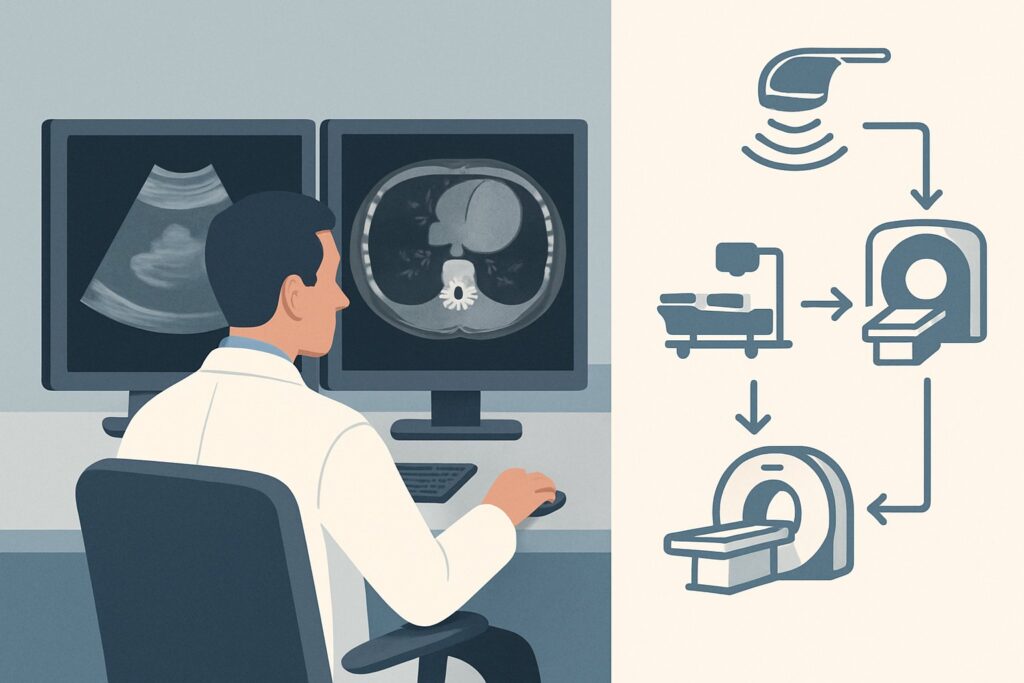
It’s 2 a.m. in the emergency department, and you’re evaluating a 78-year-old male on anticoagulation for atrial fibrillation who presents with acute, severe flank pain and hypotension. His hematocrit has dropped five points since his last check. You suspect a retroperitoneal bleed, a diagnosis that requires rapid, accurate confirmation to guide immediate management. The next decision—which imaging study to order—is critical. This article provides a focused, deep-dive workflow for this exact scenario, explaining why the American College of Radiology (ACR) has specific recommendations for initial imaging. For a clinically suspected retroperitoneal bleed, the ACR rates CT abdomen and pelvis with IV contrast as Usually Appropriate, making it the cornerstone of the initial diagnostic workup.
## Who Fits This Clinical Scenario?
This guidance applies to patients presenting with acute signs and symptoms concerning for a retroperitoneal hemorrhage. The clinical picture is often dramatic but can be subtle. This workflow is designed for the patient who has:
- Acute-onset, severe flank, back, or abdominal pain without a clear alternative cause.
- Hemodynamic instability, such as hypotension or tachycardia, that is otherwise unexplained.
- A significant, acute drop in hemoglobin or hematocrit.
- Known risk factors, including therapeutic anticoagulation, recent trauma (even minor), a known or suspected abdominal aortic aneurysm (AAA), or a recent vascular or retroperitoneal procedure.
It is equally important to know when this specific guidance does not apply. This workflow is not intended for:
- Hemodynamically unstable trauma patients heading directly to the operating room. While CT is often part of a trauma protocol, the decision may be superseded by the need for immediate surgical exploration.
- Patients with low-suspicion abdominal pain without hemodynamic changes or a significant hematocrit drop. These patients may be better evaluated under different ACR Appropriateness Criteria topics, such as acute non-localized abdominal pain or right lower quadrant pain.
- Asymptomatic patients undergoing routine surveillance for a known condition, such as a stable, unruptured AAA. These scenarios follow separate, non-emergent imaging protocols.
## What Diagnoses Are You Working Up in This Scenario?
When ordering imaging for a suspected retroperitoneal bleed, you are investigating several potentially life-threatening conditions. The differential diagnosis is narrow but critical, as each requires a specific and often urgent management pathway.
The most feared diagnosis is a ruptured or leaking abdominal aortic aneurysm (AAA). This is a true vascular emergency. The CT scan is essential not only to confirm the rupture but also to delineate the aortic anatomy, which is crucial for planning either open surgical repair or endovascular aneurysm repair (EVAR).
A spontaneous retroperitoneal hematoma is another primary consideration, particularly in the growing population of patients on anticoagulants or antiplatelet agents. While not involving a major artery like the aorta, these bleeds can be extensive, leading to significant blood loss and hemodynamic collapse. The source is often a smaller lumbar or adrenal artery.
Hemorrhage from a solid organ or tumor must also be considered. A renal angiomyolipoma (AML), a benign tumor with abnormal blood vessels, is a classic cause of spontaneous retroperitoneal bleeding (Wunderlich syndrome). Similarly, renal cell carcinoma or adrenal tumors can bleed spontaneously or after minor trauma.
Finally, a psoas hematoma can present with flank pain and signs of bleeding. This can occur spontaneously in patients with coagulopathy or following trauma or procedures like lumbar plexus blocks or femoral artery access.
## Why Is CT Abdomen and Pelvis with IV Contrast the Recommended Study?
The ACR designates CT abdomen and pelvis with IV contrast as Usually Appropriate because it directly and efficiently addresses the critical clinical questions in this scenario. Its speed, availability, and diagnostic power make it the undisputed first-line modality.
The rationale is threefold:
1. Speed and Access: In a potentially unstable patient, a CT can be completed in minutes, providing a comprehensive assessment of the entire abdomen and pelvis. This is a critical advantage over slower modalities like MRI.
2. Anatomic Detail: CT provides excellent spatial resolution to identify the location and size of a hematoma, its effect on adjacent structures, and often the underlying cause (e.g., an aneurysm or tumor).
3. IV Contrast is Key: The administration of intravenous contrast is non-negotiable in this workup. A “contrast blush” or active extravasation on arterial phase images is the definitive sign of active bleeding, indicating the need for urgent intervention. A multiphase protocol (including non-contrast, arterial, and delayed phases) is optimal. The non-contrast phase identifies baseline high-density hematoma, the arterial phase shows active bleeding, and the delayed phase can show venous injury or urinary tract involvement.
Why are other studies rated lower for this initial workup?
- Ultrasound abdomen and pelvis is rated Usually not appropriate. While useful at the bedside (e.g., with a FAST exam) to detect free intraperitoneal fluid, it is severely limited in visualizing the retroperitoneum due to overlying bowel gas and patient body habitus. It cannot reliably rule out a retroperitoneal bleed or identify its source.
- MRI abdomen and pelvis is also rated Usually not appropriate for the initial, emergent evaluation. It is significantly slower, less accessible in an emergency setting, and more susceptible to motion artifacts from an unstable or uncooperative patient. While MRI can be excellent for characterizing a subacute or chronic hematoma, it is not the tool for the acute question of “is this patient actively bleeding?”
The recommended CT study carries a moderate radiation dose (ACR RRL ☢☢☢, 1-10 mSv for a single-phase scan), but the immediate diagnostic benefit in this life-threatening scenario far outweighs the long-term radiation risk.
Once you’ve decided on the study, ensuring it is performed correctly is the next step. Our protocol guide covers the technique, contrast, and reading principles: CT Chest/Abdomen/Pelvis with IV Contrast.
## What’s Next After CT Abdomen and Pelvis with IV Contrast? Downstream Workflow
The results of the CT scan will dictate your next moves, which are often time-sensitive. The workflow branches based on the key findings.
- If the CT shows active bleeding (contrast extravasation): This is a critical result requiring immediate action. The next step is an urgent consultation with Interventional Radiology for potential transcatheter arterial embolization or with Vascular or Trauma Surgery for operative management. The patient’s hemodynamic stability and the source of the bleed will determine the best approach.
- If the CT shows a large, contained hematoma without active extravasation: The patient still requires admission to a monitored setting (often an ICU). Management focuses on hemodynamic support, reversal of any coagulopathy, and serial monitoring of vital signs and hematocrit. A repeat CT scan may be performed in 6-24 hours to ensure the hematoma is not expanding.
- If the CT is negative for hemorrhage: The focus shifts to re-evaluating the patient for other causes of their symptoms. This may include investigating for sepsis, pulmonary embolism, cardiac ischemia, or an intra-abdominal catastrophe not related to bleeding (e.g., bowel ischemia). The absence of a retroperitoneal bleed is a crucial piece of information that allows you to confidently pursue other diagnostic pathways.
- If the CT is indeterminate or identifies a potential source without clear bleeding: For example, if a vascular abnormality is seen but active extravasation is not, a formal catheter-based study like Aortography abdomen and pelvis (May be appropriate) could be considered, especially if the clinical suspicion remains high.
## Pitfalls to Avoid (and When to Get Help)
In this high-stakes clinical scenario, several common pitfalls can delay diagnosis or lead to suboptimal outcomes.
- Ordering CT without IV contrast: This is the most critical error. A non-contrast CT can identify a hematoma but cannot detect active bleeding, which is the most important finding for triage and intervention.
- Delaying the scan for renal function concerns: In a patient with a life-threatening hemorrhage, the risk of missing the diagnosis far exceeds the risk of contrast-induced acute kidney injury. Do not delay imaging for a creatinine value if the clinical suspicion is high.
- Failing to communicate with the radiologist: Call the reading room. Providing the clinical context—”78-year-old on apixaban, hypotensive, Hct drop of 5″—ensures the radiologist protocols the scan correctly (e.g., with multiphase imaging) and prioritizes the interpretation.
- Underestimating the bleed: A contained retroperitoneal hematoma can hold a large volume of blood before causing significant abdominal distention. Rely on the vital signs, lab values, and CT findings, not just the physical exam.
If the CT confirms an active bleed or a ruptured aneurysm, this is an immediate escalation to your on-call Interventional Radiology and surgical colleagues.
## Related ACR Topics and Tools
This article is a deep dive into one specific clinical scenario. For a broader overview of all variants within this topic, please see our parent guide. For other tools to help with imaging decisions, see the resources below.
- For breadth across all scenarios in Suspected Retroperitoneal Bleed, see our parent guide: Suspected Retroperitoneal Bleed: ACR Appropriateness Decoded.
- To look up other clinical scenarios, use the ACR Appropriateness Criteria Lookup.
- To review technical details for this or other studies, explore the Imaging Protocol Library.
- To discuss radiation exposure with patients, consult the Radiation Dose Calculator.
Frequently Asked Questions
Why is CT without and with IV contrast also rated ‘Usually Appropriate’?
A multiphase CT, which includes a non-contrast series followed by arterial and/or venous phase imaging after IV contrast, is often the optimal study. The initial non-contrast scan helps to identify high-density acute blood, which can sometimes be obscured by contrast. The post-contrast phases are essential for detecting active bleeding (extravasation) and identifying the underlying cause. Both ‘CT with IV contrast’ and ‘CT without and with IV contrast’ are considered appropriate first-line choices.
What if my patient has a severe contrast allergy?
In a patient with a history of a severe anaphylactic reaction to iodinated contrast, a non-contrast CT can be performed first. It can confirm or exclude a hematoma but will not show active bleeding. If a hematoma is found and the patient is unstable, the clinical team must weigh the risks of a premedication regimen and proceeding with a contrast-enhanced CT versus going directly to intervention (like angiography or surgery) based on the non-contrast findings and clinical picture.
Is there any role for a bedside ultrasound in this scenario?
Yes, but it’s limited. A point-of-care ultrasound (POCUS) exam, like the FAST (Focused Assessment with Sonography for Trauma) or RUSH (Rapid Ultrasound in Shock and Hypotension) exam, can be very useful for rapidly assessing for intraperitoneal free fluid (hemoperitoneum) or a grossly visible AAA. However, it is not sensitive for detecting a purely retroperitoneal bleed. A negative POCUS exam does not rule out the diagnosis and should not delay definitive imaging with CT if clinical suspicion remains.
Should I order a CTA instead of a standard CT with contrast?
A CT Angiography (CTA) is also rated ‘Usually Appropriate’ and is an excellent choice. A CTA is essentially a CT scan optimized with specific timing and reconstruction techniques to highlight the arterial system. For a suspected retroperitoneal bleed, a well-protocoled multiphase CT often includes a CTA component (the arterial phase). Ordering a ‘CTA abdomen and pelvis’ or a ‘multiphase CT for bleed’ will typically yield the necessary diagnostic information.
What if the patient is too unstable to transport to the CT scanner?
This is a critical clinical decision. If a patient is profoundly unstable and actively being resuscitated, they may be too fragile for transport to CT. In this rare circumstance, the next step may be an immediate trip to the operating room or interventional suite for empiric exploration or angiography, bypassing diagnostic imaging. This decision requires experienced clinical judgment and coordination between the emergency, surgical, and radiology teams.
Reviewed by Pouyan Golshani, MD, Interventional Radiologist — May 29, 2026