What Is the Best Initial Imaging for an Extremity Murmur or Thrill?
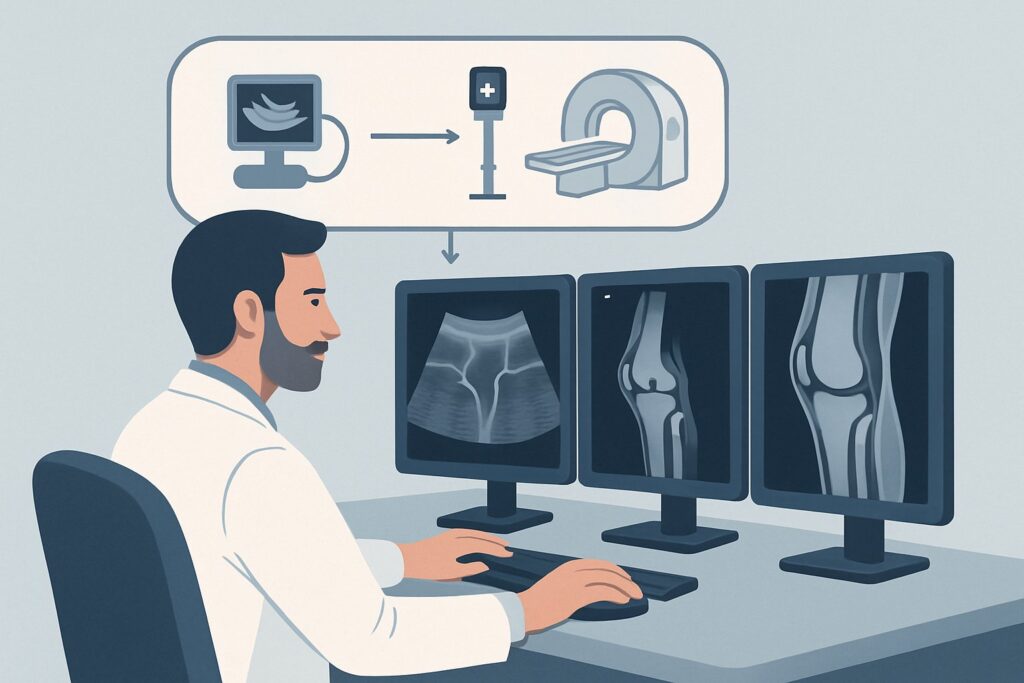
A 42-year-old patient presents to your clinic with a “pulsating lump” in his right calf that he first noticed a few months ago. On physical examination, you appreciate a soft, non-tender mass, and when you place your hand over it, you feel a distinct vibration—a thrill. Placing your stethoscope over the area reveals a continuous bruit. Your leading suspicion is a high-flow vascular malformation, likely an arteriovenous malformation (AVM) or fistula (AVF). The immediate clinical question is which imaging study to order first to confirm the diagnosis and guide the next steps. According to the American College of Radiology (ACR) Appropriateness Criteria, for a patient with a vascular murmur or thrill in an extremity, US duplex Doppler of the extremity area of interest is rated Usually Appropriate.
Who Fits This Clinical Scenario: Extremity Murmur or Thrill?
This clinical workflow is designed for the initial imaging evaluation of a patient presenting with specific physical exam findings suggestive of a high-flow vascular lesion in an upper or lower extremity.
Inclusion criteria for this pathway:
- The primary clinical finding is a palpable vascular thrill (a vibration or “buzz” felt over the skin).
- The primary clinical finding is an audible vascular murmur or bruit on auscultation.
- These findings are localized to a specific area of an arm or a leg, often associated with a palpable mass, swelling, or skin changes.
This guidance is specific to the initial diagnostic step. It is crucial to distinguish this presentation from similar, but distinct, clinical scenarios that require different imaging approaches.
Exclusion criteria (patients who fit a different ACR variant):
- Pain or Deformity without High-Flow Signs: If the patient presents with pain, swelling, or a palpable mass but lacks a bruit or thrill, the differential diagnosis shifts toward low-flow malformations (e.g., venous or lymphatic malformations). This presentation is covered in a separate ACR variant.
- Known Diagnosis Follow-up: This workflow does not apply to patients with a previously diagnosed vascular malformation undergoing surveillance or post-treatment follow-up imaging.
- Acute Trauma: A pulsatile mass and bruit developing immediately after a penetrating injury or catheterization is more likely a pseudoaneurysm or traumatic AVF, which may have a slightly different diagnostic urgency and pathway.
What Diagnoses Are You Working Up With a Palpable Extremity Thrill?
The presence of a bruit or thrill is a direct indicator of turbulent, high-velocity blood flow, significantly narrowing the differential diagnosis to high-flow vascular anomalies. The primary goal of initial imaging is to confirm the presence of this high-flow state and characterize the underlying cause.
Arteriovenous Malformation (AVM): This is the most common consideration for a congenital high-flow lesion presenting with a bruit or thrill. An AVM consists of a central nidus of abnormal vessels that creates a direct, low-resistance shunt between the arterial and venous systems, bypassing the normal capillary bed. This high-flow shunting is what generates the palpable and audible signs.
Arteriovenous Fistula (AVF): An AVF is a single direct connection between an artery and a vein. While hemodynamically similar to an AVM, it lacks a complex nidus. AVFs can be congenital but are more frequently acquired, resulting from trauma, iatrogenic injury (e.g., post-catheterization), or created surgically for hemodialysis access.
High-Flow Infantile Hemangioma: In the pediatric population, particularly during their proliferative phase, infantile hemangiomas can exhibit very high flow and present with a bruit. While technically benign vascular tumors rather than malformations, their clinical presentation can mimic an AVM.
Pseudoaneurysm: Less commonly, a pseudoaneurysm (a contained arterial rupture) can present with a pulsatile mass and a systolic bruit due to turbulent flow into and out of the contained sac. This is often seen in the context of prior trauma or intervention.
Why Is US Duplex Doppler the Recommended First Study for an Extremity Murmur?
For the initial evaluation of a suspected high-flow lesion in an extremity, US duplex Doppler is rated Usually Appropriate and serves as the ideal first-line imaging modality. Its recommendation is based on its diagnostic capability, safety profile, and accessibility.
The primary strength of duplex ultrasound is its ability to provide both anatomic (grayscale) and physiologic (Doppler) information in real time. It can directly visualize dilated feeding arteries and draining veins and, most importantly, use spectral and color Doppler to confirm the presence of high-velocity, low-resistance arterial flow and arterialized waveforms within the draining veins. This directly confirms the clinical suspicion of an arteriovenous shunt, which is the core question.
The ACR panel also rates MRA, MRI, and CTA as Usually Appropriate, but ultrasound is often preferred as the initial step for several reasons:
- Safety and Accessibility: US duplex Doppler is non-invasive, widely available, relatively inexpensive, and involves no ionizing radiation (0 mSv). This is a significant advantage, especially in younger patients.
- Focused Evaluation: It allows for a dynamic, targeted evaluation of the exact area where the thrill is palpated, providing immediate confirmation of the high-flow nature of the lesion.
Why are other studies not the first choice?
- Conventional Arteriography: While the historical gold standard for mapping, it is rated May be appropriate for initial diagnosis. It is invasive, involves radiation and contrast, and is now typically reserved for pre-interventional planning after a high-flow lesion has been confirmed non-invasively.
- Radiography: Rated Usually not appropriate, radiographs are insensitive for vascular malformations. They cannot assess flow and would only show non-specific secondary signs like soft tissue swelling or, occasionally, phleboliths (more common in low-flow venous malformations).
Once you’ve decided on US duplex Doppler, our protocol guide covers the technique and reading principles. While the linked protocol focuses on Deep Vein Thrombosis (DVT), the fundamental principles of Doppler waveform analysis and vessel interrogation are foundational for this workup as well: US Lower Extremity Doppler (DVT).
What’s Next After the Initial Ultrasound? Downstream Workflow
The results of the initial US duplex Doppler study will guide the subsequent management and imaging pathway. The goal shifts from diagnosis to detailed characterization for treatment planning.
If the US is positive for a high-flow malformation (AVM/AVF):
The next step is typically referral to a specialist, such as an Interventional Radiologist or Vascular Surgeon. To plan for potential treatment (e.g., embolization), more detailed anatomical mapping is required. MRI/MRA of the extremity without and with IV contrast is rated Usually Appropriate and is the preferred next study. It provides excellent soft-tissue detail, defines the full extent of the malformation and its nidus, and maps the feeding arteries and draining veins—all critical for procedural planning. CTA with IV contrast is a suitable alternative if MRI is contraindicated.
If the US is negative or inconclusive:
A palpable thrill is a very specific clinical sign. If the US is negative but the clinical suspicion remains high, the lesion may be deep, or the study may have been technically limited. In this case, proceeding to MRI/MRA of the extremity without and with IV contrast (Usually Appropriate) is the logical next step. MRI’s superior soft tissue contrast may reveal a lesion that was not well-visualized on ultrasound.
If the US is indeterminate:
If the ultrasound identifies a complex lesion but cannot definitively characterize the flow dynamics or type of malformation, MRI/MRA is again the problem-solving tool of choice to provide a more definitive diagnosis and guide further management.
Pitfalls to Avoid (and When to Get Help)
Navigating the workup for a suspected high-flow vascular malformation requires careful ordering and interpretation. Here are a few common pitfalls to avoid:
- Ordering a non-vascular study: Requesting a “soft tissue ultrasound” without specifying “duplex Doppler” may result in a grayscale-only study, which cannot assess flow and will miss the key diagnostic information.
- Ignoring a strong clinical sign: Do not dismiss a palpable thrill if the initial ultrasound is reported as negative. Consider the possibility of a false-negative study and proceed to cross-sectional imaging like MRI/MRA.
- Choosing the wrong cross-sectional study: Avoid ordering a CT without IV contrast, which is rated Usually not appropriate. This study provides no useful information about the vascular anatomy of the lesion.
- Delaying referral for red flags: If a patient with a suspected high-flow lesion presents with signs of high-output heart failure, limb ischemia from vascular steal, ulceration, or bleeding, this constitutes a clinical urgency. An immediate consultation with Interventional Radiology or Vascular Surgery is warranted.
Related ACR Topics and Tools
For a comprehensive overview of all clinical scenarios related to suspected vascular malformations of the extremities, or to explore the tools used to build this workflow, see the resources below.
- For breadth across all scenarios in Clinically Suspected Vascular Malformation of the Extremities, see our parent guide: Clinically Suspected Vascular Malformation of the Extremities: ACR Appropriateness Decoded.
- To look up other clinical scenarios or ACR recommendations, use the ACR Appropriateness Criteria Lookup tool.
- To review technical details for other imaging studies, explore the Imaging Protocol Library.
- To discuss radiation exposure with patients, especially when considering CT or arteriography, the Radiation Dose Calculator can be a helpful resource.
Frequently Asked Questions
Why not go straight to MRA or CTA, since they are also rated ‘Usually Appropriate’?
While MRA and CTA are excellent for detailed anatomical mapping, US duplex Doppler is often preferred as the initial test because it is non-invasive, uses no radiation, is less expensive, and can quickly confirm the fundamental clinical question: is a high-flow shunt present? If the US is positive, MRA or CTA is the logical next step for pre-treatment planning. If the US is negative, it may obviate the need for more advanced, costly imaging.
Is there a role for a plain radiograph (X-ray) in this workup?
No, for this specific scenario, the ACR rates radiography as ‘Usually not appropriate.’ An X-ray cannot evaluate blood flow or soft tissue vascular structures. It might show secondary signs like bone erosion or phleboliths, but it does not help diagnose the underlying high-flow lesion and should not be ordered as part of the initial workup.
What if the patient has a contraindication to MRI, like a pacemaker?
If MRI/MRA is needed for pre-treatment planning but is contraindicated, CTA of the extremity with IV contrast is an excellent alternative. It is also rated ‘Usually Appropriate’ and provides superb detail of the arterial and venous anatomy, though it involves ionizing radiation and iodinated contrast.
Does the location in the upper vs. lower extremity change the initial imaging choice?
No, the initial imaging recommendation remains the same. US duplex Doppler is the preferred first step for a suspected high-flow lesion presenting with a bruit or thrill, regardless of whether it is located in an arm or a leg.
What specific information should I include in the order for the US duplex Doppler?
To ensure the sonographer and radiologist perform the correct study, be specific. Your order should state ‘US duplex Doppler of the [e.g., right calf] to evaluate for vascular malformation.’ Crucially, include the clinical finding: ‘Palpable thrill and audible bruit noted at the site.’ This context is vital for guiding the examination.
Reviewed by Pouyan Golshani, MD, Interventional Radiologist — May 29, 2026