What Is the Best Initial Imaging for Suspected Cerebral Venous Sinus Thrombosis?
A 34-year-old woman presents to the emergency department with a severe, persistent headache for the past week, unlike any she has experienced before. On exam, you note bilateral papilledema. She has no focal neurologic deficits but mentions some transient visual blurring. Her history is notable for starting a new oral contraceptive pill two months ago. You are concerned about cerebral venous sinus thrombosis (CVST), a rare but serious cause of stroke in young adults. The immediate clinical question is which imaging study to order first to confirm or exclude this diagnosis. This article provides a detailed workflow for this specific scenario, based on the American College of Radiology (ACR) Appropriateness Criteria, which rate MRI head without and with IV contrast as Usually Appropriate.
Who Fits This Clinical Scenario?
This guidance applies to adult patients for whom you have a clinical suspicion of cerebral venous sinus thrombosis (CVST), also known as dural venous sinus thrombosis, and are ordering the initial diagnostic imaging. The clinical presentation is often nonspecific but typically includes one or more of the following: a new, severe, or persistent headache; signs of increased intracranial pressure like papilledema or sixth nerve palsy; seizures; or focal neurologic deficits that do not conform to a typical arterial territory.
This workflow is distinct from several related but different clinical situations:
- Clinically Suspected Acute Ischemic Stroke: Patients presenting with a sudden onset of focal deficits fitting a classic arterial distribution (e.g., aphasia, hemiparesis) fall under a different imaging algorithm, often prioritized for time-sensitive thrombolysis or thrombectomy evaluation. CVST is a diagnosis of exclusion in these cases, not the primary suspicion.
- Transient Ischemic Attack (TIA): If the patient’s symptoms were transient and have fully resolved, the workup is different, focusing on identifying the embolic source, typically in the carotid arteries or heart.
- Known Intraparenchymal Hemorrhage: If a bleed has already been identified, the imaging question shifts to follow-up and determining the underlying cause, which is a separate clinical pathway.
This article is for the initial workup where CVST is a primary consideration based on the patient’s risk factors (e.g., prothrombotic states, pregnancy, oral contraceptive use, infection) and subacute, progressive symptoms.
What Diagnoses Are You Working Up in This Scenario?
When ordering imaging for suspected CVST, you are evaluating a differential diagnosis list where symptoms overlap significantly. The goal of imaging is to pinpoint the correct etiology, as treatment pathways diverge dramatically.
Cerebral Venous Sinus Thrombosis (CVST) is the primary diagnosis to confirm or exclude. This condition involves the formation of a blood clot in the dural venous sinuses, which drain blood from the brain, or in the smaller cortical veins. The resulting venous congestion and increased intracranial pressure can lead to headache, seizures, and potentially venous infarction or hemorrhage. It is a crucial diagnosis not to miss, as it is treatable with anticoagulation.
Idiopathic Intracranial Hypertension (IIH), formerly known as pseudotumor cerebri, is a key mimic. It presents with headache, papilledema, and visual disturbances, primarily affecting young, overweight women. Imaging in IIH is typically normal or may show subtle signs like an empty sella, optic nerve sheath distention, or venous sinus stenosis, but its main role is to exclude a structural cause like a mass or, critically, CVST.
Intracranial Mass or Tumor can cause symptoms by compressing venous sinuses, leading to a secondary thrombosis or simply by raising intracranial pressure through mass effect. Imaging will directly visualize the lesion, making this an important alternative diagnosis to rule out.
Meningitis or Encephalitis can present with headache, fever, and altered mental status. While the diagnosis is often confirmed with lumbar puncture, neuroimaging is performed first to rule out a mass lesion or complications like hydrocephalus or venous thrombosis, which can be a complication of central nervous system infections.
Why Is MRI Head Without and With IV Contrast the Recommended Study for This Presentation?
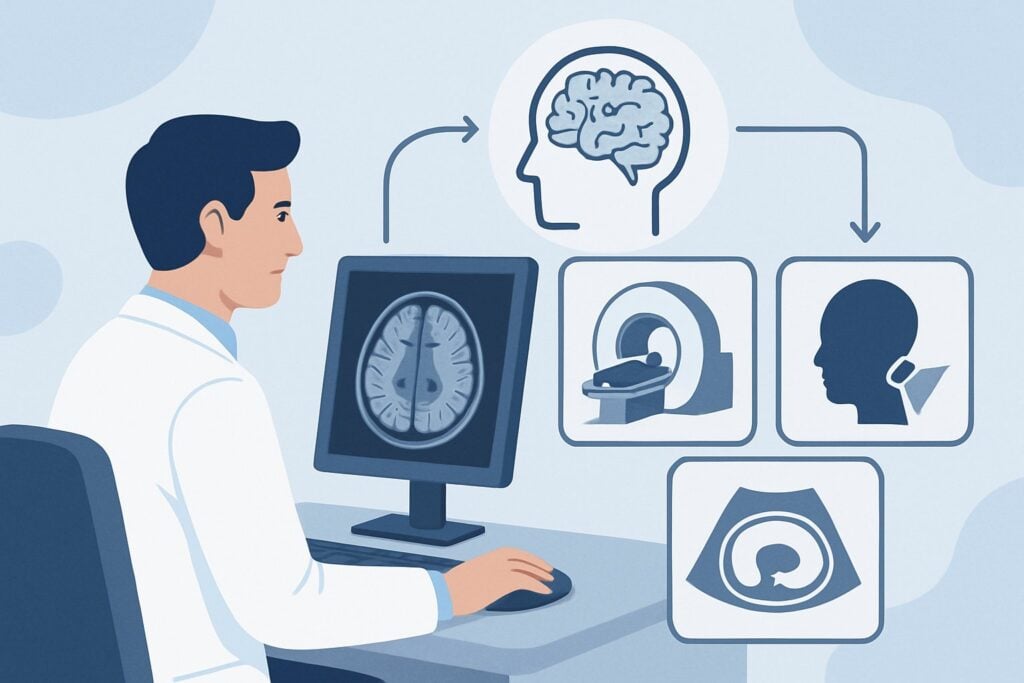
The ACR designates several imaging modalities as Usually Appropriate, but a comprehensive brain MRI with dedicated venographic sequences, both without and with intravenous contrast, provides the most definitive evaluation. It excels at both directly visualizing the thrombus and assessing for secondary parenchymal complications.
The power of MRI lies in its multiple sequences. On non-contrast sequences, an acute thrombus can be identified by the absence of the normal “flow void” (the dark signal of flowing blood) within a dural sinus. The clot itself may appear isointense on T1-weighted images and hypointense on T2-weighted images. As the clot evolves, its signal characteristics change, which can also help in dating the event. Following the administration of IV gadolinium contrast, a magnetic resonance venogram (MRV) provides a detailed map of the venous system. The thrombus appears as a filling defect within the brightly enhancing sinus—the “empty delta sign” is a classic finding in the superior sagittal sinus.
Furthermore, MRI is exquisitely sensitive for detecting the consequences of venous outflow obstruction, such as vasogenic edema, venous infarction (which doesn’t conform to an arterial territory), or hemorrhage.
How Do Alternative Studies Compare?
- CT Head Without IV Contrast: While rated Usually Appropriate, a non-contrast CT is often used as a rapid first-line test in the emergency setting to rule out major hemorrhage. It can sometimes show direct signs of CVST, like the hyperdense “cord sign” of a thrombosed vein, but its sensitivity is low. A negative non-contrast CT does not rule out CVST and should not terminate the workup if clinical suspicion remains.
- CTV Head With IV Contrast: A CT venogram is also rated Usually Appropriate and is an excellent alternative when MRI is contraindicated or unavailable. It provides high-resolution images of the venous sinuses and can clearly demonstrate filling defects. Its main disadvantages compared to MRI are the use of ionizing radiation (ACR RRL: ☢☢☢ 1-10 mSv) and iodinated contrast, and its lower sensitivity for detecting subtle parenchymal changes of venous ischemia.
- CTA Head With IV Contrast: This study is rated Usually Not Appropriate. This is a common ordering error. A CT angiogram is timed to capture the arterial phase of contrast enhancement. By the time the contrast reaches the venous sinuses, it is often too dilute for diagnostic assessment, leading to false-negative results. The proper protocol for venous imaging is a CTV, which has a delayed acquisition timed for the venous phase.
What’s Next After MRI Head Without and With IV Contrast? Downstream Workflow
The results of the initial imaging study will guide your next steps, creating a clear decision tree for patient management.
If the study is positive for CVST: The primary next step is to initiate therapeutic anticoagulation, typically starting with low-molecular-weight heparin, unless there is a significant hemorrhage or other contraindication. This requires immediate consultation with neurology and potentially hematology to guide treatment duration and plan a workup for an underlying prothrombotic state (e.g., genetic thrombophilias, antiphospholipid syndrome). The patient will require hospital admission for treatment initiation and monitoring.
If the study is negative for CVST: The workflow depends on the clinical picture. If symptoms like severe headache and papilledema persist despite a negative MRI/MRV, the focus shifts to other causes of intracranial hypertension. The next step is often a lumbar puncture to measure the opening pressure and analyze cerebrospinal fluid, which can confirm a diagnosis of IIH or identify an infectious process like meningitis. If the clinical suspicion for CVST was exceptionally high, a discussion with neuroradiology about the possibility of a technically limited study or the need for a follow-up scan may be warranted, though this is uncommon with modern imaging techniques.
If the study is indeterminate: Ambiguous findings, such as an isolated cortical vein thrombosis or a questionable flow gap in a transverse sinus (a common site of anatomic variation), require close collaboration with the interpreting neuroradiologist. Additional imaging sequences or a follow-up study in a short interval may be recommended to clarify the findings. In very rare and complex cases, conventional catheter-based digital subtraction venography may be considered.
Pitfalls to Avoid (and When to Get Help)
Navigating the workup for suspected CVST requires avoiding several common diagnostic traps.
- Stopping the Workup After a Negative Non-Contrast CT: This is the most critical pitfall. A normal non-contrast head CT is insufficient to exclude CVST. If your clinical suspicion is moderate to high, you must proceed to dedicated venous imaging (MRV or CTV).
- Ordering an MRA or CTA Instead of an MRV or CTV: Angiography is for arteries; venography is for veins. Ordering the wrong vascular study is a frequent error that delays diagnosis. Always specify that you are evaluating the venous sinuses.
- Dismissing Atypical Headache: The headache of CVST can be variable—thunderclap, subacute, or chronic. Do not dismiss a severe or persistent headache in a patient with risk factors, even if it doesn’t fit a classic migraine pattern.
If imaging is negative but the patient has clear signs of increased intracranial pressure like papilledema, escalate care by consulting neurology and ophthalmology promptly. This is a sight-threatening condition regardless of the underlying cause.
Related ACR Topics and Tools
This article focuses on a single clinical scenario. For a comprehensive overview of imaging for stroke and related conditions, or to explore the tools used to develop this guidance, please refer to the resources below.
- For breadth across all scenarios in Cerebrovascular Diseases-Stroke and Stroke-Related Conditions, see our parent guide: Cerebrovascular Diseases-Stroke and Stroke-Related Conditions: ACR Appropriateness Decoded.
- To explore other clinical presentations, use the ACR Appropriateness Criteria Lookup.
- For details on imaging techniques, visit the Imaging Protocol Library.
- To discuss radiation exposure with patients, consult the Radiation Dose Calculator.
Frequently Asked Questions
My patient has a severe headache. Why not just start with a non-contrast CT of the head?
A non-contrast head CT is an excellent first test to quickly rule out a large hemorrhage, which is a medical emergency. However, its sensitivity for detecting cerebral venous sinus thrombosis (CVST) is low. It can be normal in many cases of confirmed CVST. Therefore, if your clinical suspicion for CVST is moderate to high based on risk factors and symptoms like papilledema, a negative non-contrast CT is not reassuring and you must proceed with dedicated venous imaging like an MRV or CTV.
What is the difference between an MRV and an MRA, and why is MRA ‘Usually Not Appropriate’?
MRV stands for Magnetic Resonance Venography, which is designed to visualize the veins. MRA stands for Magnetic Resonance Angiography, which is designed to visualize arteries. CVST is a disease of the venous system. MRA sequences are timed and optimized to see fast-flowing arterial blood and will not properly evaluate the slower-flowing venous sinuses, making it the wrong test for this diagnosis. Ordering an MRA instead of an MRV is a common error that can lead to a missed diagnosis.
Can I order an MRI/MRV without contrast to evaluate for CVST?
Yes, an MRI/MRV without contrast is also rated as ‘Usually Appropriate’ by the ACR. Non-contrast techniques, such as 2D time-of-flight sequences, can effectively demonstrate the absence of flow in a thrombosed sinus. However, adding IV contrast often increases diagnostic confidence by clearly delineating the thrombus as a filling defect within the enhancing sinus and can help differentiate slow flow from true thrombosis. For the most comprehensive evaluation, both without and with contrast is preferred.
My hospital has limited MRI access at night. Is a CTV an acceptable alternative?
Absolutely. A CT venogram (CTV) with IV contrast is also rated ‘Usually Appropriate’ and is an excellent and fast alternative to MRI. It is highly sensitive and specific for detecting filling defects in the dural venous sinuses. The main trade-offs are the use of ionizing radiation and iodinated contrast, and less sensitivity for secondary brain tissue changes compared to MRI. If MRI is not readily available, a CTV is the recommended next step after a non-contrast CT.
What if the patient is pregnant? Is MRI with gadolinium safe?
CVST has a higher incidence during pregnancy and the postpartum period. For a pregnant patient, an MRI without contrast is the preferred initial study. While there is no definitive evidence of harm to the human fetus from gadolinium, it is known to cross the placenta and is generally avoided during pregnancy unless the potential benefit is deemed to outweigh the potential risk. A non-contrast MRV is often sufficient for diagnosis. If the non-contrast study is equivocal, a discussion between the clinical team and the radiologist is essential to weigh the risks and benefits of administering contrast.
Reviewed by Pouyan Golshani, MD, Interventional Radiologist — June 27, 2026